LESSON 3
COMMUNICATIVE
STYLES
C O M M U N I C A T I V E
S T Y L E S
01
Speech style is a
communicative style which
portrays how a language is
characterized in terms of
degree of formality.
C O M M U N I C A T I V E
S T Y L E S
01
A person’s approach to
communication in a
specific circumstances.
CASUAL
This is an informal
language used by friends
and peers.
Slang, vulgarities and
colloquialism, informal
contractions (e.g., ain’t,
dunno, gonna) are
normal in this type of
speech style.
CASUAL
This uses “group
language,” so only
members of the group
can understand it.
Here, nicknames are
used in addressing one
another.
Classmate 1: Hey! What’s up? You seem
so very busy.
Classmate 2: Yes, I have to finish some
things up.
Classmate 1: Oh, I see. Wanna come for
a milk tea at the canteen?
Classmate 2: That’s interesting! I wish I
could but I need to do this ASAP.
Classmate 1: Okay, just catch up when
you’re done!
EXAMPLE: CASUAL
• Everyday conversation with
buddies or friend 
• A personal message and
personal emails 
• Blogs 
• Tweets 
• Letters to friends 
• Phone calls
EXAMPLE: CASUAL
CONSULTATIVE
This is used in semi-
formal communication,
where sentences tend to
be shorter and
spontaneous. It happens
in two-way participation.
CONSULTATIVE
It uses unplanned
speech.
This is the normal style
for speaking to
strangers or persons
who are neither
acquaintances nor
friends nor relatives
EXAMPLE: CONSULTATIVE
Scene: A patient is consulting a doctor.
Patient: Good morning, Dr. Garcia.
Dr. Garcia: Hi. How have you been feeling?
Patient: I have a stomachache and LBM since last night.
Dr. Garcia: What did you eat yesterday?
Patient: I ate some “kwek-kwek and siomai with my
friends after the class.
Dr. Garcia: Likely, you ate contaminated food. I am
prescribing some medicine to control the diarrhea.
Patient: Thank you, Doc.
• Regular classroom discussions 
• Doctor-patient 
• Lawyer-client 
• Counselor- client 
• Group discussion 
• Teacher-student 
• Expert-apprentice
EXAMPLE: CONSULTATIVE
Formal speeches are
straightforward
speeches. It is used in
speaking to large groups
and is impersonal in
nature.
FORMAL
Speaker must frame
whole sentences ahead
before they are
delivered. It avoids using
slang terminologies and
uses formal English
FORMAL
Language is
comparatively rigid and
has a set, agreed-upon
vocabulary structured
complex sentences and
noun phrases.
FORMAL
EXAMPLE: FORMAL
Scene: Principal’s Welcome Remarks
"Good morning, everyone!
It’s a pleasure to welcome you all today. I want to thank our
students, teachers, and guests for being here as we kick off
another exciting chapter at our school. This year holds so much
potential, and I’m confident that together we’ll achieve great
things. Let’s continue to support one another, stay focused, and
make this year truly unforgettable.
Welcome, and let’s get started!"
• Meetings 
• Speeches 
• School lessons 
• Corporate meeting

• Interview 
• SONA 
• Welcome address 
• Announcements 
• Orations 
• Scholarly books/
Articles
• Research papers 
• Technical reports
EXAMPLE: FORMAL
This type of
communicative style
rarely or never
changes. It is “frozen”
in time and content.
FROZEN
It is generally used in a very
formal setting. This is the most
formal communicative style for a
respectful situation. It has a fixed
and static language and uses
long sentences with a good
command of grammar.
FROZEN
Scene: Wedding Ceremony – Priest, Bride, and Groom at the
Altar
Priest: “Dearly beloved, we are gathered here today to
witness the union of Joy and Ethan in holy matrimony.
This is a sacred moment, a celebration of love, commitment,
and the beginning of a new journey together."
Priest: Joy and Ethan, marriage is a bond not to be entered
into lightly, but with respect, honesty, and a deep sense of
love. Today, you are making a promise to cherish, honor, and
support one another, through all the joys and challenges life
may bring."
EXAMPLE: FROZEN
Priest: “Ethan do you take Joy to be your
lawfully wedded wife? To have and to
hold, in sickness and in health, for richer
or for poorer, for as long as you both
shall live?"
Groom: "I do."
EXAMPLE: FROZEN
Priest: “Joy, do you take Ethan to be
your lawfully wedded husband? To have
and to hold, in sickness and in health, for
richer or for poorer, for as long as you
both shall live?"
Bride: "I do."
EXAMPLE: FROZEN
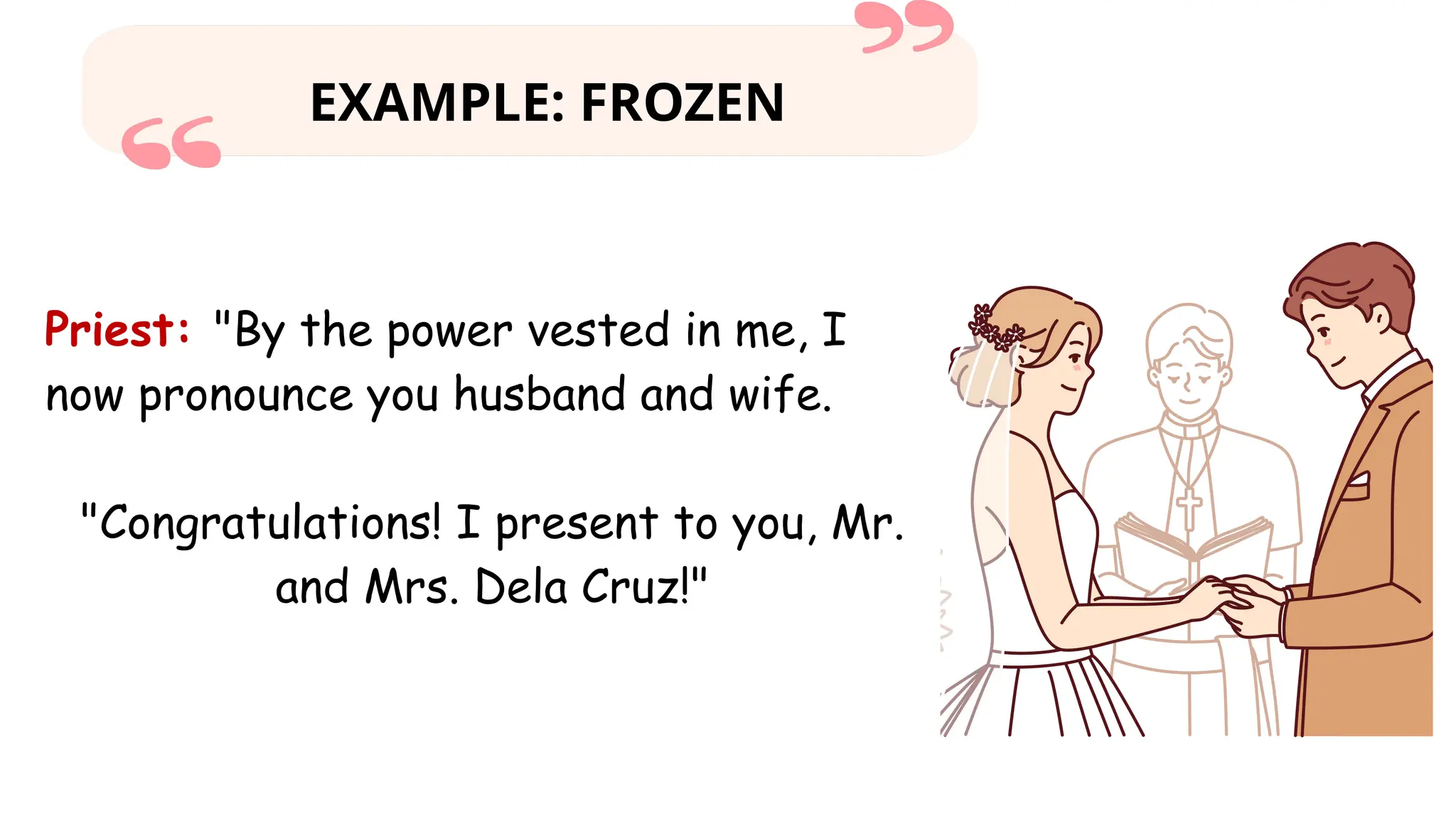
Priest: "By the power vested in me, I
now pronounce you husband and wife.
"Congratulations! I present to you, Mr.
and Mrs. Dela Cruz!"
EXAMPLE: FROZEN
• National Anthem
• Holy Mass
• Religious Rites/ Rituals
• Pledge of allegiance
• Constitution
• The Lord’s Prayer
• Oath
• Creed
EXAMPLE: FROZEN
This type of
communicative style
applies to conversational
experiences between
and/or among people
who share intimate
relationships.
INTIMATE
Such as between close
friends, siblings,
husband and wife,
parents and children,
boyfriend and girlfriend.
INTIMATE
The participants in this
style do not need for
clear articulation of
words or additional
explanation. They may
use words of
endearment as a sign of
INTIMATE
This also employs
informal and intimate
language.
INTIMATE
Friend 1 (Lily): I have to tell you something, but you have to
promise you won’t tell anyone…"
Friend 2 (Emma): “Of course, your secret’s safe with me. What’s
going on?"
Lily: “I think I’m falling for someone… and it’s Chris."
Emma: “Chris? Seriously? Wow! I didn’t see that coming. How long
have you felt this way?"
Lily: “A few weeks now. I keep trying to brush it off, but it’s just
getting stronger."
Emma: “I totally get it. I can see why you’d like him. But don’t
worry, I won’t breathe a word to anyone."
Lily: “Thanks, Emma. I knew I could trust you with this."
Emma: “Always. We’re in this together."
EXAMPLE: INTIMATE
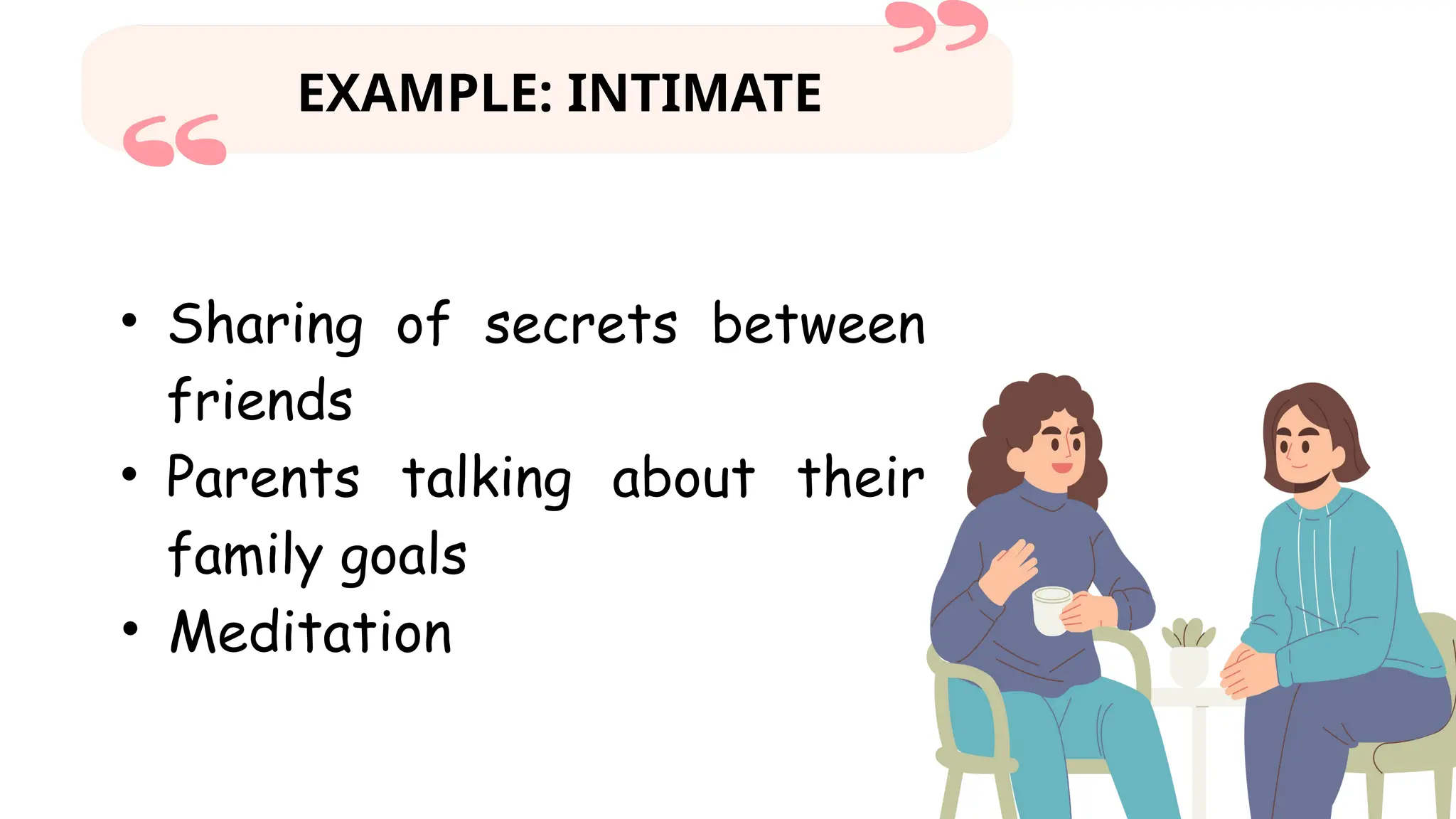
• Sharing of secrets between
friends
• Parents talking about their
family goals
• Meditation
EXAMPLE: INTIMATE
ACTIVITY
GROUP ACTIVITY
Group Activity : Communicative Style Showcase
Objectives: a. Develop students' understanding of each
communicative style.
b. Employ the types of communicative styles in
situations.
Instructions:
1) Divide students into 2 groups.
2) Each group will create and perform a short skit
showcasing the 5 communicative style.
3) Rubric
- Accuracy of portrayal - 15 pts.
- Creativity in presentation - 10 pts.
- Clarity of communication - 10 pts.
QUIZ
ASSIGNMENT
Thank you for
listening!

LESSON 3 ENG 9 COMMUNICATIVE STYLES.pptx

  • 1.
  • 2.
  • 3.
    C O MM U N I C A T I V E S T Y L E S 01 Speech style is a communicative style which portrays how a language is characterized in terms of degree of formality.
  • 4.
    C O MM U N I C A T I V E S T Y L E S 01 A person’s approach to communication in a specific circumstances.
  • 5.
    CASUAL This is aninformal language used by friends and peers. Slang, vulgarities and colloquialism, informal contractions (e.g., ain’t, dunno, gonna) are normal in this type of speech style.
  • 6.
    CASUAL This uses “group language,”so only members of the group can understand it. Here, nicknames are used in addressing one another.
  • 7.
    Classmate 1: Hey!What’s up? You seem so very busy. Classmate 2: Yes, I have to finish some things up. Classmate 1: Oh, I see. Wanna come for a milk tea at the canteen? Classmate 2: That’s interesting! I wish I could but I need to do this ASAP. Classmate 1: Okay, just catch up when you’re done! EXAMPLE: CASUAL
  • 8.
    • Everyday conversationwith buddies or friend  • A personal message and personal emails  • Blogs  • Tweets  • Letters to friends  • Phone calls EXAMPLE: CASUAL
  • 9.
    CONSULTATIVE This is usedin semi- formal communication, where sentences tend to be shorter and spontaneous. It happens in two-way participation.
  • 10.
    CONSULTATIVE It uses unplanned speech. Thisis the normal style for speaking to strangers or persons who are neither acquaintances nor friends nor relatives
  • 11.
    EXAMPLE: CONSULTATIVE Scene: Apatient is consulting a doctor. Patient: Good morning, Dr. Garcia. Dr. Garcia: Hi. How have you been feeling? Patient: I have a stomachache and LBM since last night. Dr. Garcia: What did you eat yesterday? Patient: I ate some “kwek-kwek and siomai with my friends after the class. Dr. Garcia: Likely, you ate contaminated food. I am prescribing some medicine to control the diarrhea. Patient: Thank you, Doc.
  • 12.
    • Regular classroomdiscussions  • Doctor-patient  • Lawyer-client  • Counselor- client  • Group discussion  • Teacher-student  • Expert-apprentice EXAMPLE: CONSULTATIVE
  • 13.
    Formal speeches are straightforward speeches.It is used in speaking to large groups and is impersonal in nature. FORMAL
  • 14.
    Speaker must frame wholesentences ahead before they are delivered. It avoids using slang terminologies and uses formal English FORMAL
  • 15.
    Language is comparatively rigidand has a set, agreed-upon vocabulary structured complex sentences and noun phrases. FORMAL
  • 16.
    EXAMPLE: FORMAL Scene: Principal’sWelcome Remarks "Good morning, everyone! It’s a pleasure to welcome you all today. I want to thank our students, teachers, and guests for being here as we kick off another exciting chapter at our school. This year holds so much potential, and I’m confident that together we’ll achieve great things. Let’s continue to support one another, stay focused, and make this year truly unforgettable. Welcome, and let’s get started!"
  • 17.
    • Meetings  •Speeches  • School lessons  • Corporate meeting  • Interview  • SONA  • Welcome address  • Announcements  • Orations  • Scholarly books/ Articles • Research papers  • Technical reports EXAMPLE: FORMAL
  • 18.
    This type of communicativestyle rarely or never changes. It is “frozen” in time and content. FROZEN
  • 19.
    It is generallyused in a very formal setting. This is the most formal communicative style for a respectful situation. It has a fixed and static language and uses long sentences with a good command of grammar. FROZEN
  • 20.
    Scene: Wedding Ceremony– Priest, Bride, and Groom at the Altar Priest: “Dearly beloved, we are gathered here today to witness the union of Joy and Ethan in holy matrimony. This is a sacred moment, a celebration of love, commitment, and the beginning of a new journey together." Priest: Joy and Ethan, marriage is a bond not to be entered into lightly, but with respect, honesty, and a deep sense of love. Today, you are making a promise to cherish, honor, and support one another, through all the joys and challenges life may bring." EXAMPLE: FROZEN
  • 21.
    Priest: “Ethan doyou take Joy to be your lawfully wedded wife? To have and to hold, in sickness and in health, for richer or for poorer, for as long as you both shall live?" Groom: "I do." EXAMPLE: FROZEN
  • 22.
    Priest: “Joy, doyou take Ethan to be your lawfully wedded husband? To have and to hold, in sickness and in health, for richer or for poorer, for as long as you both shall live?" Bride: "I do." EXAMPLE: FROZEN
  • 23.
    Priest: "By thepower vested in me, I now pronounce you husband and wife. "Congratulations! I present to you, Mr. and Mrs. Dela Cruz!" EXAMPLE: FROZEN
  • 24.
    • National Anthem •Holy Mass • Religious Rites/ Rituals • Pledge of allegiance • Constitution • The Lord’s Prayer • Oath • Creed EXAMPLE: FROZEN
  • 25.
    This type of communicativestyle applies to conversational experiences between and/or among people who share intimate relationships. INTIMATE
  • 26.
    Such as betweenclose friends, siblings, husband and wife, parents and children, boyfriend and girlfriend. INTIMATE
  • 27.
    The participants inthis style do not need for clear articulation of words or additional explanation. They may use words of endearment as a sign of INTIMATE
  • 28.
    This also employs informaland intimate language. INTIMATE
  • 29.
    Friend 1 (Lily):I have to tell you something, but you have to promise you won’t tell anyone…" Friend 2 (Emma): “Of course, your secret’s safe with me. What’s going on?" Lily: “I think I’m falling for someone… and it’s Chris." Emma: “Chris? Seriously? Wow! I didn’t see that coming. How long have you felt this way?" Lily: “A few weeks now. I keep trying to brush it off, but it’s just getting stronger." Emma: “I totally get it. I can see why you’d like him. But don’t worry, I won’t breathe a word to anyone." Lily: “Thanks, Emma. I knew I could trust you with this." Emma: “Always. We’re in this together." EXAMPLE: INTIMATE
  • 30.
    • Sharing ofsecrets between friends • Parents talking about their family goals • Meditation EXAMPLE: INTIMATE
  • 31.
  • 37.
  • 38.
    Group Activity :Communicative Style Showcase Objectives: a. Develop students' understanding of each communicative style. b. Employ the types of communicative styles in situations. Instructions: 1) Divide students into 2 groups. 2) Each group will create and perform a short skit showcasing the 5 communicative style. 3) Rubric - Accuracy of portrayal - 15 pts. - Creativity in presentation - 10 pts. - Clarity of communication - 10 pts.
  • 39.
  • 40.
  • 42.