TYPES OF
COMMUNICATIVE
STYLES
OBJECTIVES:
At the end of the lesson,
the students should be
able to:
1. identify various
communicative styles;
OBJECTIVES:
2. create short
conversations out of
the given
communication
situations using
appropriate
communicative styles;
and
OBJECTIVES:
3.appreciate the
importance of
suitable approach in
communication for
every situation,
person, or place.
Questions
1. What have you observed with the
utterances you just made?
2. How about the style or manner of
your speech/delivery?
3. How did you say it?
4. How about your formality as you
talked to them?
Five Types of Communicative Styles
CASUA
L
CONSULTATIVE
FORMAL
INTIMATE COMMUNICATIVE STYLE
Intimate Communicative Style
Odefined as total absence of social
interactions
O used by participants who know each
other well or share a very close
relationship, such as between close
friends, siblings, husband and wife,
parents and children, and boyfriend
and girlfriend.
Intimate Communicative
Style
OThe participants may use words of
endearment such as babe, love, dear,
honey as a sign of intimacy.
EXAMPLE:
Husband: Hon, have you seen my mask and
faceshield?
Wife: Uhmm, I guess it is in the closet.
Husband: Thanks, hon, I’ll check it.
Wife: Okay, hon. Please do not forget to wear
your mask and faceshield when you are at work.
Husband: Yes hon. I also bring hand sanitizers.
Wife: That’s good hon. Keep safe, I love you.
Husband: Thanks hon, I love you too.
CASUAL COMMUNICATIVE STYLE
Casual Communicative Style
•It is a language used between
friends, peers, colleagues, or family.
•Most of the ambience with this style
is relaxed and very light.
Casual Communicative Style
•Jargon, slang, or the vernacular
language is used.
•Also, nicknames are used in
addressing one another.
EXAMPLE:
Friend 1: Hey! What’s up? You seem so very busy.
Friend 2: Yes, I have to finish some things up.
Friend 1: Ah, I see. Wanna go with me for shopping?
Friend 2:Ohh! But it’s pandemic. My mom told me that it’s better to
stay at home.
Friend 1: Hmm, I really miss going to the mall and buy my favorite
stuffs.
Friend 2: I think, it’s good to have/order it online. Since it is a trend
nowadays. It is safer and more convenient.
CONSULTATIVE COMMUNICATIVE STYLE
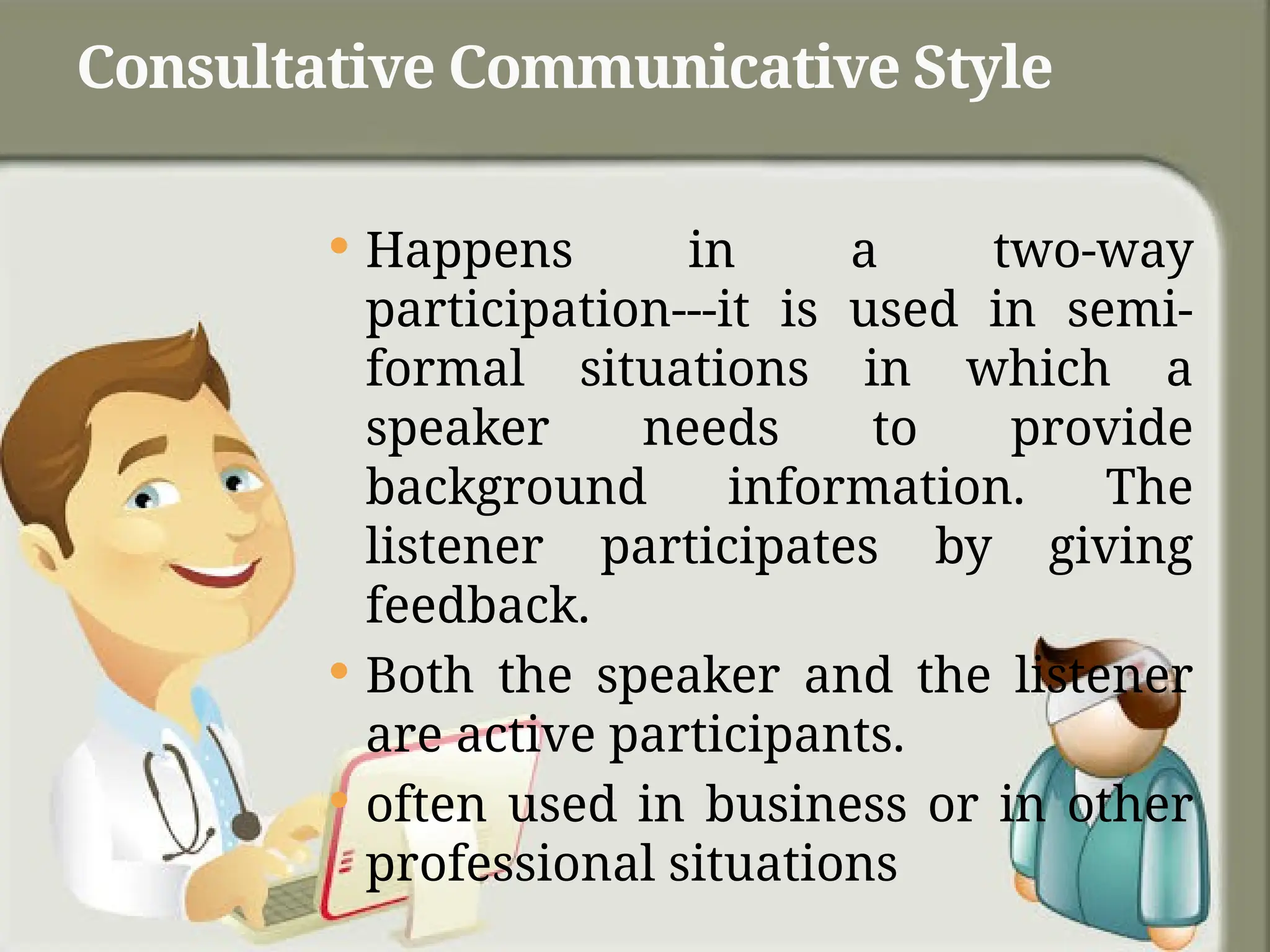
 Happens in a two-way
participation---it is used in semi-
formal situations in which a
speaker needs to provide
background information. The
listener participates by giving
feedback.
 Both the speaker and the listener
are active participants.
 often used in business or in other
professional situations
Consultative Communicative Style
EXAMPLE:
Situation: A patient is consulting a doctor.
Patient: Good morning, Dr. Garcia.
Dr. Garcia: Hi, how have you been feeling?
Patient: I have been feeling weird for the
past few days, Dr. Garcia. I have colds and
dry coughs. My fever keeps coming back
too.
Dr. Garcia: I see. Do you have any travel
history recently?
Patient: Actually, I was in Manila last week
for a seminar. I started feeling unwell a day
after I came back.
Dr. Garcia: apparently, you are showing
some of the usual signs and symptoms of
Coronavirus. We’ll have you undergo swab
testing and put you on quarantine while we
FORMAL COMMUNICATIVE STYLE
also considered to be a
straightforward speech--there is
no participation from the listener.
This style is often used in the
following formal situations where
there is only one-way
communication:
Formal Communicative
Style
 Speeches
 School lessons
 Graduation ceremony
 A television newscast
 Giving announcements
 A business meeting
 An interview or in a classroom
 Used for academic and business writing
Formal Communicative
Style
• Greetings
a. “Hello, Good morning.”
b. “How are you doing?”
c. “I hope everything is fine
with you.”
• To show approval or excitement
-That is terrific to hear!
EXAMPLES:
• Making Suggestions/ Giving advise
-Would you please allow me to
make suggestions?
• To say goodbye or good night
-Goodbye, Mrs. Pineda.
-Good night, Mr. Cruz.
FROZEN COMMUNICATIVE STYLE
 also called the oratorical style, is the most formal
style and is reserved for very formal situations
such as during weddings, other religious services
or rituals, court proceedings, and other formal
ceremonies.
 This style is used to address or is given before an
audience of absolute strangers, it uses prescribed
and highly formal language.
FROZEN COMMUNICATIVE
STYLE
EXAMPLES:
Pledge of Allegiance
I am a Filipino
I pledge my allegiance
To the flag of the
Philippines
And to the country it
represents
With honor, justice and
freedom
Put in motion by one
nation
For God, humanity,
nature and
country.
ACTIVITY 3:
Directions: Fill in the missing dialogues with your own examples. Then,
indicate what communicative style was used in the dialogue. Write your
answer on separate sheet of paper.
Take the following example as your guide:
Friend 1: I’m stuck with my assignment.
Friend 2: Uhmm.. Let me see that.
Friend 1: Please help me. I need to submit this now.
The communicative style used is: Casual style
New Neighbor: Hello! May I ask where’s the convenience store here in our village?
You: (1) _____________________________________________________________
New Neighbor: Thank you so much! Have a great day!
The speech style used is: (2) ___________________________________.
Student: Excuse me, Ma’am. May I know when is our First Periodical examinations?
Teacher: It will be on the 24th of September. Please do start reviewing your lessons,
okay?
Student: (3) __________________________________________________________
The speech style used is: (4) _____________________________________.
Mother: Oh, dear! What’s the matter with you? Can you tell me your problem?
Child: (5) __________________________________________________________
Mother: That’s okay dear, you don’t need to keep it alone. It will be easier if you
share that to me, okay?
The speech style used is: (6) ____________________________________.
Activity 4: Let’s express it!
Now it’s time for you to express what’s on
your mind by answering the following
question. Write your answer on separate
sheet of paper. How does your relationship
with others influence the way you
communicate with them?
evaluation
Multiple Choice: Choose the letter of the correct answer from the given choices. Write your answer on separate
sheet of paper.
1. What speech style is characterized by a complete absence of social interactions?
a. Casual
b. Formal
c. Frozen
d. Intimate
2. In which of the following situations would the casual communicative style be used?
a. during a business meeting
b. while chatting with a classmate
c. while conversing with husband or wife
d. while speaking with a person in authority
3. Which of the following is not a characteristic of the intimate communicative style?
a. It is used in informal situations.
b. It is used in private conversations.
c. Participants use titles to address the person spoken to.
d. The participants need to have a very close relationship.
4. Veena is chatting with her friends while waiting for their class to start.
They were talking about what they did over the weekend and how they studied for their upcoming exams. Which of the
following would most likely NOT be used in their conversation?
a. standard grammar
b. slang and contractions
c. loose sentence structure
d. rapid pronunciation of words
5. Ms. Mosquera and her husband are attending a business meeting together. Which of the following should they NOT
do?
a. Avoid the use of jargons and slang.
b. Use more formal words when speaking with others.
c. Use proper sentence structure and grammar when speaking.
d. Use the intimate communicative style when talking to each other.
6. How do listeners participate in the consultative communicative style?
a. by giving feedback
b. by asking a lot of questions
c. by leading the conversation
d. by taking charge of the situation
7. Who among the following will likely make use of the consultative communicative style?
a. Close friends
b. A husband and his wife
c. A teacher and a student
d. A mother and her daughter
8. In which of the following situations is the consultative communicative style often used?
a. business meeting
b. casual friendly chat
c. dining out with the family
d. attending baptismal ceremony
9. Which of the following terms of address is NOT USED when speaking in the
consultative communicative style?
a. Babe
b. Ma’am
c. Mr.
d. Sir
10. Glenda is doing a survey about the effects of earthquake in her community. Which
of the following communication situations would require her to use the consultative
style?
a. Asking her friends for their opinions
b. Researching on information to include in her study
c. Interviewing the evacuees regarding their experiences
d. Telling her best friend regarding what her study is about
ASSIGNMENT
Activity 9: Scene Hunting
Mechanics:
1. Find at least one scene or situation from
your favorite movie, teleserye, radio drama,
short story or novel that you consider
interesting.
2. Write down the title of the piece, and
transcribe the chosen scene/situation.
3. Write a short essay (10 sentences) for the scene detailing
why it is an example of a specific communicative style. Do
not forget to identify what communicative style is used.
Some guide questions are listed below.
a. Who are engaged in the conversation and what is their
relationship with each other?
b. Where is the conversation taking place?
c. What are they speaking about?
d. What kind of words are they using? Give specific
examples.
4. Your essay will be graded according to the following
rubric.
RUBRIC
Features 4 3 2 1 Score
Quality of
writing
 Piece was
written in an
extraordinary
style and
voice.
 Very
informative
and well
organized
 Piece was
written in
an
interesting
style and
voice
 Somewhat
informative
and
organized
 Piece had
little style or
voice
 Gives some
new
information
but poorly
organized
 Piece had
no style or
voice
 Gives no
new
information
and very
poorly
organized
Grammar
Usage &
Mechanics
 Virtually no
spelling,
punctuation
or
grammatical
errors
 A number of
spelling,
punctuation
or
grammatical
errors
 Few spelling
and
punctuations
errors, minor
grammatical
errors
 So many
spelling,
punctuation
and
grammatical
errors that
it interferes
with the
meaning
Total
THANK YOU!

COMMUNICATIVE STRATEGIES- GRADE 9- MODULE 3

  • 1.
  • 2.
    OBJECTIVES: At the endof the lesson, the students should be able to: 1. identify various communicative styles;
  • 3.
    OBJECTIVES: 2. create short conversationsout of the given communication situations using appropriate communicative styles; and
  • 4.
    OBJECTIVES: 3.appreciate the importance of suitableapproach in communication for every situation, person, or place.
  • 10.
    Questions 1. What haveyou observed with the utterances you just made? 2. How about the style or manner of your speech/delivery? 3. How did you say it? 4. How about your formality as you talked to them?
  • 11.
    Five Types ofCommunicative Styles CASUA L CONSULTATIVE FORMAL
  • 12.
  • 13.
    Intimate Communicative Style Odefinedas total absence of social interactions O used by participants who know each other well or share a very close relationship, such as between close friends, siblings, husband and wife, parents and children, and boyfriend and girlfriend.
  • 14.
    Intimate Communicative Style OThe participantsmay use words of endearment such as babe, love, dear, honey as a sign of intimacy.
  • 15.
    EXAMPLE: Husband: Hon, haveyou seen my mask and faceshield? Wife: Uhmm, I guess it is in the closet. Husband: Thanks, hon, I’ll check it. Wife: Okay, hon. Please do not forget to wear your mask and faceshield when you are at work. Husband: Yes hon. I also bring hand sanitizers. Wife: That’s good hon. Keep safe, I love you. Husband: Thanks hon, I love you too.
  • 16.
  • 17.
    Casual Communicative Style •Itis a language used between friends, peers, colleagues, or family. •Most of the ambience with this style is relaxed and very light.
  • 18.
    Casual Communicative Style •Jargon,slang, or the vernacular language is used. •Also, nicknames are used in addressing one another.
  • 19.
    EXAMPLE: Friend 1: Hey!What’s up? You seem so very busy. Friend 2: Yes, I have to finish some things up. Friend 1: Ah, I see. Wanna go with me for shopping? Friend 2:Ohh! But it’s pandemic. My mom told me that it’s better to stay at home. Friend 1: Hmm, I really miss going to the mall and buy my favorite stuffs. Friend 2: I think, it’s good to have/order it online. Since it is a trend nowadays. It is safer and more convenient.
  • 20.
  • 21.
     Happens ina two-way participation---it is used in semi- formal situations in which a speaker needs to provide background information. The listener participates by giving feedback.  Both the speaker and the listener are active participants.  often used in business or in other professional situations Consultative Communicative Style
  • 22.
    EXAMPLE: Situation: A patientis consulting a doctor. Patient: Good morning, Dr. Garcia. Dr. Garcia: Hi, how have you been feeling? Patient: I have been feeling weird for the past few days, Dr. Garcia. I have colds and dry coughs. My fever keeps coming back too. Dr. Garcia: I see. Do you have any travel history recently? Patient: Actually, I was in Manila last week for a seminar. I started feeling unwell a day after I came back. Dr. Garcia: apparently, you are showing some of the usual signs and symptoms of Coronavirus. We’ll have you undergo swab testing and put you on quarantine while we
  • 23.
  • 24.
    also considered tobe a straightforward speech--there is no participation from the listener. This style is often used in the following formal situations where there is only one-way communication: Formal Communicative Style
  • 25.
     Speeches  Schoollessons  Graduation ceremony  A television newscast  Giving announcements  A business meeting  An interview or in a classroom  Used for academic and business writing Formal Communicative Style
  • 26.
    • Greetings a. “Hello,Good morning.” b. “How are you doing?” c. “I hope everything is fine with you.” • To show approval or excitement -That is terrific to hear! EXAMPLES: • Making Suggestions/ Giving advise -Would you please allow me to make suggestions? • To say goodbye or good night -Goodbye, Mrs. Pineda. -Good night, Mr. Cruz.
  • 27.
  • 28.
     also calledthe oratorical style, is the most formal style and is reserved for very formal situations such as during weddings, other religious services or rituals, court proceedings, and other formal ceremonies.  This style is used to address or is given before an audience of absolute strangers, it uses prescribed and highly formal language. FROZEN COMMUNICATIVE STYLE
  • 29.
    EXAMPLES: Pledge of Allegiance Iam a Filipino I pledge my allegiance To the flag of the Philippines And to the country it represents With honor, justice and freedom Put in motion by one nation For God, humanity, nature and country.
  • 30.
    ACTIVITY 3: Directions: Fillin the missing dialogues with your own examples. Then, indicate what communicative style was used in the dialogue. Write your answer on separate sheet of paper. Take the following example as your guide: Friend 1: I’m stuck with my assignment. Friend 2: Uhmm.. Let me see that. Friend 1: Please help me. I need to submit this now. The communicative style used is: Casual style
  • 31.
    New Neighbor: Hello!May I ask where’s the convenience store here in our village? You: (1) _____________________________________________________________ New Neighbor: Thank you so much! Have a great day! The speech style used is: (2) ___________________________________. Student: Excuse me, Ma’am. May I know when is our First Periodical examinations? Teacher: It will be on the 24th of September. Please do start reviewing your lessons, okay? Student: (3) __________________________________________________________ The speech style used is: (4) _____________________________________. Mother: Oh, dear! What’s the matter with you? Can you tell me your problem? Child: (5) __________________________________________________________ Mother: That’s okay dear, you don’t need to keep it alone. It will be easier if you share that to me, okay? The speech style used is: (6) ____________________________________.
  • 32.
    Activity 4: Let’sexpress it! Now it’s time for you to express what’s on your mind by answering the following question. Write your answer on separate sheet of paper. How does your relationship with others influence the way you communicate with them?
  • 33.
    evaluation Multiple Choice: Choosethe letter of the correct answer from the given choices. Write your answer on separate sheet of paper. 1. What speech style is characterized by a complete absence of social interactions? a. Casual b. Formal c. Frozen d. Intimate 2. In which of the following situations would the casual communicative style be used? a. during a business meeting b. while chatting with a classmate c. while conversing with husband or wife d. while speaking with a person in authority 3. Which of the following is not a characteristic of the intimate communicative style? a. It is used in informal situations. b. It is used in private conversations. c. Participants use titles to address the person spoken to. d. The participants need to have a very close relationship.
  • 34.
    4. Veena ischatting with her friends while waiting for their class to start. They were talking about what they did over the weekend and how they studied for their upcoming exams. Which of the following would most likely NOT be used in their conversation? a. standard grammar b. slang and contractions c. loose sentence structure d. rapid pronunciation of words 5. Ms. Mosquera and her husband are attending a business meeting together. Which of the following should they NOT do? a. Avoid the use of jargons and slang. b. Use more formal words when speaking with others. c. Use proper sentence structure and grammar when speaking. d. Use the intimate communicative style when talking to each other. 6. How do listeners participate in the consultative communicative style? a. by giving feedback b. by asking a lot of questions c. by leading the conversation d. by taking charge of the situation 7. Who among the following will likely make use of the consultative communicative style? a. Close friends b. A husband and his wife c. A teacher and a student d. A mother and her daughter
  • 35.
    8. In whichof the following situations is the consultative communicative style often used? a. business meeting b. casual friendly chat c. dining out with the family d. attending baptismal ceremony 9. Which of the following terms of address is NOT USED when speaking in the consultative communicative style? a. Babe b. Ma’am c. Mr. d. Sir 10. Glenda is doing a survey about the effects of earthquake in her community. Which of the following communication situations would require her to use the consultative style? a. Asking her friends for their opinions b. Researching on information to include in her study c. Interviewing the evacuees regarding their experiences d. Telling her best friend regarding what her study is about
  • 36.
    ASSIGNMENT Activity 9: SceneHunting Mechanics: 1. Find at least one scene or situation from your favorite movie, teleserye, radio drama, short story or novel that you consider interesting. 2. Write down the title of the piece, and transcribe the chosen scene/situation.
  • 37.
    3. Write ashort essay (10 sentences) for the scene detailing why it is an example of a specific communicative style. Do not forget to identify what communicative style is used. Some guide questions are listed below. a. Who are engaged in the conversation and what is their relationship with each other? b. Where is the conversation taking place? c. What are they speaking about? d. What kind of words are they using? Give specific examples. 4. Your essay will be graded according to the following rubric.
  • 38.
    RUBRIC Features 4 32 1 Score Quality of writing  Piece was written in an extraordinary style and voice.  Very informative and well organized  Piece was written in an interesting style and voice  Somewhat informative and organized  Piece had little style or voice  Gives some new information but poorly organized  Piece had no style or voice  Gives no new information and very poorly organized Grammar Usage & Mechanics  Virtually no spelling, punctuation or grammatical errors  A number of spelling, punctuation or grammatical errors  Few spelling and punctuations errors, minor grammatical errors  So many spelling, punctuation and grammatical errors that it interferes with the meaning Total
  • 39.