Employing
Appropriate
Communicative Styles
Objectives:
1. Distinguish types of
communicative styles
2. Identify social situations in
which each communicative
style is appropriate to use
3. Employ appropriate
communicative styles
for various
situations.
LT 1:
1. “What’s up, dude?”
2. “Jose do you accept Maria as
your lawful wife?”
“Yes, father, I do.”
3. “Sweety, how’s your work?
Have you taken your lunch? What
time will you reach home?”
LT 1:
4. “Doctor Ong, what vitamin can
my child take if she often has
colds?”
“Try to give her vitamin C, plenty
of water, and lots of fruits.”
5. Good morning, Ms. Rivera. I
am Ms. Santos. I am applying as
a secondary teacher.”
What is
Communication?
According to Merriam-
Webster, communication
is a process by which
information is exchanged
between individuals through
a common system of
symbols, signs, or behavior.
Communication is a
way of sharing
information. There are
three main types of
communication: written,
verbal, and nonverbal.
According to Martin
Joos, speech style here
means the form of language
that the speaker uses which is
characterized by the degree
of formality. He identified the
styles in five classes .
Types of
Communicative
Styles
Intimate Style
Intimate language style takes place
in a private conversation between
individuals who are very close and
know each other quite well because
they have maximum shared
background information
(Largado, 2016).
• Couple talking about their future plans
• family sharing ideas
• very close friends sharing secrets
Casual Style
This is an informal communication
between groups and peers. Casual
style is used in conversation
between friends and insiders who
have something to share and have
shared background information
but don't have close relations.
• phone calls
• everyday conversation with friends
• chats
Formal Style
The formal communicative style is also
considered to be a straightforward
speech. There is no participation from
the listener. This style is often used in
the following formal situations where
there is only one-way
communication:
Speeches
Academic and business writing
Graduation ceremony
• Announcements
• SONA
• welcome addresses
Consultative Style
The consultative speech style happens in a
two-way participation. It is used in semi-formal
situations in which a speaker needs to provide
background information. The listener participates
by giving feedback. Thus, both the speaker and the
listener are active participants.
Take note that this style
is often used in business
or in other professional
situations.
• regular classroom discussions
• doctor-patient
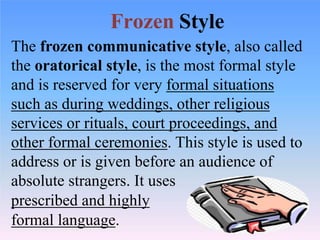
Frozen Style
The frozen communicative style, also called
the oratorical style, is the most formal style
and is reserved for very formal situations
such as during weddings, other religious
services or rituals, court proceedings, and
other formal ceremonies. This style is used to
address or is given before an audience of
absolute strangers. It uses
prescribed and highly
formal language.
• Pledges
• anthems
• marriage ceremonies
• laws
References:
• https://elcomblus.com/speech-styles-definition-
types-and-examples/
• https://core.ac.uk/download/pdf/160258448.pdf
Practice Activity
Directions: Read and identify
the type of communicative
style exemplified in the
following situations.
1.
1. Formal
2.
2. Consulative
3. Intimate
4.
4. Casual
5.
5. Formal
Questions?
“How does your relationship
with others influence the way
you communicate with them?”
QUIZ
Directions: Identify the type
of communicative style
appropriate for the following
situations. Write your answer
on your notebook.
1. reciting DepEd Vision
2. reading school policies
3. talking to a new friend
4. inquiring at the library
5. delivering news
reports
6. asking something from your
neighbor
7. talking to your groupmates
8. delivering a valedictory
address
9. talking and laughing about
memorable experiences
10.sending an inquiry to your
teacher through messenger
Answers
1. Frozen
2. Frozen
3. Casual
4. Consultative
5. Formal
6. Casual
7. Casual
8. Formal
9. Intimate
10. Consultative
Take-home Activity
Scene Hunting Mechanics:
1. Find at least one scene or situation from your
favorite movie, teleserye, radio drama, short
story or novel that you consider interesting.
2. Write down the title of the piece, and
transcribe the chosen scene/situation.
3. Write a short essay (10 sentences) for the
scene detailing why it is an example of a
specific communicative style. Do not forget
to identify what communicative style is
used.
Take-home Activity
Some guide questions are listed below.
a. Who are engaged in the conversation and
what is their relationship with each other?
b. Where is the conversation taking place?
c. What are they speaking about?
d. What kind of words are they using? Give
specific examples.
4. Your essay will be graded according to
the following rubric.
Take-home Activity
Features 10
Expert
8
Accomplished
6
Capable
4
Beginner
Quality of
Writing
Piece was
written in an
extraordinary
style and voice
Very
informative and
well-organized
Piece was written
in an interesting
style and voice
Somewhat
informative and
organized
Piece had little
style or voice
Gives some
new
information
but poorly
organized
Piece had no
style or voice
Gives no new
information
and very
poorly
organized
Grammar,
Usage &
Mechanics
Virtually no
spelling,
punctuation or
grammatical
errors
Few spelling and
punctuation
errors, minor
grammatical
errors
A number of
spelling,
punctuation or
grammatical
errors
So many
spelling,
punctuation
and
grammatical
errors that it
interferes with
the meaning
Performance Activity
1. Work with your group (5-6 members).
2. Role-play a situation showing a specific
communicative style. Take a video of
your role-playing activity.
3. Specify the communicative style you
are portraying in your video. The video
should be 3-5 minutes.
4. Send your group’s output through
messenger.

Communicative Styles.pptx

  • 1.
  • 2.
    Objectives: 1. Distinguish typesof communicative styles 2. Identify social situations in which each communicative style is appropriate to use 3. Employ appropriate communicative styles for various situations.
  • 3.
    LT 1: 1. “What’sup, dude?” 2. “Jose do you accept Maria as your lawful wife?” “Yes, father, I do.” 3. “Sweety, how’s your work? Have you taken your lunch? What time will you reach home?”
  • 4.
    LT 1: 4. “DoctorOng, what vitamin can my child take if she often has colds?” “Try to give her vitamin C, plenty of water, and lots of fruits.” 5. Good morning, Ms. Rivera. I am Ms. Santos. I am applying as a secondary teacher.”
  • 6.
  • 7.
    According to Merriam- Webster,communication is a process by which information is exchanged between individuals through a common system of symbols, signs, or behavior.
  • 8.
    Communication is a wayof sharing information. There are three main types of communication: written, verbal, and nonverbal.
  • 9.
    According to Martin Joos,speech style here means the form of language that the speaker uses which is characterized by the degree of formality. He identified the styles in five classes .
  • 10.
  • 11.
    Intimate Style Intimate languagestyle takes place in a private conversation between individuals who are very close and know each other quite well because they have maximum shared background information (Largado, 2016).
  • 12.
    • Couple talkingabout their future plans • family sharing ideas • very close friends sharing secrets
  • 13.
    Casual Style This isan informal communication between groups and peers. Casual style is used in conversation between friends and insiders who have something to share and have shared background information but don't have close relations.
  • 14.
    • phone calls •everyday conversation with friends • chats
  • 15.
    Formal Style The formalcommunicative style is also considered to be a straightforward speech. There is no participation from the listener. This style is often used in the following formal situations where there is only one-way communication: Speeches Academic and business writing Graduation ceremony
  • 16.
  • 17.
    Consultative Style The consultativespeech style happens in a two-way participation. It is used in semi-formal situations in which a speaker needs to provide background information. The listener participates by giving feedback. Thus, both the speaker and the listener are active participants. Take note that this style is often used in business or in other professional situations.
  • 18.
    • regular classroomdiscussions • doctor-patient
  • 19.
    Frozen Style The frozencommunicative style, also called the oratorical style, is the most formal style and is reserved for very formal situations such as during weddings, other religious services or rituals, court proceedings, and other formal ceremonies. This style is used to address or is given before an audience of absolute strangers. It uses prescribed and highly formal language.
  • 20.
    • Pledges • anthems •marriage ceremonies • laws
  • 21.
  • 22.
  • 23.
    Directions: Read andidentify the type of communicative style exemplified in the following situations.
  • 24.
  • 25.
  • 26.
  • 27.
  • 29.
  • 30.
  • 31.
  • 32.
  • 33.
  • 34.
  • 35.
    “How does yourrelationship with others influence the way you communicate with them?”
  • 36.
    QUIZ Directions: Identify thetype of communicative style appropriate for the following situations. Write your answer on your notebook.
  • 37.
    1. reciting DepEdVision 2. reading school policies 3. talking to a new friend 4. inquiring at the library 5. delivering news reports
  • 38.
    6. asking somethingfrom your neighbor 7. talking to your groupmates 8. delivering a valedictory address 9. talking and laughing about memorable experiences 10.sending an inquiry to your teacher through messenger
  • 39.
    Answers 1. Frozen 2. Frozen 3.Casual 4. Consultative 5. Formal 6. Casual 7. Casual 8. Formal 9. Intimate 10. Consultative
  • 40.
    Take-home Activity Scene HuntingMechanics: 1. Find at least one scene or situation from your favorite movie, teleserye, radio drama, short story or novel that you consider interesting. 2. Write down the title of the piece, and transcribe the chosen scene/situation. 3. Write a short essay (10 sentences) for the scene detailing why it is an example of a specific communicative style. Do not forget to identify what communicative style is used.
  • 41.
    Take-home Activity Some guidequestions are listed below. a. Who are engaged in the conversation and what is their relationship with each other? b. Where is the conversation taking place? c. What are they speaking about? d. What kind of words are they using? Give specific examples. 4. Your essay will be graded according to the following rubric.
  • 42.
    Take-home Activity Features 10 Expert 8 Accomplished 6 Capable 4 Beginner Qualityof Writing Piece was written in an extraordinary style and voice Very informative and well-organized Piece was written in an interesting style and voice Somewhat informative and organized Piece had little style or voice Gives some new information but poorly organized Piece had no style or voice Gives no new information and very poorly organized Grammar, Usage & Mechanics Virtually no spelling, punctuation or grammatical errors Few spelling and punctuation errors, minor grammatical errors A number of spelling, punctuation or grammatical errors So many spelling, punctuation and grammatical errors that it interferes with the meaning
  • 43.
    Performance Activity 1. Workwith your group (5-6 members). 2. Role-play a situation showing a specific communicative style. Take a video of your role-playing activity. 3. Specify the communicative style you are portraying in your video. The video should be 3-5 minutes. 4. Send your group’s output through messenger.