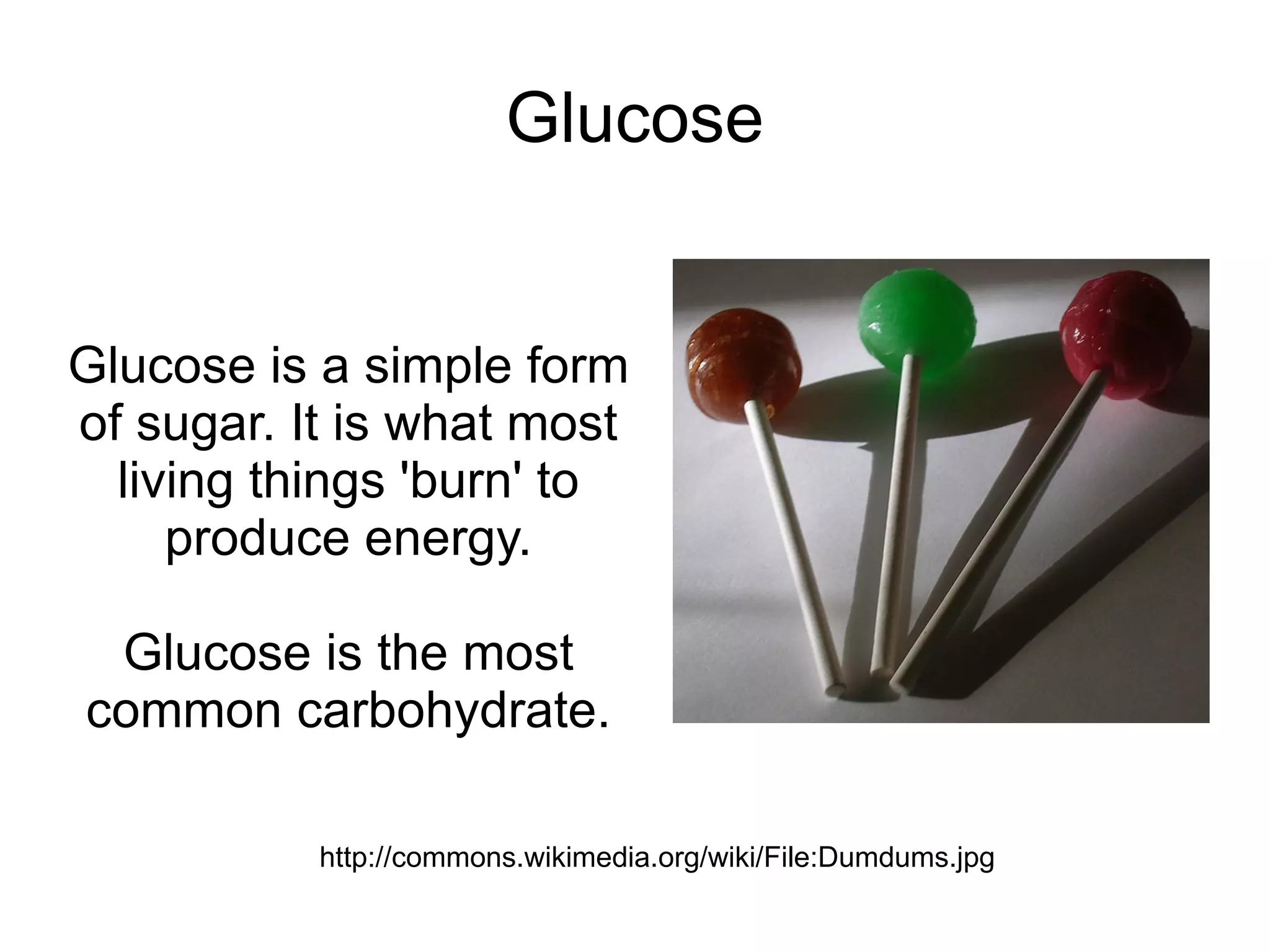
Glucose Glucose is a simple form of sugar. It is what most living things 'burn' to produce energy. Glucose is the most common carbohydrate. http://commons.wikimedia.org/wiki/File:Dumdums.jpg
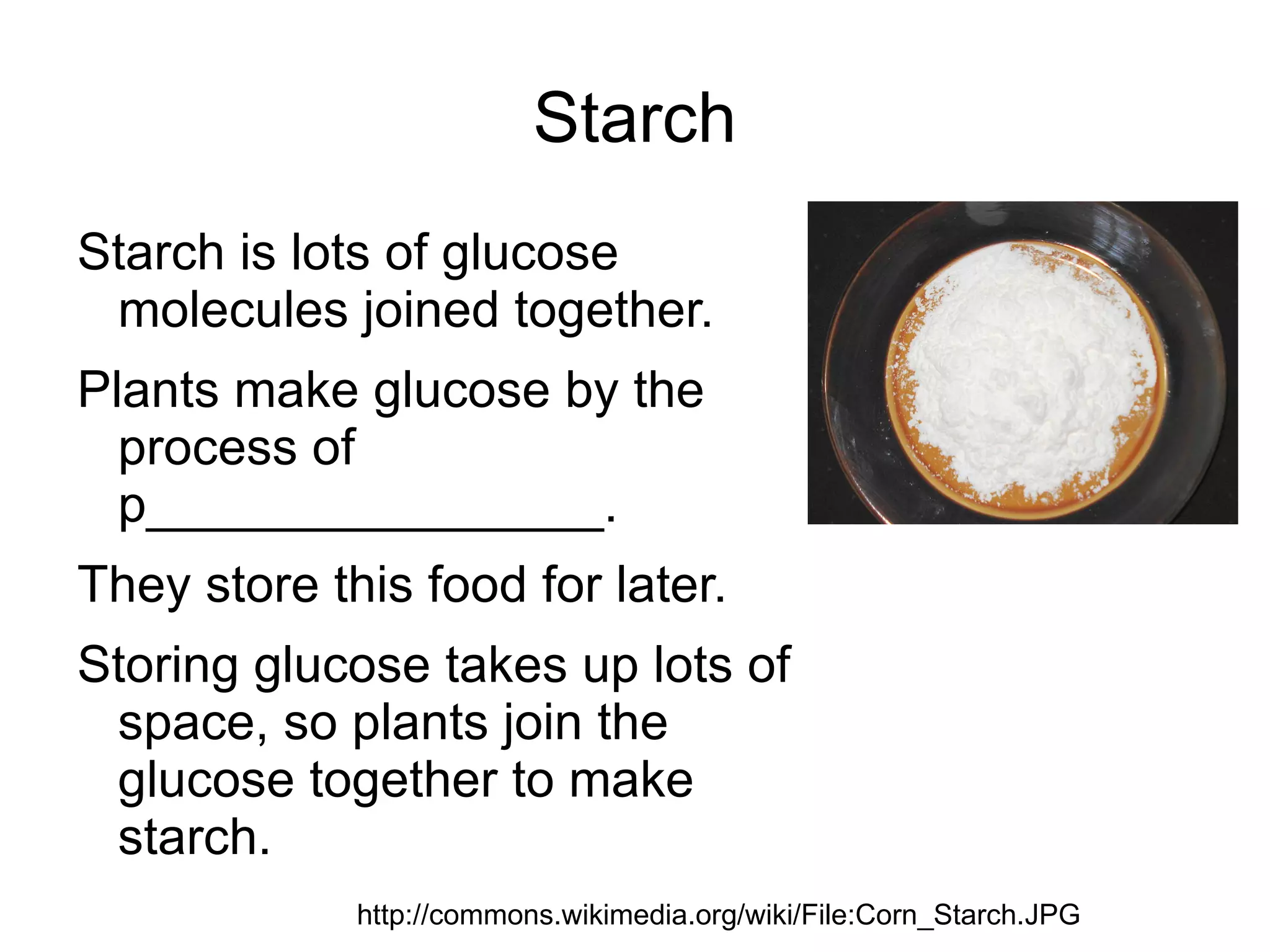
Starch Starch is lots of glucose molecules joined together.
Plants make glucose by the process of  p________________.
They store this food for later.
Storing glucose takes up lots of space, so plants join the glucose together to make starch. http://commons.wikimedia.org/wiki/File:Corn_Starch.JPG
Which types of foods contain: Starch?
Glucose? And why?
Testing for Starch • Use a spotting tile with the food samples. • Add 2 drops of iodine solution to each food sample. • Which of these foods contain starch? • Record results.
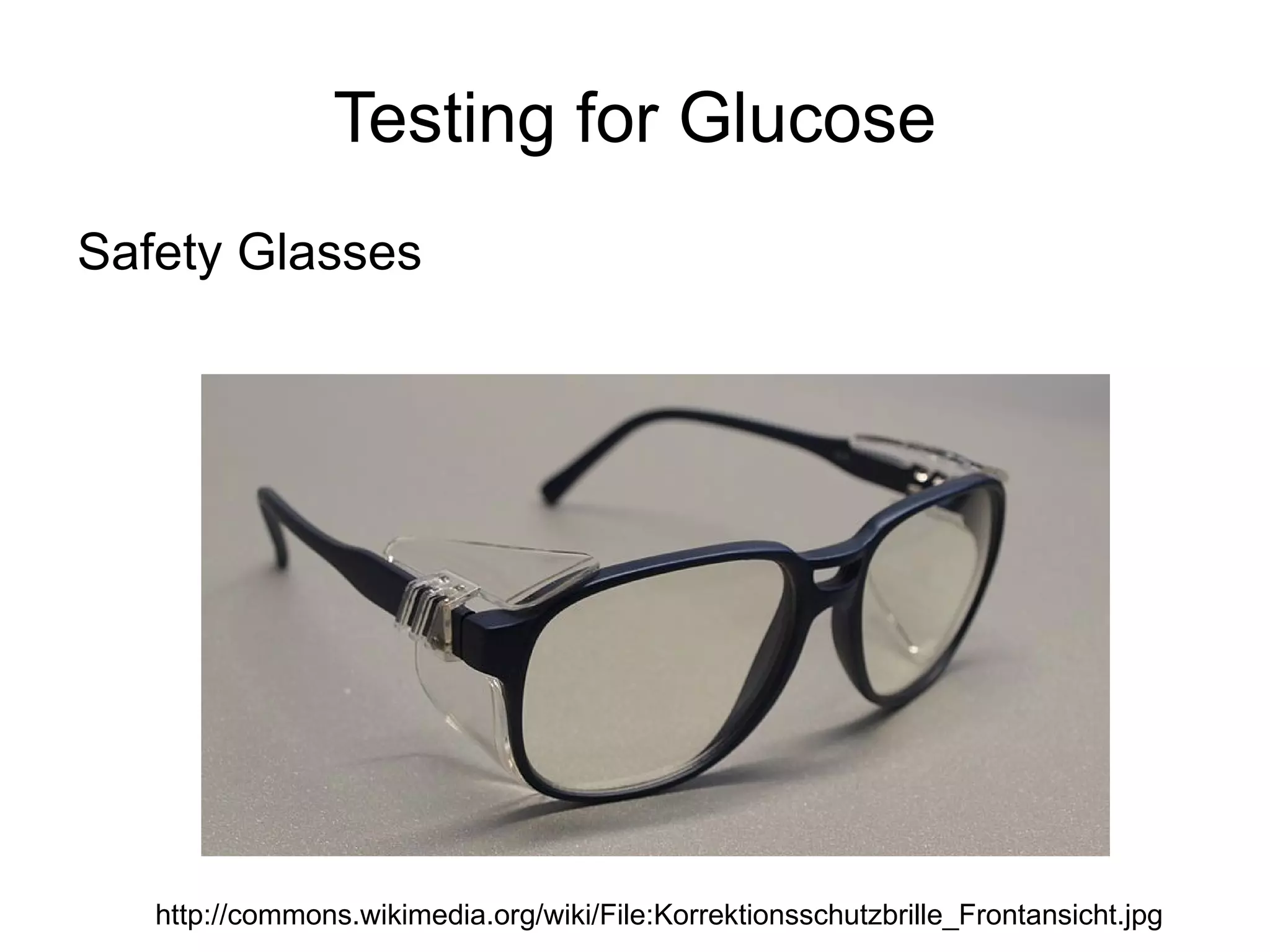
Testing for Glucose Safety Glasses http://commons.wikimedia.org/wiki/File:Korrektionsschutzbrille_Frontansicht.jpg
Testing for Glucose • Put some food  in a third of a test tube of water. Dissolve. • Put in 10 drops of Benedict’s solution. • Heat carefully in a water bath. • Note your result.
Testing for Protein Protein is tested for using Biuret's Reagant.
Biuret's Reagant is made of Copper Sulfate and  Sodium Hydroxide.
If the solution turns purple, it means that protein is present.
Online Experiment
Testing for Fat To test for fat, we grind up the food and smear it over filter paper. If it contains fat, the filter paper becomes clear.
Questions • What type of food is iodine solution used to test, and how can you tell if the test is positive?
• When rubbing different foods on filter paper, the paper sometimes becomes translucent. What does this tell you about the food?
• What is the main hazard when using Biuret solution and what precaution should you take?
• What is the name of the test that will show if protein is present in a food and how will you be able to tell?
• Glucose is a type of sugar. Your body uses glucose as a source of what?
• What test would you use for glucose and how would you know if the test was positive?
Digestion Food must be broken down into smaller components to be used in our body. This process is called digestion. This occurs in the digestive system.
Once food is broken down it needs to enter the blood. This process is called absorption. http://www.nlm.nih.gov/medlineplus/ency/imagepages/8710.htm Integrated Science 2 Page 75 Read everything, then answer questions 1-5.
Digestion Animation http://kitses.com/animation/swfs/digestion.swf
Keynote Mouth and Stomach
Notebooks Some books were excellent.
Your answers showed a good understanding of what we covered in class.

Grade 7 digestion Presentation

  • 1.
    Glucose Glucose isa simple form of sugar. It is what most living things 'burn' to produce energy. Glucose is the most common carbohydrate. http://commons.wikimedia.org/wiki/File:Dumdums.jpg
  • 2.
    Starch Starch islots of glucose molecules joined together.
  • 3.
    Plants make glucoseby the process of p________________.
  • 4.
    They store thisfood for later.
  • 5.
    Storing glucose takesup lots of space, so plants join the glucose together to make starch. http://commons.wikimedia.org/wiki/File:Corn_Starch.JPG
  • 6.
    Which types offoods contain: Starch?
  • 7.
  • 8.
    Testing for Starch• Use a spotting tile with the food samples. • Add 2 drops of iodine solution to each food sample. • Which of these foods contain starch? • Record results.
  • 9.
    Testing for GlucoseSafety Glasses http://commons.wikimedia.org/wiki/File:Korrektionsschutzbrille_Frontansicht.jpg
  • 10.
    Testing for Glucose• Put some food in a third of a test tube of water. Dissolve. • Put in 10 drops of Benedict’s solution. • Heat carefully in a water bath. • Note your result.
  • 11.
    Testing for ProteinProtein is tested for using Biuret's Reagant.
  • 12.
    Biuret's Reagant ismade of Copper Sulfate and Sodium Hydroxide.
  • 13.
    If the solutionturns purple, it means that protein is present.
  • 14.
  • 15.
    Testing for FatTo test for fat, we grind up the food and smear it over filter paper. If it contains fat, the filter paper becomes clear.
  • 16.
    Questions • Whattype of food is iodine solution used to test, and how can you tell if the test is positive?
  • 17.
    • When rubbingdifferent foods on filter paper, the paper sometimes becomes translucent. What does this tell you about the food?
  • 18.
    • What isthe main hazard when using Biuret solution and what precaution should you take?
  • 19.
    • What isthe name of the test that will show if protein is present in a food and how will you be able to tell?
  • 20.
    • Glucose isa type of sugar. Your body uses glucose as a source of what?
  • 21.
    • What testwould you use for glucose and how would you know if the test was positive?
  • 22.
    Digestion Food mustbe broken down into smaller components to be used in our body. This process is called digestion. This occurs in the digestive system.
  • 23.
    Once food isbroken down it needs to enter the blood. This process is called absorption. http://www.nlm.nih.gov/medlineplus/ency/imagepages/8710.htm Integrated Science 2 Page 75 Read everything, then answer questions 1-5.
  • 24.
  • 25.
  • 26.
    Notebooks Some bookswere excellent.
  • 27.
    Your answers showeda good understanding of what we covered in class.
  • 28.
    My Expectations 1.bring your notebook to class every day. 2. Complete everything I set. I will check it when I collect your books (about every 1-2 weeks). 3. Check my blog for homework and unfinished classwork.
  • 29.
    A “please complete”means it was not complete and MUST be completed before the next class (or detention). The same applies to anything I emailed you about.
  • 30.
    Protein Proteins arethe building blocks of life. Everything inside us is made of protein: - hair -skin -fingernails
  • 31.
    Proteins are madeof 'chains' of amino acids all joined together.
  • 32.
    When we eatprotein, our digestive system breaks the proteins down into amino acids, and puts them together to make new proteins we need.
  • 33.
    Protein is usedfor g_________ and r________.
  • 34.
    Carbohydrate Starch andglucose are two common carbohydrates. Others include fructose (in fruit) and lactose (in milk).
  • 35.
    Glucose is carriedin the blood to cells, where it is 'burned' (as fuel) to produce energy our cells need.
  • 36.
    Starch is madeof lots of glucose molecules joined together. It is broken down into glucose by a_________ in s__________, and the sugar enters the blood through the s______ i______.
  • 37.
    Carbohydrates are thebody's supply of e_______.
  • 38.
    Lipids Fats andoils are called lipids.
  • 39.
    Lipids are usedfor some important functions in the body, including in cell membranes.
  • 40.
    The main useof lipids is energy storage. If we eat more than we need, our body converts the extra food to fat. Eating foods high in fats also helps us to store fat.
  • 41.
    Fats can be'burned' like carbohydrates if we cannot get enough food.
  • 42.
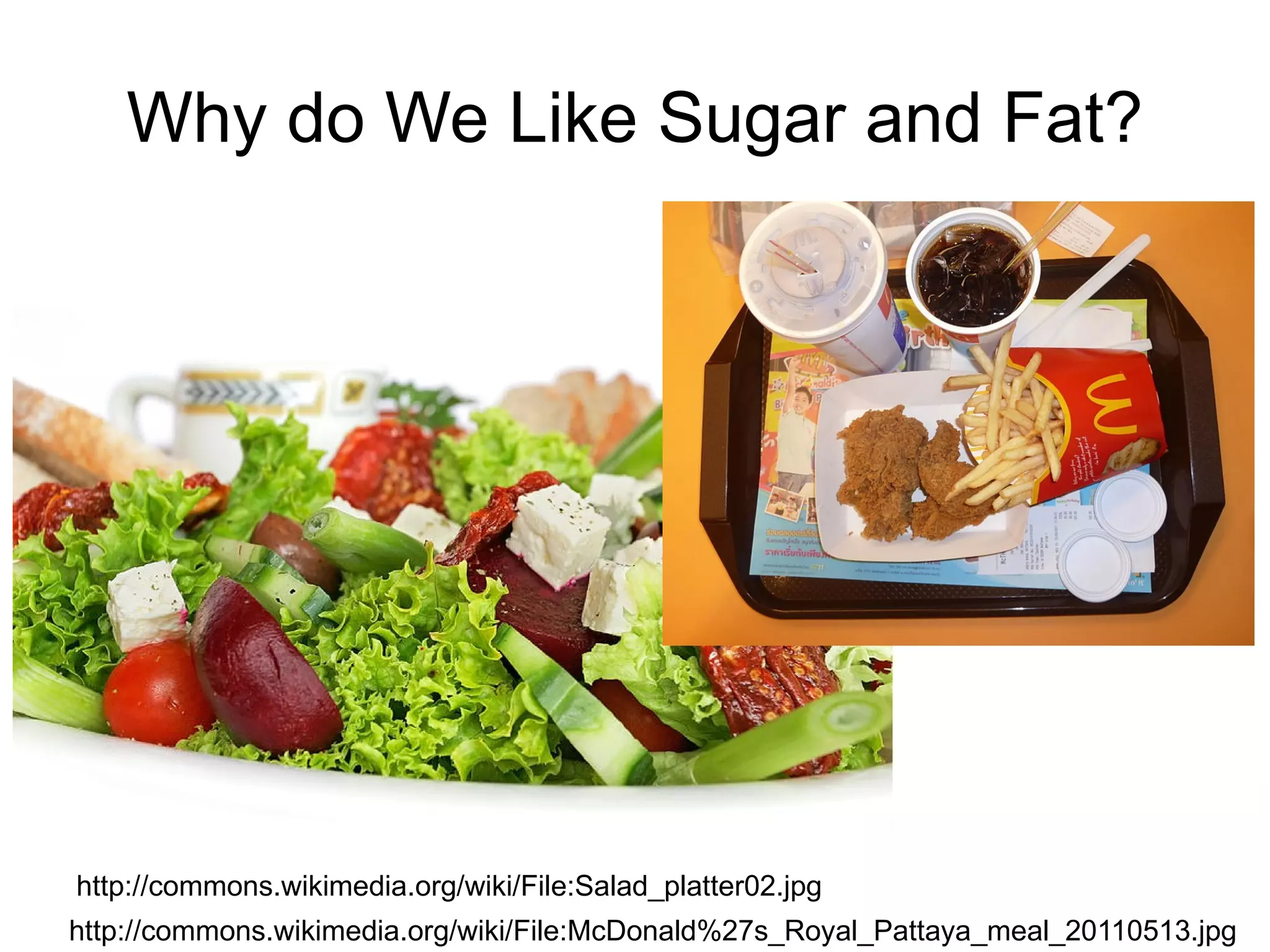
    Why do WeLike Sugar and Fat? http://commons.wikimedia.org/wiki/File:McDonald%27s_Royal_Pattaya_meal_20110513.jpg http://commons.wikimedia.org/wiki/File:Salad_platter02.jpg
  • 43.
    Sugar is foundin fruit, which provided our ancestors with important vitamins (and sugar in the energy).
  • 44.
    Our ancestors oftencouldn't get much fat, but they needed it to survive.
  • 45.
    Review Questions Whichfood group provides us with most of our energy?
  • 46.
    Under what circumstancesdoes another food group provide us with our energy?
  • 47.
    Where in ourbody is this energy produced? Name two organs in which an extra large amount of energy is produced.
  • 48.
    What else besidesfood does our body need to produce energy, and where does it get it from? How does it get to where it is needed?
  • 49.
    Oxygen and CarbonDioxide Percentages of Oxygen and Carbon Dioxide in Inhaled and Exhaled Air Table of composition of inhaled and exhaled air: http://colwiki.org/Unit_4:Respiratory_System
  • 50.
    Limewater Limewater (CalciumHydroxide) turns 'milky' if carbon dioxide is bubbled through it.
  • 51.
    One person pergroup blow through limewater. Blow firmly, but do not blow hard enough to make it splash everywhere! Limewater image: http://www.saintspeterandpaul.halton.sch.uk/HTML%20GROUP%20FILES/science/science_ks3_yr7_reactions.htm
  • 52.
    The Inhaling /Exhaling Device Draw a scientific (2-D) diagram of the apparatus. Be sure to show that inhaled air bubbles through one boiling tube and exhaled air through another.
  • 53.
    Explain why oneturned milky before the other did.
  • 54.
    Summary Mammals breathein air from the atmosphere, containing 21% oxygen and a tiny bit of carbon dioxide.
  • 55.
    Some of theoxygen we breathe in is used to 'burn' glucose to produce energy. This produces carbon dioxide, a waste product which we breathe out.
  • 56.
    Limewater turns milkyif CO2 is bubbled through it.
  • 57.
    VoiceThread Make avoicethread to explain how the heart works, using the photos from yesterday, which can be found here: http://photos.yis.ac.jp/MS/2011-Science/Hearts/19359865_JXmhSZ#1513525633_tRKgmMz
  • 58.
  • 59.
    Blood Blood ismade of many different cells, which each serve different roles in the body. Red blood cells carry oxygen around the body.
  • 60.
    White blood cellshelp fight disease and other things which our body doesn't want in it: -- phagocytes ingest ('eat') invading organisms which enter the blood. http://en.wikipedia.org/wiki/File:Neutrophil_with_anthrax_copy.jpg
  • 61.
    The Microscope Drawthe blood under the microscope.