PLANNING
SUMMER HOLIDAYS PROJECT (2023-24)
By:-SHUBHANSHU CHATURVEDI
XII-D
24
INTRODUCTION
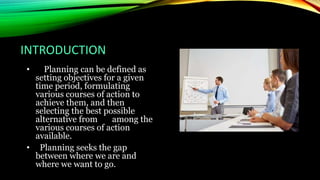
• Planning can be defined as
setting objectives for a given
time period, formulating
various courses of action to
achieve them, and then
selecting the best possible
alternative from among the
various courses of action
available.
• Planning seeks the gap
between where we are and
where we want to go.
1. Focuses on
achieving goals
2. Primary
Function of
Management
3. Pervasive
4. Continuous
5. Futuristics
6. Involves
Decision
Making
7. Mental
Exercise
FEATURES
• It focuses on achieving organizational objectives
and specific goals are set out in the plans along with
the activities to be undertaken to achieve the goals.
1. Focuses on
achieving goals
• It is the primary function of management as it lays
down the basis for all other functions of
management.
2. Primary function
of management
• It is pervasive as it is required in all the
organisations, at all levels and in all departments.
3. Pervasive
• It is continuous because a plan is framed and
implemented for a specific period of time and is followed
by another plan and so on.
4. Continuous
• It is futuristic as it involves looking ahead and preparing for the
future based on forecasting which involves anticipating future
events and drawing plans accordingly.
5. Futuristic
• Planning involves decision making as a manager has to
make a choice from among the various alternative
courses of action.
6. Involves
decision making
• It is a mental exercise as it is intellectual activity of
thinking rather than doing requiring application of mind
involving foresight, intelligent imagination and sound
judgement.
7. Mental
exercise
IMPORTANCE
1. Provides
Direction
2. Reduces
the Risks of
Uncertainty
3. Reduces
Overlapping
& Wasteful
Activities
4. Promoting
Innovative
Ideas
5. Facilitates
Decision
Making
6. Establishes
Standards for
Controlling
• 1. Provides Direction: Planning provides directions by deciding in advance what action should
be taken.
• 2. Reduces the Risks of Uncertainty: Planning reduces the risks of uncertainty by anticipating
changes and managerial responses to them.
• 3. Reduces Overlapping & Wasteful Activities: Planning reduces overlapping & wasteful
activities by coordinating the activities of different divisions.
• 4. Promotes Innovative Ideas: Planning promotes innovative ideas requiring application of
mind and foresight.
• 5. Facilitates Decision Making: Planning facilitates decision making by making a choice from
among the alternative courses of action.
• 6. Establishes Standards for Controlling: Planning establishes standards against which actual
performance is measured.
LIMITATIONS
1.Leads to
rigidity
2. May not
work in
dynamic
environment
3. Reduces
creativity
4. Involves
huge cost
5. Time
consuming
process
6. Does not
guarantee
success
1. Leads to rigidity: Planning leads to rigidity because once a well defined plan is drawn, the
managers may not be in a position to change it with the changed circumstances.
2. May not work in a dynamic environment: Planning may not work in a dynamic environment
as the environment in which a business operates keeps on changing and planning may not
foresee everything.
3. Reduces creativity: Planning reduces creativity as middle management and other decision
makers are neither allowed to deviate from plans nor they permitted to act on their own.
4. Involves huge cost: Huge cost are involved in formulating the plans and sometimes costs
incurred may not justify the benefit derived from the plan.
5. Time consuming process: Planning is a time consuming process as checking accuracy of facts
may involve lot of time and sometimes not much time is left for its implementations.
6. Does not guarantee success: Planning does not guarantee success as manager have a
tendency to rely on previously tried and tested successful plans which may create a false sense
of security and lead to failure.
PLANNING PROCESS
Setting Objectives
Developing
Premises
Identifying
Alternative
Courses of
Action
Evaluating
Alternative
Courses
Selecting
an
Alternative
Implementing
the Plan
Follow up
Action
1. Setting Objectives:
• Goals can be set for the whole organization or for each department.
• Objectives specify what the organization wants to achieve.
• After the goals has been set, it has to be communicated to all department & employees.
• Objectives of the company has to be clearly stated.
2. Developing Premises:
• The Business Managers can`t predict the future, though they are uncertain of future the business
can`t stop its work, hence the managers should make some plans by assuming somethings.
• These assumptions which provide the basis for planning, are called PREMISES
• Forecasts can be made about the demand for a particular product , government policy, tax rates,
interests rates etc. Accurate forecasts therefore, become essential for successful plans.
3. Identifying Alternative Courses of Action:
• After setting the objectives, managers should make identify all the possible alternative courses
of action to achieve them. If the project is important, more options should be generated and
discussed among the members of the organization.
4. Evaluating Alternative Courses of Action:
• After making a list of options available to achieve the objectives, the Manager should asses the
pros and cons of each of each alternatives.
5. Selecting an Alternative:
• This is the real point of decision making. The best plan has to be adopted and implemented. The
real plan would be the most feasible, profitable and with least negative consequences.
6. Implementing the Plan:
• This step is concerned with putting plan into action, i.e doing what is required.
• This is the step where other managerial functions also come into the picture.
• This step would also involve organizing for labour and purchase of machinery.
7. Follow-up Action:
• Means to see whether plans are being implemented and activities are performed according to
plans. Monitoring the plan is equally important to ensure that objectives are achieved.
TYPES OF PLAN
SINGLE-USE PLANS STANDING PLANS
Are used over and over again because they
focus on organizational situations that occur
repeatedly.
They are also called repeated use plans.
Is developed for a one-time event, these
plans are not repetitive.
It refers to a plan developed for a one-time
project that has one specific objective.
TYPES OF PLAN
• PROGRAMME
• BUDGET
SINGLE USE
• OBJECTIVES
• STRATEGY
• POLICY
• PROCEDURE
• RULE
• METHOD
STANDING PLAN
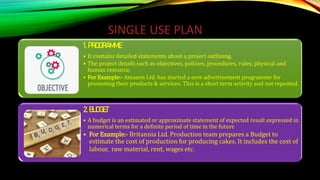
SINGLE USE PLAN
1.PROGRAMME
• It contains detailed statements about a project outlining.
• The project details such as objectives, policies, procedures, rules, physical and
human resource.
• For Example:- Amazon Ltd. has started a new advertisement programme for
promoting their products & services. This is a short term activity and not repeated.
2.BUDGET
• A budget is an estimated or approximate statement of expected result expressed in
numerical terms for a definite period of time in the future
• For Example:- Britannia Ltd. Production team prepares a Budget to
estimate the cost of production for producing cakes. It includes the cost of
labour, raw material, rent, wages etc.
STANDING PLANS
• It is a plan, that is repeated, once an
objective is set.
• Objectives are goal oriented.
• EXAMPLE:- Parle-G wants to increase
their sales by 30%.
1.OBJECTIVE
• These are guidelines & instructions.
• They guide, assist & direct the managers
to carry out the task.
• EXAMPLE:- The policy of Pizza Hut is to
make cash sales only.
3.POLICY
• Specific statement that tells do`s &
don`ts in a specified situations.
• EXAMPLE:- Hospital Staffs should wear
gloves, face masks and coat all the time
in hospital.
5.RULE
• It is a tactic or an idea of an
organization used by it to achieve its
objectives.
• EXAMPLE:- Pepsi offers a discount of
10% to compete against its
competitors in the market.
2.STRATEGY
• They indicate how a work has to be
done in a systematic manner.
• EXAMPLE:- If Parle G has to produce
bread it has to first arrange for the
wheat flour, baking powder, Bakers,
oven etc.
4.PROCEDURE
• Methods are standardized ways or
manner in which a particular task has
to be performed.
• EXAMPLE:- Quadratic Equations can
be solved by Substitution Method as
well as Elimination Method.
6.METHOD

PLANNING.pptx

  • 1.
    PLANNING SUMMER HOLIDAYS PROJECT(2023-24) By:-SHUBHANSHU CHATURVEDI XII-D 24
  • 2.
    INTRODUCTION • Planning canbe defined as setting objectives for a given time period, formulating various courses of action to achieve them, and then selecting the best possible alternative from among the various courses of action available. • Planning seeks the gap between where we are and where we want to go.
  • 3.
    1. Focuses on achievinggoals 2. Primary Function of Management 3. Pervasive 4. Continuous 5. Futuristics 6. Involves Decision Making 7. Mental Exercise FEATURES
  • 4.
    • It focuseson achieving organizational objectives and specific goals are set out in the plans along with the activities to be undertaken to achieve the goals. 1. Focuses on achieving goals • It is the primary function of management as it lays down the basis for all other functions of management. 2. Primary function of management • It is pervasive as it is required in all the organisations, at all levels and in all departments. 3. Pervasive
  • 5.
    • It iscontinuous because a plan is framed and implemented for a specific period of time and is followed by another plan and so on. 4. Continuous • It is futuristic as it involves looking ahead and preparing for the future based on forecasting which involves anticipating future events and drawing plans accordingly. 5. Futuristic • Planning involves decision making as a manager has to make a choice from among the various alternative courses of action. 6. Involves decision making
  • 6.
    • It isa mental exercise as it is intellectual activity of thinking rather than doing requiring application of mind involving foresight, intelligent imagination and sound judgement. 7. Mental exercise
  • 7.
    IMPORTANCE 1. Provides Direction 2. Reduces theRisks of Uncertainty 3. Reduces Overlapping & Wasteful Activities 4. Promoting Innovative Ideas 5. Facilitates Decision Making 6. Establishes Standards for Controlling
  • 8.
    • 1. ProvidesDirection: Planning provides directions by deciding in advance what action should be taken. • 2. Reduces the Risks of Uncertainty: Planning reduces the risks of uncertainty by anticipating changes and managerial responses to them. • 3. Reduces Overlapping & Wasteful Activities: Planning reduces overlapping & wasteful activities by coordinating the activities of different divisions. • 4. Promotes Innovative Ideas: Planning promotes innovative ideas requiring application of mind and foresight. • 5. Facilitates Decision Making: Planning facilitates decision making by making a choice from among the alternative courses of action. • 6. Establishes Standards for Controlling: Planning establishes standards against which actual performance is measured.
  • 9.
    LIMITATIONS 1.Leads to rigidity 2. Maynot work in dynamic environment 3. Reduces creativity 4. Involves huge cost 5. Time consuming process 6. Does not guarantee success
  • 10.
    1. Leads torigidity: Planning leads to rigidity because once a well defined plan is drawn, the managers may not be in a position to change it with the changed circumstances. 2. May not work in a dynamic environment: Planning may not work in a dynamic environment as the environment in which a business operates keeps on changing and planning may not foresee everything. 3. Reduces creativity: Planning reduces creativity as middle management and other decision makers are neither allowed to deviate from plans nor they permitted to act on their own. 4. Involves huge cost: Huge cost are involved in formulating the plans and sometimes costs incurred may not justify the benefit derived from the plan. 5. Time consuming process: Planning is a time consuming process as checking accuracy of facts may involve lot of time and sometimes not much time is left for its implementations. 6. Does not guarantee success: Planning does not guarantee success as manager have a tendency to rely on previously tried and tested successful plans which may create a false sense of security and lead to failure.
  • 11.
    PLANNING PROCESS Setting Objectives Developing Premises Identifying Alternative Coursesof Action Evaluating Alternative Courses Selecting an Alternative Implementing the Plan Follow up Action
  • 12.
    1. Setting Objectives: •Goals can be set for the whole organization or for each department. • Objectives specify what the organization wants to achieve. • After the goals has been set, it has to be communicated to all department & employees. • Objectives of the company has to be clearly stated. 2. Developing Premises: • The Business Managers can`t predict the future, though they are uncertain of future the business can`t stop its work, hence the managers should make some plans by assuming somethings. • These assumptions which provide the basis for planning, are called PREMISES • Forecasts can be made about the demand for a particular product , government policy, tax rates, interests rates etc. Accurate forecasts therefore, become essential for successful plans.
  • 13.
    3. Identifying AlternativeCourses of Action: • After setting the objectives, managers should make identify all the possible alternative courses of action to achieve them. If the project is important, more options should be generated and discussed among the members of the organization. 4. Evaluating Alternative Courses of Action: • After making a list of options available to achieve the objectives, the Manager should asses the pros and cons of each of each alternatives. 5. Selecting an Alternative: • This is the real point of decision making. The best plan has to be adopted and implemented. The real plan would be the most feasible, profitable and with least negative consequences.
  • 14.
    6. Implementing thePlan: • This step is concerned with putting plan into action, i.e doing what is required. • This is the step where other managerial functions also come into the picture. • This step would also involve organizing for labour and purchase of machinery. 7. Follow-up Action: • Means to see whether plans are being implemented and activities are performed according to plans. Monitoring the plan is equally important to ensure that objectives are achieved.
  • 15.
    TYPES OF PLAN SINGLE-USEPLANS STANDING PLANS Are used over and over again because they focus on organizational situations that occur repeatedly. They are also called repeated use plans. Is developed for a one-time event, these plans are not repetitive. It refers to a plan developed for a one-time project that has one specific objective.
  • 16.
    TYPES OF PLAN •PROGRAMME • BUDGET SINGLE USE • OBJECTIVES • STRATEGY • POLICY • PROCEDURE • RULE • METHOD STANDING PLAN
  • 17.
    SINGLE USE PLAN 1.PROGRAMME •It contains detailed statements about a project outlining. • The project details such as objectives, policies, procedures, rules, physical and human resource. • For Example:- Amazon Ltd. has started a new advertisement programme for promoting their products & services. This is a short term activity and not repeated. 2.BUDGET • A budget is an estimated or approximate statement of expected result expressed in numerical terms for a definite period of time in the future • For Example:- Britannia Ltd. Production team prepares a Budget to estimate the cost of production for producing cakes. It includes the cost of labour, raw material, rent, wages etc.
  • 18.
    STANDING PLANS • Itis a plan, that is repeated, once an objective is set. • Objectives are goal oriented. • EXAMPLE:- Parle-G wants to increase their sales by 30%. 1.OBJECTIVE • These are guidelines & instructions. • They guide, assist & direct the managers to carry out the task. • EXAMPLE:- The policy of Pizza Hut is to make cash sales only. 3.POLICY • Specific statement that tells do`s & don`ts in a specified situations. • EXAMPLE:- Hospital Staffs should wear gloves, face masks and coat all the time in hospital. 5.RULE • It is a tactic or an idea of an organization used by it to achieve its objectives. • EXAMPLE:- Pepsi offers a discount of 10% to compete against its competitors in the market. 2.STRATEGY • They indicate how a work has to be done in a systematic manner. • EXAMPLE:- If Parle G has to produce bread it has to first arrange for the wheat flour, baking powder, Bakers, oven etc. 4.PROCEDURE • Methods are standardized ways or manner in which a particular task has to be performed. • EXAMPLE:- Quadratic Equations can be solved by Substitution Method as well as Elimination Method. 6.METHOD