Concept of Planning
•Planning is deciding a path to be followed to reach a destination or
achieve a target.
• We all are somehow busy in making plans related to our daily life.
• For example, student plans for scoring good marks in exam, a housewife
plans for house activities, a teacher also plan his lessons to be taught, a
doctor also plans regarding his activites, a CEO of a company also plans to
achieve set target of company.
• So, planning decides the way or procedure to achieve goals or reach a
destination.
3.
Concept of Planning
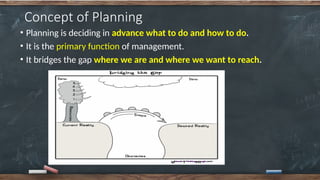
•Planning is deciding in advance what to do and how to do.
• It is the primary function of management.
• It bridges the gap where we are and where we want to reach.
4.
Concept of Planning
•It involves 2 aspects:
Setting of aims and objectives of the organization + Selecting and
developing an appropriate course of action to achieve these objectives.
• “Planning is chalking out plan of action, i.e., the result envisaged in the line
of action to be followed, the stages to go through and the methods to use.
• Planning can be defined as function of management which involves- setting
objectives for a given time period, formulating various courses of action to
achieve them, and then selecting the best possible alternative among
various courses of action available with an aim to achieve the set target
most effectively and efficiently.
5.
Features of Planning
1. Planning Focuses on Achieving Objective
2. Planning is a Primary Function of Management
3. Planning is Pervasive
4. Planning is Continuous
5. Planning is Futuristic
6. Planning Involves Decision Making
6.
Features of Planning
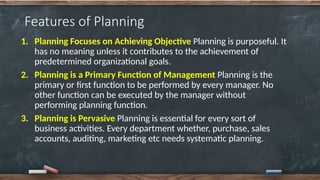
1.Planning Focuses on Achieving Objective Planning is purposeful. It
has no meaning unless it contributes to the achievement of
predetermined organizational goals.
2. Planning is a Primary Function of Management Planning is the
primary or first function to be performed by every manager. No
other function can be executed by the manager without
performing planning function.
3. Planning is Pervasive Planning is essential for every sort of
business activities. Every department whether, purchase, sales
accounts, auditing, marketing etc needs systematic planning.
7.
Features of Planning
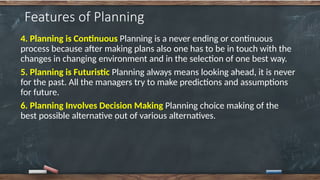
4.Planning is Continuous Planning is a never ending or continuous
process because after making plans also one has to be in touch with the
changes in changing environment and in the selection of one best way.
5. Planning is Futuristic Planning always means looking ahead, it is never
for the past. All the managers try to make predictions and assumptions
for future.
6. Planning Involves Decision Making Planning choice making of the
best possible alternative out of various alternatives.
8.
Importance of Planning
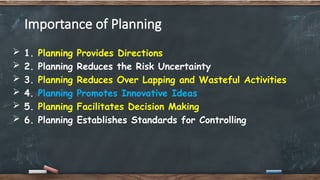
1. Planning Provides Directions
2. Planning Reduces the Risk Uncertainty
3. Planning Reduces Over Lapping and Wasteful Activities
4. Planning Promotes Innovative Ideas
5. Planning Facilitates Decision Making
6. Planning Establishes Standards for Controlling
9.
Importance of Planning
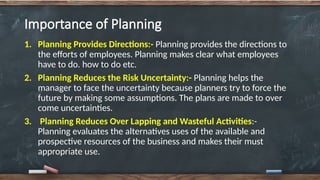
1.Planning Provides Directions:- Planning provides the directions to
the efforts of employees. Planning makes clear what employees
have to do. how to do etc.
2. Planning Reduces the Risk Uncertainty:- Planning helps the
manager to face the uncertainty because planners try to force the
future by making some assumptions. The plans are made to over
come uncertainties.
3. Planning Reduces Over Lapping and Wasteful Activities:-
Planning evaluates the alternatives uses of the available and
prospective resources of the business and makes their must
appropriate use.
10.
Importance of Planning
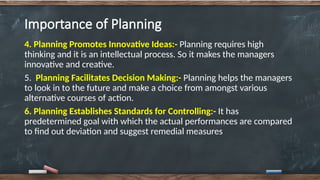
4.Planning Promotes Innovative Ideas:- Planning requires high
thinking and it is an intellectual process. So it makes the managers
innovative and creative.
5. Planning Facilitates Decision Making:- Planning helps the managers
to look in to the future and make a choice from amongst various
alternative courses of action.
6. Planning Establishes Standards for Controlling:- It has
predetermined goal with which the actual performances are compared
to find out deviation and suggest remedial measures
11.
Limitations of Planning
1. Planning Leads to Rigidity
2. Planning May Not Work in a Dynamic Environment:-
3. Planning Reduces Creativity
4. Planning Involves Huge Costs:-
5. Planning is a Time Consuming Success :-
6. Planning does not Guarantee Success:-
12.
Limitations of Planning
1.Planning Leads to Rigidity :Once plans are made to decide the future
course of action the manager may not be in a position to change them.
2. Planning May Not Work in a Dynamic Environment:- Business
environment is very dynamic as there are continuously changes. It
becomes very difficult. to forecast these future changes. Plans may fail if
the changes are very frequent.
3. Planning Reduces Creativity :-With the planning the managers of the
organization start working rigidly and they become the blind followers
of the plan only.
13.
Limitations of Planning
4.Planning Involves Huge Costs:- Planning process involves lot of cost
because it is an intellectual process and companies need to hire the
professional experts to carry on this process.
5. Planning is a Time Consuming Success :- Lot of time is needed in
developing planning premises.
6. Planning does not Guarantee Success:- Planning only provides a
base for analysing future. It is not a solution for future course of
action.
15.
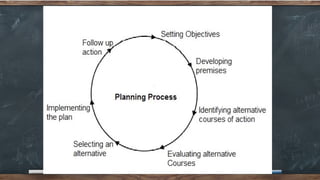
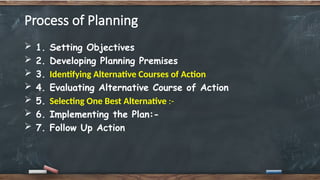
Process of Planning
1. Setting Objectives
2. Developing Planning Premises
3. Identifying Alternative Courses of Action
4. Evaluating Alternative Course of Action
5. Selecting One Best Alternative :-
6. Implementing the Plan:-
7. Follow Up Action
16.
1. Setting Objectives
•This is the primary step in the process of planning which specifies the objective
of organization i.e. what an organization wants to achieve.
• The planning process begins with the setting of objectives.
• Objectives are end results which the management wants to achieve by its
operations.
• Objectives are specific and are measurable in terms of units.
• Objectives are set for the organization as a whole for all departments and then
departments set their own objectives within the framework of organizational
objectives.
• A mobile phone company sets the objective to sell 2,00,000 units next year, which
is double the current sales.
17.
2. Developing PlanningPremises
• Planning is essentially focused on the future and there are certain events
which are expected to affect the policy formation.
• Such events are external in nature and affect the planning adversely if ignored.
• Their understanding and fair assessment are necessary for effective planning.
• Such events are the assumptions on the basis of which plans are drawn and
are known as planning premises.
• Example:
• The mobile phone company has set the objective of 2,00,000 units sale on the
basis of forecast done on the premises of favourable Government policy
towards digitization of transactions.
18.
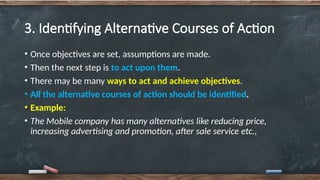
3. Identifying AlternativeCourses of Action
• Once objectives are set, assumptions are made.
• Then the next step is to act upon them.
• There may be many ways to act and achieve objectives.
• All the alternative courses of action should be identified.
• Example:
• The Mobile company has many alternatives like reducing price,
increasing advertising and promotion, after sale service etc.,
19.
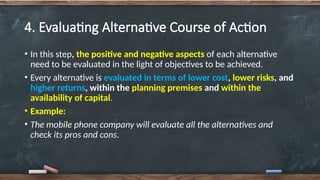
4. Evaluating AlternativeCourse of Action
• In this step, the positive and negative aspects of each alternative
need to be evaluated in the light of objectives to be achieved.
• Every alternative is evaluated in terms of lower cost, lower risks, and
higher returns, within the planning premises and within the
availability of capital.
• Example:
• The mobile phone company will evaluate all the alternatives and
check its pros and cons.
20.
5. Selecting OneBest Alternative
• The best plan which is the most profitable plan and with minimum
negative effects is adopted and implemented.
• In such cases, the manager’s experience and judgement play an
important role in selecting the best alternative.
• Example:
• Mobile phone company selects more T.V advertisements and online
marketing with great after sales service.
21.
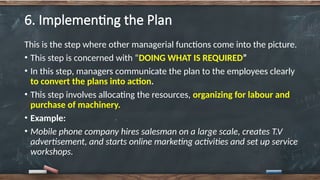
6. Implementing thePlan
This is the step where other managerial functions come into the picture.
• This step is concerned with “DOING WHAT IS REQUIRED”
• In this step, managers communicate the plan to the employees clearly
to convert the plans into action.
• This step involves allocating the resources, organizing for labour and
purchase of machinery.
• Example:
• Mobile phone company hires salesman on a large scale, creates T.V
advertisement, and starts online marketing activities and set up service
workshops.
22.
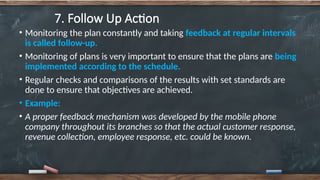
7. Follow UpAction
• Monitoring the plan constantly and taking feedback at regular intervals
is called follow-up.
• Monitoring of plans is very important to ensure that the plans are being
implemented according to the schedule.
• Regular checks and comparisons of the results with set standards are
done to ensure that objectives are achieved.
• Example:
• A proper feedback mechanism was developed by the mobile phone
company throughout its branches so that the actual customer response,
revenue collection, employee response, etc. could be known.