Chapter - 3
Business
Environment
Introduction
 Meaning of Business Environment
• Business environment can be defined as those
forces, individuals and institutions who have the
ability to influence the working of an organisation.
• In simple words, the business environment is the
surroundings in which business exists.
• Although these environment forces exists outside
the enterprise but they influence the business
enterprises.
• Therefore, it becomes essential for businessmen
to do environment scanning.
• Environment Scanning refers to complete
awareness of business environment.
• With scanning of environment enterprises can
anticipate the effect of environment forces and
factors on their enterprise.
• Business Environment provide
constraints/threats and opportunities for the
businessman.
Features/ Characteristics of Business
Environment
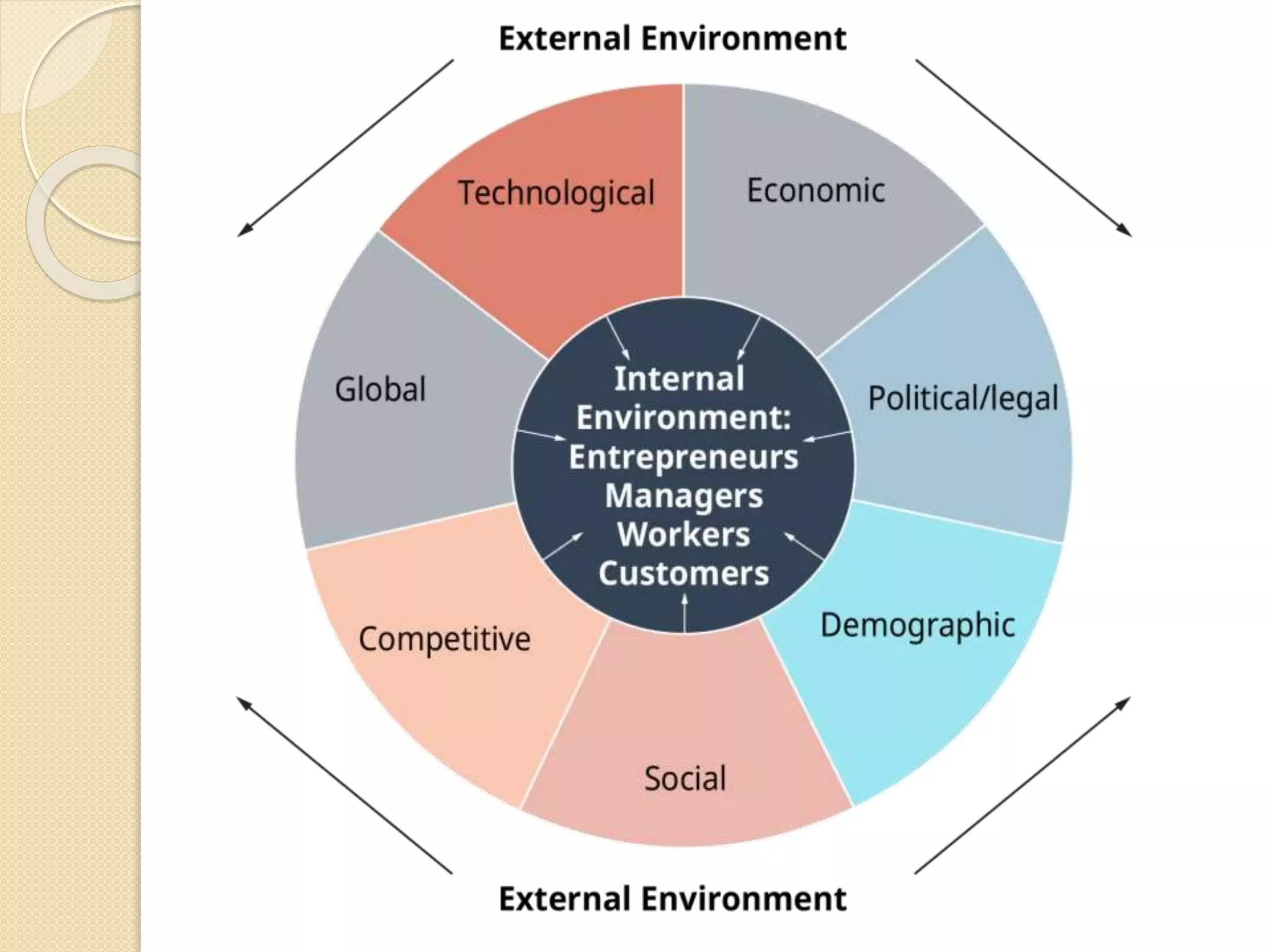
1. Totality of external forces: Business environment
is the sum total of all the forces/factors external to
a business firm.
2. Specific and general forces: Specific forces
include investors, competitors, customers etc. who
influence business firm directly while general forces
include social, political, economic, legal and
technological conditions which affect a business firm
indirectly.
3. Inter-relatedness: All the forces/factors of a
business environment are closely interrelated. For
example, increased awareness of health care has
raised the demand for organic food and roasted
snacks.
4. Dynamic: Business environment is dynamic in
nature which keeps on changing with the
change in technology, consumer's fashion and
tastes etc.
5. Uncertainty: Business environment is
uncertain as it is difficult to predict the future
environmental changes and their impact with
full accuracy.
6. Complexity: Business environment is complex
which is easy to understand in parts separately
but it is difficult to understand in totality.
7. Relativity: Business environment is a relative
concept whose impact differs from country to
country, region to region and firm to firm.
Q.1 "Demand for sarees may be high in India but
not in Europe". Which feature of business
environment is highlighted here?
Importance of Business
Environment
Proper understanding and awareness about the
business environment brings lots of benefits for the
businessman.
1. Identification of opportunities to get first mover
advantage: Understanding of business environment
helps an organisation in identifying advantageous
opportunities and getting their benefits prior to
competitors, thus reaping the benefits of being a
pioneer.
2. Identification of threats: Correct knowledge of
business environment helps an organisation to
identify those threats which may adversely affect its
operations. For example, Bajaj Auto made
considerable improvements in its two wheelers when
Honda & other companies entered the auto industry.
3. Tapping useful resources: Business environment
makes available various resources such as capital,
labour, machines, raw material etc. to a business firm.
In order to know the availability of resources and
making them available on time at economical price,
knowledge of business environment is necessary.
4. Coping with Rapid changes: Continuous
study/scanning of business environment helps in
knowing the changes which are taking place and thus
they can be faced effectively.
5. Assistance in planning and policy formulation:
Understanding and analysis of business environment
helps an organisation in planning & policy formulation.
For example, ITC Hotels planned new: hotels in India
after observing boom in tourism sector.
6. Helps in improving performance: Correct
analysis and continuous monitoring of business
environment helps an organisation in improving
its performance.
Dimensions of Business
Environment
• Dimensions of business environment mean all the
factors, forces and institutions which have direct or
indirect influence over the business transactions.
• General environment is the most important
dimension of business environment as the
business man cannot change the components of
general environment rather he has to change his
plans and policies according to the changes taking
place in general environment.
I. Economic Environment:
• All the forces and factors which influence the
economy of the country.
• Has immediate and direct economic impact on a
business.
• Economic environment may offer opportunities to a
firm or it may put constraints.
• Some aspects of Economic Environment are:
▪ Rate of Interest ▪ Inflation Rate ▪ Monetary Policy
▪ Change in the Income of People ▪ GST Bill
▪ Demonetisation ▪ Banking Sector Reforms
▪ Increase in GDP ▪ Balance of Trade
▪ Balance of Payments ▪ International Debt
▪ Changes in Fiscal Policy and Economic Policy
▪ Money Supply
II. Social Environment:
• It includes various social forces such as customs,
beliefs, literacy rate, educational levels, lifestyle,
values etc.
• Changes in social environment affect an organisation
in the long run.
• Example: Now a day’s people are paying more
attention towards their health as a result of which
demand for mineral water, diet coke etc. has
increased while demand
of tobacco, fatty food products has decreased.
• Some aspects of Social Environment are:
▪ Standard of Living ▪ Quality of Life
▪ Demand for Reservations in Jobs for Women
▪ Social Movements to Improve Girl Child Education
▪ Education and Literacy Rates ▪ Habits
▪ Demand for Equal Status of Women
III. Political Environment:
• It constitutes all the factors related to
governments affairs such as type of government
in power, attitude of govt.
• It has immediate and great impact on the
business transactions.
• Political stability builds confidence among
business community while political instability and
bad law & order situation may bring uncertainty in
business activities.
• Some aspects of Political Environment are:
▪ Ideology of the Political Party
▪ Attitude of Government towards Business
▪ Type of Govt.-Single party or Coalition Govt.
IV. Legal Environment:
• It constitutes the laws and legislations passed by
the Government, administrative orders, court
judgements, decisions of various commissions and
agencies.
• Businessmen have to act according to various
legislations and their knowledge is very necessary.
• Example: Advertisement of Alcoholic products is
prohibited and it is compulsory to give statutory
warning on advertisement of cigarettes.
• Some aspects of Political Environment are:
▪ Legal Policies related to Foreign Trade
▪ FEMA ▪ Companies Act, 2013
▪ Consumer Protection Act, 1986
▪ Laws to Keep Check on Advertisements
V. Technological Environment:
• It includes forces related to scientific improvements
and innovation.
• It provides new and advance ways/ techniques of
production.
• A businessman must closely monitor the technological
changes taking place in the industry as it helps in
facing competition and improving quality of the
product.
• Some aspects of Technological Environment are:
▪ Digital Watches in Place of Traditional Watches
▪ Booking of Railway Tickets on Internet
▪ Development in IT Sector
▪ Shift from Carbon Copies to Photocopier
▪ Online Shopping
▪ Use of e-Money
Q.2 Identify the type of dimension of environment
to the following are related:
i. Banks reducing interest rate on housing loans.
ii. An increasing number of working women.
iii. Booking of air tickets through interne.
iv. Alcohol beverages are prohibited to be advertised
on Doordarshan.
v. A stable government has built up confidence
among the firms to invest in big project.
Q.3 Just after declaration of Lok Sabha Elections
2014 results, the Bombay stock exchange's price
index (Sensex) rose by 1000 points in a day. Identify
the environmental factor which led to this rise.
Features of the New Economic
Policy 1991
1. Liberalization: It means freeing of Indian Industry
from all unnecessary government controls and
restrictions.
▪ Abolishing licensing requirements
▪ Freedom in deciding the scale of business
▪ Removals of restriction on movements of goods and
service
▪ Reduction in tax rates
▪ Freedom in fixing prices
▪ Simplifying procedures, making it easier to attract
foreign investment.
▪ Liberalisation in import and export
2. Privatization: Giving greater role to private sector
in the nation building process and reduced role of
public sector.
▪ Disinvestment in many Public Sectors undertaking
etc.
▪ Setting up of BIFR to revive sick units in public
sector enterprises suffering losses.
▪ It aimed at improving efficiency and performance of
government undertakings, reducing budgetary deficit
& better utilization of national resources.
3. Globalization: It means integration of various
economies of the world leading to the emergence of
cohesive global economy.
• The measures taken by the Government include
▪ Trade liberalization which includes import
liberalization
▪ Export Promotion through rationalization of tariff
structure
▪ Foreign exchange liberalization
▪ Increased interaction among global economies
under the aegis (protection/support) of WTO.
▪ It resulted in addition of Export duty. Reduction
of import.
Impact of Government Policy Changes on
Business and Industry
1. Increasing Competition: Delicencing and entry of
foreign firms Indian market is increased the level of
competition for Indian firms.
2. More Demanding Customers: Now customers are
more aware and they keep maximum information
of the market as the result of which now market is
customer/buyer oriented. Now products are produced
keeping in mind the demands of the customers.
3. Rapid Changing Technological Environment:
Rapid Technological advancement has
changed/improved the production process as a result
of which maximum production is possible a minimum
cost but it lead to tough challenges in front of small
firms.
4. Necessity for Change: After New Industrial. Policy the
market force (demand & supply) are changing at a very
fast rate. Change in the various components of
business environment has made it necessary for the
business firms to modify their policies & operations
from time to time.
5. Need for Developing Human Resources: The
changing market conditions of today require people
with higher competence and greater commitment;
hence there is a need for developing human resources
which could increase their effectiveness and efficiency.
6. Market Orientation: Earlier selling concept was
famous in the market now its place is taken by the
Marketing concept. Today firms produce those goods &
services which are required by the customers.
Marketing research, educational advertising, after sales
services have become more significant.
7. Reduction in budgetary Support to Public
Sector: The budgetary a support given by the
government to the public sector is reducing thus
the public sector has to survive and grow by
utilising their own resources efficiently.
Managerial Response to Changes in
Business Environment
1. Diversification: The first response seen after new
policy is the companies are going for diversification.
Even companies like Reliance, Voltas, LG,
Samsung are diversifying their activities by adding
more products in their portfolio.
2. Joint Venture: Most of the MNC’s came to India
through joint venture. For example, Jaguar enters
with TATA Motors, Honda enters with Siel; Vodafone
merged with Idea, etc.
3. Brand Building: After NEP the brand building,
goodwill and image of company has become an
important element for promotion of company.
4. Use of Latest Technology: To get the first mover
advantage companies are trying to get the latest
technology first in their product. The expenditure on
research & development department is increased by
all the companies.
5. Customer Focus: The focus of market is totally
shifted from producer to consumer. Today consumer
is the keep in the market all companies are coming
with various schemes to attract the consumers.

Business Environment

  • 1.
  • 3.
    Introduction  Meaning ofBusiness Environment • Business environment can be defined as those forces, individuals and institutions who have the ability to influence the working of an organisation. • In simple words, the business environment is the surroundings in which business exists. • Although these environment forces exists outside the enterprise but they influence the business enterprises. • Therefore, it becomes essential for businessmen to do environment scanning.
  • 4.
    • Environment Scanningrefers to complete awareness of business environment. • With scanning of environment enterprises can anticipate the effect of environment forces and factors on their enterprise. • Business Environment provide constraints/threats and opportunities for the businessman.
  • 6.
    Features/ Characteristics ofBusiness Environment 1. Totality of external forces: Business environment is the sum total of all the forces/factors external to a business firm. 2. Specific and general forces: Specific forces include investors, competitors, customers etc. who influence business firm directly while general forces include social, political, economic, legal and technological conditions which affect a business firm indirectly. 3. Inter-relatedness: All the forces/factors of a business environment are closely interrelated. For example, increased awareness of health care has raised the demand for organic food and roasted snacks.
  • 7.
    4. Dynamic: Businessenvironment is dynamic in nature which keeps on changing with the change in technology, consumer's fashion and tastes etc. 5. Uncertainty: Business environment is uncertain as it is difficult to predict the future environmental changes and their impact with full accuracy. 6. Complexity: Business environment is complex which is easy to understand in parts separately but it is difficult to understand in totality. 7. Relativity: Business environment is a relative concept whose impact differs from country to country, region to region and firm to firm.
  • 8.
    Q.1 "Demand forsarees may be high in India but not in Europe". Which feature of business environment is highlighted here?
  • 9.
    Importance of Business Environment Properunderstanding and awareness about the business environment brings lots of benefits for the businessman. 1. Identification of opportunities to get first mover advantage: Understanding of business environment helps an organisation in identifying advantageous opportunities and getting their benefits prior to competitors, thus reaping the benefits of being a pioneer. 2. Identification of threats: Correct knowledge of business environment helps an organisation to identify those threats which may adversely affect its operations. For example, Bajaj Auto made considerable improvements in its two wheelers when Honda & other companies entered the auto industry.
  • 10.
    3. Tapping usefulresources: Business environment makes available various resources such as capital, labour, machines, raw material etc. to a business firm. In order to know the availability of resources and making them available on time at economical price, knowledge of business environment is necessary. 4. Coping with Rapid changes: Continuous study/scanning of business environment helps in knowing the changes which are taking place and thus they can be faced effectively. 5. Assistance in planning and policy formulation: Understanding and analysis of business environment helps an organisation in planning & policy formulation. For example, ITC Hotels planned new: hotels in India after observing boom in tourism sector.
  • 11.
    6. Helps inimproving performance: Correct analysis and continuous monitoring of business environment helps an organisation in improving its performance.
  • 12.
  • 13.
    • Dimensions ofbusiness environment mean all the factors, forces and institutions which have direct or indirect influence over the business transactions. • General environment is the most important dimension of business environment as the business man cannot change the components of general environment rather he has to change his plans and policies according to the changes taking place in general environment.
  • 14.
    I. Economic Environment: •All the forces and factors which influence the economy of the country. • Has immediate and direct economic impact on a business. • Economic environment may offer opportunities to a firm or it may put constraints. • Some aspects of Economic Environment are: ▪ Rate of Interest ▪ Inflation Rate ▪ Monetary Policy ▪ Change in the Income of People ▪ GST Bill ▪ Demonetisation ▪ Banking Sector Reforms ▪ Increase in GDP ▪ Balance of Trade ▪ Balance of Payments ▪ International Debt ▪ Changes in Fiscal Policy and Economic Policy ▪ Money Supply
  • 16.
    II. Social Environment: •It includes various social forces such as customs, beliefs, literacy rate, educational levels, lifestyle, values etc. • Changes in social environment affect an organisation in the long run. • Example: Now a day’s people are paying more attention towards their health as a result of which demand for mineral water, diet coke etc. has increased while demand of tobacco, fatty food products has decreased. • Some aspects of Social Environment are: ▪ Standard of Living ▪ Quality of Life ▪ Demand for Reservations in Jobs for Women ▪ Social Movements to Improve Girl Child Education ▪ Education and Literacy Rates ▪ Habits ▪ Demand for Equal Status of Women
  • 18.
    III. Political Environment: •It constitutes all the factors related to governments affairs such as type of government in power, attitude of govt. • It has immediate and great impact on the business transactions. • Political stability builds confidence among business community while political instability and bad law & order situation may bring uncertainty in business activities. • Some aspects of Political Environment are: ▪ Ideology of the Political Party ▪ Attitude of Government towards Business ▪ Type of Govt.-Single party or Coalition Govt.
  • 20.
    IV. Legal Environment: •It constitutes the laws and legislations passed by the Government, administrative orders, court judgements, decisions of various commissions and agencies. • Businessmen have to act according to various legislations and their knowledge is very necessary. • Example: Advertisement of Alcoholic products is prohibited and it is compulsory to give statutory warning on advertisement of cigarettes. • Some aspects of Political Environment are: ▪ Legal Policies related to Foreign Trade ▪ FEMA ▪ Companies Act, 2013 ▪ Consumer Protection Act, 1986 ▪ Laws to Keep Check on Advertisements
  • 22.
    V. Technological Environment: •It includes forces related to scientific improvements and innovation. • It provides new and advance ways/ techniques of production. • A businessman must closely monitor the technological changes taking place in the industry as it helps in facing competition and improving quality of the product. • Some aspects of Technological Environment are: ▪ Digital Watches in Place of Traditional Watches ▪ Booking of Railway Tickets on Internet ▪ Development in IT Sector ▪ Shift from Carbon Copies to Photocopier ▪ Online Shopping ▪ Use of e-Money
  • 24.
    Q.2 Identify thetype of dimension of environment to the following are related: i. Banks reducing interest rate on housing loans. ii. An increasing number of working women. iii. Booking of air tickets through interne. iv. Alcohol beverages are prohibited to be advertised on Doordarshan. v. A stable government has built up confidence among the firms to invest in big project. Q.3 Just after declaration of Lok Sabha Elections 2014 results, the Bombay stock exchange's price index (Sensex) rose by 1000 points in a day. Identify the environmental factor which led to this rise.
  • 25.
    Features of theNew Economic Policy 1991 1. Liberalization: It means freeing of Indian Industry from all unnecessary government controls and restrictions. ▪ Abolishing licensing requirements ▪ Freedom in deciding the scale of business ▪ Removals of restriction on movements of goods and service ▪ Reduction in tax rates ▪ Freedom in fixing prices ▪ Simplifying procedures, making it easier to attract foreign investment. ▪ Liberalisation in import and export
  • 26.
    2. Privatization: Givinggreater role to private sector in the nation building process and reduced role of public sector. ▪ Disinvestment in many Public Sectors undertaking etc. ▪ Setting up of BIFR to revive sick units in public sector enterprises suffering losses. ▪ It aimed at improving efficiency and performance of government undertakings, reducing budgetary deficit & better utilization of national resources.
  • 27.
    3. Globalization: Itmeans integration of various economies of the world leading to the emergence of cohesive global economy. • The measures taken by the Government include ▪ Trade liberalization which includes import liberalization ▪ Export Promotion through rationalization of tariff structure ▪ Foreign exchange liberalization ▪ Increased interaction among global economies under the aegis (protection/support) of WTO. ▪ It resulted in addition of Export duty. Reduction of import.
  • 28.
    Impact of GovernmentPolicy Changes on Business and Industry 1. Increasing Competition: Delicencing and entry of foreign firms Indian market is increased the level of competition for Indian firms. 2. More Demanding Customers: Now customers are more aware and they keep maximum information of the market as the result of which now market is customer/buyer oriented. Now products are produced keeping in mind the demands of the customers. 3. Rapid Changing Technological Environment: Rapid Technological advancement has changed/improved the production process as a result of which maximum production is possible a minimum cost but it lead to tough challenges in front of small firms.
  • 29.
    4. Necessity forChange: After New Industrial. Policy the market force (demand & supply) are changing at a very fast rate. Change in the various components of business environment has made it necessary for the business firms to modify their policies & operations from time to time. 5. Need for Developing Human Resources: The changing market conditions of today require people with higher competence and greater commitment; hence there is a need for developing human resources which could increase their effectiveness and efficiency. 6. Market Orientation: Earlier selling concept was famous in the market now its place is taken by the Marketing concept. Today firms produce those goods & services which are required by the customers. Marketing research, educational advertising, after sales services have become more significant.
  • 30.
    7. Reduction inbudgetary Support to Public Sector: The budgetary a support given by the government to the public sector is reducing thus the public sector has to survive and grow by utilising their own resources efficiently.
  • 31.
    Managerial Response toChanges in Business Environment 1. Diversification: The first response seen after new policy is the companies are going for diversification. Even companies like Reliance, Voltas, LG, Samsung are diversifying their activities by adding more products in their portfolio. 2. Joint Venture: Most of the MNC’s came to India through joint venture. For example, Jaguar enters with TATA Motors, Honda enters with Siel; Vodafone merged with Idea, etc. 3. Brand Building: After NEP the brand building, goodwill and image of company has become an important element for promotion of company.
  • 32.
    4. Use ofLatest Technology: To get the first mover advantage companies are trying to get the latest technology first in their product. The expenditure on research & development department is increased by all the companies. 5. Customer Focus: The focus of market is totally shifted from producer to consumer. Today consumer is the keep in the market all companies are coming with various schemes to attract the consumers.