Click the Q&Abutton to ask
any questions and for your
queries. The Mentor will
answer your question during
or at the end of the session
Click the button if Mentor
asks you to ‘raise your hand’.
Do not click this button to
ask questions
Done with the
session?
Click here to leave
the session
LEARN
SESSION
To study morelog on to: www.geneo.in
Recommended Learning
Chapter : 8
Textbook Page Number : 98-113
Video : Motion in a straight line, Introduction to Motion, Distance and
Displacement, Motion- uniform and Non-Uniform, Measuring the rate of
motion, Speed with direction, Speed and its application, What is velocity,
Calculating average velocity and speed, Acceleration and its types
Objectives
1
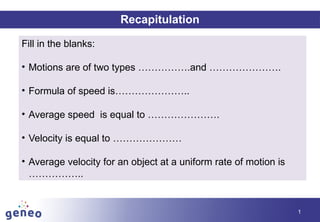
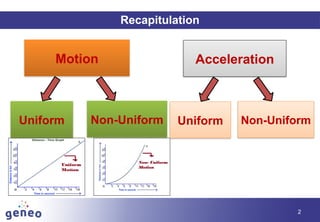
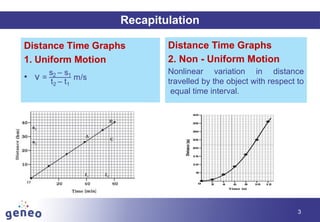
Recapitulation
Fill in theblanks:
• Motions are of two types …………….and ………………….
• Formula of speed is…………………..
• Average speed is equal to ………………….
• Velocity is equal to …………………
• Average velocity for an object at a uniform rate of motion is
……………..
Objectives
4
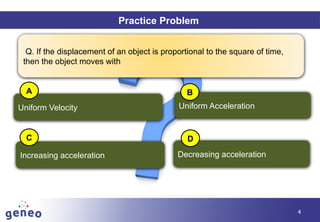
Practice Problem
Q. Ifthe displacement of an object is proportional to the square of time,
then the object moves with
Uniform Velocity
Increasing acceleration Decreasing acceleration
Uniform Acceleration
A B
C D
10.
Objectives
5
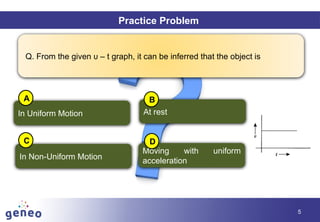
Practice Problem
Q. Fromthe given υ – t graph, it can be inferred that the object is
In Uniform Motion
In Non-Uniform Motion
Moving with uniform
acceleration
At rest
A B
C D
11.
6
Graphical Representation ofMotion
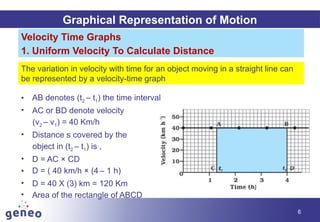
Velocity Time Graphs
1. Uniform Velocity To Calculate Distance
• AB denotes (t2 – t1) the time interval
• AC or BD denote velocity
(v2 – v1) = 40 Km/h
• Distance s covered by the
object in (t2 – t1) is ,
• D = AC × CD
• D = ( 40 km/h × (4 – 1 h)
• D = 40 X (3) km = 120 Km
• Area of the rectangle of ABCD
The variation in velocity with time for an object moving in a straight line can
be represented by a velocity-time graph
12.
7
Graphical Representation ofMotion
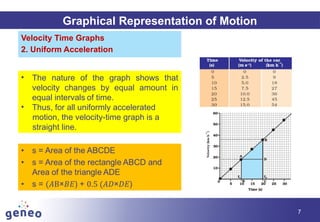
Velocity Time Graphs
2. Uniform Acceleration
• The nature of the graph shows that
velocity changes by equal amount in
equal intervals of time.
• Thus, for all uniformly accelerated
motion, the velocity-time graph is a
straight line.
13.
8
Graphical Representation ofMotion
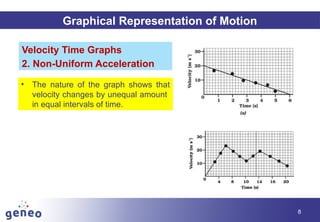
Velocity Time Graphs
2. Non-Uniform Acceleration
• The nature of the graph shows that
velocity changes by unequal amount
in equal intervals of time.
10
Equations Of MotionBy Graphical Method
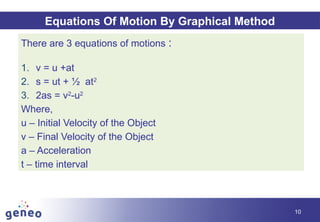
There are 3 equations of motions :
1. v = u +at
2. s = ut + ½ at2
3. 2as = v2
-u2
Where,
u – Initial Velocity of the Object
v – Final Velocity of the Object
a – Acceleration
t – time interval
16.
11
Equation For Velocity- Time Relation
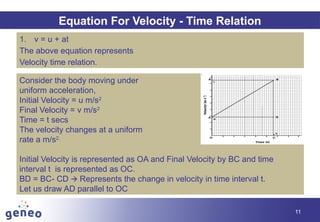
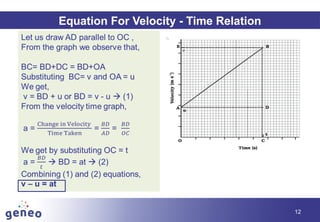
1. v = u + at
The above equation represents
Velocity time relation.
Consider the body moving under
uniform acceleration,
Initial Velocity = u m/s2
Final Velocity = v m/s2
Time = t secs
The velocity changes at a uniform
rate a m/s2.
Initial Velocity is represented as OA and Final Velocity by BC and time
interval t is represented as OC.
BD = BC- CD Represents the change in velocity in time interval t.
🡪
Let us draw AD parallel to OC
13
Equations For Position- Time Relation
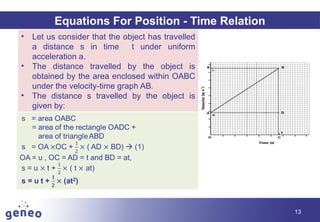
• Let us consider that the object has travelled
a distance s in time t under uniform
acceleration a.
• The distance travelled by the object is
obtained by the area enclosed within OABC
under the velocity-time graph AB.
• The distance s travelled by the object is
given by:
19.
14
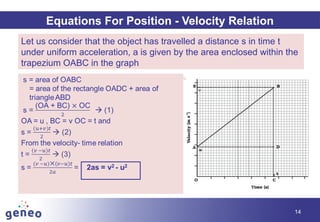
Equations For Position- Velocity Relation
Let us consider that the object has travelled a distance s in time t
under uniform acceleration, a is given by the area enclosed within the
trapezium OABC in the graph
Objectives
16
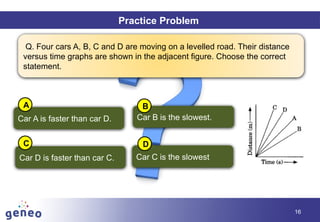
Practice Problem
Q. Fourcars A, B, C and D are moving on a levelled road. Their distance
versus time graphs are shown in the adjacent figure. Choose the correct
statement.
Car A is faster than car D.
Car D is faster than car C. Car C is the slowest
Car B is the slowest.
A B
C D
18
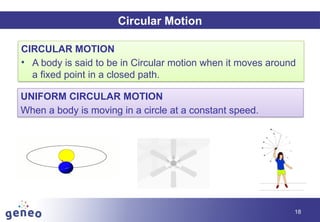
Circular Motion
CIRCULAR MOTION
•A body is said to be in Circular motion when it moves around
a fixed point in a closed path.
UNIFORM CIRCULAR MOTION
When a body is moving in a circle at a constant speed.
20
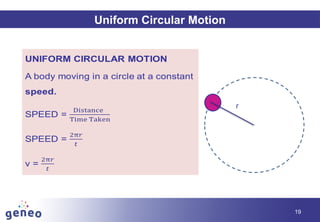
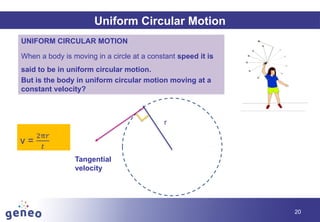
UNIFORM CIRCULAR MOTION
Whena body is moving in a circle at a constant speed it is
said to be in uniform circular motion.
But is the body in uniform circular motion moving at a
constant velocity?
r
Tangential
velocity
Uniform Circular Motion
26.
21
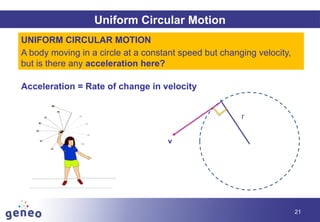
UNIFORM CIRCULAR MOTION
Abody moving in a circle at a constant speed but changing velocity,
but is there any acceleration here?
r
v
Acceleration = Rate of change in velocity
Uniform Circular Motion
27.
22
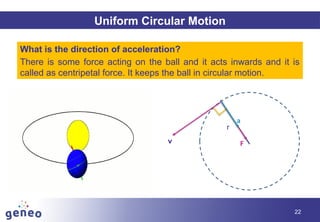
What is thedirection of acceleration?
There is some force acting on the ball and it acts inwards and it is
called as centripetal force. It keeps the ball in circular motion.
r
v F
a
Uniform Circular Motion
Objectives
24
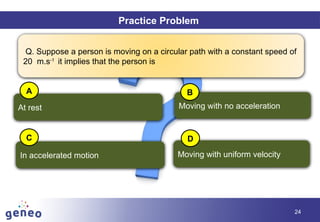
Practice Problem
Q. Supposea person is moving on a circular path with a constant speed of
20 m.s-1
it implies that the person is
At rest
In accelerated motion Moving with uniform velocity
Moving with no acceleration
A B
C D
30.
25
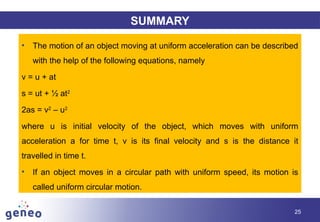
• The motionof an object moving at uniform acceleration can be described
with the help of the following equations, namely
v = u + at
s = ut + ½ at2
2as = v2
– u2
where u is initial velocity of the object, which moves with uniform
acceleration a for time t, v is its final velocity and s is the distance it
travelled in time t.
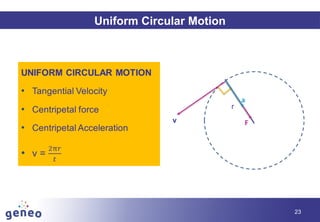
• If an object moves in a circular path with uniform speed, its motion is
called uniform circular motion.
SUMMARY
LEARN
SESSION
To study morelog on to: www.geneo.in
Recommended Learning
Chapter : 8
Textbook Page Number : 98-113
Video : Motion in a straight line, Introduction to Motion, Distance and
Displacement, Motion- uniform and Non-Uniform, Measuring the rate of
motion, Speed with direction, Speed and its application, What is velocity,
Calculating average velocity and speed, Acceleration and its types
33.
LEARN
SESSION
Geneo LIVE ClassesSchedule
Class 09
Subject Chapter Time
13-11-2022
Mathematics Heron’s Formula - 1 06:00 PM
To study more log on to: www.geneo.in



![Objectives
15
Practice Problem [NCERT-Exemplar]
Q. Area under a v – t graph represents a physical quantity which has the
unit
m
m3 m.s-1
m2
A B
C D](https://image.slidesharecdn.com/class9ch8pt41-250526195550-66eb1890/85/Class-9-Ch-8-Pt-4-1-Motion-in-Physics-20-320.jpg)
![Objectives
17
Practice Problem [NCERT-Exemplar]
Q. An object starting from rest travels 20 m in first 2 s and 160 m in next 4
s. What will be the velocity after 7 s from the start.](https://image.slidesharecdn.com/class9ch8pt41-250526195550-66eb1890/85/Class-9-Ch-8-Pt-4-1-Motion-in-Physics-22-320.jpg)





![8motion [autosaved]](https://cdn.slidesharecdn.com/ss_thumbnails/8motionautosaved-150707124342-lva1-app6891-thumbnail.jpg?width=640&height=640&fit=bounds)


