Design Continued
  form, function, and funkiness
This is Jackson “Jack the Dripper” Pollock
 standing in front of a huge (8‘X20’) blank
canvas. He had just been commissioned by
Peggy Guggenheim to paint a mural for her
                    home.
This is Jackson “Jack the Dripper” Pollock
 standing in front of a huge (8‘X20’) blank
canvas. He had just been commissioned by
Peggy Guggenheim to paint a mural for her
                    home.


 I love this image. The artist’s silhouette as
   blank as the canvas. Imagine what he is
 thinking. He has this huge opportunity to
impress someone who could skyrocket his
        career....he’s probably thinking
This is Jackson “Jack the Dripper” Pollock
 standing in front of a huge (8‘X20’) blank
canvas. He had just been commissioned by
Peggy Guggenheim to paint a mural for her
                    home.


 I love this image. The artist’s silhouette as
   blank as the canvas. Imagine what he is
 thinking. He has this huge opportunity to
impress someone who could skyrocket his
        career....he’s probably thinking


WTF am I going to do?
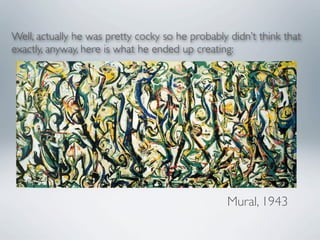
Well, actually he was pretty cocky so he probably didn’t think that
exactly, anyway, here is what he ended up creating:


                                                 Mural, 1943
Well, actually he was pretty cocky so he probably didn’t think that
exactly, anyway, here is what he ended up creating:


                                                 Mural, 1943
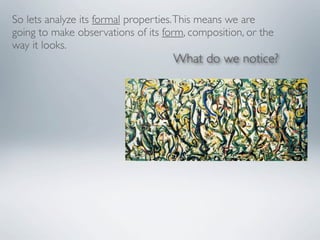
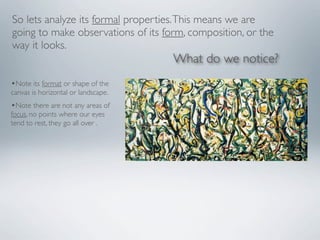
So lets analyze its formal properties. This means we are
going to make observations of its form, composition, or the
way it looks.
                                    What do we notice?
So lets analyze its formal properties. This means we are
going to make observations of its form, composition, or the
way it looks.
                                     What do we notice?
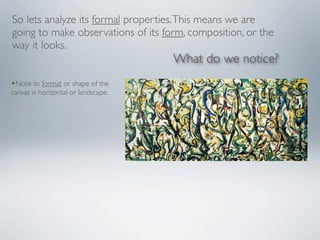
•Note its format or shape of the
canvas is horizontal or landscape.
So lets analyze its formal properties. This means we are
going to make observations of its form, composition, or the
way it looks.
                                     What do we notice?
•Note its format or shape of the
canvas is horizontal or landscape.
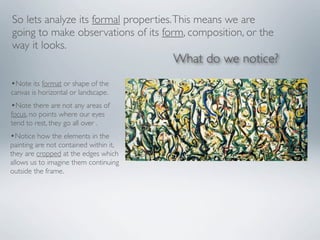
•Note there are not any areas of
focus, no points where our eyes
tend to rest, they go all over .
So lets analyze its formal properties. This means we are
going to make observations of its form, composition, or the
way it looks.
                                        What do we notice?
•Note its format or shape of the
canvas is horizontal or landscape.
•Note there are not any areas of
focus, no points where our eyes
tend to rest, they go all over .
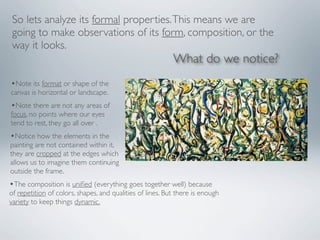
•Notice how the elements in the
painting are not contained within it,
they are cropped at the edges which
allows us to imagine them continuing
outside the frame.
So lets analyze its formal properties. This means we are
 going to make observations of its form, composition, or the
 way it looks.
                                                           What do we notice?
•Note its format or shape of the
canvas is horizontal or landscape.
•Note there are not any areas of
focus, no points where our eyes
tend to rest, they go all over .
•Notice how the elements in the
painting are not contained within it,
they are cropped at the edges which
allows us to imagine them continuing
outside the frame.
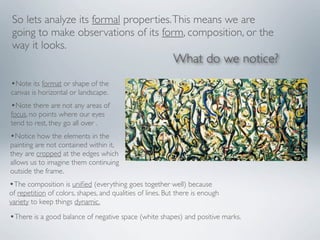
•The composition is unified (everything goes together well) because
of repetition of colors, shapes, and qualities of lines. But there is enough
variety to keep things dynamic.
So lets analyze its formal properties. This means we are
 going to make observations of its form, composition, or the
 way it looks.
                                                           What do we notice?
•Note its format or shape of the
canvas is horizontal or landscape.
•Note there are not any areas of
focus, no points where our eyes
tend to rest, they go all over .
•Notice how the elements in the
painting are not contained within it,
they are cropped at the edges which
allows us to imagine them continuing
outside the frame.
•The composition is unified (everything goes together well) because
of repetition of colors, shapes, and qualities of lines. But there is enough
variety to keep things dynamic.

•There is a good balance of negative space (white shapes) and positive marks.
And there are several other formal observations we can make,

  But what does all this mean? Why take the time to
  analyze it in these formal terms?
And there are several other formal observations we can make,

       But what does all this mean? Why take the time to
       analyze it in these formal terms?
Well, the form of something, abstract or not, helps to determine how we feel when we look at it.
And there are several other formal observations we can make,

       But what does all this mean? Why take the time to
       analyze it in these formal terms?
Well, the form of something, abstract or not, helps to determine how we feel when we look at it.

  A horizontal format has a different feel than a vertical one. A
  compositional focal point allows the viewers eye to rest, makes us see
  something as important, something deserving attention.
And there are several other formal observations we can make,

       But what does all this mean? Why take the time to
       analyze it in these formal terms?
Well, the form of something, abstract or not, helps to determine how we feel when we look at it.

  A horizontal format has a different feel than a vertical one. A
  compositional focal point allows the viewers eye to rest, makes us see
  something as important, something deserving attention.


         An allover composition like Mural makes us see the
         whole canvas as one thing.
And there are several other formal observations we can make,

       But what does all this mean? Why take the time to
       analyze it in these formal terms?
Well, the form of something, abstract or not, helps to determine how we feel when we look at it.

  A horizontal format has a different feel than a vertical one. A
  compositional focal point allows the viewers eye to rest, makes us see
  something as important, something deserving attention.


         An allover composition like Mural makes us see the
         whole canvas as one thing.

                  And of course, a design with controlled chaos has a much different feel than one
                  with highly organized and similar elements.
So, if Pollock wanted the viewer of Mural to feel something (and most
abstract artists do), he had to control (either consciously or not) all the formal
elements in a way that creates the desired effect.
So, if Pollock wanted the viewer of Mural to feel something (and most
     abstract artists do), he had to control (either consciously or not) all the formal
     elements in a way that creates the desired effect.


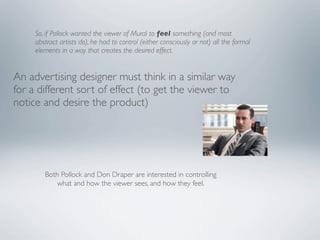
An advertising designer must think in a similar way
for a different sort of effect (to get the viewer to
notice and desire the product)
So, if Pollock wanted the viewer of Mural to feel something (and most
     abstract artists do), he had to control (either consciously or not) all the formal
     elements in a way that creates the desired effect.


An advertising designer must think in a similar way
for a different sort of effect (to get the viewer to
notice and desire the product)
So, if Pollock wanted the viewer of Mural to feel something (and most
     abstract artists do), he had to control (either consciously or not) all the formal
     elements in a way that creates the desired effect.


An advertising designer must think in a similar way
for a different sort of effect (to get the viewer to
notice and desire the product)


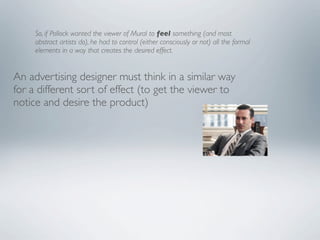
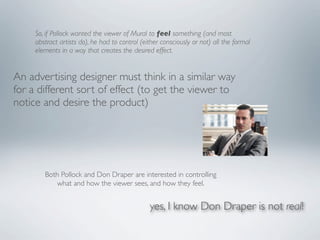
        Both Pollock and Don Draper are interested in controlling
           what and how the viewer sees, and how they feel.
So, if Pollock wanted the viewer of Mural to feel something (and most
     abstract artists do), he had to control (either consciously or not) all the formal
     elements in a way that creates the desired effect.


An advertising designer must think in a similar way
for a different sort of effect (to get the viewer to
notice and desire the product)


        Both Pollock and Don Draper are interested in controlling
           what and how the viewer sees, and how they feel.


                                                yes, I know Don Draper is not real!
BUT WHERE DID THIS ALL
     COME FROM?
BUT WHERE DID THIS ALL
     COME FROM?


        you may ask.
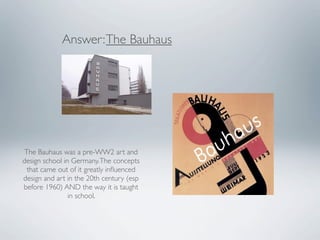
Answer: The Bauhaus


 The Bauhaus was a pre-WW2 art and
design school in Germany. The concepts
  that came out of it greatly influenced
design and art in the 20th century (esp
before 1960) AND the way it is taught
                in school.
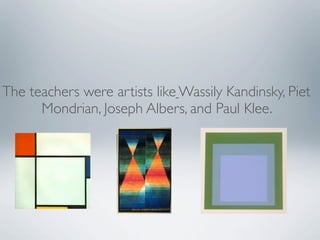
The teachers were artists like Wassily Kandinsky, Piet
      Mondrian, Joseph Albers, and Paul Klee.
They believed in the idea that all humans see the same way no
 matter where they are from, and that they could create forms
 that represented some idealized, universal abstract purity. They
also compartmentalized the different mediums (a painting is distinct from
                           a sculpture for example).
They believed in the idea that all humans see the same way no
 matter where they are from, and that they could create forms
 that represented some idealized, universal abstract purity. They
also compartmentalized the different mediums (a painting is distinct from
                           a sculpture for example).


 So, in their art, and in the classes they taught, they
                    “broke it down”.
Now, their idea that all humans perceive things the same way did not come from nowhere.
Psychologists at the turn of the 20th century developed Gestalt theory, which describes
how we all perceive visual information.
Now, their idea that all humans perceive things the same way did not come from nowhere.
Psychologists at the turn of the 20th century developed Gestalt theory, which describes
how we all perceive visual information.


   How is it we see the disparate parts as a whole thing. Why
    are we able to differentiate between the figure and the
                            ground?
Now, their idea that all humans perceive things the same way did not come from nowhere.
Psychologists at the turn of the 20th century developed Gestalt theory, which describes
how we all perceive visual information.


   How is it we see the disparate parts as a whole thing. Why
    are we able to differentiate between the figure and the
                            ground?

             Basically, we (and many other animals)
               developed these skills for survival
There are different versions of this, but this is
basically how the Bauhaus folks broke it down.
There are different versions of this, but this is
basically how the Bauhaus folks broke it down.

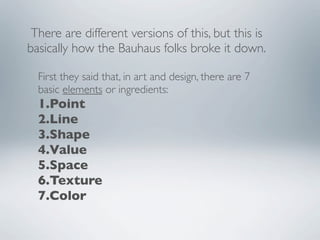
  First they said that, in art and design, there are 7
  basic elements or ingredients:
  1.Point
  2.Line
  3.Shape
  4.Value
  5.Space
  6.Texture
  7.Color
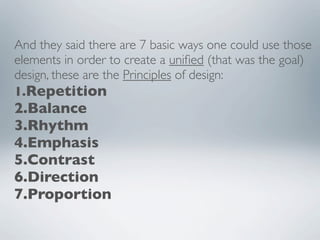
And they said there are 7 basic ways one could use those
elements in order to create a unified (that was the goal)
design, these are the Principles of design:
1.Repetition
2.Balance
3.Rhythm
4.Emphasis
5.Contrast
6.Direction
7.Proportion
For better or worse, these elements and
principles have been codified into our thinking
about form (and more importantly for you) in
    how art and design is taught in schools.
    typical 2d design assignment examples:
The thing is, although these concepts are wonderful for making nice
looking design, its no longer relevant to look at only these things as
                            foundational,


           Since the 60s, many other concepts have been important in art and
              design. Unity is no longer the only goal; hybridity, fragmentation,
            appropriation, social issues, pop culture, multiculturalism, and more
                                  became more important.
So, in this class, one of the goals for you is to
  determine what are the foundations and
  principles of art that are important and
  relevant to you and your generation. And
understand that those can change over time.
So, in this class, one of the goals for you is to
   determine what are the foundations and
   principles of art that are important and
   relevant to you and your generation. And
 understand that those can change over time.

 BUT, before you start to think about that I still
 want you to have a mastery of those original
 elements and principles because they are still
important as tools in creating meaning. Mastery
  of form is crucial in developing sophisticated
            ways to present content.
So for homework, I want you to research the
definitions of those terms (the 7 elements and the 7
    principles), write the definitions down in your
sketchbook beside 2 examples of each. (look at those websites
from the first slideshow, take your own images, or find them elsewhere) They should just be
       separate images that “foreground” each concept. For example, in this image:


  the element of line is foregrounded (meaning its the most prominent thing). Most images
   have several different elements and principles but your goal is to find or make ones that
                               are clear examples of dominance.

           These will be due in 2 weeks. Have fun.

Designpart2

  • 1.
    Design Continued form, function, and funkiness
  • 2.
    This is Jackson“Jack the Dripper” Pollock standing in front of a huge (8‘X20’) blank canvas. He had just been commissioned by Peggy Guggenheim to paint a mural for her home.
  • 3.
    This is Jackson“Jack the Dripper” Pollock standing in front of a huge (8‘X20’) blank canvas. He had just been commissioned by Peggy Guggenheim to paint a mural for her home. I love this image. The artist’s silhouette as blank as the canvas. Imagine what he is thinking. He has this huge opportunity to impress someone who could skyrocket his career....he’s probably thinking
  • 4.
    This is Jackson“Jack the Dripper” Pollock standing in front of a huge (8‘X20’) blank canvas. He had just been commissioned by Peggy Guggenheim to paint a mural for her home. I love this image. The artist’s silhouette as blank as the canvas. Imagine what he is thinking. He has this huge opportunity to impress someone who could skyrocket his career....he’s probably thinking WTF am I going to do?
  • 5.
    Well, actually hewas pretty cocky so he probably didn’t think that exactly, anyway, here is what he ended up creating: Mural, 1943
  • 6.
    Well, actually hewas pretty cocky so he probably didn’t think that exactly, anyway, here is what he ended up creating: Mural, 1943
  • 7.
    So lets analyzeits formal properties. This means we are going to make observations of its form, composition, or the way it looks. What do we notice?
  • 8.
    So lets analyzeits formal properties. This means we are going to make observations of its form, composition, or the way it looks. What do we notice? •Note its format or shape of the canvas is horizontal or landscape.
  • 9.
    So lets analyzeits formal properties. This means we are going to make observations of its form, composition, or the way it looks. What do we notice? •Note its format or shape of the canvas is horizontal or landscape. •Note there are not any areas of focus, no points where our eyes tend to rest, they go all over .
  • 10.
    So lets analyzeits formal properties. This means we are going to make observations of its form, composition, or the way it looks. What do we notice? •Note its format or shape of the canvas is horizontal or landscape. •Note there are not any areas of focus, no points where our eyes tend to rest, they go all over . •Notice how the elements in the painting are not contained within it, they are cropped at the edges which allows us to imagine them continuing outside the frame.
  • 11.
    So lets analyzeits formal properties. This means we are going to make observations of its form, composition, or the way it looks. What do we notice? •Note its format or shape of the canvas is horizontal or landscape. •Note there are not any areas of focus, no points where our eyes tend to rest, they go all over . •Notice how the elements in the painting are not contained within it, they are cropped at the edges which allows us to imagine them continuing outside the frame. •The composition is unified (everything goes together well) because of repetition of colors, shapes, and qualities of lines. But there is enough variety to keep things dynamic.
  • 12.
    So lets analyzeits formal properties. This means we are going to make observations of its form, composition, or the way it looks. What do we notice? •Note its format or shape of the canvas is horizontal or landscape. •Note there are not any areas of focus, no points where our eyes tend to rest, they go all over . •Notice how the elements in the painting are not contained within it, they are cropped at the edges which allows us to imagine them continuing outside the frame. •The composition is unified (everything goes together well) because of repetition of colors, shapes, and qualities of lines. But there is enough variety to keep things dynamic. •There is a good balance of negative space (white shapes) and positive marks.
  • 13.
    And there areseveral other formal observations we can make, But what does all this mean? Why take the time to analyze it in these formal terms?
  • 14.
    And there areseveral other formal observations we can make, But what does all this mean? Why take the time to analyze it in these formal terms? Well, the form of something, abstract or not, helps to determine how we feel when we look at it.
  • 15.
    And there areseveral other formal observations we can make, But what does all this mean? Why take the time to analyze it in these formal terms? Well, the form of something, abstract or not, helps to determine how we feel when we look at it. A horizontal format has a different feel than a vertical one. A compositional focal point allows the viewers eye to rest, makes us see something as important, something deserving attention.
  • 16.
    And there areseveral other formal observations we can make, But what does all this mean? Why take the time to analyze it in these formal terms? Well, the form of something, abstract or not, helps to determine how we feel when we look at it. A horizontal format has a different feel than a vertical one. A compositional focal point allows the viewers eye to rest, makes us see something as important, something deserving attention. An allover composition like Mural makes us see the whole canvas as one thing.
  • 17.
    And there areseveral other formal observations we can make, But what does all this mean? Why take the time to analyze it in these formal terms? Well, the form of something, abstract or not, helps to determine how we feel when we look at it. A horizontal format has a different feel than a vertical one. A compositional focal point allows the viewers eye to rest, makes us see something as important, something deserving attention. An allover composition like Mural makes us see the whole canvas as one thing. And of course, a design with controlled chaos has a much different feel than one with highly organized and similar elements.
  • 18.
    So, if Pollockwanted the viewer of Mural to feel something (and most abstract artists do), he had to control (either consciously or not) all the formal elements in a way that creates the desired effect.
  • 19.
    So, if Pollockwanted the viewer of Mural to feel something (and most abstract artists do), he had to control (either consciously or not) all the formal elements in a way that creates the desired effect. An advertising designer must think in a similar way for a different sort of effect (to get the viewer to notice and desire the product)
  • 20.
    So, if Pollockwanted the viewer of Mural to feel something (and most abstract artists do), he had to control (either consciously or not) all the formal elements in a way that creates the desired effect. An advertising designer must think in a similar way for a different sort of effect (to get the viewer to notice and desire the product)
  • 21.
    So, if Pollockwanted the viewer of Mural to feel something (and most abstract artists do), he had to control (either consciously or not) all the formal elements in a way that creates the desired effect. An advertising designer must think in a similar way for a different sort of effect (to get the viewer to notice and desire the product) Both Pollock and Don Draper are interested in controlling what and how the viewer sees, and how they feel.
  • 22.
    So, if Pollockwanted the viewer of Mural to feel something (and most abstract artists do), he had to control (either consciously or not) all the formal elements in a way that creates the desired effect. An advertising designer must think in a similar way for a different sort of effect (to get the viewer to notice and desire the product) Both Pollock and Don Draper are interested in controlling what and how the viewer sees, and how they feel. yes, I know Don Draper is not real!
  • 23.
    BUT WHERE DIDTHIS ALL COME FROM?
  • 24.
    BUT WHERE DIDTHIS ALL COME FROM? you may ask.
  • 25.
    Answer: The Bauhaus The Bauhaus was a pre-WW2 art and design school in Germany. The concepts that came out of it greatly influenced design and art in the 20th century (esp before 1960) AND the way it is taught in school.
  • 26.
    The teachers wereartists like Wassily Kandinsky, Piet Mondrian, Joseph Albers, and Paul Klee.
  • 27.
    They believed inthe idea that all humans see the same way no matter where they are from, and that they could create forms that represented some idealized, universal abstract purity. They also compartmentalized the different mediums (a painting is distinct from a sculpture for example).
  • 28.
    They believed inthe idea that all humans see the same way no matter where they are from, and that they could create forms that represented some idealized, universal abstract purity. They also compartmentalized the different mediums (a painting is distinct from a sculpture for example). So, in their art, and in the classes they taught, they “broke it down”.
  • 29.
    Now, their ideathat all humans perceive things the same way did not come from nowhere. Psychologists at the turn of the 20th century developed Gestalt theory, which describes how we all perceive visual information.
  • 30.
    Now, their ideathat all humans perceive things the same way did not come from nowhere. Psychologists at the turn of the 20th century developed Gestalt theory, which describes how we all perceive visual information. How is it we see the disparate parts as a whole thing. Why are we able to differentiate between the figure and the ground?
  • 31.
    Now, their ideathat all humans perceive things the same way did not come from nowhere. Psychologists at the turn of the 20th century developed Gestalt theory, which describes how we all perceive visual information. How is it we see the disparate parts as a whole thing. Why are we able to differentiate between the figure and the ground? Basically, we (and many other animals) developed these skills for survival
  • 32.
    There are differentversions of this, but this is basically how the Bauhaus folks broke it down.
  • 33.
    There are differentversions of this, but this is basically how the Bauhaus folks broke it down. First they said that, in art and design, there are 7 basic elements or ingredients: 1.Point 2.Line 3.Shape 4.Value 5.Space 6.Texture 7.Color
  • 34.
    And they saidthere are 7 basic ways one could use those elements in order to create a unified (that was the goal) design, these are the Principles of design: 1.Repetition 2.Balance 3.Rhythm 4.Emphasis 5.Contrast 6.Direction 7.Proportion
  • 35.
    For better orworse, these elements and principles have been codified into our thinking about form (and more importantly for you) in how art and design is taught in schools. typical 2d design assignment examples:
  • 36.
    The thing is,although these concepts are wonderful for making nice looking design, its no longer relevant to look at only these things as foundational, Since the 60s, many other concepts have been important in art and design. Unity is no longer the only goal; hybridity, fragmentation, appropriation, social issues, pop culture, multiculturalism, and more became more important.
  • 37.
    So, in thisclass, one of the goals for you is to determine what are the foundations and principles of art that are important and relevant to you and your generation. And understand that those can change over time.
  • 38.
    So, in thisclass, one of the goals for you is to determine what are the foundations and principles of art that are important and relevant to you and your generation. And understand that those can change over time. BUT, before you start to think about that I still want you to have a mastery of those original elements and principles because they are still important as tools in creating meaning. Mastery of form is crucial in developing sophisticated ways to present content.
  • 39.
    So for homework,I want you to research the definitions of those terms (the 7 elements and the 7 principles), write the definitions down in your sketchbook beside 2 examples of each. (look at those websites from the first slideshow, take your own images, or find them elsewhere) They should just be separate images that “foreground” each concept. For example, in this image: the element of line is foregrounded (meaning its the most prominent thing). Most images have several different elements and principles but your goal is to find or make ones that are clear examples of dominance. These will be due in 2 weeks. Have fun.