GPUDirect RDMA and Green
Multi-GPU Architectures

GE Intelligent Platforms
Mil/Aero Embedded Computing


Dustin Franklin, GPGPU Applications Engineer
 dustin.franklin@ge.com
 443.310.9812 (Washington, DC)
What this talk is about
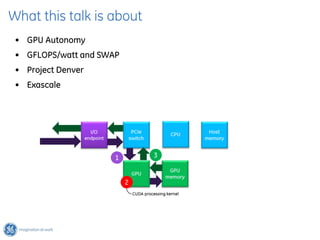
 • GPU Autonomy
 • GFLOPS/watt and SWAP
 • Project Denver
 • Exascale
Without GPUDirect
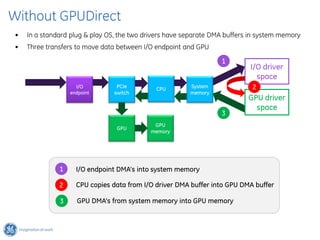
•   In a standard plug & play OS, the two drivers have separate DMA buffers in system memory
•   Three transfers to move data between I/O endpoint and GPU

                                                                  1
                                                                           I/O driver
                                                                             space
                    I/O          PCIe        CPU        System              2
                  endpoint      switch                  memory
                                                                           GPU driver
                                                                             space
                                                                  3
                                            GPU
                                 GPU
                                           memory


              1     I/O endpoint DMA’s into system memory

              2     CPU copies data from I/O driver DMA buffer into GPU DMA buffer

              3     GPU DMA’s from system memory into GPU memory
GPUDirect RDMA
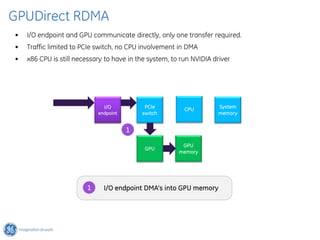
•   I/O endpoint and GPU communicate directly, only one transfer required.
•   Traffic limited to PCIe switch, no CPU involvement in DMA
•   x86 CPU is still necessary to have in the system, to run NVIDIA driver


                              I/O           PCIe          CPU        System
                            endpoint       switch                    memory


                                       1

                                                         GPU
                                            GPU
                                                        memory


                        1     I/O endpoint DMA’s into GPU memory
Endpoints
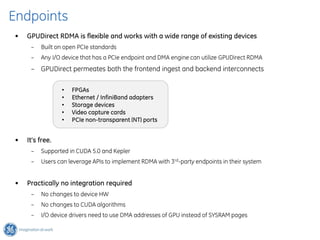
•   GPUDirect RDMA is flexible and works with a wide range of existing devices
     –   Built on open PCIe standards
     –   Any I/O device that has a PCIe endpoint and DMA engine can utilize GPUDirect RDMA
     – GPUDirect permeates both the frontend ingest and backend interconnects

                 •   FPGAs
                 •   Ethernet / InfiniBand adapters
                 •   Storage devices
                 •   Video capture cards
                 •   PCIe non-transparent (NT) ports


•   It’s free.
     –   Supported in CUDA 5.0 and Kepler
     –   Users can leverage APIs to implement RDMA with 3rd-party endpoints in their system


•   Practically no integration required
     –   No changes to device HW
     –   No changes to CUDA algorithms
     –   I/O device drivers need to use DMA addresses of GPU instead of SYSRAM pages
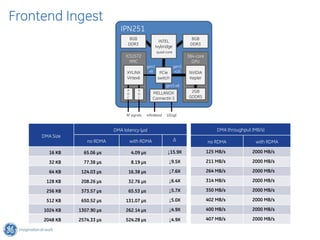
Frontend Ingest
                                IPN251
                                    8GB                                     8GB
                                                          INTEL
                                    DDR3                                    DDR3
                                                        Ivybridge
                                                        quad-core
                                  ICS1572                                  384-core
                                    XMC                                      GPU
                                                 gen1               gen3
                                   XYLINX         x8      PCIe       x16   NVIDIA
                                   Virtex6               switch            Kepler
                                                              gen3 x8
                                   A      A                                 2GB
                                   D      D         MELLANOX
                                   C      C         ConnectX-3             GDDR5


                                   RF signals    InfiniBand   10GigE


                             DMA latency (µs)                                             DMA throughput (MB/s)
     DMA Size
                   no RDMA             with RDMA                    Δ                 no RDMA              with RDMA

        16 KB     65.06 µs             4.09 µs                ↓15.9X                  125 MB/s           2000 MB/s

        32 KB     77.38 µs             8.19 µs                 ↓9.5X                  211 MB/s           2000 MB/s

        64 KB    124.03 µs          16.38 µs                   ↓7.6X                  264 MB/s           2000 MB/s

      128 KB     208.26 µs          32.76 µs                   ↓6.4X                  314 MB/s           2000 MB/s

      256 KB     373.57 µs          65.53 µs                   ↓5.7X                  350 MB/s           2000 MB/s

      512 KB     650.52 µs        131.07 µs                    ↓5.0X                  402 MB/s           2000 MB/s

     1024 KB    1307.90 µs        262.14 µs                    ↓4.9X                  400 MB/s           2000 MB/s

     2048 KB    2574.33 µs        524.28 µs                    ↓4.9X                  407 MB/s           2000 MB/s
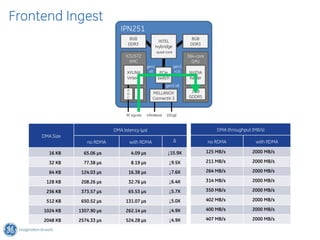
Frontend Ingest
                                IPN251
                                    8GB                                     8GB
                                                          INTEL
                                    DDR3                                    DDR3
                                                        Ivybridge
                                                        quad-core
                                  ICS1572                                  384-core
                                    XMC                                      GPU
                                                 gen1               gen3
                                   XYLINX         x8      PCIe       x16   NVIDIA
                                   Virtex6               switch            Kepler
                                                              gen3 x8
                                   A      A                                 2GB
                                   D      D         MELLANOX
                                   C      C         ConnectX-3             GDDR5


                                   RF signals    InfiniBand   10GigE


                             DMA latency (µs)                                             DMA throughput (MB/s)
     DMA Size
                   no RDMA             with RDMA                    Δ                 no RDMA              with RDMA

        16 KB     65.06 µs             4.09 µs                ↓15.9X                  125 MB/s           2000 MB/s

        32 KB     77.38 µs             8.19 µs                 ↓9.5X                  211 MB/s           2000 MB/s

        64 KB    124.03 µs          16.38 µs                   ↓7.6X                  264 MB/s           2000 MB/s

      128 KB     208.26 µs          32.76 µs                   ↓6.4X                  314 MB/s           2000 MB/s

      256 KB     373.57 µs          65.53 µs                   ↓5.7X                  350 MB/s           2000 MB/s

      512 KB     650.52 µs        131.07 µs                    ↓5.0X                  402 MB/s           2000 MB/s

     1024 KB    1307.90 µs        262.14 µs                    ↓4.9X                  400 MB/s           2000 MB/s

     2048 KB    2574.33 µs        524.28 µs                    ↓4.9X                  407 MB/s           2000 MB/s
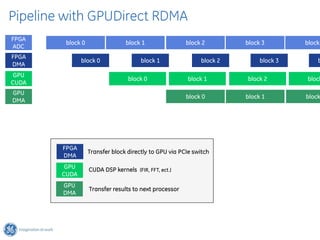
Pipeline with GPUDirect RDMA
FPGA
         block 0                 block 1                block 2        block 3        block
ADC
FPGA
               block 0                 block 1               block 2        block 3       b
DMA
 GPU
                                  block 0               block 1        block 2        block
CUDA
GPU
                                                        block 0        block 1        block
DMA


        FPGA
                   Transfer block directly to GPU via PCIe switch
        DMA
         GPU       CUDA DSP kernels (FIR, FFT, ect.)
        CUDA
        GPU
                   Transfer results to next processor
        DMA
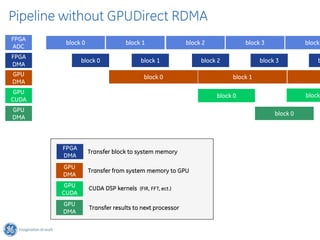
Pipeline without GPUDirect RDMA
FPGA
         block 0                 block 1                block 2             block 3             block
ADC
FPGA
               block 0                 block 1               block 2             block 3            b
DMA
GPU                                      block 0                       block 1
DMA
 GPU
                                                                  block 0                       block
CUDA
GPU
                                                                                      block 0
DMA


        FPGA
                   Transfer block to system memory
        DMA
        GPU
                   Transfer from system memory to GPU
        DMA
         GPU       CUDA DSP kernels (FIR, FFT, ect.)
        CUDA
        GPU
                   Transfer results to next processor
        DMA
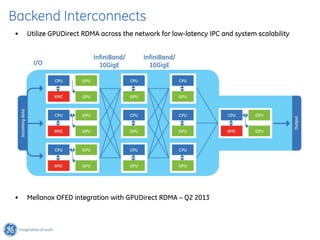
Backend Interconnects
•   Utilize GPUDirect RDMA across the network for low-latency IPC and system scalability


•   Mellanox OFED integration with GPUDirect RDMA – Q2 2013
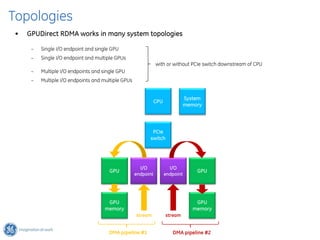
Topologies
 •   GPUDirect RDMA works in many system topologies

      –   Single I/O endpoint and single GPU
      –   Single I/O endpoint and multiple GPUs
                                                                with or without PCIe switch downstream of CPU
      –   Multiple I/O endpoints and single GPU
      –   Multiple I/O endpoints and multiple GPUs


                                                                                 System
                                                                CPU
                                                                                 memory


                                                              PCIe
                                                             switch


                                                       I/O              I/O
                                        GPU                                          GPU
                                                     endpoint         endpoint


                                       GPU                                           GPU
                                      memory                                        memory
                                                     stream           stream


                                       DMA pipeline #1                   DMA pipeline #2
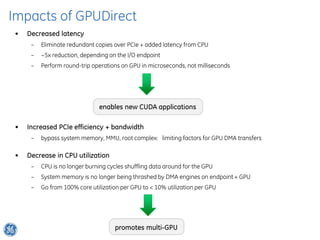
Impacts of GPUDirect
 •   Decreased latency
      –   Eliminate redundant copies over PCIe + added latency from CPU
      –   ~5x reduction, depending on the I/O endpoint
      –   Perform round-trip operations on GPU in microseconds, not milliseconds


                                enables new CUDA applications

 •   Increased PCIe efficiency + bandwidth
      –   bypass system memory, MMU, root complex: limiting factors for GPU DMA transfers

 •   Decrease in CPU utilization
      –   CPU is no longer burning cycles shuffling data around for the GPU
      –   System memory is no longer being thrashed by DMA engines on endpoint + GPU
      –   Go from 100% core utilization per GPU to < 10% utilization per GPU


                                     promotes multi-GPU
Before GPUDirect…
•   Many multi-GPU systems had 2 GPU nodes
•   Additional GPUs quickly choked system memory and CPU resources

•   Dual-socket CPU design very common
•   Dual root-complex prevents P2P across CPUs (QPI/HT untraversable)


                                           System     System
                                           memory     memory


                               I/O
                                            CPU         CPU
                             endpoint


                                            GPU         GPU


                                           GFLOPS/watt
                                        Xeon E5     K20X          system
                      SGEMM              2.32       12.34            8.45
                      DGEMM              1.14         5.19           3.61
Rise of Multi-GPU
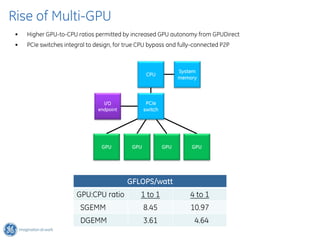
 •   Higher GPU-to-CPU ratios permitted by increased GPU autonomy from GPUDirect
 •   PCIe switches integral to design, for true CPU bypass and fully-connected P2P


                                                                 System
                                                   CPU
                                                                 memory


                                  I/O              PCIe
                                endpoint          switch


                                 GPU        GPU            GPU       GPU


                                           GFLOPS/watt
                       GPU:CPU ratio            1 to 1              4 to 1
                         SGEMM                    8.45               10.97
                         DGEMM                    3.61                4.64
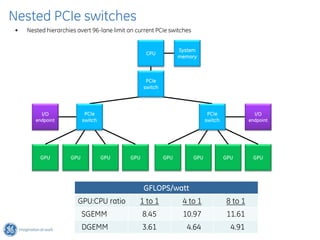
Nested PCIe switches
 •   Nested hierarchies avert 96-lane limit on current PCIe switches


                                                                 System
                                                   CPU
                                                                 memory


                                                   PCIe
                                                  switch


          I/O               PCIe                                              PCIe               I/O
        endpoint           switch                                            switch            endpoint


          GPU        GPU            GPU     GPU            GPU         GPU            GPU       GPU


                                                  GFLOPS/watt
                        GPU:CPU ratio           1 to 1            4 to 1              8 to 1
                           SGEMM                  8.45            10.97                11.61
                           DGEMM                  3.61             4.64                 4.91
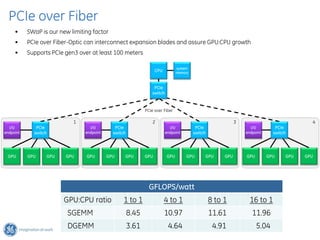
PCIe over Fiber
     •     SWaP is our new limiting factor
     •     PCIe over Fiber-Optic can interconnect expansion blades and assure GPU:CPU growth
     •     Supports PCIe gen3 over at least 100 meters

                                                                                 system
                                                                    CPU          memory


                                                                   PCIe
                                                                  switch


                                                              PCIe over Fiber

                            1                                     2                                           3                             4
  I/O         PCIe                 I/O         PCIe                          I/O           PCIe                     I/O         PCIe
endpoint     switch              endpoint     switch                       endpoint       switch                  endpoint     switch


 GPU       GPU    GPU    GPU     GPU        GPU    GPU        GPU          GPU        GPU      GPU      GPU       GPU        GPU    GPU   GPU


                                                                GFLOPS/watt
                         GPU:CPU ratio             1 to 1                 4 to 1                   8 to 1           16 to 1
                          SGEMM                        8.45               10.97                    11.61             11.96
                          DGEMM                        3.61                 4.64                    4.91                5.04
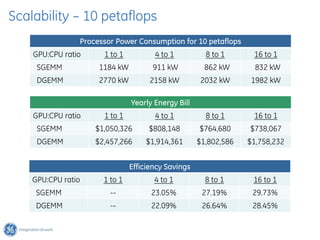
Scalability – 10 petaflops
                Processor Power Consumption for 10 petaflops
    GPU:CPU ratio     1 to 1          4 to 1          8 to 1      16 to 1
     SGEMM           1184 kW         911 kW           862 kW       832 kW
     DGEMM           2770 kW         2158 kW        2032 kW      1982 kW

                               Yearly Energy Bill
    GPU:CPU ratio     1 to 1          4 to 1          8 to 1      16 to 1
     SGEMM          $1,050,326      $808,148        $764,680     $738,067
     DGEMM          $2,457,266     $1,914,361       $1,802,586   $1,758,232


                               Efficiency Savings
    GPU:CPU ratio     1 to 1          4 to 1          8 to 1      16 to 1
     SGEMM              --           23.05%          27.19%       29.73%
     DGEMM              --           22.09%          26.64%       28.45%
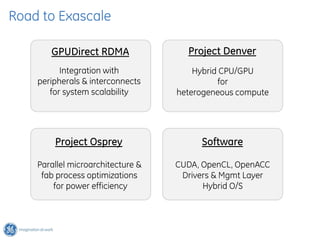
Road to Exascale

       GPUDirect RDMA                Project Denver
          Integration with             Hybrid CPU/GPU
    peripherals & interconnects              for
       for system scalability      heterogeneous compute


        Project Osprey                  Software

    Parallel microarchitecture &   CUDA, OpenCL, OpenACC
     fab process optimizations      Drivers & Mgmt Layer
        for power efficiency             Hybrid O/S
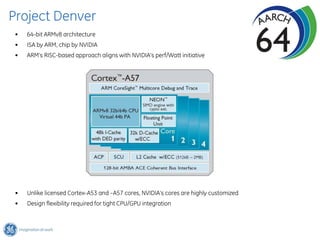
Project Denver
 •   64-bit ARMv8 architecture
 •   ISA by ARM, chip by NVIDIA
 •   ARM’s RISC-based approach aligns with NVIDIA’s perf/Watt initiative


 •   Unlike licensed Cortex-A53 and –A57 cores, NVIDIA’s cores are highly customized
 •   Design flexibility required for tight CPU/GPU integration
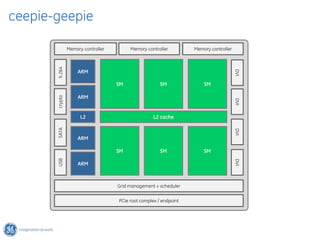
ceepie-geepie

                Memory controller          Memory controller         Memory controller


                                    NPN240
       h.264

                    ARM


                                                                                         DVI
                                     SM                  SM              SM

                    ARM
       crypto


                                                                                         DVI
                      L2                              L2 cache
       SATA


                                                                                         DVI
                    ARM

                                     SM                  SM              SM
       USB


                                                                                         DVI
                    ARM


                                     Grid management + scheduler

                                      PCIe root complex / endpoint
Mem ctrl         Mem ctrl       Mem ctrl

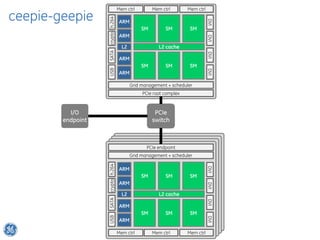
ceepie-geepie


                   crypto h.264
                                   ARM       NPN


                                                                             DVI
                                             SM          SM        SM
                                   ARM       240


                                                                             DVI
                                    L2               L2 cache


                   SATA


                                                                             DVI
                                   ARM
                                              SM         SM        SM


                   USB


                                                                             DVI
                                   ARM

                                         Grid management + scheduler
                                              PCIe root complex


          I/O                                       PCIe
        endpoint                                   switch


                                                PCIe endpoint
                                         Grid management + scheduler
                   crypto h.264


                                   ARM       NPN


                                                                             DVI
                                             SM         SM         SM
                                   ARM       240


                                                                             DVI
                                    L2               L2 cache
                   SATA


                                   ARM                                       DVI
                                              SM        SM         SM
                   USB


                                                                             DVI

                                   ARM

                                  Mem ctrl         Mem ctrl       Mem ctrl
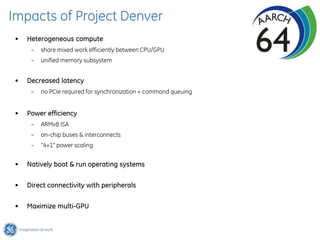
Impacts of Project Denver
 •   Heterogeneous compute
      –   share mixed work efficiently between CPU/GPU
      –   unified memory subsystem


 •   Decreased latency
      –   no PCIe required for synchronization + command queuing


 •   Power efficiency
      –   ARMv8 ISA
      –   on-chip buses & interconnects
      –   “4+1” power scaling


 •   Natively boot & run operating systems

 •   Direct connectivity with peripherals

 •   Maximize multi-GPU
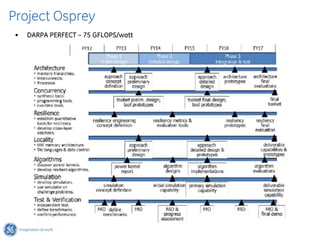
Project Osprey
 •   DARPA PERFECT – 75 GFLOPS/watt
Summary
• System-wide integration of GPUDirect RDMA
• Increase GPU:CPU ratio for better GFLOPS/watt
• Utilize PCIe switches instead of dual-socket CPU/IOH


• Exascale compute – what’s good for HPC is good for embedded/mobile
• Denver & Osprey – what’s good for embedded/mobile is good for HPC


                           questions?

                            booth 201

GPUDirect RDMA and Green Multi-GPU Architectures

  • 1.
    GPUDirect RDMA andGreen Multi-GPU Architectures GE Intelligent Platforms Mil/Aero Embedded Computing Dustin Franklin, GPGPU Applications Engineer dustin.franklin@ge.com 443.310.9812 (Washington, DC)
  • 2.
    What this talkis about • GPU Autonomy • GFLOPS/watt and SWAP • Project Denver • Exascale
  • 3.
    Without GPUDirect • In a standard plug & play OS, the two drivers have separate DMA buffers in system memory • Three transfers to move data between I/O endpoint and GPU 1 I/O driver space I/O PCIe CPU System 2 endpoint switch memory GPU driver space 3 GPU GPU memory 1 I/O endpoint DMA’s into system memory 2 CPU copies data from I/O driver DMA buffer into GPU DMA buffer 3 GPU DMA’s from system memory into GPU memory
  • 4.
    GPUDirect RDMA • I/O endpoint and GPU communicate directly, only one transfer required. • Traffic limited to PCIe switch, no CPU involvement in DMA • x86 CPU is still necessary to have in the system, to run NVIDIA driver I/O PCIe CPU System endpoint switch memory 1 GPU GPU memory 1 I/O endpoint DMA’s into GPU memory
  • 5.
    Endpoints • GPUDirect RDMA is flexible and works with a wide range of existing devices – Built on open PCIe standards – Any I/O device that has a PCIe endpoint and DMA engine can utilize GPUDirect RDMA – GPUDirect permeates both the frontend ingest and backend interconnects • FPGAs • Ethernet / InfiniBand adapters • Storage devices • Video capture cards • PCIe non-transparent (NT) ports • It’s free. – Supported in CUDA 5.0 and Kepler – Users can leverage APIs to implement RDMA with 3rd-party endpoints in their system • Practically no integration required – No changes to device HW – No changes to CUDA algorithms – I/O device drivers need to use DMA addresses of GPU instead of SYSRAM pages
  • 6.
    Frontend Ingest IPN251 8GB 8GB INTEL DDR3 DDR3 Ivybridge quad-core ICS1572 384-core XMC GPU gen1 gen3 XYLINX x8 PCIe x16 NVIDIA Virtex6 switch Kepler gen3 x8 A A 2GB D D MELLANOX C C ConnectX-3 GDDR5 RF signals InfiniBand 10GigE DMA latency (µs) DMA throughput (MB/s) DMA Size no RDMA with RDMA Δ no RDMA with RDMA 16 KB 65.06 µs 4.09 µs ↓15.9X 125 MB/s 2000 MB/s 32 KB 77.38 µs 8.19 µs ↓9.5X 211 MB/s 2000 MB/s 64 KB 124.03 µs 16.38 µs ↓7.6X 264 MB/s 2000 MB/s 128 KB 208.26 µs 32.76 µs ↓6.4X 314 MB/s 2000 MB/s 256 KB 373.57 µs 65.53 µs ↓5.7X 350 MB/s 2000 MB/s 512 KB 650.52 µs 131.07 µs ↓5.0X 402 MB/s 2000 MB/s 1024 KB 1307.90 µs 262.14 µs ↓4.9X 400 MB/s 2000 MB/s 2048 KB 2574.33 µs 524.28 µs ↓4.9X 407 MB/s 2000 MB/s
  • 7.
    Frontend Ingest IPN251 8GB 8GB INTEL DDR3 DDR3 Ivybridge quad-core ICS1572 384-core XMC GPU gen1 gen3 XYLINX x8 PCIe x16 NVIDIA Virtex6 switch Kepler gen3 x8 A A 2GB D D MELLANOX C C ConnectX-3 GDDR5 RF signals InfiniBand 10GigE DMA latency (µs) DMA throughput (MB/s) DMA Size no RDMA with RDMA Δ no RDMA with RDMA 16 KB 65.06 µs 4.09 µs ↓15.9X 125 MB/s 2000 MB/s 32 KB 77.38 µs 8.19 µs ↓9.5X 211 MB/s 2000 MB/s 64 KB 124.03 µs 16.38 µs ↓7.6X 264 MB/s 2000 MB/s 128 KB 208.26 µs 32.76 µs ↓6.4X 314 MB/s 2000 MB/s 256 KB 373.57 µs 65.53 µs ↓5.7X 350 MB/s 2000 MB/s 512 KB 650.52 µs 131.07 µs ↓5.0X 402 MB/s 2000 MB/s 1024 KB 1307.90 µs 262.14 µs ↓4.9X 400 MB/s 2000 MB/s 2048 KB 2574.33 µs 524.28 µs ↓4.9X 407 MB/s 2000 MB/s
  • 8.
    Pipeline with GPUDirectRDMA FPGA block 0 block 1 block 2 block 3 block ADC FPGA block 0 block 1 block 2 block 3 b DMA GPU block 0 block 1 block 2 block CUDA GPU block 0 block 1 block DMA FPGA Transfer block directly to GPU via PCIe switch DMA GPU CUDA DSP kernels (FIR, FFT, ect.) CUDA GPU Transfer results to next processor DMA
  • 9.
    Pipeline without GPUDirectRDMA FPGA block 0 block 1 block 2 block 3 block ADC FPGA block 0 block 1 block 2 block 3 b DMA GPU block 0 block 1 DMA GPU block 0 block CUDA GPU block 0 DMA FPGA Transfer block to system memory DMA GPU Transfer from system memory to GPU DMA GPU CUDA DSP kernels (FIR, FFT, ect.) CUDA GPU Transfer results to next processor DMA
  • 10.
    Backend Interconnects • Utilize GPUDirect RDMA across the network for low-latency IPC and system scalability • Mellanox OFED integration with GPUDirect RDMA – Q2 2013
  • 11.
    Topologies • GPUDirect RDMA works in many system topologies – Single I/O endpoint and single GPU – Single I/O endpoint and multiple GPUs with or without PCIe switch downstream of CPU – Multiple I/O endpoints and single GPU – Multiple I/O endpoints and multiple GPUs System CPU memory PCIe switch I/O I/O GPU GPU endpoint endpoint GPU GPU memory memory stream stream DMA pipeline #1 DMA pipeline #2
  • 12.
    Impacts of GPUDirect • Decreased latency – Eliminate redundant copies over PCIe + added latency from CPU – ~5x reduction, depending on the I/O endpoint – Perform round-trip operations on GPU in microseconds, not milliseconds enables new CUDA applications • Increased PCIe efficiency + bandwidth – bypass system memory, MMU, root complex: limiting factors for GPU DMA transfers • Decrease in CPU utilization – CPU is no longer burning cycles shuffling data around for the GPU – System memory is no longer being thrashed by DMA engines on endpoint + GPU – Go from 100% core utilization per GPU to < 10% utilization per GPU promotes multi-GPU
  • 13.
    Before GPUDirect… • Many multi-GPU systems had 2 GPU nodes • Additional GPUs quickly choked system memory and CPU resources • Dual-socket CPU design very common • Dual root-complex prevents P2P across CPUs (QPI/HT untraversable) System System memory memory I/O CPU CPU endpoint GPU GPU GFLOPS/watt Xeon E5 K20X system SGEMM 2.32 12.34 8.45 DGEMM 1.14 5.19 3.61
  • 14.
    Rise of Multi-GPU • Higher GPU-to-CPU ratios permitted by increased GPU autonomy from GPUDirect • PCIe switches integral to design, for true CPU bypass and fully-connected P2P System CPU memory I/O PCIe endpoint switch GPU GPU GPU GPU GFLOPS/watt GPU:CPU ratio 1 to 1 4 to 1 SGEMM 8.45 10.97 DGEMM 3.61 4.64
  • 15.
    Nested PCIe switches • Nested hierarchies avert 96-lane limit on current PCIe switches System CPU memory PCIe switch I/O PCIe PCIe I/O endpoint switch switch endpoint GPU GPU GPU GPU GPU GPU GPU GPU GFLOPS/watt GPU:CPU ratio 1 to 1 4 to 1 8 to 1 SGEMM 8.45 10.97 11.61 DGEMM 3.61 4.64 4.91
  • 16.
    PCIe over Fiber • SWaP is our new limiting factor • PCIe over Fiber-Optic can interconnect expansion blades and assure GPU:CPU growth • Supports PCIe gen3 over at least 100 meters system CPU memory PCIe switch PCIe over Fiber 1 2 3 4 I/O PCIe I/O PCIe I/O PCIe I/O PCIe endpoint switch endpoint switch endpoint switch endpoint switch GPU GPU GPU GPU GPU GPU GPU GPU GPU GPU GPU GPU GPU GPU GPU GPU GFLOPS/watt GPU:CPU ratio 1 to 1 4 to 1 8 to 1 16 to 1 SGEMM 8.45 10.97 11.61 11.96 DGEMM 3.61 4.64 4.91 5.04
  • 17.
    Scalability – 10petaflops Processor Power Consumption for 10 petaflops GPU:CPU ratio 1 to 1 4 to 1 8 to 1 16 to 1 SGEMM 1184 kW 911 kW 862 kW 832 kW DGEMM 2770 kW 2158 kW 2032 kW 1982 kW Yearly Energy Bill GPU:CPU ratio 1 to 1 4 to 1 8 to 1 16 to 1 SGEMM $1,050,326 $808,148 $764,680 $738,067 DGEMM $2,457,266 $1,914,361 $1,802,586 $1,758,232 Efficiency Savings GPU:CPU ratio 1 to 1 4 to 1 8 to 1 16 to 1 SGEMM -- 23.05% 27.19% 29.73% DGEMM -- 22.09% 26.64% 28.45%
  • 18.
    Road to Exascale GPUDirect RDMA Project Denver Integration with Hybrid CPU/GPU peripherals & interconnects for for system scalability heterogeneous compute Project Osprey Software Parallel microarchitecture & CUDA, OpenCL, OpenACC fab process optimizations Drivers & Mgmt Layer for power efficiency Hybrid O/S
  • 19.
    Project Denver • 64-bit ARMv8 architecture • ISA by ARM, chip by NVIDIA • ARM’s RISC-based approach aligns with NVIDIA’s perf/Watt initiative • Unlike licensed Cortex-A53 and –A57 cores, NVIDIA’s cores are highly customized • Design flexibility required for tight CPU/GPU integration
  • 20.
    ceepie-geepie Memory controller Memory controller Memory controller NPN240 h.264 ARM DVI SM SM SM ARM crypto DVI L2 L2 cache SATA DVI ARM SM SM SM USB DVI ARM Grid management + scheduler PCIe root complex / endpoint
  • 21.
    Mem ctrl Mem ctrl Mem ctrl ceepie-geepie crypto h.264 ARM NPN DVI SM SM SM ARM 240 DVI L2 L2 cache SATA DVI ARM SM SM SM USB DVI ARM Grid management + scheduler PCIe root complex I/O PCIe endpoint switch PCIe endpoint Grid management + scheduler crypto h.264 ARM NPN DVI SM SM SM ARM 240 DVI L2 L2 cache SATA ARM DVI SM SM SM USB DVI ARM Mem ctrl Mem ctrl Mem ctrl
  • 22.
    Impacts of ProjectDenver • Heterogeneous compute – share mixed work efficiently between CPU/GPU – unified memory subsystem • Decreased latency – no PCIe required for synchronization + command queuing • Power efficiency – ARMv8 ISA – on-chip buses & interconnects – “4+1” power scaling • Natively boot & run operating systems • Direct connectivity with peripherals • Maximize multi-GPU
  • 23.
    Project Osprey • DARPA PERFECT – 75 GFLOPS/watt
  • 24.
    Summary • System-wide integrationof GPUDirect RDMA • Increase GPU:CPU ratio for better GFLOPS/watt • Utilize PCIe switches instead of dual-socket CPU/IOH • Exascale compute – what’s good for HPC is good for embedded/mobile • Denver & Osprey – what’s good for embedded/mobile is good for HPC questions? booth 201