WELCOME TO BEAGLE BOARD OVER VIEW
BEAGLE BOARD MEANS
•   Bring your own peripherals
•   Entry-level cost ($149/179)
•   ARM Cortex-A8 (superscalar)
•   Graphics and DSP accelerated
•   Linux and open source community
•   Environment for innovators
BEAGLE BOARD HISTORY
• IT AS TWO VERSIONS 1)BEAGLE BOARD
•                     2)BEAGLE BOARD XM
• Feb 2008: Rev A concept demonstrated at meeting with key
  kernel maintainers and open source developers at TIDC
• Jun 2008: Rev B launched broad availability with Digit-Key
• Mar 2009: First hands-on ESC BYOES training
• May 2009: Rev C doubles RAM to 256MB
• Jan 2010: Rev C4 bumps performance to 720MHz and resolves
  USB power supply stability issue
• Jun 2010: xM Rev A board demonstrated at hands-on ESC
  BYOES training
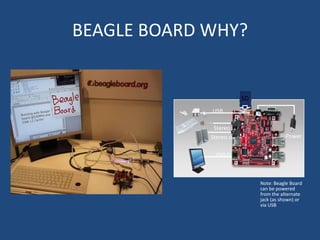
BEAGLE BOARD WHY?


                          SD
             USB

              Stereo in
             Stereo out                  Power

              DVI-D


                               Note: Beagle Board
                               can be powered
                               from the alternate
                               jack (as shown) or
                               via USB
WHY PRODUCTION OF BEAGLE BOARDXM

IN BEAGLE BOARD THERE IS NO OVER VOLTGE
 PROTECTION CIRCUIT.
IT IS HAVING ONLY ONE USB,NO INSERTION
 OF MMC CARD,CAMERA HEADER,MMC3
 EXPANTION,MCBSP,
IT IS HAVING ONLY 256MB OF MEMORY AS
 COMPARE TO THE BEAGLE BOARD XM.
BEAGLE BOARD
                                                                 Peripheral I/O
OMAP3530 Processor                                                DVI-D video out
 720MHz** Cortex-A8                     3.1”                     SD/MMC+
       NEON+VFPv3
       16KB/16KB L1$                                             S-Video out
       256KB L2$                                                 USB 2.0 HS OTG
 430MHz C64x+ DSP
                                                                  I2C, I2S, SPI,
       32K/32K L1$
       48K L1D                                                    MMC/SD
       32K L2                                                    JTAG
 PowerVR SGX GPU                                                 Stereo in/out
 64K on-chip RAM
                                                                  Alternate power
POP Memory
 256MB* LPDDR RAM                                                RS-232 serial
 256MB NAND flash
* Revisions before C had 128MB
** Revisions before C4 were 600MHz              USB Powered
                                                 2W maximum consumption
                                                       OMAP is small % of that
                                                 Many adapter options
                                                       Car, wall, battery, solar, …
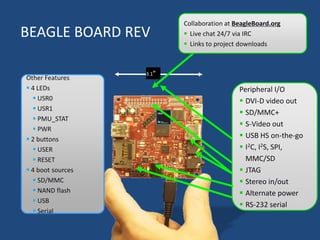
Collaboration at BeagleBoard.org
BEAGLE BOARD REV           Live chat 24/7 via IRC
                           Links to project downloads


                   3.1”
Other Features
 4 LEDs                                    Peripheral I/O
   USR0                                     DVI-D video out
   USR1
                                             SD/MMC+
   PMU_STAT
                                             S-Video out
   PWR
 2 buttons                                  USB HS on-the-go
   USER                                     I2C, I2S, SPI,
   RESET                                     MMC/SD
 4 boot sources                             JTAG
   SD/MMC                                   Stereo in/out
   NAND flash                               Alternate power
   USB
                                             RS-232 serial
   Serial
REVISION C

                               3.1”


Peripheral I/O
                                         256MB LPDDR RAM
 USB HS/host-only                       (up from 128MB)
 (in addition to existing
 USB HS on-the-go)
 LCD expansion
BEAGLE BOARD XM
• XM                      • 2,000 Dhrystone MIPS performance
                            with ARM® Cortex™-A8
                          • 512MB POP memory enabling
                              – Native builds of Ubuntu and other
                                distros
                              – More multitasking with complex apps
                                like Firefox or OpenOffice.org
                          • Robust expansion with more direct
                            connectivity without external hubs;
                            on-board Ethernet and five USB 2.0
       xM means             ports
       Extra MHz
                          • USB-powered board via low power
   $1     and
                            processor integration
        Extra MB
                          • Active and growing open source
                            community at beagleboard.org


                                                                      9
BEAGLE BOARD XM
BEAGLE BOARD FEATURES
OMAP PROCESSOR 3530
HS USB 2.0 OTG Port
HS USB 2.0 Host Port
Stereo Audio Output Connector
Stereo Audio In Connector
S-Video Connector
DVI-D Connector
LCD Header
BUTTONS&INDICATORS
SD/MMC 6 in 1 Connector

->WiFi Cards
->o Camera
 ->Bluetooth Cards
-> GPS Modules
 ->SD Memory Cards
 ->MMC Memory Cards
-> SDIO Cards
->MMCMobile cards
-> RS-MMC Cards
-> miniSD Cards
RESET AND USER BUTTON
•   WHEN RESET BUTTON IS PRESSED
•   o USB
•   o UART
•   o MMC1
•   o NAND
•   WHEN USER USER BUTTON IS PRESSED
•   o NAND
•   o USB
•   o UART3
•   o MMC1
POWER SUPPLY
  1)USB OTG SUPPLY
     2)DC SUPPLY
POWER SUPPLY:
            Voltage 5.0 V
   Current 500mA (minimum) mA
Connector 2.1mm x 5.5mm Center hot
TPS 65950 POWER SUPPLY

The TPS2141 has an integrated 3.3V LDO which is being
  used to supply the 3.3V as required on the BeagleBoard for
  the DVI-D interface and the UART CALLED WALL SUPPLY.
•  When the DC supply is plugged in, the switch is disabled
  because the Ground Is removed from tps 2141.
• TPS 65950 FUNCTIONS
 o Main Core Voltages
• o Peripheral Voltages
• o Power Sequencing
• o Reset
• o Current measurement via SW
TPS 65950 P.S
        o VDD_PLL2
•   o VDD_PLL1
•   o VDAC_1V8
•   o VDD_SIM
•   o VMMC1
•   o VAUX2
•   IT AS TWO REGULATORS VDD1&VDD2.THOSE ARE
    CONTROLLED THROUGH THE “SMART REFLEX COMPLAINT
    VOLTAGE.”
•   IT AS TWO MODES VDD1&VDD2.THESE ARE CONTROLLE
    THROUGH THE SOFTWARE.
POP MEMORY
 a MCP (Multi Chip Package) that contains both the SDRAM and
NAND Flash.IT IS MULTI CHIP PACKAGE.
SD/MMC CARDS.
 The SD/MMC connector is supplied power from the
             TPS65950 using the VMMC1 rail
      When a card is inserted into the SD/MMC
     connector, the Card Detect pin is grounded.
   This is detected on pin P12 of the TPS65950. An
           interrupt, if enabled, is sent to the
             OMAP3530 via the interrupt pin
 If an SD card is inserted into the SD/MMC connector
            and the write protect pin is active,
             the Write Detect pin is grounded
S-VIDEO CABLE
An S-Video cable can be connected to the BeagleBoard and
from there is can be connected to a TV or monitor that supports
an S-Video input.
IT SUPPORTS NTSC AN PAL FORMAT.
NTSC MEANS “NATIONAL TELIVISION SYSTEM COMMITEE”.
PAL MEANS
It can be changed via the Software.
DIFFERENCE BETWEEN NTSC AND PAL:

• NTSC IT USES THE
MCBSP
McBSP2
The multi-channel buffered serial port (McBSP) McBSP2 provides a full-duplex direct
serial interface between the OMAP3530 and the audio CODEC in the TPS65950
MCBSP1
McBSP1
McBSP1 provides a full-duplex direct serial interface between the OMAP3530 and
the expansion interface. There are 6 signals supported on McBSP1.
MCBSP3
McBSP3 provides a full-duplex direct serial interface between the OMAP3530 and the
EXPANSION INTERFACE.
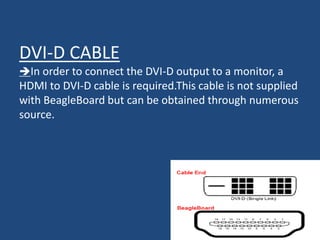
DVI-D CABLE
In order to connect the DVI-D output to a monitor, a
HDMI to DVI-D cable is required.This cable is not supplied
with BeagleBoard but can be obtained through numerous
source.
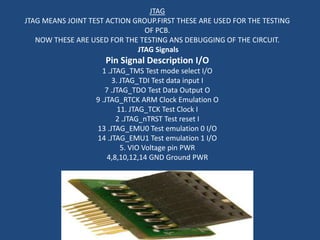
JTAG
JTAG MEANS JOINT TEST ACTION GROUP.FIRST THESE ARE USED FOR THE TESTING
                                OF PCB.
   NOW THESE ARE USED FOR THE TESTING ANS DEBUGGING OF THE CIRCUIT.
                              JTAG Signals
                     Pin Signal Description I/O
                     1 .JTAG_TMS Test mode select I/O
                         3. JTAG_TDI Test data input I
                      7 .JTAG_TDO Test Data Output O
                   9 .JTAG_RTCK ARM Clock Emulation O
                           11. JTAG_TCK Test Clock I
                          2 .JTAG_nTRST Test reset I
                   13 .JTAG_EMU0 Test emulation 0 I/O
                   14 .JTAG_EMU1 Test emulation 1 I/O
                            5. VIO Voltage pin PWR
                       4,8,10,12,14 GND Ground PWR
RS 232 HEADER:-
In order to access the serial port of the BeagleBoard a flat cable is
required to connect to a PC. The adapter will not plug directly into the
PC and will require an external Female to Female twisted cable (Null
Modem) in order to connect it to the PC. The ribbon cable
is not supplied with the BeagleBoard but can be obtained from
numerous sources.
AUDIO CABLES:
A 3.5mm standard stereo output audio jack is provided
to access the stereo output of the onboard audio CODEC.
The Audio CODEC is provided by the TPS65950.
A 3.5mm standard stereo audio input jack is
provided to access the stereo output of the
onboard audio Codec.
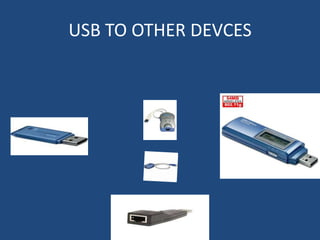
USB TO OTHER DEVCES
BATTERY:
This is a
Vanadium Pentoxide Lithium Rechargeable Battery with a
7mAH capacity.
1)Remove all cables from the board.
2) Remove R66 from the board as shown on
3) Using Figure 66, locate the positive (+) lead of the battery.
4) Insert the (+) lead into the hole that is marked (+)

Beagle board

  • 1.
    WELCOME TO BEAGLEBOARD OVER VIEW
  • 2.
    BEAGLE BOARD MEANS • Bring your own peripherals • Entry-level cost ($149/179) • ARM Cortex-A8 (superscalar) • Graphics and DSP accelerated • Linux and open source community • Environment for innovators
  • 3.
    BEAGLE BOARD HISTORY •IT AS TWO VERSIONS 1)BEAGLE BOARD • 2)BEAGLE BOARD XM • Feb 2008: Rev A concept demonstrated at meeting with key kernel maintainers and open source developers at TIDC • Jun 2008: Rev B launched broad availability with Digit-Key • Mar 2009: First hands-on ESC BYOES training • May 2009: Rev C doubles RAM to 256MB • Jan 2010: Rev C4 bumps performance to 720MHz and resolves USB power supply stability issue • Jun 2010: xM Rev A board demonstrated at hands-on ESC BYOES training
  • 4.
    BEAGLE BOARD WHY? SD USB Stereo in Stereo out Power DVI-D Note: Beagle Board can be powered from the alternate jack (as shown) or via USB
  • 5.
    WHY PRODUCTION OFBEAGLE BOARDXM IN BEAGLE BOARD THERE IS NO OVER VOLTGE PROTECTION CIRCUIT. IT IS HAVING ONLY ONE USB,NO INSERTION OF MMC CARD,CAMERA HEADER,MMC3 EXPANTION,MCBSP, IT IS HAVING ONLY 256MB OF MEMORY AS COMPARE TO THE BEAGLE BOARD XM.
  • 6.
    BEAGLE BOARD Peripheral I/O OMAP3530 Processor  DVI-D video out  720MHz** Cortex-A8 3.1”  SD/MMC+  NEON+VFPv3  16KB/16KB L1$  S-Video out  256KB L2$  USB 2.0 HS OTG  430MHz C64x+ DSP  I2C, I2S, SPI,  32K/32K L1$  48K L1D MMC/SD  32K L2  JTAG  PowerVR SGX GPU  Stereo in/out  64K on-chip RAM  Alternate power POP Memory  256MB* LPDDR RAM  RS-232 serial  256MB NAND flash * Revisions before C had 128MB ** Revisions before C4 were 600MHz USB Powered  2W maximum consumption  OMAP is small % of that  Many adapter options  Car, wall, battery, solar, …
  • 7.
    Collaboration at BeagleBoard.org BEAGLEBOARD REV  Live chat 24/7 via IRC  Links to project downloads 3.1” Other Features  4 LEDs Peripheral I/O  USR0  DVI-D video out  USR1  SD/MMC+  PMU_STAT  S-Video out  PWR  2 buttons  USB HS on-the-go  USER  I2C, I2S, SPI,  RESET MMC/SD  4 boot sources  JTAG  SD/MMC  Stereo in/out  NAND flash  Alternate power  USB  RS-232 serial  Serial
  • 8.
    REVISION C 3.1” Peripheral I/O 256MB LPDDR RAM  USB HS/host-only (up from 128MB) (in addition to existing USB HS on-the-go)  LCD expansion
  • 9.
    BEAGLE BOARD XM •XM • 2,000 Dhrystone MIPS performance with ARM® Cortex™-A8 • 512MB POP memory enabling – Native builds of Ubuntu and other distros – More multitasking with complex apps like Firefox or OpenOffice.org • Robust expansion with more direct connectivity without external hubs; on-board Ethernet and five USB 2.0 xM means ports Extra MHz • USB-powered board via low power $1 and processor integration Extra MB • Active and growing open source community at beagleboard.org 9
  • 10.
  • 11.
    BEAGLE BOARD FEATURES OMAPPROCESSOR 3530 HS USB 2.0 OTG Port HS USB 2.0 Host Port Stereo Audio Output Connector Stereo Audio In Connector S-Video Connector DVI-D Connector LCD Header BUTTONS&INDICATORS SD/MMC 6 in 1 Connector ->WiFi Cards ->o Camera ->Bluetooth Cards -> GPS Modules ->SD Memory Cards ->MMC Memory Cards -> SDIO Cards ->MMCMobile cards -> RS-MMC Cards -> miniSD Cards
  • 12.
    RESET AND USERBUTTON • WHEN RESET BUTTON IS PRESSED • o USB • o UART • o MMC1 • o NAND • WHEN USER USER BUTTON IS PRESSED • o NAND • o USB • o UART3 • o MMC1
  • 13.
    POWER SUPPLY 1)USB OTG SUPPLY 2)DC SUPPLY
  • 14.
    POWER SUPPLY: Voltage 5.0 V Current 500mA (minimum) mA Connector 2.1mm x 5.5mm Center hot
  • 15.
    TPS 65950 POWERSUPPLY The TPS2141 has an integrated 3.3V LDO which is being used to supply the 3.3V as required on the BeagleBoard for the DVI-D interface and the UART CALLED WALL SUPPLY. •  When the DC supply is plugged in, the switch is disabled because the Ground Is removed from tps 2141. • TPS 65950 FUNCTIONS  o Main Core Voltages • o Peripheral Voltages • o Power Sequencing • o Reset • o Current measurement via SW
  • 16.
    TPS 65950 P.S o VDD_PLL2 • o VDD_PLL1 • o VDAC_1V8 • o VDD_SIM • o VMMC1 • o VAUX2 • IT AS TWO REGULATORS VDD1&VDD2.THOSE ARE CONTROLLED THROUGH THE “SMART REFLEX COMPLAINT VOLTAGE.” • IT AS TWO MODES VDD1&VDD2.THESE ARE CONTROLLE THROUGH THE SOFTWARE.
  • 17.
    POP MEMORY aMCP (Multi Chip Package) that contains both the SDRAM and NAND Flash.IT IS MULTI CHIP PACKAGE.
  • 18.
    SD/MMC CARDS. TheSD/MMC connector is supplied power from the TPS65950 using the VMMC1 rail  When a card is inserted into the SD/MMC connector, the Card Detect pin is grounded. This is detected on pin P12 of the TPS65950. An interrupt, if enabled, is sent to the OMAP3530 via the interrupt pin  If an SD card is inserted into the SD/MMC connector and the write protect pin is active, the Write Detect pin is grounded
  • 19.
    S-VIDEO CABLE An S-Videocable can be connected to the BeagleBoard and from there is can be connected to a TV or monitor that supports an S-Video input. IT SUPPORTS NTSC AN PAL FORMAT. NTSC MEANS “NATIONAL TELIVISION SYSTEM COMMITEE”. PAL MEANS It can be changed via the Software.
  • 20.
    DIFFERENCE BETWEEN NTSCAND PAL: • NTSC IT USES THE
  • 21.
    MCBSP McBSP2 The multi-channel bufferedserial port (McBSP) McBSP2 provides a full-duplex direct serial interface between the OMAP3530 and the audio CODEC in the TPS65950
  • 22.
    MCBSP1 McBSP1 McBSP1 provides afull-duplex direct serial interface between the OMAP3530 and the expansion interface. There are 6 signals supported on McBSP1.
  • 23.
    MCBSP3 McBSP3 provides afull-duplex direct serial interface between the OMAP3530 and the EXPANSION INTERFACE.
  • 24.
    DVI-D CABLE In orderto connect the DVI-D output to a monitor, a HDMI to DVI-D cable is required.This cable is not supplied with BeagleBoard but can be obtained through numerous source.
  • 25.
    JTAG JTAG MEANS JOINTTEST ACTION GROUP.FIRST THESE ARE USED FOR THE TESTING OF PCB. NOW THESE ARE USED FOR THE TESTING ANS DEBUGGING OF THE CIRCUIT. JTAG Signals Pin Signal Description I/O 1 .JTAG_TMS Test mode select I/O 3. JTAG_TDI Test data input I 7 .JTAG_TDO Test Data Output O 9 .JTAG_RTCK ARM Clock Emulation O 11. JTAG_TCK Test Clock I 2 .JTAG_nTRST Test reset I 13 .JTAG_EMU0 Test emulation 0 I/O 14 .JTAG_EMU1 Test emulation 1 I/O 5. VIO Voltage pin PWR 4,8,10,12,14 GND Ground PWR
  • 26.
    RS 232 HEADER:- Inorder to access the serial port of the BeagleBoard a flat cable is required to connect to a PC. The adapter will not plug directly into the PC and will require an external Female to Female twisted cable (Null Modem) in order to connect it to the PC. The ribbon cable is not supplied with the BeagleBoard but can be obtained from numerous sources.
  • 27.
    AUDIO CABLES: A 3.5mmstandard stereo output audio jack is provided to access the stereo output of the onboard audio CODEC. The Audio CODEC is provided by the TPS65950. A 3.5mm standard stereo audio input jack is provided to access the stereo output of the onboard audio Codec.
  • 28.
  • 29.
    BATTERY: This is a VanadiumPentoxide Lithium Rechargeable Battery with a 7mAH capacity. 1)Remove all cables from the board. 2) Remove R66 from the board as shown on 3) Using Figure 66, locate the positive (+) lead of the battery. 4) Insert the (+) lead into the hole that is marked (+)