Global Positioning System
A system that’s changed Navigation forever.
By :- Praveen Singh
M.C.A (4th sem)
Govt. Engineering College, Ajmer
What is GPS ?
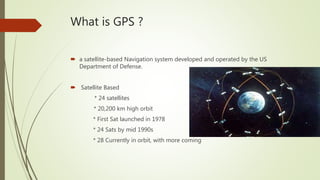
 a satellite-based Navigation system developed and operated by the US
Department of Defense.
 Satellite Based
* 24 satellites
* 20,200 km high orbit
* First Sat launched in 1978
* 24 Sats by mid 1990s
* 28 Currently in orbit, with more coming
Why GPS ?
Trying to figure out where you are and where you are going is
one of man’s oldest passtimes.
Navigation and positioning are crucial to so many activities and
yet the process has always been quite difficult and slow.
INFORMATION IN A GPS SIGNAL
 The GPS signal contains mainly two types of data, they are:
 Ephemeris data
 Almanac data
 Ephemeris data is constantly transmitted by each satellite and contains
important information such as status of the satellite (healthy or unhealthy),
current date, and time. This part of the signal is essential to determining a
position.
 Almanac data tells the GPS receiver where each GPS satellite should be
at any time throughout the day. Each satellite transmits almanac data
How GPS works ?
It uses five step process
 Trilateration
 Measuring distance
 The perfect timing
 Position of satellites
 Error correction
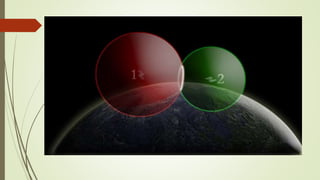
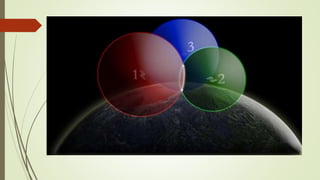
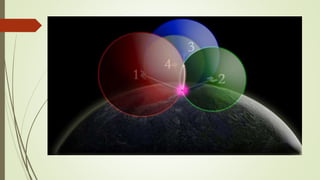
Trilateration
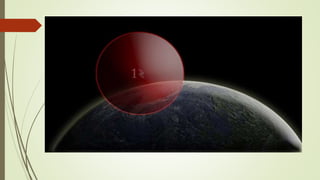
 More generally, trilateration methods involve the
determination of absolute or relative location of points by
measurement of distance, using the geometry of Speheres or
triangles.
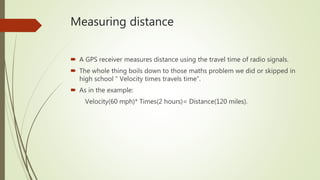
Measuring distance
 A GPS receiver measures distance using the travel time of radio signals.
 The whole thing boils down to those maths problem we did or skipped in
high school “ Velocity times travels time”.
 As in the example:
Velocity(60 mph)* Times(2 hours)= Distance(120 miles).
The perfect timing
 If the timing of the radioj signals is off by just a thousandth of a second, at the
speed of lights, that translates into almost 200 miles of error !
 On the satellite side, timing is almost perfect because they have incredibly precise
atomic clocks on board.
Position of satellites
 On the ground all GPS receivers have an almanac programmed into their
computers that tells them where in the sky each satellite is, moment by moment.
 The basic orbit are quite exact but just to make things perfect the GPS satellite are
constantly monitored by the Departent of Defence(DoD).
Error correction
 In the real world there are lots of things that can happen to a GPS signal
that will make its life less than mathematically perfect.
 To get the most out of the system, a good GPS receiver needs to take a
wide variety of possible errors into account.
To compute a positions in three dimensions. We need to have four satellite
measurements. The GPS uses a trigonometric approach to calculate the
positions.
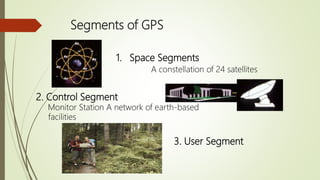
Segments of GPS
1. Space Segments
A constellation of 24 satellites
2. Control Segment
Monitor Station A network of earth-based
facilities
3. User Segment
Applications of GPS
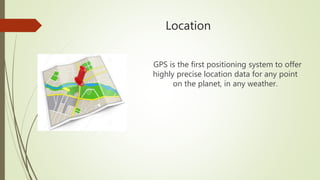
Location
GPS is the first positioning system to offer
highly precise location data for any point
on the planet, in any weather.
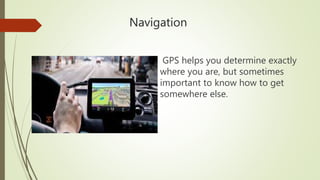
Navigation
GPS helps you determine exactly
where you are, but sometimes
important to know how to get
somewhere else.
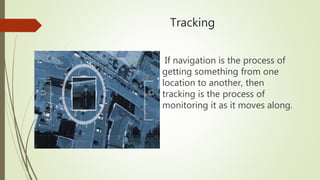
Tracking
If navigation is the process of
getting something from one
location to another, then
tracking is the process of
monitoring it as it moves along.
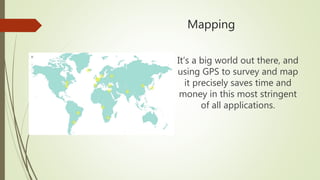
Mapping
It’s a big world out there, and
using GPS to survey and map
it precisely saves time and
money in this most stringent
of all applications.
Timing
Knowing that a group of
timed events is perfectly
synchronized is often very
important. GPS makes the
job of “synchronizing” easy
and reliable.
Global Positioning System

Global Positioning System

  • 1.
    Global Positioning System Asystem that’s changed Navigation forever. By :- Praveen Singh M.C.A (4th sem) Govt. Engineering College, Ajmer
  • 2.
    What is GPS?  a satellite-based Navigation system developed and operated by the US Department of Defense.  Satellite Based * 24 satellites * 20,200 km high orbit * First Sat launched in 1978 * 24 Sats by mid 1990s * 28 Currently in orbit, with more coming
  • 3.
    Why GPS ? Tryingto figure out where you are and where you are going is one of man’s oldest passtimes. Navigation and positioning are crucial to so many activities and yet the process has always been quite difficult and slow.
  • 4.
    INFORMATION IN AGPS SIGNAL  The GPS signal contains mainly two types of data, they are:  Ephemeris data  Almanac data  Ephemeris data is constantly transmitted by each satellite and contains important information such as status of the satellite (healthy or unhealthy), current date, and time. This part of the signal is essential to determining a position.  Almanac data tells the GPS receiver where each GPS satellite should be at any time throughout the day. Each satellite transmits almanac data
  • 5.
    How GPS works? It uses five step process  Trilateration  Measuring distance  The perfect timing  Position of satellites  Error correction
  • 6.
    Trilateration  More generally,trilateration methods involve the determination of absolute or relative location of points by measurement of distance, using the geometry of Speheres or triangles.
  • 7.
    Measuring distance  AGPS receiver measures distance using the travel time of radio signals.  The whole thing boils down to those maths problem we did or skipped in high school “ Velocity times travels time”.  As in the example: Velocity(60 mph)* Times(2 hours)= Distance(120 miles).
  • 8.
    The perfect timing If the timing of the radioj signals is off by just a thousandth of a second, at the speed of lights, that translates into almost 200 miles of error !  On the satellite side, timing is almost perfect because they have incredibly precise atomic clocks on board.
  • 9.
    Position of satellites On the ground all GPS receivers have an almanac programmed into their computers that tells them where in the sky each satellite is, moment by moment.  The basic orbit are quite exact but just to make things perfect the GPS satellite are constantly monitored by the Departent of Defence(DoD).
  • 10.
    Error correction  Inthe real world there are lots of things that can happen to a GPS signal that will make its life less than mathematically perfect.  To get the most out of the system, a good GPS receiver needs to take a wide variety of possible errors into account. To compute a positions in three dimensions. We need to have four satellite measurements. The GPS uses a trigonometric approach to calculate the positions.
  • 15.
    Segments of GPS 1.Space Segments A constellation of 24 satellites 2. Control Segment Monitor Station A network of earth-based facilities 3. User Segment
  • 16.
  • 17.
    Location GPS is thefirst positioning system to offer highly precise location data for any point on the planet, in any weather.
  • 18.
    Navigation GPS helps youdetermine exactly where you are, but sometimes important to know how to get somewhere else.
  • 19.
    Tracking If navigation isthe process of getting something from one location to another, then tracking is the process of monitoring it as it moves along.
  • 20.
    Mapping It’s a bigworld out there, and using GPS to survey and map it precisely saves time and money in this most stringent of all applications.
  • 21.
    Timing Knowing that agroup of timed events is perfectly synchronized is often very important. GPS makes the job of “synchronizing” easy and reliable.