Global Positioning Satellite System
(GPS)
- Prakash Kumar Sekar
Overview
 The Navigation Problem
 Earlier Approaches
 GPS Description
 How does GPS Work?
Acknowledgement
Many of the graphical images used in this
talk are courtesy of Peter H. Dana of the
Department of Geography, University of
Texas at Austin -
http://www.utexas.edu/depts/grg/gcraft/
notes/gps/gps.html
The best web site for GPS
The Navigation Problem
 The ancient question:
Where am I?
 Earth coordinates:
latitude and longitude
Lafayette: N40/W86
 Latitude can be
determined by Sun
angle
 What about longitude?
Latitude and Longitude
Longitude Problem
 No easy way to determine longitude
 On July 8, 1714 the Longitude Act was
established in England to solve the
“longitude problem”
 Two solutions were proposed
-- use of stars and moons
-- the “time” solution
Longitude
Longitude : The True Story of a Lone
Genius Who Solved the Greatest Scientific
Problem of His Time
Dava Sobel
Longitude Problem: References
 http://www.pbs.org/wgbh/nova/longitude/
The “Time” Solution
 Where am I? <=> What time is it in
Greenwich, England?
 The ability to find one’s position is based
on how well one can tell what time is it?
 The development of the chronometer
 To find longitude to within 0.5 degree
requires a clock that loses or gains no more
than 3 seconds/day
Longitude
 How does this work?
 The earth turns 360 degrees in 24 hours:
15 degrees = 1 hour
 If you know the time in Greenwich when it
is local noon at your location one can find
your longitude relative to Greenwich
 Must know “datum” reference to use maps
Datum Reference
Lone Pine Cemetery - N400 13.8’’ E260 17.24”
Satellite Navigation
 US Department of Defense has need for
very precise navigation
 In 1973, the US Air Force proposed a new
system for navigation using satellites
 The system is known as: Navigation System
with Timing and Ranging: Global
Positioning System or NAVSTAR GPS
NAVSTAR GPS Goals
 What time is it?
 What is my position (including attitude)?
 What is my velocity?
 Other Goals:
- What is the local time?
- When is sunrise and sunset?
- What is the distance between two points?
- What is my estimated time arrival?
GSP System
Simply stated: The GPS satellites are nothing
more than a set of clocks in the sky
GPS Segments
 Space Segment: the constellation of
satellites
 Control Segment: control the satellites
 User Segment: users with receivers
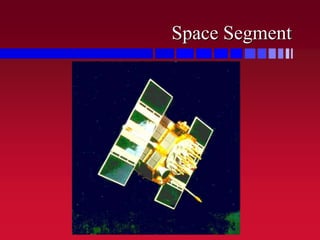
Space Segment
Space Segment
 System consists of 24 satellites in the
operational mode: 21 in use and 3 spares
3 other satellites are used for testing
 Altitude: 20,200 Km with periods of 12 hr.
 Current Satellites: Block IIR- $25,000,000
2000 KG
 Hydrogen Maser Atomic Clocks
Hydrogen Maser Clock
These clocks lose one second every
2,739,000 million years
GPS Orbits
GPS Orbits
Control Segment
Master Control Station is located at the
Consolidated Space Operations Center
(CSOC) at Flacon Air Force Station near
Colorado Springs
The Global Positioning System.
GPS antenna
GPS receiver
and batteries!
Windows CE handheld computer
Paper Map
with targets
Matt Evans of Abe591a and
Aaron Pierce of the Biology
Department; mapping the
Purdue University Ross
Reserve.
Sample Location
Flag/Pin
ASM 215 April
2009
User component
 Individuals with GPS
receivers
Prakash Kumar Sekar
Basic GPS Surveying Techniques
Presented by:
Neil Gray, Teacher-in-Charge, Columboola EEC.
On behalf of ICT Innovators Centre, STiS Project.
Not sphere but spheroid
 Newton and others in the 17th and 18th century
proposed that the Earth is flattened due to rotational
forces.
 Complex, repeated, highly accurate measurements
established that the curvature of the Earth was greater
at the equator than the poles
Image from ESRI online course
Prakash Kumar Sekar
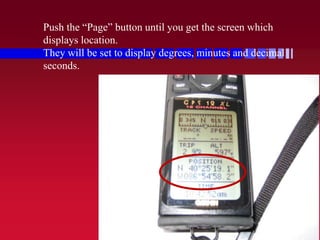
Push the “Page” button until you get the screen which
displays location.
They will be set to display degrees, minutes and decimal
seconds.
Combining range measurements
Range measurement from coded
signal
Topographic assessment at Davis Purdue
Ag Center
Control Segment
Differential
correction
• Post-processed
• Real-time
Differential Correction
 Two receivers are used to
greatly improve the
accuracy of GPS
positional measurements
 Base station at known
location
Prakash Kumar Sekar
CSOC
 Track the satellites for orbit and clock
determination
 Time synchronization
 Upload the Navigation Message
 Manage DOA
Operational Capabilities
Initial Operational Capability - December 8,
1993
Full Operational Capability declared by the
Secretary of Defense at 00:01 hours on
July 17, 1995
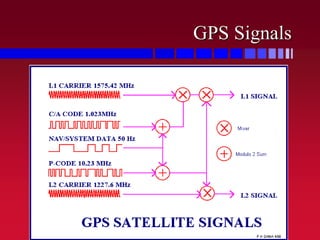
GPS Transmitted Signal
 Two signals are transmitted on carriers:
L1 = 1575.42 MHz
L2 = 1227.60 MHz
These are derived from the system clock of
10.23 MHz (phase quadrature)
 Modulation used is Direct Sequence Spread
Spectrum
(code division multiple access - CDMA)
GPS Signals
GPS Clock Signals
 Two types of clock signals are transmitted
 C/A Code - Coarse/Acquisition Code
available for civilian use on L1 provides
300 m resolution
 P Code - Precise Code on L1 and L2 used
by the military provides 3m resolution
Spread Spectrum
 Spread Spectrum is used because
- resistance to jamming
- masks the transmissions
- resist multipath effects
- multiple access
 All 24 GPS satellites transmit on the same
two frequencies BUT use a different ID
sequence
GPS Signals
 The satellites transmit as part of their
unique Spread Spectrum signal a clock or
timing signal
 The range or distance to the satellite is
obtained by measuring how long it takes for
the transmitted signal to reach the receiver
 This is not the “true” range due to clock
errors - what is obtained is know as the
“pseudo-range”
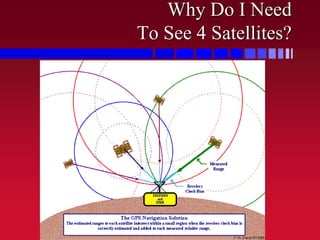
GPS Position
 By knowing how far one is from three
satellites one can ideally find their 3D
coordinates
 To correct for clock errors one needs to
receive four satellites
GPS: How does it work?
 Typical receiver: one channel C/A code on
L1
 During the “acquisition” time you are
receiving the navigation message also on L1
 The receiver then reads the timing
information and computes the “pseudo-
ranges”
 The pseudo-ranges are then corrected
GPS: How does it work?
 Corrected ranges are used to compute the
position
 This is a very complicated iterative
nonlinear equation
Navigation Message
 To compute your position one must know
the position of the satellite
 Navigation Message - transmitted on both
L1 and L2 at 50 bits/s for 30 s
 Navigation message consists of two parts:
- satellite almanac
- clock bias
Why Do I Need
To See 4 Satellites?
 The problem is that the clock signal from
the satellite is corrupted by atmospheric
refraction
 Another major problem is that the receiver’s
clock is not very accurate
 For a 2D fix <=> 3 satellites
Why Do I Need
To See 4 Satellites?
Denial of Accuracy (DOA)
 The US military uses two approaches to
prohibit use of the full resolution of the
system
 Selective Availability (SA) - noise is added
to the clock signal and the navigation
message has “lies” in it
 Anti-Spoofing (AS) - P-code is encrypted
 The military sometimes turns off both DOA
techniques
Differential GPS
 Used to improve accuracy
 Put a “satellite” on the ground at a precise
position
 Differential signal is not “transmitted” on
standard satellite frequencies
Uses of GPS
 Airplane and Boat Navigation
 Continental Drift
 Surveying
 Precise Timing
 Iceberg Tracking
 Archaeological Expeditions
 Mobile Multimedia
Applications of GPS
GPS Clock Rollover
 GPS System Time rolled over at midnight
21-22 August 1999, 132 days before the
Year 2000
 On 22 August 1999, unless repaired, many
GPS receivers claimed that it is 6 January
1980
 http://www.navcen.uscg.mil/gps/geninfo/
y2k/gpsweek.htm
Conclusion
 GPS will find more civilian uses
 DOD has promised to eliminate SA
 Russia has a system known as GLONASS
 The EU is discussing deploying its own
system
References
 B. Hofmann-Wellenhof, H. Lichtenegger,
and J. Collins, GPS: Theory and Practice,
Third Edition, Springer-Verlag, 1994.
 T. Logsdon, The Navstar Global
Positioning System, Van Nostrand, 1992.
 A. Leick, GPS Satellite Surveying, Second
edition, Wiley, 1995.
References
 T. A. Herring, "The Global Positioning
System," Scientific American, pp. 44-50,
February 1996.
 N. J. Hotchkiss, A Comprehensive Guide to
Land Navigation with GPS, Alexis, 1994.
 Special Edition on the Global Positioning
System, Satellite Times, March/April 1996.
 D. Sobel, Longitude, Walker, 1995.
Web Sites
 GPS Program Office:
http://www.laafb.af.mil/SMC/CZ/homepage/
 US Coast Guard Navaigation Center
http://www.navcen.uscg.mil/default.htm
 GPS Precise Orbits
http://www.ngs.noaa.gov/GPS/GPS.html
 GPS World Magazine
http://www.gpsworld.com/

Gps surveying

  • 1.
    Global Positioning SatelliteSystem (GPS) - Prakash Kumar Sekar
  • 2.
    Overview  The NavigationProblem  Earlier Approaches  GPS Description  How does GPS Work?
  • 3.
    Acknowledgement Many of thegraphical images used in this talk are courtesy of Peter H. Dana of the Department of Geography, University of Texas at Austin - http://www.utexas.edu/depts/grg/gcraft/ notes/gps/gps.html The best web site for GPS
  • 4.
    The Navigation Problem The ancient question: Where am I?  Earth coordinates: latitude and longitude Lafayette: N40/W86  Latitude can be determined by Sun angle  What about longitude?
  • 5.
  • 6.
  • 7.
    Longitude Problem  Noeasy way to determine longitude  On July 8, 1714 the Longitude Act was established in England to solve the “longitude problem”  Two solutions were proposed -- use of stars and moons -- the “time” solution
  • 8.
    Longitude Longitude : TheTrue Story of a Lone Genius Who Solved the Greatest Scientific Problem of His Time Dava Sobel
  • 9.
    Longitude Problem: References http://www.pbs.org/wgbh/nova/longitude/
  • 10.
    The “Time” Solution Where am I? <=> What time is it in Greenwich, England?  The ability to find one’s position is based on how well one can tell what time is it?  The development of the chronometer  To find longitude to within 0.5 degree requires a clock that loses or gains no more than 3 seconds/day
  • 11.
    Longitude  How doesthis work?  The earth turns 360 degrees in 24 hours: 15 degrees = 1 hour  If you know the time in Greenwich when it is local noon at your location one can find your longitude relative to Greenwich  Must know “datum” reference to use maps
  • 12.
    Datum Reference Lone PineCemetery - N400 13.8’’ E260 17.24”
  • 13.
    Satellite Navigation  USDepartment of Defense has need for very precise navigation  In 1973, the US Air Force proposed a new system for navigation using satellites  The system is known as: Navigation System with Timing and Ranging: Global Positioning System or NAVSTAR GPS
  • 14.
    NAVSTAR GPS Goals What time is it?  What is my position (including attitude)?  What is my velocity?  Other Goals: - What is the local time? - When is sunrise and sunset? - What is the distance between two points? - What is my estimated time arrival?
  • 15.
    GSP System Simply stated:The GPS satellites are nothing more than a set of clocks in the sky
  • 16.
    GPS Segments  SpaceSegment: the constellation of satellites  Control Segment: control the satellites  User Segment: users with receivers
  • 17.
  • 18.
    Space Segment  Systemconsists of 24 satellites in the operational mode: 21 in use and 3 spares 3 other satellites are used for testing  Altitude: 20,200 Km with periods of 12 hr.  Current Satellites: Block IIR- $25,000,000 2000 KG  Hydrogen Maser Atomic Clocks
  • 19.
    Hydrogen Maser Clock Theseclocks lose one second every 2,739,000 million years
  • 20.
  • 21.
  • 22.
    Control Segment Master ControlStation is located at the Consolidated Space Operations Center (CSOC) at Flacon Air Force Station near Colorado Springs
  • 23.
    The Global PositioningSystem. GPS antenna GPS receiver and batteries! Windows CE handheld computer Paper Map with targets Matt Evans of Abe591a and Aaron Pierce of the Biology Department; mapping the Purdue University Ross Reserve. Sample Location Flag/Pin ASM 215 April 2009
  • 24.
    User component  Individualswith GPS receivers Prakash Kumar Sekar
  • 25.
    Basic GPS SurveyingTechniques Presented by: Neil Gray, Teacher-in-Charge, Columboola EEC. On behalf of ICT Innovators Centre, STiS Project.
  • 27.
    Not sphere butspheroid  Newton and others in the 17th and 18th century proposed that the Earth is flattened due to rotational forces.  Complex, repeated, highly accurate measurements established that the curvature of the Earth was greater at the equator than the poles Image from ESRI online course Prakash Kumar Sekar
  • 28.
    Push the “Page”button until you get the screen which displays location. They will be set to display degrees, minutes and decimal seconds.
  • 29.
  • 30.
  • 31.
    Topographic assessment atDavis Purdue Ag Center
  • 32.
  • 33.
  • 34.
    Differential Correction  Tworeceivers are used to greatly improve the accuracy of GPS positional measurements  Base station at known location Prakash Kumar Sekar
  • 35.
    CSOC  Track thesatellites for orbit and clock determination  Time synchronization  Upload the Navigation Message  Manage DOA
  • 36.
    Operational Capabilities Initial OperationalCapability - December 8, 1993 Full Operational Capability declared by the Secretary of Defense at 00:01 hours on July 17, 1995
  • 37.
    GPS Transmitted Signal Two signals are transmitted on carriers: L1 = 1575.42 MHz L2 = 1227.60 MHz These are derived from the system clock of 10.23 MHz (phase quadrature)  Modulation used is Direct Sequence Spread Spectrum (code division multiple access - CDMA)
  • 38.
  • 39.
    GPS Clock Signals Two types of clock signals are transmitted  C/A Code - Coarse/Acquisition Code available for civilian use on L1 provides 300 m resolution  P Code - Precise Code on L1 and L2 used by the military provides 3m resolution
  • 40.
    Spread Spectrum  SpreadSpectrum is used because - resistance to jamming - masks the transmissions - resist multipath effects - multiple access  All 24 GPS satellites transmit on the same two frequencies BUT use a different ID sequence
  • 41.
    GPS Signals  Thesatellites transmit as part of their unique Spread Spectrum signal a clock or timing signal  The range or distance to the satellite is obtained by measuring how long it takes for the transmitted signal to reach the receiver  This is not the “true” range due to clock errors - what is obtained is know as the “pseudo-range”
  • 42.
    GPS Position  Byknowing how far one is from three satellites one can ideally find their 3D coordinates  To correct for clock errors one needs to receive four satellites
  • 43.
    GPS: How doesit work?  Typical receiver: one channel C/A code on L1  During the “acquisition” time you are receiving the navigation message also on L1  The receiver then reads the timing information and computes the “pseudo- ranges”  The pseudo-ranges are then corrected
  • 44.
    GPS: How doesit work?  Corrected ranges are used to compute the position  This is a very complicated iterative nonlinear equation
  • 45.
    Navigation Message  Tocompute your position one must know the position of the satellite  Navigation Message - transmitted on both L1 and L2 at 50 bits/s for 30 s  Navigation message consists of two parts: - satellite almanac - clock bias
  • 46.
    Why Do INeed To See 4 Satellites?  The problem is that the clock signal from the satellite is corrupted by atmospheric refraction  Another major problem is that the receiver’s clock is not very accurate  For a 2D fix <=> 3 satellites
  • 47.
    Why Do INeed To See 4 Satellites?
  • 48.
    Denial of Accuracy(DOA)  The US military uses two approaches to prohibit use of the full resolution of the system  Selective Availability (SA) - noise is added to the clock signal and the navigation message has “lies” in it  Anti-Spoofing (AS) - P-code is encrypted  The military sometimes turns off both DOA techniques
  • 49.
    Differential GPS  Usedto improve accuracy  Put a “satellite” on the ground at a precise position  Differential signal is not “transmitted” on standard satellite frequencies
  • 50.
    Uses of GPS Airplane and Boat Navigation  Continental Drift  Surveying  Precise Timing  Iceberg Tracking  Archaeological Expeditions  Mobile Multimedia
  • 51.
  • 52.
    GPS Clock Rollover GPS System Time rolled over at midnight 21-22 August 1999, 132 days before the Year 2000  On 22 August 1999, unless repaired, many GPS receivers claimed that it is 6 January 1980  http://www.navcen.uscg.mil/gps/geninfo/ y2k/gpsweek.htm
  • 53.
    Conclusion  GPS willfind more civilian uses  DOD has promised to eliminate SA  Russia has a system known as GLONASS  The EU is discussing deploying its own system
  • 54.
    References  B. Hofmann-Wellenhof,H. Lichtenegger, and J. Collins, GPS: Theory and Practice, Third Edition, Springer-Verlag, 1994.  T. Logsdon, The Navstar Global Positioning System, Van Nostrand, 1992.  A. Leick, GPS Satellite Surveying, Second edition, Wiley, 1995.
  • 55.
    References  T. A.Herring, "The Global Positioning System," Scientific American, pp. 44-50, February 1996.  N. J. Hotchkiss, A Comprehensive Guide to Land Navigation with GPS, Alexis, 1994.  Special Edition on the Global Positioning System, Satellite Times, March/April 1996.  D. Sobel, Longitude, Walker, 1995.
  • 56.
    Web Sites  GPSProgram Office: http://www.laafb.af.mil/SMC/CZ/homepage/  US Coast Guard Navaigation Center http://www.navcen.uscg.mil/default.htm  GPS Precise Orbits http://www.ngs.noaa.gov/GPS/GPS.html  GPS World Magazine http://www.gpsworld.com/