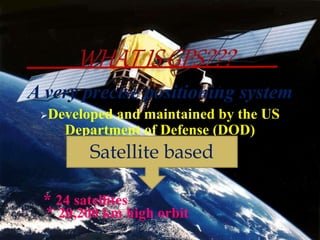
A very precise positioning system
Developed and maintained by the US
Department of Defense (DOD)
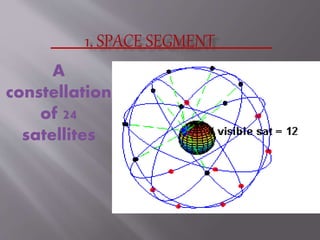
* 24 satellites
* 20,200 km high orbit
Satellite based
 Official name of GPS is Navigational Satellite Timing
And Ranging Global Positioning System (NAVSTAR
GPS)
 It costs about $750 million to manage and maintain the
system per year
 Mainly used for navigation, map-making and surveying
 The GPS project was developed in 1973 to overcome the
limitations of previous navigation systems
 It became fully operational in 1994. Roger L. Easton is
generally credited as its inventor.
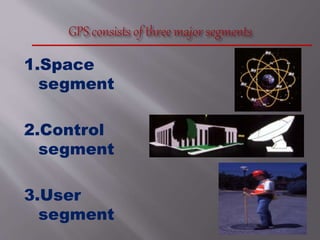
1.Space
segment
2.Control
segment
3.User
segment
A
constellation
of 24
satellites
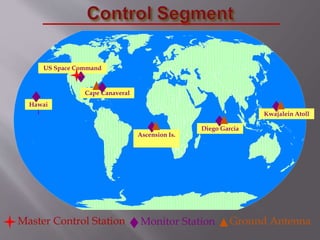
Kwajalein Atoll
US Space Command
Hawai
i
Ascension Is.
Diego Garcia
Cape Canaveral
Ground AntennaMaster Control Station Monitor Station
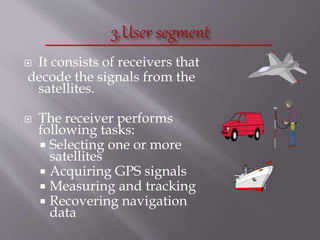
 It consists of receivers that
decode the signals from the
satellites.
 The receiver performs
following tasks:
 Selecting one or more
satellites
 Acquiring GPS signals
 Measuring and tracking
 Recovering navigation
data
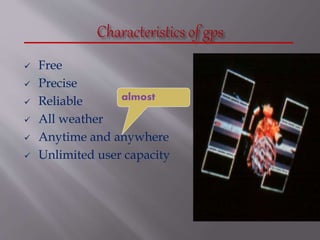
 Free
 Precise
 Reliable
 All weather
 Anytime and anywhere
 Unlimited user capacity
almost
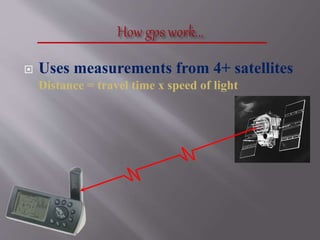
 Uses measurements from 4+ satellites
Distance = travel time x speed of light
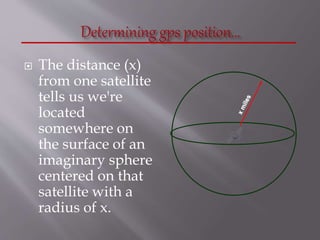
 The distance (x)
from one satellite
tells us we're
located
somewhere on
the surface of an
imaginary sphere
centered on that
satellite with a
radius of x.
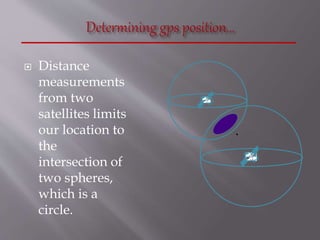
 Distance
measurements
from two
satellites limits
our location to
the
intersection of
two spheres,
which is a
circle.
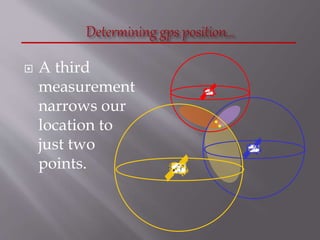
 A third
measurement
narrows our
location to
just two
points.
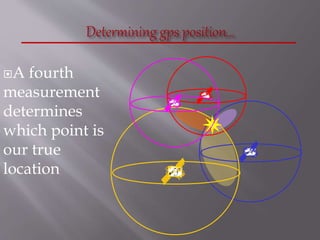
A fourth
measurement
determines
which point is
our true
location
 Each satellite transmits its own
unique code
 Two frequencies used
L1 Carrier 1.57542 GHz
L2 Carrier 1.22760 GHz
 Codes
CA Code use L1 (civilian code)
P (Y) Code use L1 & L2 (military
code)
 Many factors can affect the accuracy of GPS
data. Accuracy can range from 1 centimeter to
over 40 meters
significant parameter:-
•Number of visible
satellites
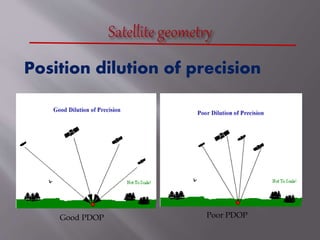
•Satellite Geometry
•Receiver Errors
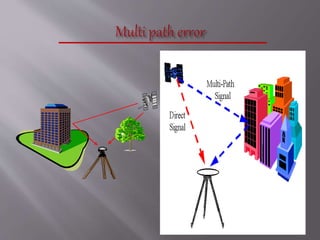
•Multipath
•Satellite Clock Errors
•Time spent on
measurement
•Atmospheric Effects
•Operator knowledge
and awareness
Position dilution of precision
Good PDOP Poor PDOP
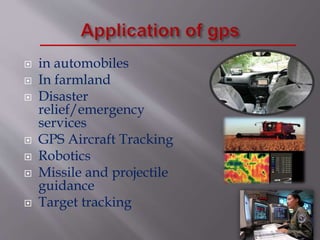
 in automobiles
 In farmland
 Disaster
relief/emergency
services
 GPS Aircraft Tracking
 Robotics
 Missile and projectile
guidance
 Target tracking
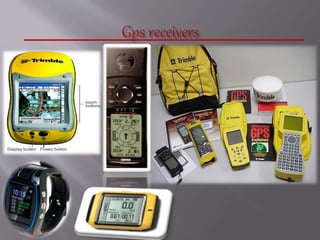
Gps
Gps

Gps

  • 2.
    A very precisepositioning system Developed and maintained by the US Department of Defense (DOD) * 24 satellites * 20,200 km high orbit Satellite based
  • 3.
     Official nameof GPS is Navigational Satellite Timing And Ranging Global Positioning System (NAVSTAR GPS)  It costs about $750 million to manage and maintain the system per year  Mainly used for navigation, map-making and surveying  The GPS project was developed in 1973 to overcome the limitations of previous navigation systems  It became fully operational in 1994. Roger L. Easton is generally credited as its inventor.
  • 4.
  • 5.
  • 6.
    Kwajalein Atoll US SpaceCommand Hawai i Ascension Is. Diego Garcia Cape Canaveral Ground AntennaMaster Control Station Monitor Station
  • 7.
     It consistsof receivers that decode the signals from the satellites.  The receiver performs following tasks:  Selecting one or more satellites  Acquiring GPS signals  Measuring and tracking  Recovering navigation data
  • 8.
     Free  Precise Reliable  All weather  Anytime and anywhere  Unlimited user capacity almost
  • 9.
     Uses measurementsfrom 4+ satellites Distance = travel time x speed of light
  • 10.
     The distance(x) from one satellite tells us we're located somewhere on the surface of an imaginary sphere centered on that satellite with a radius of x.
  • 11.
     Distance measurements from two satelliteslimits our location to the intersection of two spheres, which is a circle.
  • 12.
     A third measurement narrowsour location to just two points.
  • 13.
  • 14.
     Each satellitetransmits its own unique code  Two frequencies used L1 Carrier 1.57542 GHz L2 Carrier 1.22760 GHz  Codes CA Code use L1 (civilian code) P (Y) Code use L1 & L2 (military code)
  • 15.
     Many factorscan affect the accuracy of GPS data. Accuracy can range from 1 centimeter to over 40 meters significant parameter:- •Number of visible satellites •Satellite Geometry •Receiver Errors •Multipath •Satellite Clock Errors •Time spent on measurement •Atmospheric Effects •Operator knowledge and awareness
  • 17.
    Position dilution ofprecision Good PDOP Poor PDOP
  • 18.
     in automobiles In farmland  Disaster relief/emergency services  GPS Aircraft Tracking  Robotics  Missile and projectile guidance  Target tracking