Submitted To: Submitted By:
WHAT IS
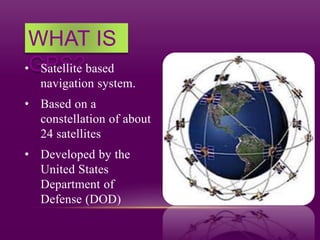
GPS?• Satellite based
navigation system.
• Based on a
constellation of about
24 satellites
• Developed by the
United States
Department of
Defense (DOD)
WHAT IS
GPS?
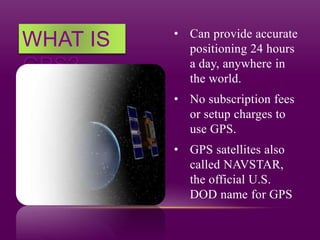
• Can provide accurate
positioning 24 hours
a day, anywhere in
the world.
• No subscription fees
or setup charges to
use GPS.
• GPS satellites also
called NAVSTAR,
the official U.S.
DOD name for GPS
STRUC
TURE
Space Segment Control Segment
User Segment
HOW GPS
DETERMINES A
LOCATION
HOW GPS
DETERMINES A
LOCATION
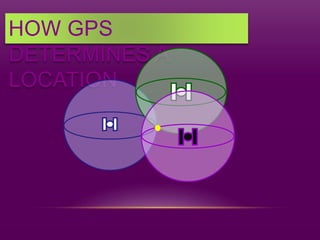
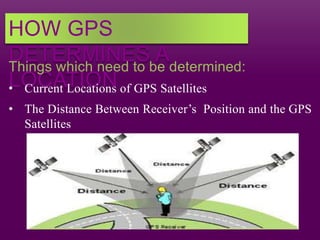
Things which need to be determined:
• Current Locations of GPS Satellites
• The Distance Between Receiver’s Position and the GPS
Satellites
CURRENT LOCATIONS OF
GPS SATELLITES
• GPS satellites are orbiting the earth at an altitude
of 11,000 miles.
• The orbits, and the locations of the satellites, are
known in advance.
• GPS receivers store this orbit information for all of
the GPS satellites in an ALMANAC*.
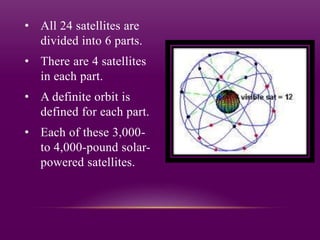
• All 24 satellites are
divided into 6 parts.
• There are 4 satellites
in each part.
• A definite orbit is
defined for each part.
• Each of these 3,000-
to 4,000-pound solar-
powered satellites.
DISTANCE BETWEEN
RECEIVER’S POSITION
& THE GPS SATELLITES• By measuring the amount of time taken by
radio signal (the GPS signal) to travel from
the satellite to the receiver.
• Radio waves travel at the speed of light, i.e.
about 186,000 miles per second.
• The distance from the satellite to the receiver
can be determined by the formula “distance =
speed x time”.
EPHEMERIS ERRORS:
• The predicted changes in the orbit of a
satellite.
• Which cause a deviation of 0 to 5 m.
from the actual position of receiver
CLOCK DRIFT:
• Due to different code generations in
satellite and receiver simultaneously.
• Which cause a deviation of 0 to 1.5 m.
from the actual position of receiver
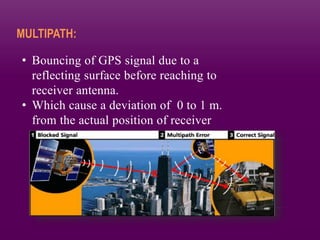
MULTIPATH:
• Bouncing of GPS signal due to a
reflecting surface before reaching to
receiver antenna.
• Which cause a deviation of 0 to 1 m.
from the actual position of receiver
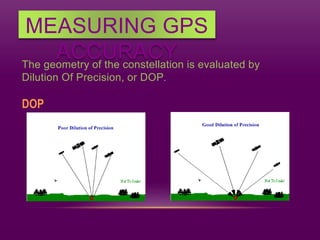
MEASURING GPS
ACCURACYThe geometry of the constellation is evaluated by
Dilution Of Precision, or DOP.
DOP
INCREASING
ACCURACY OF GPS• Differential correction provides accuracy within 1-5 m.
• Coarse Acquisition receiver provides accuracy within
1-5m.
• Carrier Phase receivers provides accuracy within 10-30
cm.
• Dual-Frequency receivers are capable of providing sub-
centimeter GPS position accuracy.
APPLICA
TIONS
AVIATION AGRICULTURE
MARINE TIMING
SPACE RAILWAYS
ROADWAYS DISASTER RELIEF
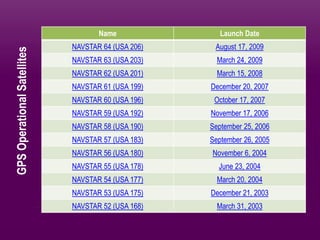
Name Launch Date
NAVSTAR 64 (USA 206) August 17, 2009
NAVSTAR 63 (USA 203) March 24, 2009
NAVSTAR 62 (USA 201) March 15, 2008
NAVSTAR 61 (USA 199) December 20, 2007
NAVSTAR 60 (USA 196) October 17, 2007
NAVSTAR 59 (USA 192) November 17, 2006
NAVSTAR 58 (USA 190) September 25, 2006
NAVSTAR 57 (USA 183) September 26, 2005
NAVSTAR 56 (USA 180) November 6, 2004
NAVSTAR 55 (USA 178) June 23, 2004
NAVSTAR 54 (USA 177) March 20, 2004
NAVSTAR 53 (USA 175) December 21, 2003
NAVSTAR 52 (USA 168) March 31, 2003
GPSOperationalSatellites
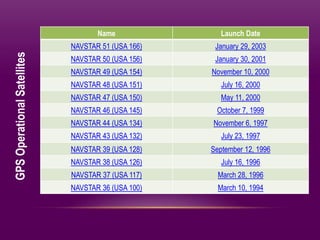
Name Launch Date
NAVSTAR 51 (USA 166) January 29, 2003
NAVSTAR 50 (USA 156) January 30, 2001
NAVSTAR 49 (USA 154) November 10, 2000
NAVSTAR 48 (USA 151) July 16, 2000
NAVSTAR 47 (USA 150) May 11, 2000
NAVSTAR 46 (USA 145) October 7, 1999
NAVSTAR 44 (USA 134) November 6, 1997
NAVSTAR 43 (USA 132) July 23, 1997
NAVSTAR 39 (USA 128) September 12, 1996
NAVSTAR 38 (USA 126) July 16, 1996
NAVSTAR 37 (USA 117) March 28, 1996
NAVSTAR 36 (USA 100) March 10, 1994
GPSOperationalSatellites
Gpsppt 130412005659-phpapp01

Gpsppt 130412005659-phpapp01

  • 1.
  • 2.
    WHAT IS GPS?• Satellitebased navigation system. • Based on a constellation of about 24 satellites • Developed by the United States Department of Defense (DOD)
  • 3.
    WHAT IS GPS? • Canprovide accurate positioning 24 hours a day, anywhere in the world. • No subscription fees or setup charges to use GPS. • GPS satellites also called NAVSTAR, the official U.S. DOD name for GPS
  • 4.
  • 5.
  • 6.
    HOW GPS DETERMINES A LOCATION Thingswhich need to be determined: • Current Locations of GPS Satellites • The Distance Between Receiver’s Position and the GPS Satellites
  • 7.
    CURRENT LOCATIONS OF GPSSATELLITES • GPS satellites are orbiting the earth at an altitude of 11,000 miles. • The orbits, and the locations of the satellites, are known in advance. • GPS receivers store this orbit information for all of the GPS satellites in an ALMANAC*.
  • 8.
    • All 24satellites are divided into 6 parts. • There are 4 satellites in each part. • A definite orbit is defined for each part. • Each of these 3,000- to 4,000-pound solar- powered satellites.
  • 9.
    DISTANCE BETWEEN RECEIVER’S POSITION &THE GPS SATELLITES• By measuring the amount of time taken by radio signal (the GPS signal) to travel from the satellite to the receiver. • Radio waves travel at the speed of light, i.e. about 186,000 miles per second. • The distance from the satellite to the receiver can be determined by the formula “distance = speed x time”.
  • 10.
    EPHEMERIS ERRORS: • Thepredicted changes in the orbit of a satellite. • Which cause a deviation of 0 to 5 m. from the actual position of receiver CLOCK DRIFT: • Due to different code generations in satellite and receiver simultaneously. • Which cause a deviation of 0 to 1.5 m. from the actual position of receiver
  • 11.
    MULTIPATH: • Bouncing ofGPS signal due to a reflecting surface before reaching to receiver antenna. • Which cause a deviation of 0 to 1 m. from the actual position of receiver
  • 12.
    MEASURING GPS ACCURACYThe geometryof the constellation is evaluated by Dilution Of Precision, or DOP. DOP
  • 13.
    INCREASING ACCURACY OF GPS•Differential correction provides accuracy within 1-5 m. • Coarse Acquisition receiver provides accuracy within 1-5m. • Carrier Phase receivers provides accuracy within 10-30 cm. • Dual-Frequency receivers are capable of providing sub- centimeter GPS position accuracy.
  • 14.
  • 15.
  • 16.
    Name Launch Date NAVSTAR64 (USA 206) August 17, 2009 NAVSTAR 63 (USA 203) March 24, 2009 NAVSTAR 62 (USA 201) March 15, 2008 NAVSTAR 61 (USA 199) December 20, 2007 NAVSTAR 60 (USA 196) October 17, 2007 NAVSTAR 59 (USA 192) November 17, 2006 NAVSTAR 58 (USA 190) September 25, 2006 NAVSTAR 57 (USA 183) September 26, 2005 NAVSTAR 56 (USA 180) November 6, 2004 NAVSTAR 55 (USA 178) June 23, 2004 NAVSTAR 54 (USA 177) March 20, 2004 NAVSTAR 53 (USA 175) December 21, 2003 NAVSTAR 52 (USA 168) March 31, 2003 GPSOperationalSatellites
  • 17.
    Name Launch Date NAVSTAR51 (USA 166) January 29, 2003 NAVSTAR 50 (USA 156) January 30, 2001 NAVSTAR 49 (USA 154) November 10, 2000 NAVSTAR 48 (USA 151) July 16, 2000 NAVSTAR 47 (USA 150) May 11, 2000 NAVSTAR 46 (USA 145) October 7, 1999 NAVSTAR 44 (USA 134) November 6, 1997 NAVSTAR 43 (USA 132) July 23, 1997 NAVSTAR 39 (USA 128) September 12, 1996 NAVSTAR 38 (USA 126) July 16, 1996 NAVSTAR 37 (USA 117) March 28, 1996 NAVSTAR 36 (USA 100) March 10, 1994 GPSOperationalSatellites

Editor's Notes

  • #3 The Global Positioning System (GPS) is a satellite-based navigation system made up of a network of 24 satellites placed into orbit by the U.S. Department of Defense. GPS was originally intended for military applications, but in the 1980s, the government made the system available for civilian use
  • #7 How does the Global Positioning System work ? Updated 26th June 2011   Article by Darren Griffin   Introduction When I first wrote this article back in 2002, consumer grade GPS was very new, very expensive and very rare! Consequently most of those who chose to invest in GPS hardware had a vested interest in discovering how this marvel of technology worked. Back in 2001 when map based GPS navigation first arrived, new users could not believe that the system was fee free with no service plan and no contract, what was the catch they all asked? And so the seed of an idea that became this explanation was born.   6+ years on GPS is mainstream, a commodity item that is no longer amazing or to be marveled at. We just open the box, switch on and use it with little thought to the technology that drives it. But it is still worth explaining how a small black box sat on your dashboard or held in your hand can know where you are anywhere on the surface of the planet to an accuracy of about 10m for consumer grade and 10mm for survey grade devices! That device on your dash is receiving a signal from a satellite orbiting above you at an altitude of over 11,000 miles! Not bad for a device that is not connected to a 2m dish!   Background - Navstar The Global Positioning System (GPS) network we all use is called Navstar and is paid for and operated by the US Department of Defence (DoD). This Global Navigation Satellite System (GNSS) is currently the only fully operational system but Russia has GLONASS, China has COMPASS and the EU has GALILEO each at varying stages of development or testing.   As a military system, Navstar was originally designed and reserved for the sole use of the military but civilian users were allowed access in 1983. Back then, accuracy for civilian users was intentionally degraded to +/- 100m using a system known as Selective Availability (SA) but this was eliminated in May 2000.   The Satellite Network The GPS satellites transmit signals to a GPS receiver. These receivers passively receive satellite signals; they do not transmit and require an unobstructed view of the sky, so they can only be used effectively outdoors. Early receivers did not perform well within forested areas or near tall buildings but later receiver designs such as SiRFStarIII, MTK etc have overcome this and improved performance and sensitivity markedly. GPS operations depend on a very accurate time reference, which is provided by atomic clocks on board the satellites.   The Navstar GPS Constellation   Each GPS satellite transmits data that indicates its location and the current time. All GPS satellites synchronize operations so that these repeating signals are transmitted at the same instant. The signals, moving at the speed of light, arrive at a GPS receiver at slightly different times because some satellites are further away than others. The distance to the GPS satellites can be determined by estimating the amount of time it takes for their signals to reach the receiver. When the receiver estimates the distance to at least four GPS satellites, it can calculate its position in three dimensions.   There are at least 24 operational GPS satellites at all times plus a number of spares.  The satellites, operated by the US DoD, orbit with a period of 12 hours (two orbits per day) at a height of about 11,500 miles traveling at 9,000mph (3.9km/s or 14,000kph). Ground stations are used to precisely track each satellite's orbit.   Here is an interesting comparison. The GPS signals are transmitted at a power equivalent to a 50 watt domestic light bulb. Those signal have to pass through space and our atmosphere before reaching your satnav after a journey of 11,500 miles. Compare that with a TV signal, transmitted from a large tower 10 - 20 miles away at most, at a power level of 5-10,000 watts. And compare the size of your TV's roof mounted antenna with that of your GPS, often hidden inside the case itself. A wonder then that it works as well as it does and when the occasional hiccup occurs you will at least understand the reasons why.   Signals from multiple satellites are required to calculate a position   How Position is Determined A GPS receiver "knows" the location of the satellites because that information is included in the transmitted Ephemeris data (see below). By estimating how far away a satellite is, the receiver also "knows" it is located somewhere on the surface of an imaginary sphere centred at the satellite. It then determines the sizes of several spheres, one for each satellite and therefore knows the receiver is located where these spheres intersect
  • #8 * the Almanac is a file which contains positional information for all of the GPS satellites