T H E G R O U P P A R T N E R S
LITTLE
BOOK
Group Partners was created to fill a gap. It was born from a frustration
caused by the groundhog day of meetings and the inability to provide or
receive clear briefs. Over the last 10 years we have evolved our Practice
into what we like to call the ‘Pixar of Consulting’.
Our mission is to change the way that
Businesses think and work - and avoid solving
the wrong problems really well.
We have introduced a new and engaging way
to shape the future – through a philosophy
that we call Structured Visual Thinking™
– SVT™. Encouraging thinking this way is
proven to be the difference between success
and failure, innovation and diminishing
value, clarity and confusion.
Achieving targets is rarely solely dependant
on those working within the organisation.
Most large organisations have to operate in
a much larger ‘eco system’ where the internal
challenges are further complicated by multiple
partnership and alliance, different agendas,
conflicting priorities and multiple definitions
and interpretations.
This is the world that we thrive in
– one that demands 21st Century
thinking and techniques.
In Our
Experience
The pressures faced by businesses and
organisations in the 21st Century, , mean
that it is rare these days for senior leaderships
teams to be fully aligned and in tune with
all of the challenges that each leader and
their departments faces. In our view there
are many reasons for this and we see the
effects and consequences in nearly all of our
engagements. Nearly all of these causes link
back to one common theme.
Organisations are simply not designed for
collaboration and integration:
• Targetsandgoalsaresetagainstindividual
departments and often conflict
• There are no meaningful or effective
consequences for failure – or success
• There are often significant disconnects
between the senior leadership and their
strategy and vision and the ‘day job’
Unpacking SVT™
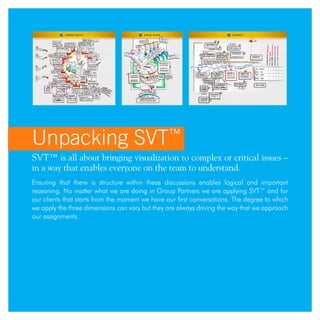
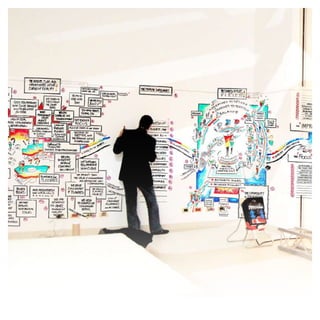
SVT™ is all about bringing visualization to complex or critical issues –
in a way that enables everyone on the team to understand.
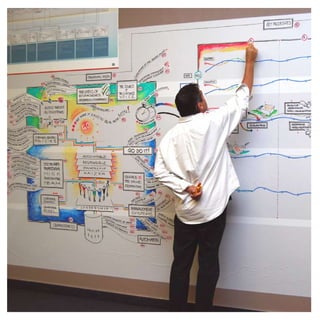
Ensuring that there is structure within these discussions enables logical and important
reasoning. No matter what we are doing in Group Partners we are applying SVT™ and for
our clients that starts from the moment we have our first conversations. The degree to which
we apply the three dimensions can vary but they are always driving the way that we approach
our assignments.
There is no deep or hidden meaning behind the three – 			
they mean exactly what they you might expect:
Structure – without some structure to a challenge and without being about to create
some degree of order from complexity, it is particularly challenging to shape the future. For
us structure primarily takes the form of architectures and frameworks within which we can
develop context. We have developed an approach called 4D™ which we will explain later.
Visual – even for people who wouldn’t class themselves as visual or creative, an image
provides significantly more clarity and meaning that words alone. Visualization brings a subject
to life and removes ambiguity and semantics. There was a time when it was the only form of
communication – telling stories through pictures dates back to the earliest days of man. We
have a very unique approach to visualization.
Thinking – the world that we live in today is not exactly conducive to taking time out to
think, time is becoming too rare a commodity and the result is that we spend most of our
time simply reacting or just ‘doing’. We believe that quality time now and then – especially at
critical times in a businesses lifecycle – pays dividends and should never be underestimated
or undervalued.
It is sometimes quite hard for people to fully appreciate the benefits of this approach until they
actually experience it fully, and we often find it hard ourselves to explain the core principles and
why it is so effective.
Our aim is to achieve simplicity for the client - achieving that is anything but simple!
Through this article we
would like to invite you into
our world and share a little
of our passion with you.
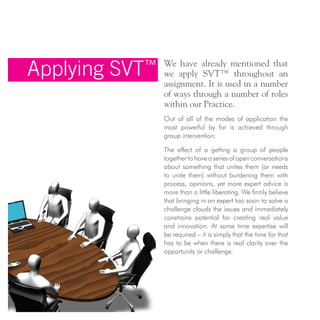
Applying SVT™ We have already mentioned that
we apply SVT™ throughout an
assignment. It is used in a number
of ways through a number of roles
within our Practice.
Out of all of the modes of application the
most powerful by far is achieved through
group intervention.
The effect of a getting a group of people
togethertohaveaseriesofopenconversations
about something that unites them (or needs
to unite them) without burdening them with
process, opinions, yet more expert advice is
more than a little liberating. We firmly believe
that bringing in an expert too soon to solve a
challenge clouds the issues and immediately
constrains potential for creating real value
and innovation. At some time expertise will
be required – it is simply that the time for that
has to be when there is real clarity over the
opportunity or challenge.
As Lewis Carroll famously said:
If you don’t know where
you are going, any road
will take you there.
– therefore it goes without saying that if you ask an expert what your problem is they will
immediately solve it from within their sphere of expertise.
Trust us –
it Works!
Coming to a workshop unprepared
and without the inevitable slide
decks to present or a declared
method to follow can require a
leap of faith.
For us there is a fine balance between
providing enough information to reassure
attendees and too much that overwhelms
them. It is also much more valuable if
attendees arrive with open minds – so any
advance questions or actions are carefully
considered so that we are not guilty of
leading the witness ahead of the discussions.
There is a lot more structure and logic to this
process than will be immediately obvious
– this is due to the 4D™ approach that we
have developed over the years. All of our
conversations find their way into a logic
framework – or at least the critical aspects
of the conversations, the insights and
observations that will help the team to gain
value from the engagement and equip them
to continue to work on the program after we
have completed our assignment.
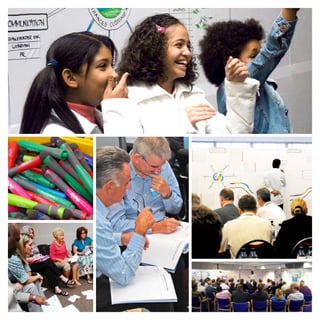
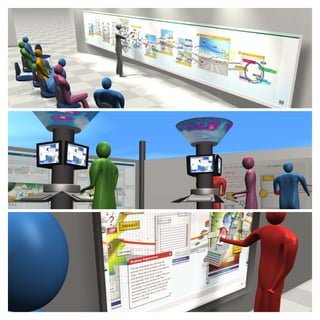
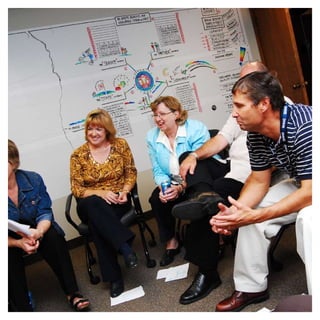
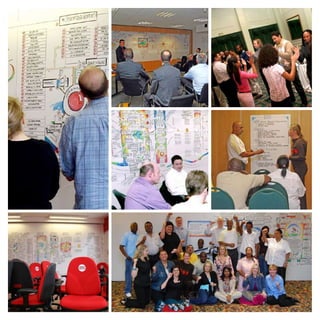
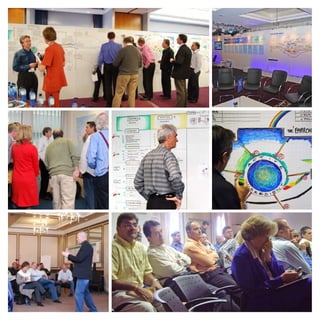
Our workshops are fun, highly interactive,
very inclusive and intense. They are meant
for teams who want to have a real say in the
future success of their company; they require
focus, commitment and engagement.
And they work – as long as that
commitment persists beyond
the event.
The Science
Behind the
Approach
Knowing how to guide and
interpret conversation and
how to make the most of
complex information is where
we claim expertise.
We have been thinking like this for
many years – for us it is the only way
to think and we spend a significant
amount of time exploring related
philosophies and capturing experiences
so that we keep our approach
continuously evolving and responding
to changes and new insights – our
thinking has to stay relevant to the
world in which we all operate.
Introducing
Frameworks
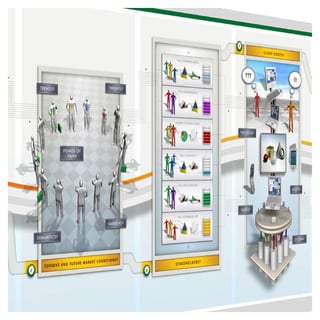
4D™ is framework approach that
underpins 4 steps covering everything
from strategy definition through to
planning implementation.
This is simply a logical sequence of progression and
you will find many variations of this theme – this
one works well in our world and has the benefit of a
governing logic framework supporting each step.
The first thing that we do is to form a concise
statement of the problem that we are trying to solve.
We call this the Exam Question and it will shape and
govern every conversation that we have as a group.
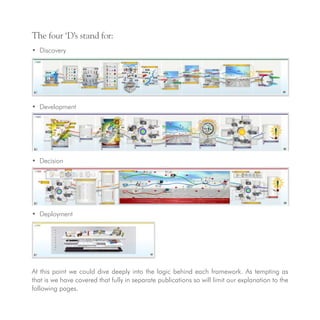
• Development
• Decision
• Deployment
The four ‘D’s stand for:
• Discovery
At this point we could dive deeply into the logic behind each framework. As tempting as
that is we have covered that fully in separate publications so will limit our explanation to the
following pages.
DEVELOPMENT
DISCOVERY
DECISIONDEPLOYMENT
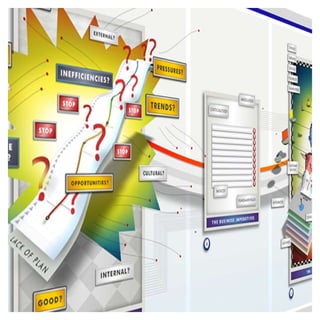
Discovery – is about building alignment as a team and
uniting against a clearly defined challenge / problem /
opportunity. There are 11 conversations that are governed by
the Discovery Framework and we spend a day in session with
the team to populate it.
The Framework is underpinned by a logic that connects each
module to present a whole systems approach to the outcome.
This is the Business Equation. In Discovery this reads:
By what decision criteria [H] do we decide what value
proposition, story or offer [G] about which mix of product [E]
and/or service [F], gets delivered through which channels [D],
addressing what trend, market issue or point of pain [C], to
which (most valuable) customer segments [B], resolving what
aspiration or need [A]. With what capabilities and behaviors [I],
against what time-line [J] achieving the goals [K] at minimum
risk and maximum return on investment?
D1
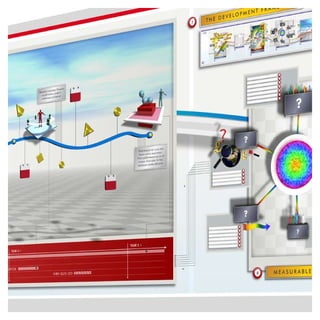
Development – is about framing our strategy or program
and building the rationale for the business case and
implementation plan. This framework makes sure that we really
are building a program that will deliver the outcomes we want.
There are eight conversations in this framework. We spend two
days with the team to create the first baseline and often work
on multiple iterations.
Development is also supported by its own Business Equation:
To achieve the desired Strategic Outcome; (the ultimate
goal) (H) and deliver the Redefined Conditions (G); (the
measurable effects that result) optimally enabled by the
necessary Governance, Capability and Cultural Environment
Operating Model (F) - what is the planned Roadmap of
Activities and Actions (E), (Action Plan) that will deliver against
the integrated Strategic Themes (D) that themselves are directly
driving the effects in (G) and take the business towards the new
Future Vision (C) based on the Business Imperatives (B) (the
business drivers) which will move the business away from the
Current Reality (A) and fully answer the Exam Question.
D2
Decision – is about making sure that we make the best
possible choices regarding how we implement our strategy
and manage the risks and uncertainties. Apart from the
cascading information from the previous two frameworks
there are three new conversations in this step. Decision
sessions can run for three days in extreme cases.
D3
Deployment – we only really have one conversation
at this stage – but a hugely significant one that leads to
many subordinate conversations. Deployment is all about
doing whatever we decided we would do to achieve our
vision. This is where it becomes quite appropriate to bring
in experts if the capability is not available internally.
D4
The Complete
Lifecycle
A complete lifecycle for us typically
runs for 4 – 6 weeks – based on an
initial engagement. We don’t scope
programs beyond that as that would
mean we were making assumptions
about the likely outcome.
Many clients to ask us to continue to support
them – through further refinement, return
health/maturity checks, team on boarding
and communication. Our programs are
designed so that there is no dependency
built in – we make the logic of the framework
freely available and encourage the team to
continue to apply it. And we leave teams
equipped with the outcomes fully packaged
and with supporting guidance for its
continued use.
Sometimes members of our Expert Network –
people who support our philosophy and can
help clients to sustain the program – will be
called in to work with the team after we have
handed over the reins.
We called ourselves
Group Partners
quite deliberately...
Our intention is to grow through
partnership - helping others to
apply SVT™ themselves. We
have a few models that we can
consider for doing this.
1. Our partners ask us to establish the
foundations for a larger programme.
2. We work with partners within our Expert
Network to jointly deliver a programme.
3. We develop a joint offering that combines
the 4D approach™ with a partners core
capability. This has been done to great
effect in areas like Customer Excellence
where the additional capability also
shares a strong neutral stance.
4. We accredit and licence others to apply
all or parts of our approach using
specially built tools and with appropriate
capability transfer and support.
Typical Programs
We establish the most appropriate program for an assignment once
we have a clear brief and have started to shape the Exam Question.
However there are a number of ‘species’ of program that form the basis
of any engagement:
1. Entry level - alignment of teams and creation of strategy
or high level change/transformation programmes
2. Team Engagement - socialisation and engagement of
the enterprise around a new strategy or programme
3. Effective Communications - bringing stories to life
through sophisticated interactive tools that can be
deployed across the enterprise
4. Excellence programmes - unpacking a strategy
or programme to focus on specific areas where
excellence is the ambition - Customer, Operational and
Leadership
5. Making Change Stick - working with our sister company
- Affiniti - to ensure that the vision and programme is
embraced and sustained throughout the enterprise
“Helping our clients avoid solving the wrong problem really well...”
Group Partners America
111 West John Street, Suite 302
Seattle, WA 98119
Group Partners Europe
32 St James’s Street, Mayfair
London SW1A 1HD, UK
www.grouppartners.net
www.grouppartnerswiki.net

Gp Multicoloured Book4 Lr

  • 1.
    T H EG R O U P P A R T N E R S LITTLE BOOK
  • 3.
    Group Partners wascreated to fill a gap. It was born from a frustration caused by the groundhog day of meetings and the inability to provide or receive clear briefs. Over the last 10 years we have evolved our Practice into what we like to call the ‘Pixar of Consulting’. Our mission is to change the way that Businesses think and work - and avoid solving the wrong problems really well. We have introduced a new and engaging way to shape the future – through a philosophy that we call Structured Visual Thinking™ – SVT™. Encouraging thinking this way is proven to be the difference between success and failure, innovation and diminishing value, clarity and confusion.
  • 5.
    Achieving targets israrely solely dependant on those working within the organisation. Most large organisations have to operate in a much larger ‘eco system’ where the internal challenges are further complicated by multiple partnership and alliance, different agendas, conflicting priorities and multiple definitions and interpretations. This is the world that we thrive in – one that demands 21st Century thinking and techniques. In Our Experience The pressures faced by businesses and organisations in the 21st Century, , mean that it is rare these days for senior leaderships teams to be fully aligned and in tune with all of the challenges that each leader and their departments faces. In our view there are many reasons for this and we see the effects and consequences in nearly all of our engagements. Nearly all of these causes link back to one common theme. Organisations are simply not designed for collaboration and integration: • Targetsandgoalsaresetagainstindividual departments and often conflict • There are no meaningful or effective consequences for failure – or success • There are often significant disconnects between the senior leadership and their strategy and vision and the ‘day job’
  • 7.
    Unpacking SVT™ SVT™ isall about bringing visualization to complex or critical issues – in a way that enables everyone on the team to understand. Ensuring that there is structure within these discussions enables logical and important reasoning. No matter what we are doing in Group Partners we are applying SVT™ and for our clients that starts from the moment we have our first conversations. The degree to which we apply the three dimensions can vary but they are always driving the way that we approach our assignments.
  • 9.
    There is nodeep or hidden meaning behind the three – they mean exactly what they you might expect: Structure – without some structure to a challenge and without being about to create some degree of order from complexity, it is particularly challenging to shape the future. For us structure primarily takes the form of architectures and frameworks within which we can develop context. We have developed an approach called 4D™ which we will explain later. Visual – even for people who wouldn’t class themselves as visual or creative, an image provides significantly more clarity and meaning that words alone. Visualization brings a subject to life and removes ambiguity and semantics. There was a time when it was the only form of communication – telling stories through pictures dates back to the earliest days of man. We have a very unique approach to visualization. Thinking – the world that we live in today is not exactly conducive to taking time out to think, time is becoming too rare a commodity and the result is that we spend most of our time simply reacting or just ‘doing’. We believe that quality time now and then – especially at critical times in a businesses lifecycle – pays dividends and should never be underestimated or undervalued. It is sometimes quite hard for people to fully appreciate the benefits of this approach until they actually experience it fully, and we often find it hard ourselves to explain the core principles and why it is so effective. Our aim is to achieve simplicity for the client - achieving that is anything but simple!
  • 11.
    Through this articlewe would like to invite you into our world and share a little of our passion with you.
  • 12.
    Applying SVT™ Wehave already mentioned that we apply SVT™ throughout an assignment. It is used in a number of ways through a number of roles within our Practice. Out of all of the modes of application the most powerful by far is achieved through group intervention. The effect of a getting a group of people togethertohaveaseriesofopenconversations about something that unites them (or needs to unite them) without burdening them with process, opinions, yet more expert advice is more than a little liberating. We firmly believe that bringing in an expert too soon to solve a challenge clouds the issues and immediately constrains potential for creating real value and innovation. At some time expertise will be required – it is simply that the time for that has to be when there is real clarity over the opportunity or challenge.
  • 13.
    As Lewis Carrollfamously said: If you don’t know where you are going, any road will take you there. – therefore it goes without saying that if you ask an expert what your problem is they will immediately solve it from within their sphere of expertise.
  • 14.
  • 15.
    Coming to aworkshop unprepared and without the inevitable slide decks to present or a declared method to follow can require a leap of faith. For us there is a fine balance between providing enough information to reassure attendees and too much that overwhelms them. It is also much more valuable if attendees arrive with open minds – so any advance questions or actions are carefully considered so that we are not guilty of leading the witness ahead of the discussions. There is a lot more structure and logic to this process than will be immediately obvious – this is due to the 4D™ approach that we have developed over the years. All of our conversations find their way into a logic framework – or at least the critical aspects of the conversations, the insights and observations that will help the team to gain value from the engagement and equip them to continue to work on the program after we have completed our assignment. Our workshops are fun, highly interactive, very inclusive and intense. They are meant for teams who want to have a real say in the future success of their company; they require focus, commitment and engagement. And they work – as long as that commitment persists beyond the event.
  • 17.
    The Science Behind the Approach Knowinghow to guide and interpret conversation and how to make the most of complex information is where we claim expertise. We have been thinking like this for many years – for us it is the only way to think and we spend a significant amount of time exploring related philosophies and capturing experiences so that we keep our approach continuously evolving and responding to changes and new insights – our thinking has to stay relevant to the world in which we all operate.
  • 19.
    Introducing Frameworks 4D™ is frameworkapproach that underpins 4 steps covering everything from strategy definition through to planning implementation. This is simply a logical sequence of progression and you will find many variations of this theme – this one works well in our world and has the benefit of a governing logic framework supporting each step. The first thing that we do is to form a concise statement of the problem that we are trying to solve. We call this the Exam Question and it will shape and govern every conversation that we have as a group.
  • 21.
    • Development • Decision •Deployment The four ‘D’s stand for: • Discovery At this point we could dive deeply into the logic behind each framework. As tempting as that is we have covered that fully in separate publications so will limit our explanation to the following pages.
  • 23.
  • 25.
    Discovery – isabout building alignment as a team and uniting against a clearly defined challenge / problem / opportunity. There are 11 conversations that are governed by the Discovery Framework and we spend a day in session with the team to populate it. The Framework is underpinned by a logic that connects each module to present a whole systems approach to the outcome. This is the Business Equation. In Discovery this reads: By what decision criteria [H] do we decide what value proposition, story or offer [G] about which mix of product [E] and/or service [F], gets delivered through which channels [D], addressing what trend, market issue or point of pain [C], to which (most valuable) customer segments [B], resolving what aspiration or need [A]. With what capabilities and behaviors [I], against what time-line [J] achieving the goals [K] at minimum risk and maximum return on investment? D1
  • 27.
    Development – isabout framing our strategy or program and building the rationale for the business case and implementation plan. This framework makes sure that we really are building a program that will deliver the outcomes we want. There are eight conversations in this framework. We spend two days with the team to create the first baseline and often work on multiple iterations. Development is also supported by its own Business Equation: To achieve the desired Strategic Outcome; (the ultimate goal) (H) and deliver the Redefined Conditions (G); (the measurable effects that result) optimally enabled by the necessary Governance, Capability and Cultural Environment Operating Model (F) - what is the planned Roadmap of Activities and Actions (E), (Action Plan) that will deliver against the integrated Strategic Themes (D) that themselves are directly driving the effects in (G) and take the business towards the new Future Vision (C) based on the Business Imperatives (B) (the business drivers) which will move the business away from the Current Reality (A) and fully answer the Exam Question. D2
  • 29.
    Decision – isabout making sure that we make the best possible choices regarding how we implement our strategy and manage the risks and uncertainties. Apart from the cascading information from the previous two frameworks there are three new conversations in this step. Decision sessions can run for three days in extreme cases. D3
  • 31.
    Deployment – weonly really have one conversation at this stage – but a hugely significant one that leads to many subordinate conversations. Deployment is all about doing whatever we decided we would do to achieve our vision. This is where it becomes quite appropriate to bring in experts if the capability is not available internally. D4
  • 33.
    The Complete Lifecycle A completelifecycle for us typically runs for 4 – 6 weeks – based on an initial engagement. We don’t scope programs beyond that as that would mean we were making assumptions about the likely outcome. Many clients to ask us to continue to support them – through further refinement, return health/maturity checks, team on boarding and communication. Our programs are designed so that there is no dependency built in – we make the logic of the framework freely available and encourage the team to continue to apply it. And we leave teams equipped with the outcomes fully packaged and with supporting guidance for its continued use. Sometimes members of our Expert Network – people who support our philosophy and can help clients to sustain the program – will be called in to work with the team after we have handed over the reins.
  • 36.
    We called ourselves GroupPartners quite deliberately...
  • 37.
    Our intention isto grow through partnership - helping others to apply SVT™ themselves. We have a few models that we can consider for doing this. 1. Our partners ask us to establish the foundations for a larger programme. 2. We work with partners within our Expert Network to jointly deliver a programme. 3. We develop a joint offering that combines the 4D approach™ with a partners core capability. This has been done to great effect in areas like Customer Excellence where the additional capability also shares a strong neutral stance. 4. We accredit and licence others to apply all or parts of our approach using specially built tools and with appropriate capability transfer and support.
  • 39.
    Typical Programs We establishthe most appropriate program for an assignment once we have a clear brief and have started to shape the Exam Question. However there are a number of ‘species’ of program that form the basis of any engagement: 1. Entry level - alignment of teams and creation of strategy or high level change/transformation programmes 2. Team Engagement - socialisation and engagement of the enterprise around a new strategy or programme 3. Effective Communications - bringing stories to life through sophisticated interactive tools that can be deployed across the enterprise 4. Excellence programmes - unpacking a strategy or programme to focus on specific areas where excellence is the ambition - Customer, Operational and Leadership 5. Making Change Stick - working with our sister company - Affiniti - to ensure that the vision and programme is embraced and sustained throughout the enterprise
  • 40.
    “Helping our clientsavoid solving the wrong problem really well...” Group Partners America 111 West John Street, Suite 302 Seattle, WA 98119 Group Partners Europe 32 St James’s Street, Mayfair London SW1A 1HD, UK www.grouppartners.net www.grouppartnerswiki.net