
Presented by www.slideshop.com
It is easy to understand the
concept of change
management. Let’s take a look
at Prosci’s definition:
“Change management is the application of a structured
process and set of tools for leading the people side of
change to achieve a desired outcome.”
But once change implementation has
started, things can get so stressful.
“Any change, even a change for the better, is always
accompanied by drawbacks and discomforts.”
Arnold Bennett
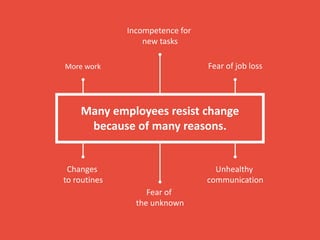
Many employees resist change
because of many reasons.
Changes
to routines
More work Fear of job loss
Incompetence for
new tasks
Unhealthy
communication
Fear of
the unknown
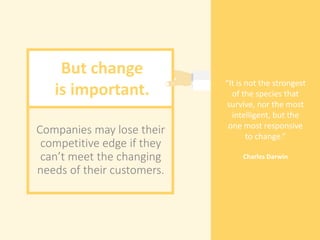
But change
is important.
“It is not the strongest
of the species that
survive, nor the most
intelligent, but the
one most responsive
to change.”
Charles Darwin
Companies may lose their
competitive edge if they
can’t meet the changing
needs of their customers.
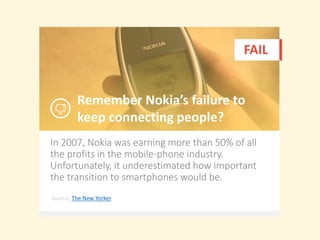
In 2007, Nokia was earning more than 50% of all
the profits in the mobile-phone industry.
Unfortunately, it underestimated how important
the transition to smartphones would be.
Remember Nokia’s failure to
keep connecting people?
FAIL
Source: The New Yorker
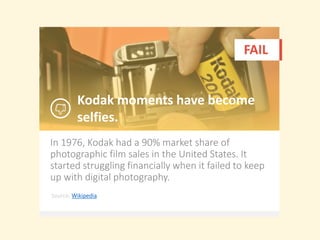
In 1976, Kodak had a 90% market share of
photographic film sales in the United States. It
started struggling financially when it failed to keep
up with digital photography.
Kodak moments have become
selfies.
FAIL
Source: Wikipedia
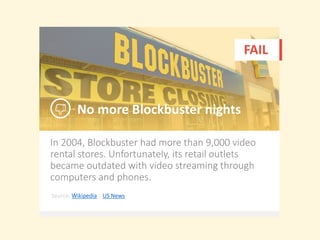
In 2004, Blockbuster had more than 9,000 video
rental stores. Unfortunately, its retail outlets
became outdated with video streaming through
computers and phones.
No more Blockbuster nights
FAIL
Source: Wikipedia | US News
So if you want your business to keep going,
remember this:
Growth comes with
changes.
Successful change management
entails a lot of planning.
Here are 6 questions to help you plan for
change management in your organization.
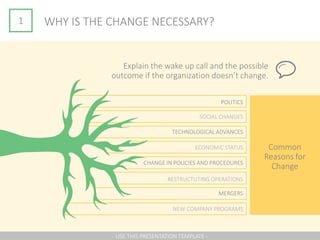
1 WHY IS THE CHANGE NECESSARY?
Explain the wake up call and the possible
outcome if the organization doesn’t change.
Common
Reasons for
Change
- USE THIS PRESENTATION TEMPLATE -
POLITICS
SOCIAL CHANGES
TECHNOLOGICAL ADVANCES
ECONOMIC STATUS
CHANGE IN POLICIES AND PROCEDURES
RESTRUCTUTING OPERATIONS
MERGERS
NEW COMPANY PROGRAMS
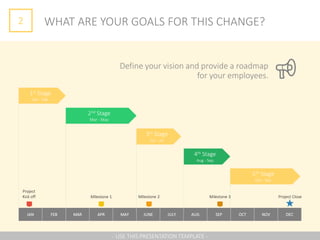
2 WHAT ARE YOUR GOALS FOR THIS CHANGE?
Define your vision and provide a roadmap
for your employees.
JAN FEB MAR APR MAY JUNE JULY AUG SEP OCT NOV DEC
1st Stage
Jan - Feb
2nd Stage
Mar - May
3rd Stage
Jun - Jul
4th Stage
Aug - Sep
5th Stage
Oct - Dec
Project
Kick off Milestone 1 Milestone 2 Milestone 3 Project Close
- USE THIS PRESENTATION TEMPLATE -
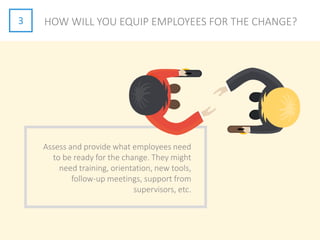
3 HOW WILL YOU EQUIP EMPLOYEES FOR THE CHANGE?
Assess and provide what employees need
to be ready for the change. They might
need training, orientation, new tools,
follow-up meetings, support from
supervisors, etc.
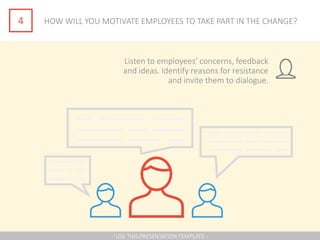
4 HOW WILL YOU MOTIVATE EMPLOYEES TO TAKE PART IN THE CHANGE?
Listen to employees’ concerns, feedback
and ideas. Identify reasons for resistance
and invite them to dialogue.
- USE THIS PRESENTATION TEMPLATE -
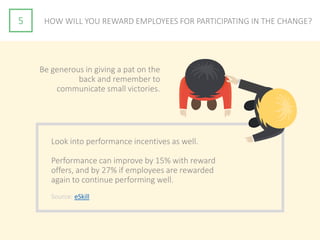
5 HOW WILL YOU REWARD EMPLOYEES FOR PARTICIPATING IN THE CHANGE?
Be generous in giving a pat on the
back and remember to
communicate small victories.
Source: eSkill
Look into performance incentives as well.
Performance can improve by 15% with reward
offers, and by 27% if employees are rewarded
again to continue performing well.
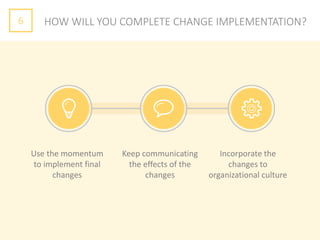
6 HOW WILL YOU COMPLETE CHANGE IMPLEMENTATION?
Use the momentum
to implement final
changes
Keep communicating
the effects of the
changes
Incorporate the
changes to
organizational culture
Get ready for the next change!
Only the wisest and stupidest of men never change.
- Confucius -
contact: support@slideshop.com
fb: theslideshop
twitter: @slide_shop
blog: http://blog.slideshop.com/
pinterest: Slideshop
slideshare: slideshop.com
phone number: +1 602 559 4554
The world's leading
supplier of unique, creative
and effective PowerPoint
templates.
Do you want to customize
this presentation?
Download it on our website.
Download

6 Questions to Ask Before Implementing Change in Organizations

  • 1.
  • 2.
    It is easyto understand the concept of change management. Let’s take a look at Prosci’s definition: “Change management is the application of a structured process and set of tools for leading the people side of change to achieve a desired outcome.”
  • 3.
    But once changeimplementation has started, things can get so stressful. “Any change, even a change for the better, is always accompanied by drawbacks and discomforts.” Arnold Bennett
  • 4.
    Many employees resistchange because of many reasons. Changes to routines More work Fear of job loss Incompetence for new tasks Unhealthy communication Fear of the unknown
  • 5.
    But change is important. “Itis not the strongest of the species that survive, nor the most intelligent, but the one most responsive to change.” Charles Darwin Companies may lose their competitive edge if they can’t meet the changing needs of their customers.
  • 6.
    In 2007, Nokiawas earning more than 50% of all the profits in the mobile-phone industry. Unfortunately, it underestimated how important the transition to smartphones would be. Remember Nokia’s failure to keep connecting people? FAIL Source: The New Yorker
  • 7.
    In 1976, Kodakhad a 90% market share of photographic film sales in the United States. It started struggling financially when it failed to keep up with digital photography. Kodak moments have become selfies. FAIL Source: Wikipedia
  • 8.
    In 2004, Blockbusterhad more than 9,000 video rental stores. Unfortunately, its retail outlets became outdated with video streaming through computers and phones. No more Blockbuster nights FAIL Source: Wikipedia | US News
  • 9.
    So if youwant your business to keep going, remember this: Growth comes with changes.
  • 10.
    Successful change management entailsa lot of planning. Here are 6 questions to help you plan for change management in your organization.
  • 11.
    1 WHY ISTHE CHANGE NECESSARY? Explain the wake up call and the possible outcome if the organization doesn’t change. Common Reasons for Change - USE THIS PRESENTATION TEMPLATE - POLITICS SOCIAL CHANGES TECHNOLOGICAL ADVANCES ECONOMIC STATUS CHANGE IN POLICIES AND PROCEDURES RESTRUCTUTING OPERATIONS MERGERS NEW COMPANY PROGRAMS
  • 12.
    2 WHAT AREYOUR GOALS FOR THIS CHANGE? Define your vision and provide a roadmap for your employees. JAN FEB MAR APR MAY JUNE JULY AUG SEP OCT NOV DEC 1st Stage Jan - Feb 2nd Stage Mar - May 3rd Stage Jun - Jul 4th Stage Aug - Sep 5th Stage Oct - Dec Project Kick off Milestone 1 Milestone 2 Milestone 3 Project Close - USE THIS PRESENTATION TEMPLATE -
  • 13.
    3 HOW WILLYOU EQUIP EMPLOYEES FOR THE CHANGE? Assess and provide what employees need to be ready for the change. They might need training, orientation, new tools, follow-up meetings, support from supervisors, etc.
  • 14.
    4 HOW WILLYOU MOTIVATE EMPLOYEES TO TAKE PART IN THE CHANGE? Listen to employees’ concerns, feedback and ideas. Identify reasons for resistance and invite them to dialogue. - USE THIS PRESENTATION TEMPLATE -
  • 15.
    5 HOW WILLYOU REWARD EMPLOYEES FOR PARTICIPATING IN THE CHANGE? Be generous in giving a pat on the back and remember to communicate small victories. Source: eSkill Look into performance incentives as well. Performance can improve by 15% with reward offers, and by 27% if employees are rewarded again to continue performing well.
  • 16.
    6 HOW WILLYOU COMPLETE CHANGE IMPLEMENTATION? Use the momentum to implement final changes Keep communicating the effects of the changes Incorporate the changes to organizational culture
  • 17.
    Get ready forthe next change! Only the wisest and stupidest of men never change. - Confucius -
  • 18.
    contact: support@slideshop.com fb: theslideshop twitter:@slide_shop blog: http://blog.slideshop.com/ pinterest: Slideshop slideshare: slideshop.com phone number: +1 602 559 4554 The world's leading supplier of unique, creative and effective PowerPoint templates. Do you want to customize this presentation? Download it on our website. Download