HLP entwicklungspartner GbR . Voltastraße 31 . D-60486 Frankfurt . info@hlp-entwicklungspartner.de
Telefon: 0049(69)43 00 820-00 . Telefax: 0049(69)43 00 820-10 . www.hlp-entwicklungspartner.de
Dr. Jens-Peter Abresch
Fabian Berg
Clemens Frowein
TRANSFORMATION DESIGNTRANSFORMATION DESIGNTRANSFORMATION DESIGNTRANSFORMATION DESIGN
Next Generation Change Management - for
Organization-Movers and Lean Enterprise-Changers
6. August 2013
epepepep TRANSFORMATION DESIGNTRANSFORMATION DESIGNTRANSFORMATION DESIGNTRANSFORMATION DESIGN
Change the way you changeChange the way you changeChange the way you changeChange the way you change
Become a OrganizationBecome a OrganizationBecome a OrganizationBecome a Organization----MoverMoverMoverMover
and Enterpriseand Enterpriseand Enterpriseand Enterprise----DisruptorDisruptorDisruptorDisruptor
Change with new spirit ofChange with new spirit ofChange with new spirit ofChange with new spirit of
Design Thinking +Design Thinking +Design Thinking +Design Thinking +
CollaborationCollaborationCollaborationCollaboration
epepepep TRANSFORMATION DESIGNTRANSFORMATION DESIGNTRANSFORMATION DESIGNTRANSFORMATION DESIGN
Transformation and change management often is planned and orchestrated by experts and consultants. Managers
and affected employees find this quite normal. But not to involve those who are subjects to the transformation in
the design process already is giving away a huge opportunity. We learned from the field of strategy with the
approach of Alex Osterwalder (Business Model Generation) , that this kind of early involvement leads to more
successful results also in change management.
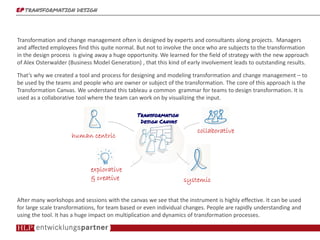
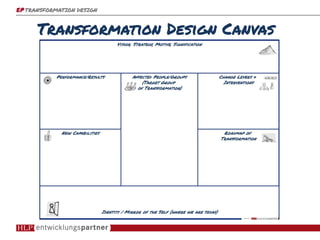
That’s why we created a tool and a process for designing and modeling organizational change – to be used by
teams and people with ownership of the transformation. At the core of this approach is the “Transformation
Canvas”. We understand this tableau as a common grammar for teams to design transformation. It is used as a
collaborative tool where the team can work on by visualizing the input.
After many workshops and sessions with the canvas we see that the instrument is highly effective. It can be used
for large scale transformations, for team based or even individual changes. People are rapidly understanding and
using the tool. It has a huge impact on multiplication and dynamics of transformation processes.
collaborativecollaborativecollaborativecollaborative
systemicsystemicsystemicsystemic
eeeexplorativexplorativexplorativexplorative
& creative& creative& creative& creative
hhhhuman centricuman centricuman centricuman centric
Transformation DesignTransformation DesignTransformation DesignTransformation Design
CanvasCanvasCanvasCanvas
epepepep TRANSFORMATION DESIGNTRANSFORMATION DESIGNTRANSFORMATION DESIGNTRANSFORMATION DESIGN
Transformation Design CanvasTransformation Design CanvasTransformation Design CanvasTransformation Design Canvas
epepepep TRANSFORMATION DESIGNTRANSFORMATION DESIGNTRANSFORMATION DESIGNTRANSFORMATION DESIGN Vision, Strategy, Motive, Signification
Identity / Mirror of the Self (where we are today)
New Performance/
New Results
Affected People/Groups
& Relationships
(Target Group of Transformation)
New Capabilities
Change Levers
& key interventions
Roadmap
of the Transformation
copyright
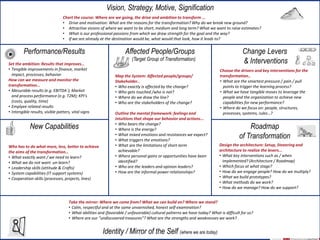
Set the ambition: Results that improve…
• Tangible improvements in finance, market
impact, processes, behavior
How can we measure and monitor the
transformation…
• Measurable results (e.g. EBITDA´); Market
and process performance (e.g. T2M); KPI‘s
(costs, quality, time)
• Employee related results
• Intangible results, visible patters, vital signs
Map the System: Affected people/groups/
Stakeholder..
• Who exactly is affected by the change?
• Who gets touched /who is not?
• Where do we draw the line?
• Who are the stakeholders of the change?
Outline the mental framework: feelings and
intuitions that shape our behavior and actions...
• Who bears the change?
• Where is the energy?
• What mixed emotions and resistances we expect?
• What triggers the emotions?
• What are the limitations of short-term
achievable?
• Where personal gains or opportunities have been
identified?
• Who are the leaders and opinion leaders?
• How are the informal power relationships?
Choose the drivers and key interventions for the
transformation..
• What are the smartest pressure / pain / pull
points to trigger the learning process?
• What we have tangible moves to leverage the
people and the organization to achieve new
capabilities for new performance?
• Where do we focus on: people, structures,
processes, systems, rules and values …?
Design the architecture: Setup, steering and
(reporting) structure to realize the levers...
• What interventions such as / when implemented?
(Architecture / Roadmap)
• Which focus at what stage?
• How do we engage people? How do we multiply?
• What change prototypes can we build?
• What methods will work?
• How do we manage, how do we support?
Who has to do what, more, less, better to achieve
the goals of the transformation …
• What exactly want / need to learn?
• What we do not want un-learn?
• Leadership skills (attitude & crafts)?
• System capabilities (IT support systems)?
• Co-operation skills (processes, projects, lines)?
Chart the course: Where are we going, the drive and ambition to transform ...
• Drive and motivation: What are the reasons for the transformation? Why do we break new ground?
• Attractive visions of where we want to be short, medium and long term? What we want to raise estimates?
• What are our professional passions from which we draw strength for the goal and the way?
• If we are already at the destination would be, what would that look, how it leads to?
Hold up the mirror to yourself: Where do we come from? What we can build on? Where we stand today?
• Calm, respectful and at the same time unvarnished, honest self-examination?
• What abilities and (favorable / unfavorable) cultural patterns we have today? What is difficult for us?
• Where are our “hidden treasures"? What are the strengths and weaknesses we work with?
epepepep TRANSFORMATION DESIGNTRANSFORMATION DESIGNTRANSFORMATION DESIGNTRANSFORMATION DESIGN
6
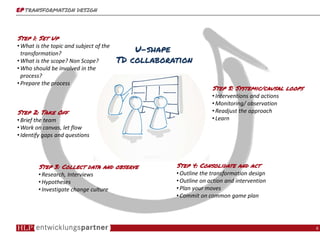
StepStepStepStep 1:1:1:1:
SetSetSetSet UpUpUpUp &&&& taketaketaketake offoffoffoff
•What is the topic and subject of the
transformation?
•What is the scope? Non-Scope?
•Who should be involved in the
process?
•Prepare the process
StepStepStepStep 2222
ExploreExploreExploreExplore andandandand observeobserveobserveobserve
•Research, Interviews
•Hypotheses
•Investigate the change culture StepStepStepStep 3:3:3:3:
Design, Prototype, TestDesign, Prototype, TestDesign, Prototype, TestDesign, Prototype, Test
•Outline the transformation design
•Outline of actions and interventions
•Prototype the design, test it
•Commit on common game plan i.e. roadmap
StepStepStepStep 54545454
manage,manage,manage,manage, LearnLearnLearnLearn,,,, ImproveImproveImproveImprove
•Plan the moves
•Interventions and actions
•Monitoring/ observation
•Re-adjust the approach
•Learn and acquire new capabilities
UUUU----shapeshapeshapeshape
Transformation DesignTransformation DesignTransformation DesignTransformation Design
epepepep TRANSFORMATION DESIGNTRANSFORMATION DESIGNTRANSFORMATION DESIGNTRANSFORMATION DESIGN
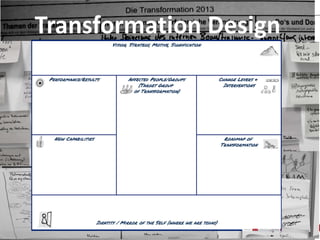
Vision, Strategy, Motive, Signification
Identity / Mirror of the Self (where we are today)
New Performance/
New Results
Affected People/Groups
& Relationships
New Capabilities
Change Levers &
Interventions
Roadmap of
Transformation
copyright
epepepep TRANSFORMATION DESIGNTRANSFORMATION DESIGNTRANSFORMATION DESIGNTRANSFORMATION DESIGN
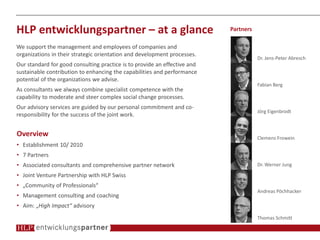
HLP entwicklungspartner – at a glance
Dr. Jens-Peter Abresch
Fabian Berg
Jörg Eigenbrodt
Clemens Frowein
Dr. Werner Jung
Andreas Pöchhacker
Thomas Schmitt
We support the management and employees of companies and
organizations in their strategic orientation and development processes.
Our standard for good consulting practice is to provide an effective and
sustainable contribution to enhancing the capabilities and performance
potential of the organizations we advise.
As consultants we always combine specialist competence with the
capability to moderate and steer complex social change processes.
Our advisory services are guided by our personal commitment and co-
responsibility for the success of the joint work.
Overview
• Establishment 10/ 2010
• 7 Partners
• Associated consultants and comprehensive partner network
• Joint Venture Partnership with HLP Swiss
• „Community of Professionals“
• Management consulting and coaching
• Aim: „High Impact“ advisory
Partners
Our consulting approach
HLP entwicklungspartner advises privately-owned companies, public institutions and curch organizations. Our team currently boasts
7 partners. All the colleagues are long-time experienced in management consulting.
Our open business model means that we are able to provide our service with a strong network of consultants and partners. This
allows us to offer customized teams and advisory services to our clients. We do not aim for the largest possible consulting
intervention – our approach is exclusively oriented to the quality of the advisory service.
Our corporate philosophy aims at long-term, partnership-based client relationships with a high degree of trust between clients and
consultants. We do not sell consulting products; rather we are integral part of our clients development processes. Our business is
generated less through classical acquisition but rather through personal recommendation.
Our motivation is a genuine and personal interest in developing the strategic, organizational and management competencies and
capabilities of our clients with all their idiosyncrasies, their culture and history, their orientation and aims.
Our measure for the success of our work is the long-term stability of the client’s organization. Our clients value us as a sparring
partner and advisor in their orientation and the design of their processes, in the professionalization of their project work, in the
improvement of organizational management, leadership and cooperation. Our consulting approach relies on sustainable common,
and also painstaking, development and transformation.
We are neither better experts nor better managers than our clients. We support organizations in their development assuming the
role of the external partner, with respect for the capabilities and expertise of our clients. This also means being at eye level with our
clients, having the courage for critical feedback and appropriate confrontation, as well as adopting an open attitude to our own
advisory possibilities and limitations.
Our experience shows that we are successful in organizations seeking such a consulting approach: Clients, therefore, who want to
change and who in doing so desire a true development partnership.
HLP entwicklungspartner GbR . Voltastraße 31 . D-60486 Frankfurt . info@hlp-entwicklungspartner.de
Telefon: 0049(69)43 00 820-00 . Telefax: 0049(69)43 00 820-10 . www.hlp-entwicklungspartner.de
HLP Swiss Managementberatung GmbH · Wankdorffeldstrasse 102 · Postfach 261 · CH-3000 Bern 22
Telefon: +41 31 972 06 12 · post@hlp-swiss.ch · www.hlp-swiss.ch

TRANSFORMATION DESIGN

  • 1.
    HLP entwicklungspartner GbR. Voltastraße 31 . D-60486 Frankfurt . info@hlp-entwicklungspartner.de Telefon: 0049(69)43 00 820-00 . Telefax: 0049(69)43 00 820-10 . www.hlp-entwicklungspartner.de Dr. Jens-Peter Abresch Fabian Berg Clemens Frowein TRANSFORMATION DESIGNTRANSFORMATION DESIGNTRANSFORMATION DESIGNTRANSFORMATION DESIGN Next Generation Change Management - for Organization-Movers and Lean Enterprise-Changers 6. August 2013
  • 2.
    epepepep TRANSFORMATION DESIGNTRANSFORMATIONDESIGNTRANSFORMATION DESIGNTRANSFORMATION DESIGN Change the way you changeChange the way you changeChange the way you changeChange the way you change Become a OrganizationBecome a OrganizationBecome a OrganizationBecome a Organization----MoverMoverMoverMover and Enterpriseand Enterpriseand Enterpriseand Enterprise----DisruptorDisruptorDisruptorDisruptor Change with new spirit ofChange with new spirit ofChange with new spirit ofChange with new spirit of Design Thinking +Design Thinking +Design Thinking +Design Thinking + CollaborationCollaborationCollaborationCollaboration
  • 3.
    epepepep TRANSFORMATION DESIGNTRANSFORMATIONDESIGNTRANSFORMATION DESIGNTRANSFORMATION DESIGN Transformation and change management often is planned and orchestrated by experts and consultants. Managers and affected employees find this quite normal. But not to involve those who are subjects to the transformation in the design process already is giving away a huge opportunity. We learned from the field of strategy with the approach of Alex Osterwalder (Business Model Generation) , that this kind of early involvement leads to more successful results also in change management. That’s why we created a tool and a process for designing and modeling organizational change – to be used by teams and people with ownership of the transformation. At the core of this approach is the “Transformation Canvas”. We understand this tableau as a common grammar for teams to design transformation. It is used as a collaborative tool where the team can work on by visualizing the input. After many workshops and sessions with the canvas we see that the instrument is highly effective. It can be used for large scale transformations, for team based or even individual changes. People are rapidly understanding and using the tool. It has a huge impact on multiplication and dynamics of transformation processes. collaborativecollaborativecollaborativecollaborative systemicsystemicsystemicsystemic eeeexplorativexplorativexplorativexplorative & creative& creative& creative& creative hhhhuman centricuman centricuman centricuman centric Transformation DesignTransformation DesignTransformation DesignTransformation Design CanvasCanvasCanvasCanvas
  • 4.
    epepepep TRANSFORMATION DESIGNTRANSFORMATIONDESIGNTRANSFORMATION DESIGNTRANSFORMATION DESIGN Transformation Design CanvasTransformation Design CanvasTransformation Design CanvasTransformation Design Canvas
  • 5.
    epepepep TRANSFORMATION DESIGNTRANSFORMATIONDESIGNTRANSFORMATION DESIGNTRANSFORMATION DESIGN Vision, Strategy, Motive, Signification Identity / Mirror of the Self (where we are today) New Performance/ New Results Affected People/Groups & Relationships (Target Group of Transformation) New Capabilities Change Levers & key interventions Roadmap of the Transformation copyright Set the ambition: Results that improve… • Tangible improvements in finance, market impact, processes, behavior How can we measure and monitor the transformation… • Measurable results (e.g. EBITDA´); Market and process performance (e.g. T2M); KPI‘s (costs, quality, time) • Employee related results • Intangible results, visible patters, vital signs Map the System: Affected people/groups/ Stakeholder.. • Who exactly is affected by the change? • Who gets touched /who is not? • Where do we draw the line? • Who are the stakeholders of the change? Outline the mental framework: feelings and intuitions that shape our behavior and actions... • Who bears the change? • Where is the energy? • What mixed emotions and resistances we expect? • What triggers the emotions? • What are the limitations of short-term achievable? • Where personal gains or opportunities have been identified? • Who are the leaders and opinion leaders? • How are the informal power relationships? Choose the drivers and key interventions for the transformation.. • What are the smartest pressure / pain / pull points to trigger the learning process? • What we have tangible moves to leverage the people and the organization to achieve new capabilities for new performance? • Where do we focus on: people, structures, processes, systems, rules and values …? Design the architecture: Setup, steering and (reporting) structure to realize the levers... • What interventions such as / when implemented? (Architecture / Roadmap) • Which focus at what stage? • How do we engage people? How do we multiply? • What change prototypes can we build? • What methods will work? • How do we manage, how do we support? Who has to do what, more, less, better to achieve the goals of the transformation … • What exactly want / need to learn? • What we do not want un-learn? • Leadership skills (attitude & crafts)? • System capabilities (IT support systems)? • Co-operation skills (processes, projects, lines)? Chart the course: Where are we going, the drive and ambition to transform ... • Drive and motivation: What are the reasons for the transformation? Why do we break new ground? • Attractive visions of where we want to be short, medium and long term? What we want to raise estimates? • What are our professional passions from which we draw strength for the goal and the way? • If we are already at the destination would be, what would that look, how it leads to? Hold up the mirror to yourself: Where do we come from? What we can build on? Where we stand today? • Calm, respectful and at the same time unvarnished, honest self-examination? • What abilities and (favorable / unfavorable) cultural patterns we have today? What is difficult for us? • Where are our “hidden treasures"? What are the strengths and weaknesses we work with?
  • 6.
    epepepep TRANSFORMATION DESIGNTRANSFORMATIONDESIGNTRANSFORMATION DESIGNTRANSFORMATION DESIGN 6 StepStepStepStep 1:1:1:1: SetSetSetSet UpUpUpUp &&&& taketaketaketake offoffoffoff •What is the topic and subject of the transformation? •What is the scope? Non-Scope? •Who should be involved in the process? •Prepare the process StepStepStepStep 2222 ExploreExploreExploreExplore andandandand observeobserveobserveobserve •Research, Interviews •Hypotheses •Investigate the change culture StepStepStepStep 3:3:3:3: Design, Prototype, TestDesign, Prototype, TestDesign, Prototype, TestDesign, Prototype, Test •Outline the transformation design •Outline of actions and interventions •Prototype the design, test it •Commit on common game plan i.e. roadmap StepStepStepStep 54545454 manage,manage,manage,manage, LearnLearnLearnLearn,,,, ImproveImproveImproveImprove •Plan the moves •Interventions and actions •Monitoring/ observation •Re-adjust the approach •Learn and acquire new capabilities UUUU----shapeshapeshapeshape Transformation DesignTransformation DesignTransformation DesignTransformation Design
  • 7.
    epepepep TRANSFORMATION DESIGNTRANSFORMATIONDESIGNTRANSFORMATION DESIGNTRANSFORMATION DESIGN Vision, Strategy, Motive, Signification Identity / Mirror of the Self (where we are today) New Performance/ New Results Affected People/Groups & Relationships New Capabilities Change Levers & Interventions Roadmap of Transformation copyright
  • 8.
    epepepep TRANSFORMATION DESIGNTRANSFORMATIONDESIGNTRANSFORMATION DESIGNTRANSFORMATION DESIGN
  • 9.
    HLP entwicklungspartner –at a glance Dr. Jens-Peter Abresch Fabian Berg Jörg Eigenbrodt Clemens Frowein Dr. Werner Jung Andreas Pöchhacker Thomas Schmitt We support the management and employees of companies and organizations in their strategic orientation and development processes. Our standard for good consulting practice is to provide an effective and sustainable contribution to enhancing the capabilities and performance potential of the organizations we advise. As consultants we always combine specialist competence with the capability to moderate and steer complex social change processes. Our advisory services are guided by our personal commitment and co- responsibility for the success of the joint work. Overview • Establishment 10/ 2010 • 7 Partners • Associated consultants and comprehensive partner network • Joint Venture Partnership with HLP Swiss • „Community of Professionals“ • Management consulting and coaching • Aim: „High Impact“ advisory Partners
  • 10.
    Our consulting approach HLPentwicklungspartner advises privately-owned companies, public institutions and curch organizations. Our team currently boasts 7 partners. All the colleagues are long-time experienced in management consulting. Our open business model means that we are able to provide our service with a strong network of consultants and partners. This allows us to offer customized teams and advisory services to our clients. We do not aim for the largest possible consulting intervention – our approach is exclusively oriented to the quality of the advisory service. Our corporate philosophy aims at long-term, partnership-based client relationships with a high degree of trust between clients and consultants. We do not sell consulting products; rather we are integral part of our clients development processes. Our business is generated less through classical acquisition but rather through personal recommendation. Our motivation is a genuine and personal interest in developing the strategic, organizational and management competencies and capabilities of our clients with all their idiosyncrasies, their culture and history, their orientation and aims. Our measure for the success of our work is the long-term stability of the client’s organization. Our clients value us as a sparring partner and advisor in their orientation and the design of their processes, in the professionalization of their project work, in the improvement of organizational management, leadership and cooperation. Our consulting approach relies on sustainable common, and also painstaking, development and transformation. We are neither better experts nor better managers than our clients. We support organizations in their development assuming the role of the external partner, with respect for the capabilities and expertise of our clients. This also means being at eye level with our clients, having the courage for critical feedback and appropriate confrontation, as well as adopting an open attitude to our own advisory possibilities and limitations. Our experience shows that we are successful in organizations seeking such a consulting approach: Clients, therefore, who want to change and who in doing so desire a true development partnership.
  • 11.
    HLP entwicklungspartner GbR. Voltastraße 31 . D-60486 Frankfurt . info@hlp-entwicklungspartner.de Telefon: 0049(69)43 00 820-00 . Telefax: 0049(69)43 00 820-10 . www.hlp-entwicklungspartner.de HLP Swiss Managementberatung GmbH · Wankdorffeldstrasse 102 · Postfach 261 · CH-3000 Bern 22 Telefon: +41 31 972 06 12 · post@hlp-swiss.ch · www.hlp-swiss.ch