Disruptive Innovation
Members
MELWIN MATHEW
NOWFAL
MUHAMMAD RASHID.A
TAMJEED ROSHAN
GOOGLE
• Google is an American multinational technology company specializing
in Internet-related services and products. These include online
advertising technologies, search, cloud computing, software,
and hardware.
• Google was founded in 1996 by Larry Page and Sergey Brin while they
were P.H.D.. students at Stanford University, in California. Together,
they own about 14 percent of its shares and control 56 percent of the
stockholder voting power through supervoting stock.
• Revenue : 89.46 billion USD
• Headquarter: Google plexMountain View, California, U.S.
Products and services
• Advertising :For the 2006 fiscal year, the company reported
$10.492 billion in total advertising revenues and only $112 million in
licensing and other revenues. In 2011, 96% of Google's revenue was
derived from its advertising programs
• Search engine:According to market research published
by comScore in November 2009, Google Search is the dominant
search engine in the United States market, with a market share of
65.6%. Google indexes billions of web pages, so that users can search
for the information they desire through the use of keywords
and operators.
• Enterprise services: G Suiteis a monthly subscription offering for
organizations and businesses to get access to a collection of Google's
services, including Gmail, Google Drive and Docs, Sheets, and Slides,
with additional administrative tools, unique domain names, and 24/7
support
• Google Search Appliance was launched in February 2002, targeted
toward providing search technology for larger organizations.[7] Google
launched the Mini three years later, which was targeted at smaller
organizations
• Consumer services:In 2004, Google launched Gmail, a web-based
email service, with a significantly higher storage offer than
competitors. Gmail grew to become the world's most popular email
service, with over a billion active users in February 2016
• Internet services:
In February 2010, Google announced the Google Fiber project, with
experimental plans to build an ultra-high-speed broadband network
for 50,000 to 500,000 customers in one or more American cities
Meaning of Disruptive
Innovation
A disruptive innovation is an innovation that creates a new
market and value network and eventually disrupts an existing
market and value network, displacing established market
leading firms, products and alliances.
Major Innovations By Google
1. Google Driverless Car and Bike
2. Google Android
3. Google Loon
4. Google Map
5. Google Contact Lens
6. Google Youtube
7. google Translator
8. Google Glass
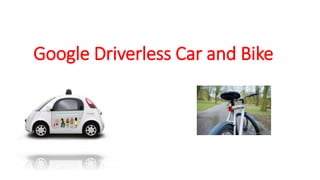
Google Driverless Car and Bike
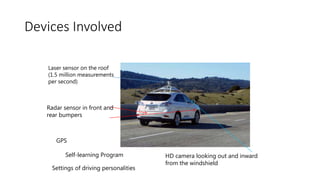
Devices Involved
Laser sensor on the roof
(1.5 million measurements
per second)
Radar sensor in front and
rear bumpers
GPS
Settings of driving personalities
Self-learning Program HD camera looking out and inward
from the windshield
Advantages
1. Efficient use of highways
2. Optimal speed
3. Reduction in car accidents
4. Saving of parking space
5. Transportation will no longer be a hindrance
Challenges
Cost Issue
Total cost: US$ 300,000
includes:
• Laser system - $ 70,000
• Hi-tech Equipment - $ 150,000
• Driverless car” still illegal in 50 states
•
Google Android
Google Android
Using : Smartphones, tablet computers, Android TV, Android Auto and Android Wear
Versions
Android 1.0 - September 2008
Android 1.5 (Cupcake) - April 2009
Android 1.6 (Donut) - September 2009
Android 2.0 (Éclair) - October 2009
Android 2.2 (Froyo) - May 2010
Android 2.3 (Gingerbread) - December 2010
Android 3.0 (Honeycomb) - February 2011
Android 4.0 (Ice Cream Sandwich) - October 2011
Android 4.1 (Jelly Bean) - June 2012
Android 4.4 (KitKat) - September 2013
Android 5.0 (Lollipop) - November 2014
Android 6.0 (Marshmallow) 2016
Android 7.0 (Nougat) 2016
Google Loon
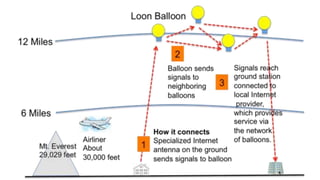
• Developed by Google X
• Key people: Rich DeVaul, Mike Cassidy and Cyrus Behroozi.
• Officially announced on 14 June 2013.
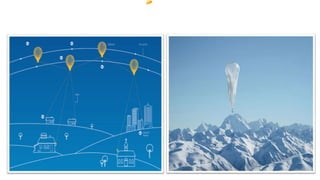
• A network of balloons travelling on the edge of space.
• Provide Internet access to rural and remote areas.
Features
• Fly between 60,000 and 90,000 feet.
• Create an aerial wireless network with up to 4G-like speeds.
• Solar-powered and have rechargeable batteries.
• Equipped with GPS and weather monitoring equipment.
Advantages
• Availability of Information in rural and remote areas
• Use of Renewable Energy
• Education
• Health and Medicine
• Lower Cost to build
Disadvantages
• Need over flight permissions in countries
• Durability of balloons
• Hardware failure
• Weather Adversities
Google Map
ABOUT GOOGLE
MAPS
● launched in 2005
● web mapping service and technology supported by Google that
can be used on desktop computers and smart phones
● provide various map information including satellite images, street
view, weather, traffic, business locations and more
March 5, 2015
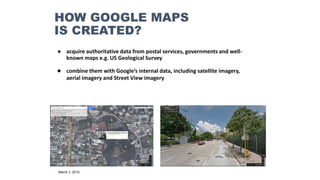
HOW GOOGLE MAPS
IS CREATED?
● acquire authoritative data from postal services, governments and well-
known maps e.g. US Geological Survey
● combine them with Google’s internal data, including satellite imagery,
aerial imagery and Street View imagery
March 5, 2015
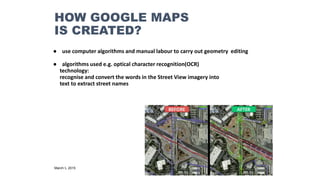
HOW GOOGLE MAPS
IS CREATED?
● use computer algorithms and manual labour to carry out geometry editing
● algorithms used e.g. optical character recognition(OCR)
technology:
recognise and convert the words in the Street View imagery into
text to extract street names
March 5, 2015
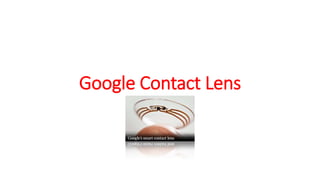
Google Contact Lens
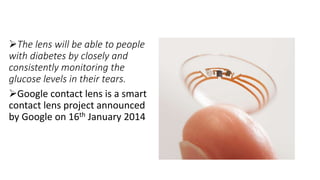
The lens will be able to people
with diabetes by closely and
consistently monitoring the
glucose levels in their tears.
Google contact lens is a smart
contact lens project announced
by Google on 16th January 2014
What Does Google Lens Do?
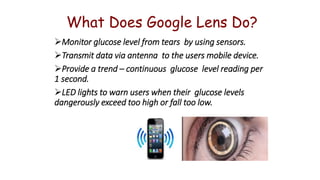
Monitor glucose level from tears by using sensors.
Transmit data via antenna to the users mobile device.
Provide a trend – continuous glucose level reading per
1 second.
LED lights to warn users when their glucose levels
dangerously exceed too high or fall too low.
ADVANTAGES OF SMART LENS
It is a simple and painless method.
 Continues glucose monitoring
Mobility to users – wearable system can be
integrated with life cycle.
Accurate reading – ensures efficiency and
safe use.
Reusable (cost effective solution)
FUTURE ENHANCEMENT
New service can be derived with the use of this
lens which opens up new opportunities.
 Remote monitoring of glucose level.
 Possibility of insurance compliance .
Valuable data collection.
Real time insulin dosage adjustment.
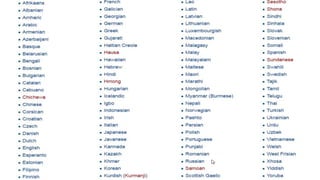
Google Translate
Google Translate
• 2008
• Google Translate is a server-side machine translation
service, which can translate between 50 different
languages
Google Translate
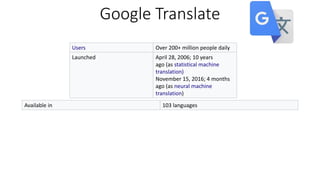
Users Over 200+ million people daily
Launched April 28, 2006; 10 years
ago (as statistical machine
translation)
November 15, 2016; 4 months
ago (as neural machine
translation)
Available in 103 languages
Features
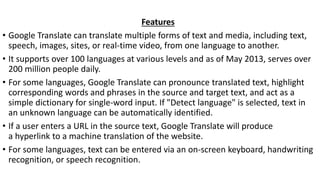
• Google Translate can translate multiple forms of text and media, including text,
speech, images, sites, or real-time video, from one language to another.
• It supports over 100 languages at various levels and as of May 2013, serves over
200 million people daily.
• For some languages, Google Translate can pronounce translated text, highlight
corresponding words and phrases in the source and target text, and act as a
simple dictionary for single-word input. If "Detect language" is selected, text in
an unknown language can be automatically identified.
• If a user enters a URL in the source text, Google Translate will produce
a hyperlink to a machine translation of the website.
• For some languages, text can be entered via an on-screen keyboard, handwriting
recognition, or speech recognition.
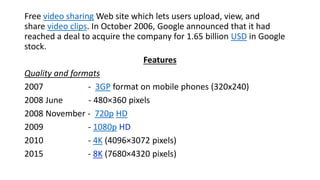
Free video sharing Web site which lets users upload, view, and
share video clips. In October 2006, Google announced that it had
reached a deal to acquire the company for 1.65 billion USD in Google
stock.
Features
Quality and formats
2007 - 3GP format on mobile phones (320x240)
2008 June - 480×360 pixels
2008 November - 720p HD
2009 - 1080p HD
2010 - 4K (4096×3072 pixels)
2015 - 8K (7680×4320 pixels)
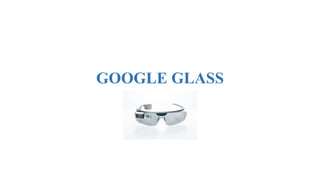
GOOGLE GLASS
Google Glass is an optical head mounted display designed in the shape of a pair of
eyeglasses. It was developed by X (previously Google X)]with the mission of producing
an ubiquitous computer.] Google Glass displayed information in a smartphone-like
hands-free format. Wearers communicated with the Internet via natural language voice
commands.[
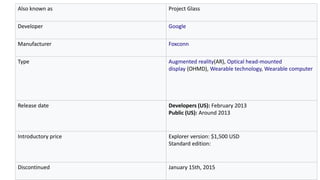
Also known as Project Glass
Developer Google
Manufacturer Foxconn
Type Augmented reality(AR), Optical head-mounted
display (OHMD), Wearable technology, Wearable computer
Release date Developers (US): February 2013
Public (US): Around 2013
Introductory price Explorer version: $1,500 USD
Standard edition:
Discontinued January 15th, 2015
Operating system Glass OS (Google Xe Software)
CPU OMAP 4430 System on a chip, dual-core processor
Memory 2 GB RAM
Storage 16 GB flash memory total (12 GB of usable memory)
Display Prism projector, 640×360 pixels (equivalent of a
25 in/64 cm screen from 8 ft/2.4 m away)
Sound Bone conduction transducer
Input Voice command through
microphone,
[8]
accelerometer,
[8]
gyroscope,
[8]
magneto
meter,ambient light sensor, proximity sensor
Controller input Touchpad, MyGlass phone mobile app
Camera 5 Megapixelphotos
720p video
Connectivity Wi-Fi 802.11b/G,Bluetooth,micro USB
Power 570 mAh Internal lithium-ion battery
Weight 36 g (1.27oz)
Backward
compatibility
Any Bluetooth-capable phone; MyGlass companion
app requires Android 4.0.3 (Ice Cream Sandwich) or
higher or any iOS 7.0 or higher
[8]
Related articles Oculus Rift
Website google.com/glass
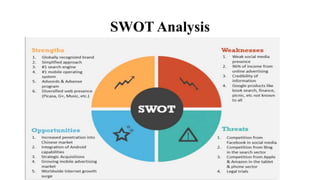
SWOT Analysis
Google's Disruptive Innovation

Google's Disruptive Innovation

  • 1.
  • 2.
    GOOGLE • Google isan American multinational technology company specializing in Internet-related services and products. These include online advertising technologies, search, cloud computing, software, and hardware. • Google was founded in 1996 by Larry Page and Sergey Brin while they were P.H.D.. students at Stanford University, in California. Together, they own about 14 percent of its shares and control 56 percent of the stockholder voting power through supervoting stock. • Revenue : 89.46 billion USD • Headquarter: Google plexMountain View, California, U.S.
  • 3.
    Products and services •Advertising :For the 2006 fiscal year, the company reported $10.492 billion in total advertising revenues and only $112 million in licensing and other revenues. In 2011, 96% of Google's revenue was derived from its advertising programs • Search engine:According to market research published by comScore in November 2009, Google Search is the dominant search engine in the United States market, with a market share of 65.6%. Google indexes billions of web pages, so that users can search for the information they desire through the use of keywords and operators.
  • 4.
    • Enterprise services:G Suiteis a monthly subscription offering for organizations and businesses to get access to a collection of Google's services, including Gmail, Google Drive and Docs, Sheets, and Slides, with additional administrative tools, unique domain names, and 24/7 support • Google Search Appliance was launched in February 2002, targeted toward providing search technology for larger organizations.[7] Google launched the Mini three years later, which was targeted at smaller organizations
  • 5.
    • Consumer services:In2004, Google launched Gmail, a web-based email service, with a significantly higher storage offer than competitors. Gmail grew to become the world's most popular email service, with over a billion active users in February 2016 • Internet services: In February 2010, Google announced the Google Fiber project, with experimental plans to build an ultra-high-speed broadband network for 50,000 to 500,000 customers in one or more American cities
  • 6.
    Meaning of Disruptive Innovation Adisruptive innovation is an innovation that creates a new market and value network and eventually disrupts an existing market and value network, displacing established market leading firms, products and alliances.
  • 7.
    Major Innovations ByGoogle 1. Google Driverless Car and Bike 2. Google Android 3. Google Loon 4. Google Map 5. Google Contact Lens 6. Google Youtube 7. google Translator 8. Google Glass
  • 8.
  • 9.
    Devices Involved Laser sensoron the roof (1.5 million measurements per second) Radar sensor in front and rear bumpers GPS Settings of driving personalities Self-learning Program HD camera looking out and inward from the windshield
  • 10.
    Advantages 1. Efficient useof highways 2. Optimal speed 3. Reduction in car accidents 4. Saving of parking space 5. Transportation will no longer be a hindrance
  • 11.
    Challenges Cost Issue Total cost:US$ 300,000 includes: • Laser system - $ 70,000 • Hi-tech Equipment - $ 150,000 • Driverless car” still illegal in 50 states •
  • 12.
  • 13.
    Google Android Using :Smartphones, tablet computers, Android TV, Android Auto and Android Wear Versions Android 1.0 - September 2008 Android 1.5 (Cupcake) - April 2009 Android 1.6 (Donut) - September 2009 Android 2.0 (Éclair) - October 2009 Android 2.2 (Froyo) - May 2010 Android 2.3 (Gingerbread) - December 2010 Android 3.0 (Honeycomb) - February 2011 Android 4.0 (Ice Cream Sandwich) - October 2011 Android 4.1 (Jelly Bean) - June 2012 Android 4.4 (KitKat) - September 2013 Android 5.0 (Lollipop) - November 2014 Android 6.0 (Marshmallow) 2016 Android 7.0 (Nougat) 2016
  • 14.
  • 15.
    • Developed byGoogle X • Key people: Rich DeVaul, Mike Cassidy and Cyrus Behroozi. • Officially announced on 14 June 2013. • A network of balloons travelling on the edge of space. • Provide Internet access to rural and remote areas.
  • 17.
    Features • Fly between60,000 and 90,000 feet. • Create an aerial wireless network with up to 4G-like speeds. • Solar-powered and have rechargeable batteries. • Equipped with GPS and weather monitoring equipment.
  • 19.
    Advantages • Availability ofInformation in rural and remote areas • Use of Renewable Energy • Education • Health and Medicine • Lower Cost to build
  • 20.
    Disadvantages • Need overflight permissions in countries • Durability of balloons • Hardware failure • Weather Adversities
  • 21.
  • 22.
    ABOUT GOOGLE MAPS ● launchedin 2005 ● web mapping service and technology supported by Google that can be used on desktop computers and smart phones ● provide various map information including satellite images, street view, weather, traffic, business locations and more March 5, 2015
  • 23.
    HOW GOOGLE MAPS ISCREATED? ● acquire authoritative data from postal services, governments and well- known maps e.g. US Geological Survey ● combine them with Google’s internal data, including satellite imagery, aerial imagery and Street View imagery March 5, 2015
  • 24.
    HOW GOOGLE MAPS ISCREATED? ● use computer algorithms and manual labour to carry out geometry editing ● algorithms used e.g. optical character recognition(OCR) technology: recognise and convert the words in the Street View imagery into text to extract street names March 5, 2015
  • 25.
  • 26.
    The lens willbe able to people with diabetes by closely and consistently monitoring the glucose levels in their tears. Google contact lens is a smart contact lens project announced by Google on 16th January 2014
  • 27.
    What Does GoogleLens Do? Monitor glucose level from tears by using sensors. Transmit data via antenna to the users mobile device. Provide a trend – continuous glucose level reading per 1 second. LED lights to warn users when their glucose levels dangerously exceed too high or fall too low.
  • 28.
    ADVANTAGES OF SMARTLENS It is a simple and painless method.  Continues glucose monitoring Mobility to users – wearable system can be integrated with life cycle. Accurate reading – ensures efficiency and safe use. Reusable (cost effective solution)
  • 29.
    FUTURE ENHANCEMENT New servicecan be derived with the use of this lens which opens up new opportunities.  Remote monitoring of glucose level.  Possibility of insurance compliance . Valuable data collection. Real time insulin dosage adjustment.
  • 30.
  • 31.
    Google Translate • 2008 •Google Translate is a server-side machine translation service, which can translate between 50 different languages
  • 32.
    Google Translate Users Over200+ million people daily Launched April 28, 2006; 10 years ago (as statistical machine translation) November 15, 2016; 4 months ago (as neural machine translation) Available in 103 languages
  • 33.
    Features • Google Translatecan translate multiple forms of text and media, including text, speech, images, sites, or real-time video, from one language to another. • It supports over 100 languages at various levels and as of May 2013, serves over 200 million people daily. • For some languages, Google Translate can pronounce translated text, highlight corresponding words and phrases in the source and target text, and act as a simple dictionary for single-word input. If "Detect language" is selected, text in an unknown language can be automatically identified. • If a user enters a URL in the source text, Google Translate will produce a hyperlink to a machine translation of the website. • For some languages, text can be entered via an on-screen keyboard, handwriting recognition, or speech recognition.
  • 36.
    Free video sharingWeb site which lets users upload, view, and share video clips. In October 2006, Google announced that it had reached a deal to acquire the company for 1.65 billion USD in Google stock. Features Quality and formats 2007 - 3GP format on mobile phones (320x240) 2008 June - 480×360 pixels 2008 November - 720p HD 2009 - 1080p HD 2010 - 4K (4096×3072 pixels) 2015 - 8K (7680×4320 pixels)
  • 37.
  • 38.
    Google Glass isan optical head mounted display designed in the shape of a pair of eyeglasses. It was developed by X (previously Google X)]with the mission of producing an ubiquitous computer.] Google Glass displayed information in a smartphone-like hands-free format. Wearers communicated with the Internet via natural language voice commands.[
  • 39.
    Also known asProject Glass Developer Google Manufacturer Foxconn Type Augmented reality(AR), Optical head-mounted display (OHMD), Wearable technology, Wearable computer Release date Developers (US): February 2013 Public (US): Around 2013 Introductory price Explorer version: $1,500 USD Standard edition: Discontinued January 15th, 2015
  • 40.
    Operating system GlassOS (Google Xe Software) CPU OMAP 4430 System on a chip, dual-core processor Memory 2 GB RAM Storage 16 GB flash memory total (12 GB of usable memory) Display Prism projector, 640×360 pixels (equivalent of a 25 in/64 cm screen from 8 ft/2.4 m away) Sound Bone conduction transducer Input Voice command through microphone, [8] accelerometer, [8] gyroscope, [8] magneto meter,ambient light sensor, proximity sensor
  • 41.
    Controller input Touchpad,MyGlass phone mobile app Camera 5 Megapixelphotos 720p video Connectivity Wi-Fi 802.11b/G,Bluetooth,micro USB Power 570 mAh Internal lithium-ion battery Weight 36 g (1.27oz) Backward compatibility Any Bluetooth-capable phone; MyGlass companion app requires Android 4.0.3 (Ice Cream Sandwich) or higher or any iOS 7.0 or higher [8] Related articles Oculus Rift Website google.com/glass
  • 42.