Made by:-
Priyanka Suryawanshi
8012
Veena Dose
Chaitali Gaikwad 8019
Himanshu Dwivedi 8048
Nisha Latpate 8065
Date:- September 4, 1998
Larry Page and Sergey Brin (Founders) Sundar Pichai (CEO)
 1. What is Google innovation outlook?
 2. Google’s Value Chain Analysis.
 3. Google’s Innovation Journey.
 4. What are Future Plans Of Google?
 5. Mission and Vision
 6. Financial Data
1. Looking for Innovation in Every Sphere
While Google doesn’t have an innovation department, every employee of the
company is encouraged to be creative and contribute their ideas for new products.
As a result, many of which are welcomed by the company and incorporated into its
big picture.
2. Resolve the User’s Problem
Google doesn’t believe in counting the money involved in creating a product.
Rather, it focuses on the user. Instant search marketing is an example of Google’s
attempt to resolve the problem of ads on search engine websites. It offers search
results as you type in the keyword which hardly gives people any time to see
advertisements. Nonetheless, Instant Search has become so popular, that users
keep returning to Google to search for information online.
3. Make a Dramatic Change
When Google launched its Google Books in 2004, it did not have the money or
technology at the time to undertake this project. Rather than sitting back,
Google went all out to improve Google Books. Despite multiple copyright
lawsuits, Google was able to partner with multiple libraries and educational
institutions to complete its goal of creating a digital library of written works
Currently, Google Books has over 30 million scanned books in its library and is
considered one of the largest online bodies of knowledge.
Google was able to identify an industry that was outdated and ripe for change.
4. Launch and Change
 There is no such thing as a perfect product. Every product has scope for improvement.
 Google could have waited to introduce the browser until it was perfect, however, they
chose to release Chrome on time, with regular updates and bug fixes. Now every six
weeks a newer version of the browser is released with small changes that help make the
product more user-friendly.
 The keyword here is action. People love to follow a brand that’s doing exciting things. It
might not be perfect, but you will attract early adopters, build awareness, and have time
to improve.
Inbound logistics: Generally means
obtaining raw material
Operations:- icludes those activities
that convert raw material to
finished goods
Outbond Logistics:- Involves
storage supply and distribution of
finished products
Marketing and Sales:- This great
scale of marketing and advertisig is
spanned over different channels
and media.
Service:- Google forums play an
instrumental role in terms of
assisting customers to deal with a
wide range of technical and other
issues.
A product introduced in 2011, the Chrome
book is a series of laptops and desktop OS’s
launched by Google. The OS is a Linux-based
Google operating system that supports all
Google apps and is said to be an extension of
your Android phone.
Maps was a mapping service based on the
manual mapping, satellite imagery, and
government data. Soon, from just being a
map viewing, it evolved into a navigation,
business hosting, and location optimization
service too.
Google street view is a midway between Google Maps and
Google Earth, where live cars roam roads and take live 3D
pictures of streets. This includes 3D views inside iconic
buildings and most streets around the world. It is a
subdued version of a map-based virtual reality system.
Probably, the most widely circulated Google
invention of all time, Android has become a
smartphone staple. Establishing a partial
monopoly with Apple devices, Androids
heavily adapted and the customizable interface
has made it climb market share ranks.
Google’s free neural machine translation
app, ‘Translate’ was rolled out in 2006. It
takes a language in typed form and
translates it into any of the 13 languages
available with it. Translate is now slowly
rolling out a picture- and voice-based
translation medium
Google Photos is the cloud-based exclusive
photo storage app from Google. The app
syncs your photos across all devices and
makes them accessible as soon as you log in
using your primary email.
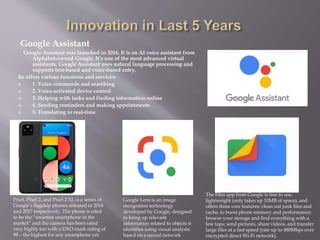
Google Assistant
Google Assistant was launched in 2016, It is an AI voice assistant from
Alphabet-owned Google. It’s one of the most advanced virtual
assistants. Google Assistant uses natural language processing and
supports text-based and voice-based entry.
Its offers various functions and services:
 1. Voice commands and searching
 2. Voice-activated device control
 3. Helping with tasks and finding information online
 4. Sending reminders and making appointments
 5. Translating in real-time
Google Lens is an image
recognition technology
developed by Google, designed
to bring up relevant
information related to objects it
identifies using visual analysis
based on a neural network
Pixel, Pixel 2, and Pixel 2 XL is a series of
Google’s flagship phones released in 2016
and 2017 respectively. The phone is cited
to be the “smartest smartphone in the
market” and the camera has been rated
very highly too with a DXO mark rating of
98 – the highest for any smartphone yet.
The Files app from Google is free to use,
lightweight (only takes up 10MB of space), and
offers three core features: clean out junk files and
cache, to boost phone memory and performance;
browse your storage and find everything with a
few taps; send pictures, share videos, and transfer
large files at a fast speed (rate up to 480Mbps over
encrypted direct Wi-Fi network).
A journey that started in 1998 has made Google establish itself as a multi-billion-dollar company in 2020.
Today, Google is considered to be a pillar of innovation and development. But what’s next? What do the brilliant
minds at Google have in store for us in the next five, maybe 10 years?
Mobility
Google has been working on driverless cars for a while now. Its Waymo project is
spearheading the entire autonomous mobility division.
We have already seen Waymo cars on the roads being tested in California and Google’s
making sure that funding keeps pouring into Waymo for further R&D.
Serious Hardware
Google has been striving to amplify the reach of its hardware portfolio. From its Pixel
smartphones to the Chromebook, Google has big plans to get a Google device to every
internet user on the planet.
There’s a catch to it, you see. More Google device users mean more data for Google and
like I told you before, data is the new oil.
For this, Google might also make its devices cheaper in the future. So, a Pixel phone
might be as cheap as a Xiaomi 5-10 years later.
Google is also working in the field of space exploration via its Lunar XPRIZE project
where it is inviting inventors to come up with space exploration solutions.
If this project flies, we may see Google battling SpaceX for NASA contracts in the future.
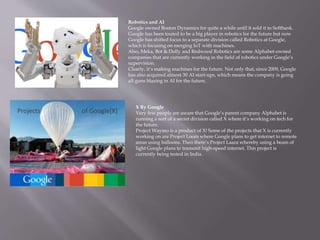
Robotics and AI
Google owned Boston Dynamics for quite a while until it sold it to Softbank.
Google has been touted to be a big player in robotics for the future but now
Google has shifted focus to a separate division called Robotics at Google,
which is focusing on merging IoT with machines.
Also, Meka, Bot & Dolly and Redwood Robotics are some Alphabet-owned
companies that are currently working in the field of robotics under Google’s
supervision.
Clearly, it’s making machines for the future. Not only that, since 2009, Google
has also acquired almost 30 AI start-ups, which means the company is going
all guns blazing in AI for the future.
X By Google
Very few people are aware that Google’s parent company Alphabet is
running a sort of a secret division called X where it’s working on tech for
the future.
Project Waymo is a product of X! Some of the projects that X is currently
working on are Project Loom where Google plans to get internet to remote
areas using balloons. Then there’s Project Laara whereby using a beam of
light Google plans to transmit high-speed internet. This project is
currently being tested in India.
 Google’s corporate mission is “to organize the world’s
information and make it universally accessible and
useful.” Google continues to focus on ensuring people’s
access to the information they need. In this regard, the
following are the primary elements of Google’s
corporate mission:
 World’s information
 Organization
 Universal accessibility
 Usefulness
 The company fulfills the “world’s information”
component by crawling websites. Google also fulfills
the “universal accessibility” by offering its products
worldwide. For example, the company’s online
blogging platform (Blogger.com), and video-sharing
platform (subsidiary YouTube) are globally
accessible. Such organizing of information makes
results useful to the individual user.
 Google’s corporate vision is “to provide
access to the world’s information in one
click.”
 The following are the primary elements
of the company’s corporate vision:
 World’s information
 Access
 One click
 The company fulfills the “world’s
information” component by indexing
webpages and maintaining databases of
the resulting information. Google fulfills
the “accessibility” component by
offering its products to everyone around
the world. The “one click” component of
the corporate vision refers to easy access
to information.
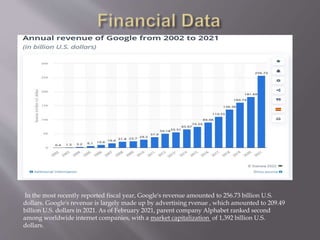
In the most recently reported fiscal year, Google's revenue amounted to 256.73 billion U.S.
dollars. Google's revenue is largely made up by advertising rvenue , which amounted to 209.49
billion U.S. dollars in 2021. As of February 2021, parent company Alphabet ranked second
among worldwide internet companies, with a market capitalization of 1,392 billion U.S.
dollars.
This statistic displays Google's operating income from 2013 through
2020. In 2020, the internet company's operating income amounted to
49 billion U.S. dollars. Google is the main revenue generator of online
business conglomerate Alphabet.
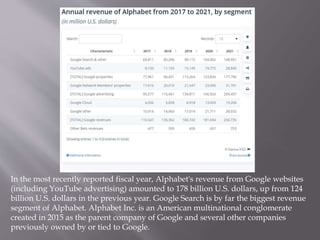
In the most recently reported fiscal year, Alphabet's revenue from Google websites
(including YouTube advertising) amounted to 178 billion U.S. dollars, up from 124
billion U.S. dollars in the previous year. Google Search is by far the biggest revenue
segment of Alphabet. Alphabet Inc. is an American multinational conglomerate
created in 2015 as the parent company of Google and several other companies
previously owned by or tied to Google.
Presentation1

Presentation1

  • 1.
    Made by:- Priyanka Suryawanshi 8012 VeenaDose Chaitali Gaikwad 8019 Himanshu Dwivedi 8048 Nisha Latpate 8065
  • 2.
    Date:- September 4,1998 Larry Page and Sergey Brin (Founders) Sundar Pichai (CEO)
  • 3.
     1. Whatis Google innovation outlook?  2. Google’s Value Chain Analysis.  3. Google’s Innovation Journey.  4. What are Future Plans Of Google?  5. Mission and Vision  6. Financial Data
  • 4.
    1. Looking forInnovation in Every Sphere While Google doesn’t have an innovation department, every employee of the company is encouraged to be creative and contribute their ideas for new products. As a result, many of which are welcomed by the company and incorporated into its big picture. 2. Resolve the User’s Problem Google doesn’t believe in counting the money involved in creating a product. Rather, it focuses on the user. Instant search marketing is an example of Google’s attempt to resolve the problem of ads on search engine websites. It offers search results as you type in the keyword which hardly gives people any time to see advertisements. Nonetheless, Instant Search has become so popular, that users keep returning to Google to search for information online.
  • 5.
    3. Make aDramatic Change When Google launched its Google Books in 2004, it did not have the money or technology at the time to undertake this project. Rather than sitting back, Google went all out to improve Google Books. Despite multiple copyright lawsuits, Google was able to partner with multiple libraries and educational institutions to complete its goal of creating a digital library of written works Currently, Google Books has over 30 million scanned books in its library and is considered one of the largest online bodies of knowledge. Google was able to identify an industry that was outdated and ripe for change. 4. Launch and Change  There is no such thing as a perfect product. Every product has scope for improvement.  Google could have waited to introduce the browser until it was perfect, however, they chose to release Chrome on time, with regular updates and bug fixes. Now every six weeks a newer version of the browser is released with small changes that help make the product more user-friendly.  The keyword here is action. People love to follow a brand that’s doing exciting things. It might not be perfect, but you will attract early adopters, build awareness, and have time to improve.
  • 6.
    Inbound logistics: Generallymeans obtaining raw material Operations:- icludes those activities that convert raw material to finished goods Outbond Logistics:- Involves storage supply and distribution of finished products Marketing and Sales:- This great scale of marketing and advertisig is spanned over different channels and media. Service:- Google forums play an instrumental role in terms of assisting customers to deal with a wide range of technical and other issues.
  • 7.
    A product introducedin 2011, the Chrome book is a series of laptops and desktop OS’s launched by Google. The OS is a Linux-based Google operating system that supports all Google apps and is said to be an extension of your Android phone. Maps was a mapping service based on the manual mapping, satellite imagery, and government data. Soon, from just being a map viewing, it evolved into a navigation, business hosting, and location optimization service too. Google street view is a midway between Google Maps and Google Earth, where live cars roam roads and take live 3D pictures of streets. This includes 3D views inside iconic buildings and most streets around the world. It is a subdued version of a map-based virtual reality system. Probably, the most widely circulated Google invention of all time, Android has become a smartphone staple. Establishing a partial monopoly with Apple devices, Androids heavily adapted and the customizable interface has made it climb market share ranks. Google’s free neural machine translation app, ‘Translate’ was rolled out in 2006. It takes a language in typed form and translates it into any of the 13 languages available with it. Translate is now slowly rolling out a picture- and voice-based translation medium Google Photos is the cloud-based exclusive photo storage app from Google. The app syncs your photos across all devices and makes them accessible as soon as you log in using your primary email.
  • 8.
    Google Assistant Google Assistantwas launched in 2016, It is an AI voice assistant from Alphabet-owned Google. It’s one of the most advanced virtual assistants. Google Assistant uses natural language processing and supports text-based and voice-based entry. Its offers various functions and services:  1. Voice commands and searching  2. Voice-activated device control  3. Helping with tasks and finding information online  4. Sending reminders and making appointments  5. Translating in real-time Google Lens is an image recognition technology developed by Google, designed to bring up relevant information related to objects it identifies using visual analysis based on a neural network Pixel, Pixel 2, and Pixel 2 XL is a series of Google’s flagship phones released in 2016 and 2017 respectively. The phone is cited to be the “smartest smartphone in the market” and the camera has been rated very highly too with a DXO mark rating of 98 – the highest for any smartphone yet. The Files app from Google is free to use, lightweight (only takes up 10MB of space), and offers three core features: clean out junk files and cache, to boost phone memory and performance; browse your storage and find everything with a few taps; send pictures, share videos, and transfer large files at a fast speed (rate up to 480Mbps over encrypted direct Wi-Fi network).
  • 9.
    A journey thatstarted in 1998 has made Google establish itself as a multi-billion-dollar company in 2020. Today, Google is considered to be a pillar of innovation and development. But what’s next? What do the brilliant minds at Google have in store for us in the next five, maybe 10 years? Mobility Google has been working on driverless cars for a while now. Its Waymo project is spearheading the entire autonomous mobility division. We have already seen Waymo cars on the roads being tested in California and Google’s making sure that funding keeps pouring into Waymo for further R&D. Serious Hardware Google has been striving to amplify the reach of its hardware portfolio. From its Pixel smartphones to the Chromebook, Google has big plans to get a Google device to every internet user on the planet. There’s a catch to it, you see. More Google device users mean more data for Google and like I told you before, data is the new oil. For this, Google might also make its devices cheaper in the future. So, a Pixel phone might be as cheap as a Xiaomi 5-10 years later. Google is also working in the field of space exploration via its Lunar XPRIZE project where it is inviting inventors to come up with space exploration solutions. If this project flies, we may see Google battling SpaceX for NASA contracts in the future.
  • 10.
    Robotics and AI Googleowned Boston Dynamics for quite a while until it sold it to Softbank. Google has been touted to be a big player in robotics for the future but now Google has shifted focus to a separate division called Robotics at Google, which is focusing on merging IoT with machines. Also, Meka, Bot & Dolly and Redwood Robotics are some Alphabet-owned companies that are currently working in the field of robotics under Google’s supervision. Clearly, it’s making machines for the future. Not only that, since 2009, Google has also acquired almost 30 AI start-ups, which means the company is going all guns blazing in AI for the future. X By Google Very few people are aware that Google’s parent company Alphabet is running a sort of a secret division called X where it’s working on tech for the future. Project Waymo is a product of X! Some of the projects that X is currently working on are Project Loom where Google plans to get internet to remote areas using balloons. Then there’s Project Laara whereby using a beam of light Google plans to transmit high-speed internet. This project is currently being tested in India.
  • 11.
     Google’s corporatemission is “to organize the world’s information and make it universally accessible and useful.” Google continues to focus on ensuring people’s access to the information they need. In this regard, the following are the primary elements of Google’s corporate mission:  World’s information  Organization  Universal accessibility  Usefulness  The company fulfills the “world’s information” component by crawling websites. Google also fulfills the “universal accessibility” by offering its products worldwide. For example, the company’s online blogging platform (Blogger.com), and video-sharing platform (subsidiary YouTube) are globally accessible. Such organizing of information makes results useful to the individual user.
  • 12.
     Google’s corporatevision is “to provide access to the world’s information in one click.”  The following are the primary elements of the company’s corporate vision:  World’s information  Access  One click  The company fulfills the “world’s information” component by indexing webpages and maintaining databases of the resulting information. Google fulfills the “accessibility” component by offering its products to everyone around the world. The “one click” component of the corporate vision refers to easy access to information.
  • 13.
    In the mostrecently reported fiscal year, Google's revenue amounted to 256.73 billion U.S. dollars. Google's revenue is largely made up by advertising rvenue , which amounted to 209.49 billion U.S. dollars in 2021. As of February 2021, parent company Alphabet ranked second among worldwide internet companies, with a market capitalization of 1,392 billion U.S. dollars.
  • 14.
    This statistic displaysGoogle's operating income from 2013 through 2020. In 2020, the internet company's operating income amounted to 49 billion U.S. dollars. Google is the main revenue generator of online business conglomerate Alphabet.
  • 15.
    In the mostrecently reported fiscal year, Alphabet's revenue from Google websites (including YouTube advertising) amounted to 178 billion U.S. dollars, up from 124 billion U.S. dollars in the previous year. Google Search is by far the biggest revenue segment of Alphabet. Alphabet Inc. is an American multinational conglomerate created in 2015 as the parent company of Google and several other companies previously owned by or tied to Google.