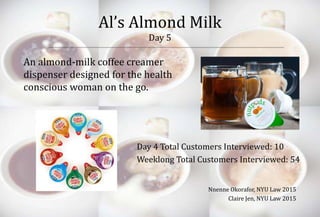
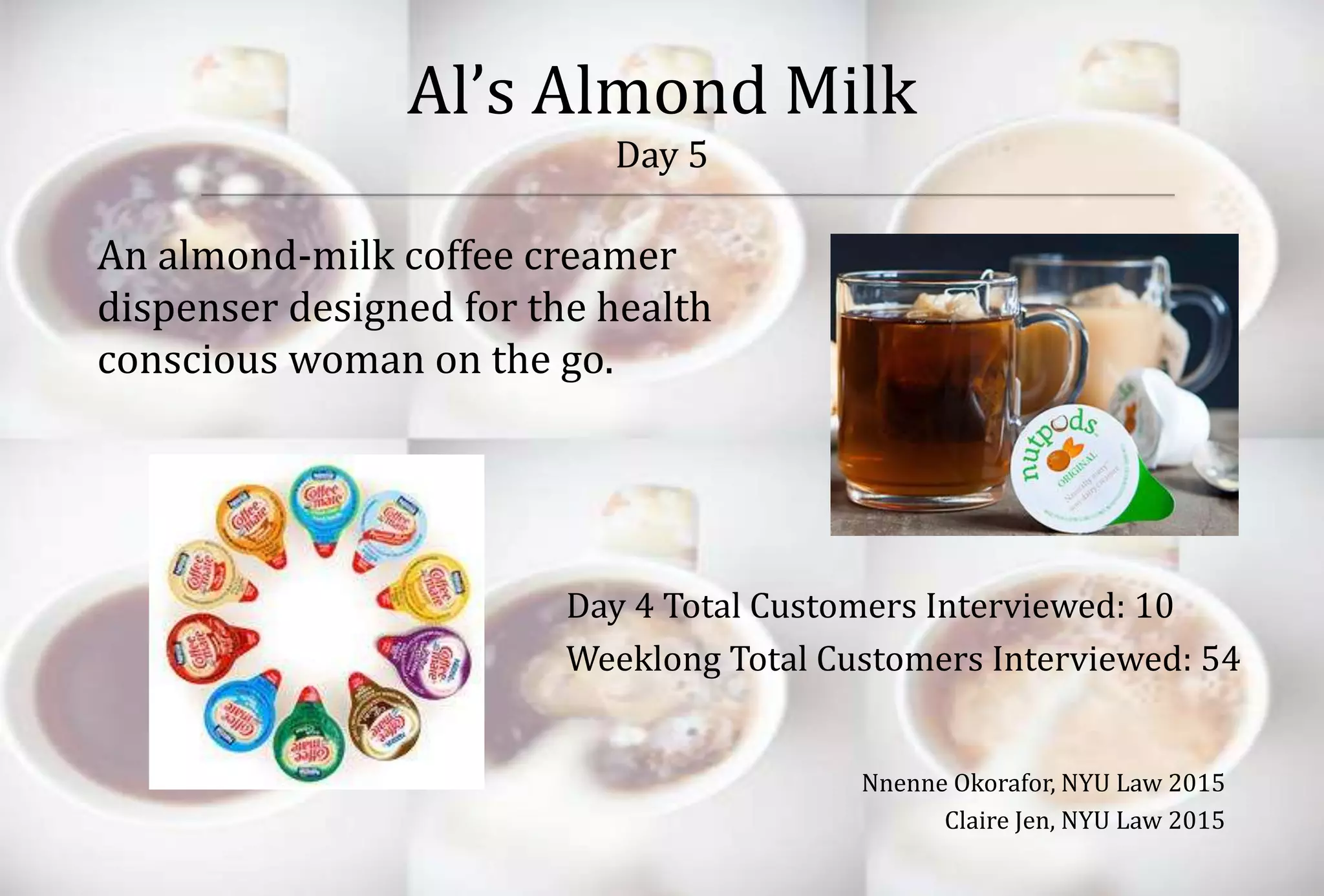
Al’s Almond Milk 
Day 5 
An almond-milk coffee creamer 
dispenser designed for the health 
conscious woman on the go. 
Day 4 Total Customers Interviewed: 10 
Weeklong Total Customers Interviewed: 54 
Nnenne Okorafor, NYU Law 2015 
Claire Jen, NYU Law 2015
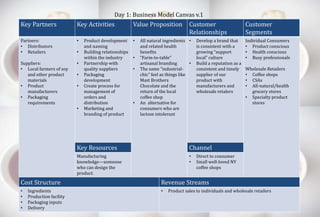
Day 1: Business Model Canvas v.1 
Key Partners Key Activities Value Proposition Customer 
Relationships 
Customer 
Segments 
Partners: 
• Distributors 
• Retailers 
Suppliers: 
• Local farmers of soy 
and other product 
materials 
• Product 
manufacturers 
• Packaging 
requirements 
• Product development 
and naming 
• Building relationships 
within the industry 
• Partnership with 
quality suppliers 
• Packaging 
development 
• Create process for 
management of 
orders and 
distribution 
• Marketing and 
branding of product 
• All natural ingredients 
and related health 
benefits 
• “Farm-to-table” 
artisanal branding 
• The same “industrial-chic” 
feel as things like 
Mast Brothers 
Chocolate and the 
return of the local 
coffee shop 
• An alternative for 
consumers who are 
lactose intolerant 
• Develop a brand that 
is consistent with a 
growing “support 
local” culture 
• Build a reputation as a 
consistent and timely 
supplier of our 
product with 
manufacturers and 
wholesale retalers 
Individual Consumers 
• Product conscious 
• Health conscious 
• Busy professionals 
Wholesale Retailers 
• Coffee shops 
• CSAs 
• All-natural/health 
grocery stores 
• Specialty product 
stores 
Key Resources Channel 
Manufacturing 
knowledge—someone 
who can design the 
product. 
• Direct to consumer 
• Small well-loved NY 
coffee shops 
Cost Structure Revenue Streams 
• Ingredients 
• Production facility 
• Packaging inputs 
• Delivery 
• Product sales to individuals and wholesale retailers
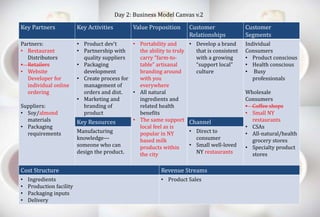
Day 2: Business Model Canvas v.2 
Key Partners Key Activities Value Proposition Customer 
Relationships 
Customer 
Segments 
Partners: 
• Restaurant 
Distributors 
• Retailers 
• Website 
Developer for 
individual online 
ordering 
Suppliers: 
• Soy/almond 
materials 
• Packaging 
requirements 
• Product dev’t 
• Partnership with 
quality suppliers 
• Packaging 
development 
• Create process for 
management of 
orders and dist. 
• Marketing and 
branding of 
product 
• Portability and 
the ability to truly 
carry “farm-to-table” 
artisanal 
branding around 
with you 
everywhere 
• All natural 
ingredients and 
related health 
benefits 
• The same support 
local feel as is 
popular in NY 
based milk 
products within 
the city 
• Develop a brand 
that is consistent 
with a growing 
“support local” 
culture 
Individual 
Consumers 
• Product conscious 
• Health conscious 
• Busy 
professionals 
Wholesale 
Consumers 
• Coffee shops 
• Small NY 
restaurants 
• CSAs 
• All-natural/health 
grocery stores 
• Specialty product 
stores 
Key Resources Channel 
Manufacturing 
knowledge— 
someone who can 
design the product. 
• Direct to 
consumer 
• Small well-loved 
NY restaurants 
Cost Structure Revenue Streams 
• Ingredients 
• Product Sales 
• Production facility 
• Packaging inputs 
• Delivery
Day 3: Business Model Canvas v.3 
Key Partners Key Activities Value Proposition Customer 
Relationships 
Customer 
Segments 
Partners: 
• Restaurants and 
Grocery Stores 
• Distributors, 
Business/Corpora 
te customers 
• Retailers 
• Website 
Developer for 
individual online 
ordering 
Suppliers: 
• Soy/Almond 
materials 
• Packaging 
requirements 
• Product dev’t 
• Partnership with 
quality suppliers 
• Packaging 
development 
• Create process for 
management of 
orders and dist. 
• Marketing and 
branding of 
product 
• Functional: The 
ability to 
conveniently have 
a preferred coffee 
creamer with you 
at all times 
• Social: The 
appearance of 
being “in the 
know” about 
health and 
wellness 
• Emotional: The 
promotion of 
personal/personn 
el well being 
• Develop a brand 
that is consistent 
with a growing 
“healthy 
professional” 
culture 
Ind’l Customer 
• 25-45 
• Single 
• Female 
• Busy working 
professional 
• Socially aware 
(but not overly 
engaged) 
Business Customer 
• Mid-large sized 
corporate offices 
• Currently offer 
individual 
creamers 
[Retail Customers?] 
Key Resources Channel 
Manufacturing 
knowledge— 
someone who can 
design the product. 
• Direct to 
consumer 
• Small well-loved 
NY restaurants 
and grocery 
stores 
Cost Structure Revenue Streams 
• Ingredients 
• Product Sales 
• Production facility 
• Packaging inputs 
• Delivery
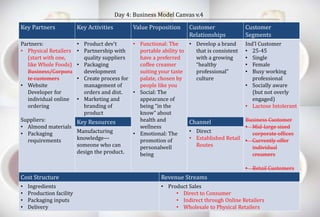
Day 4: Business Model Canvas v.4 
Key Partners Key Activities Value Proposition Customer 
Relationships 
Customer 
Segments 
Partners: 
• Physical Retailers 
(start with one, 
like Whole Foods) 
Business/Corpora 
te customers 
• Website 
Developer for 
individual online 
ordering 
Suppliers: 
• Almond materials 
• Packaging 
requirements 
• Product dev’t 
• Partnership with 
quality suppliers 
• Packaging 
development 
• Create process for 
management of 
orders and dist. 
• Marketing and 
branding of 
product 
• Functional: The 
portable ability to 
have a preferred 
coffee creamer 
suiting your taste 
palate, chosen by 
people like you 
• Social: The 
appearance of 
being “in the 
know” about 
health and 
wellness 
• Emotional: The 
promotion of 
personalwell 
being 
• Develop a brand 
that is consistent 
with a growing 
“healthy 
professional” 
culture 
Ind’l Customer 
• 25-45 
• Single 
• Female 
• Busy working 
professional 
• Socially aware 
(but not overly 
engaged) 
• Lactose Intolerant 
Business Customer 
• Mid-large sized 
corporate offices 
• Currently offer 
individual 
creamers 
• Retail Customers 
Key Resources Channel 
Manufacturing 
knowledge— 
someone who can 
design the product. 
• Direct 
• Established Retail 
Routes 
Cost Structure Revenue Streams 
• Ingredients 
• Product Sales 
• Production facility 
• Packaging inputs 
• Delivery 
• Direct to Consumer 
• Indirect through Online Retailers 
• Wholesale to Physical Retailers
Day 5: Business Model Canvas v.5 
Key Partners Key Activities Value Proposition Customer 
Relationships 
Customer 
Segments 
Partners: 
• Large Physical 
Retailers (start 
with one, like 
Whole Foods) 
• Vendors, trade 
shows, etc that 
service physical 
retailers 
• Website 
Developer for 
individual online 
ordering 
Suppliers: 
• Almond materials 
• Packaging 
requirements 
• Product and 
packaging dev’t 
• Manufacturing/di 
stribution 
• Branding: 
Develop and 
market a brand 
that is consistent 
with a growing 
“healthy 
professional” 
culture 
• Functional: The 
portable ability to 
have a preferred 
coffee creamer 
suiting your taste 
palate, chosen by 
people like you 
• Social: The 
appearance of 
being “in the 
know” about 
health and 
wellness 
• Emotional: The 
promotion of 
personal well 
being 
• Sampling and 
sponsorship at 
key events and 
tradeshows 
• Online/Social: 
relationships with 
bloggers and 
websites, use of 
instagram, twitter 
• Relationships 
with frequently 
used Retailers and 
Service Providers 
Ind’l Customer 
• 25-40 
• Single 
• Female 
• Busy working 
professional 
• Socially aware 
(but not overly 
engaged) 
• Health conscious 
• Lactose Intolerant 
[Vendors and 
Tradeshows, initially, 
until they become 
Key Partners] 
Key Resources Channel 
Manufacturing 
knowledge— 
someone who can 
design the product. 
• Direct 
• Established Retail 
Routes 
Cost Structure Revenue Streams 
• Ingredients/Packaging inputs 
• Product Sales 
• Production facility 
• Distribution process 
• Marketing/branding 
• Direct to Consumer (limited) 
• Indirect through Online Retailers 
• Wholesale to Physical Retailers (main stream)
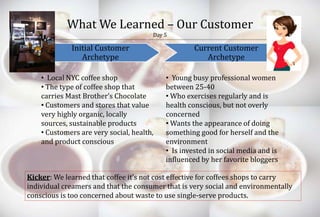
What We Learned – Our Customer 
Day 5 
Initial Customer 
Archetype 
Current Customer 
Archetype 
• Local NYC coffee shop 
• The type of coffee shop that 
carries Mast Brother’s Chocolate 
• Customers and stores that value 
very highly organic, locally 
sources, sustainable products 
• Customers are very social, health, 
and product conscious 
• Young busy professional women 
between 25-40 
• Who exercises regularly and is 
health conscious, but not overly 
concerned 
•Wants the appearance of doing 
something good for herself and the 
environment 
• Is invested in social media and is 
influenced by her favorite bloggers 
Kicker: We learned that coffee it’s not cost effective for coffees shops to carry 
individual creamers and that the consumer that is very social and environmentally 
conscious is too concerned about waste to use single-serve products.
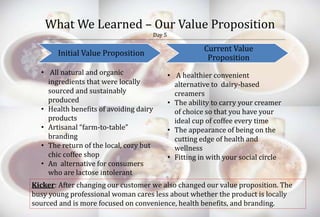
What We Learned – Our Value Proposition 
Day 5 
Initial Value Proposition 
Current Value 
Proposition 
• All natural and organic 
ingredients that were locally 
sourced and sustainably 
produced 
• Health benefits of avoiding dairy 
products 
• Artisanal “farm-to-table” 
branding 
• The return of the local, cozy but 
chic coffee shop 
• An alternative for consumers 
who are lactose intolerant 
• A healthier convenient 
alternative to dairy-based 
creamers 
• The ability to carry your creamer 
of choice so that you have your 
ideal cup of coffee every time 
• The appearance of being on the 
cutting edge of health and 
wellness 
• Fitting in with your social circle 
Kicker: After changing our customer we also changed our value proposition. The 
busy young professional woman cares less about whether the product is locally 
sourced and is more focused on convenience, health benefits, and branding.
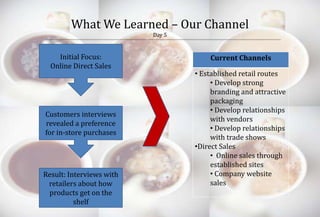
What We Learned – Our Channel 
Day 5 
Initial Focus: 
Online Direct Sales 
Customers interviews 
revealed a preference 
for in-store purchases 
Result: Interviews with 
retailers about how 
products get on the 
shelf 
Current Channels 
• Established retail routes 
• Develop strong 
branding and attractive 
packaging 
• Develop relationships 
with vendors 
• Develop relationships 
with trade shows 
•Direct Sales 
• Online sales through 
established sites 
• Company website 
sales
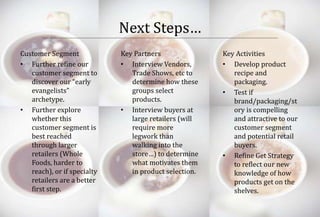
Next Steps… 
Customer Segment 
• Further refine our 
customer segment to 
discover our “early 
evangelists” 
archetype. 
• Further explore 
whether this 
customer segment is 
best reached 
through larger 
retailers (Whole 
Foods, harder to 
reach), or if specialty 
retailers are a better 
first step. 
Key Partners 
• Interview Vendors, 
Trade Shows, etc to 
determine how these 
groups select 
products. 
• Interview buyers at 
large retailers (will 
require more 
legwork than 
walking into the 
store…) to determine 
what motivates them 
in product selection. 
Key Activities 
• Develop product 
recipe and 
packaging. 
• Test if 
brand/packaging/st 
ory is compelling 
and attractive to our 
customer segment 
and potential retail 
buyers. 
• Refine Get Strategy 
to reflect our new 
knowledge of how 
products get on the 
shelves.

Al's Almond Milk NYU Final presentation

  • 1.
    Al’s Almond Milk Day 5 An almond-milk coffee creamer dispenser designed for the health conscious woman on the go. Day 4 Total Customers Interviewed: 10 Weeklong Total Customers Interviewed: 54 Nnenne Okorafor, NYU Law 2015 Claire Jen, NYU Law 2015
  • 2.
    Day 1: BusinessModel Canvas v.1 Key Partners Key Activities Value Proposition Customer Relationships Customer Segments Partners: • Distributors • Retailers Suppliers: • Local farmers of soy and other product materials • Product manufacturers • Packaging requirements • Product development and naming • Building relationships within the industry • Partnership with quality suppliers • Packaging development • Create process for management of orders and distribution • Marketing and branding of product • All natural ingredients and related health benefits • “Farm-to-table” artisanal branding • The same “industrial-chic” feel as things like Mast Brothers Chocolate and the return of the local coffee shop • An alternative for consumers who are lactose intolerant • Develop a brand that is consistent with a growing “support local” culture • Build a reputation as a consistent and timely supplier of our product with manufacturers and wholesale retalers Individual Consumers • Product conscious • Health conscious • Busy professionals Wholesale Retailers • Coffee shops • CSAs • All-natural/health grocery stores • Specialty product stores Key Resources Channel Manufacturing knowledge—someone who can design the product. • Direct to consumer • Small well-loved NY coffee shops Cost Structure Revenue Streams • Ingredients • Production facility • Packaging inputs • Delivery • Product sales to individuals and wholesale retailers
  • 3.
    Day 2: BusinessModel Canvas v.2 Key Partners Key Activities Value Proposition Customer Relationships Customer Segments Partners: • Restaurant Distributors • Retailers • Website Developer for individual online ordering Suppliers: • Soy/almond materials • Packaging requirements • Product dev’t • Partnership with quality suppliers • Packaging development • Create process for management of orders and dist. • Marketing and branding of product • Portability and the ability to truly carry “farm-to-table” artisanal branding around with you everywhere • All natural ingredients and related health benefits • The same support local feel as is popular in NY based milk products within the city • Develop a brand that is consistent with a growing “support local” culture Individual Consumers • Product conscious • Health conscious • Busy professionals Wholesale Consumers • Coffee shops • Small NY restaurants • CSAs • All-natural/health grocery stores • Specialty product stores Key Resources Channel Manufacturing knowledge— someone who can design the product. • Direct to consumer • Small well-loved NY restaurants Cost Structure Revenue Streams • Ingredients • Product Sales • Production facility • Packaging inputs • Delivery
  • 4.
    Day 3: BusinessModel Canvas v.3 Key Partners Key Activities Value Proposition Customer Relationships Customer Segments Partners: • Restaurants and Grocery Stores • Distributors, Business/Corpora te customers • Retailers • Website Developer for individual online ordering Suppliers: • Soy/Almond materials • Packaging requirements • Product dev’t • Partnership with quality suppliers • Packaging development • Create process for management of orders and dist. • Marketing and branding of product • Functional: The ability to conveniently have a preferred coffee creamer with you at all times • Social: The appearance of being “in the know” about health and wellness • Emotional: The promotion of personal/personn el well being • Develop a brand that is consistent with a growing “healthy professional” culture Ind’l Customer • 25-45 • Single • Female • Busy working professional • Socially aware (but not overly engaged) Business Customer • Mid-large sized corporate offices • Currently offer individual creamers [Retail Customers?] Key Resources Channel Manufacturing knowledge— someone who can design the product. • Direct to consumer • Small well-loved NY restaurants and grocery stores Cost Structure Revenue Streams • Ingredients • Product Sales • Production facility • Packaging inputs • Delivery
  • 5.
    Day 4: BusinessModel Canvas v.4 Key Partners Key Activities Value Proposition Customer Relationships Customer Segments Partners: • Physical Retailers (start with one, like Whole Foods) Business/Corpora te customers • Website Developer for individual online ordering Suppliers: • Almond materials • Packaging requirements • Product dev’t • Partnership with quality suppliers • Packaging development • Create process for management of orders and dist. • Marketing and branding of product • Functional: The portable ability to have a preferred coffee creamer suiting your taste palate, chosen by people like you • Social: The appearance of being “in the know” about health and wellness • Emotional: The promotion of personalwell being • Develop a brand that is consistent with a growing “healthy professional” culture Ind’l Customer • 25-45 • Single • Female • Busy working professional • Socially aware (but not overly engaged) • Lactose Intolerant Business Customer • Mid-large sized corporate offices • Currently offer individual creamers • Retail Customers Key Resources Channel Manufacturing knowledge— someone who can design the product. • Direct • Established Retail Routes Cost Structure Revenue Streams • Ingredients • Product Sales • Production facility • Packaging inputs • Delivery • Direct to Consumer • Indirect through Online Retailers • Wholesale to Physical Retailers
  • 6.
    Day 5: BusinessModel Canvas v.5 Key Partners Key Activities Value Proposition Customer Relationships Customer Segments Partners: • Large Physical Retailers (start with one, like Whole Foods) • Vendors, trade shows, etc that service physical retailers • Website Developer for individual online ordering Suppliers: • Almond materials • Packaging requirements • Product and packaging dev’t • Manufacturing/di stribution • Branding: Develop and market a brand that is consistent with a growing “healthy professional” culture • Functional: The portable ability to have a preferred coffee creamer suiting your taste palate, chosen by people like you • Social: The appearance of being “in the know” about health and wellness • Emotional: The promotion of personal well being • Sampling and sponsorship at key events and tradeshows • Online/Social: relationships with bloggers and websites, use of instagram, twitter • Relationships with frequently used Retailers and Service Providers Ind’l Customer • 25-40 • Single • Female • Busy working professional • Socially aware (but not overly engaged) • Health conscious • Lactose Intolerant [Vendors and Tradeshows, initially, until they become Key Partners] Key Resources Channel Manufacturing knowledge— someone who can design the product. • Direct • Established Retail Routes Cost Structure Revenue Streams • Ingredients/Packaging inputs • Product Sales • Production facility • Distribution process • Marketing/branding • Direct to Consumer (limited) • Indirect through Online Retailers • Wholesale to Physical Retailers (main stream)
  • 7.
    What We Learned– Our Customer Day 5 Initial Customer Archetype Current Customer Archetype • Local NYC coffee shop • The type of coffee shop that carries Mast Brother’s Chocolate • Customers and stores that value very highly organic, locally sources, sustainable products • Customers are very social, health, and product conscious • Young busy professional women between 25-40 • Who exercises regularly and is health conscious, but not overly concerned •Wants the appearance of doing something good for herself and the environment • Is invested in social media and is influenced by her favorite bloggers Kicker: We learned that coffee it’s not cost effective for coffees shops to carry individual creamers and that the consumer that is very social and environmentally conscious is too concerned about waste to use single-serve products.
  • 8.
    What We Learned– Our Value Proposition Day 5 Initial Value Proposition Current Value Proposition • All natural and organic ingredients that were locally sourced and sustainably produced • Health benefits of avoiding dairy products • Artisanal “farm-to-table” branding • The return of the local, cozy but chic coffee shop • An alternative for consumers who are lactose intolerant • A healthier convenient alternative to dairy-based creamers • The ability to carry your creamer of choice so that you have your ideal cup of coffee every time • The appearance of being on the cutting edge of health and wellness • Fitting in with your social circle Kicker: After changing our customer we also changed our value proposition. The busy young professional woman cares less about whether the product is locally sourced and is more focused on convenience, health benefits, and branding.
  • 9.
    What We Learned– Our Channel Day 5 Initial Focus: Online Direct Sales Customers interviews revealed a preference for in-store purchases Result: Interviews with retailers about how products get on the shelf Current Channels • Established retail routes • Develop strong branding and attractive packaging • Develop relationships with vendors • Develop relationships with trade shows •Direct Sales • Online sales through established sites • Company website sales
  • 10.
    Next Steps… CustomerSegment • Further refine our customer segment to discover our “early evangelists” archetype. • Further explore whether this customer segment is best reached through larger retailers (Whole Foods, harder to reach), or if specialty retailers are a better first step. Key Partners • Interview Vendors, Trade Shows, etc to determine how these groups select products. • Interview buyers at large retailers (will require more legwork than walking into the store…) to determine what motivates them in product selection. Key Activities • Develop product recipe and packaging. • Test if brand/packaging/st ory is compelling and attractive to our customer segment and potential retail buyers. • Refine Get Strategy to reflect our new knowledge of how products get on the shelves.

Editor's Notes

  • #2 Day 0: 7 Day 1: 14 Day 2: 8