L‟Oreal
- Building
A Global Cosmetic Brand
Presenting By,
Subash
Balasaheb
Ashwini
Bharath
Bhasker
Synopsis
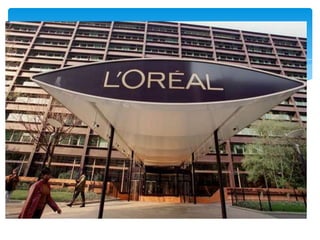
 France based leading global cosmetic company.
 Founded in 1909.
 Led by Lindsey Owen Jones, the chairman and CEO of
the Company.
 Achieved double digit profit for eighteen consecutive
years.
 Business in 130 countries with a turnover of around
13.7 billion Euros.
 Only cosmetic company in the world to own more
than one brand franchisee.
 Cosmetic industry refers to the cosmetics, toiletry and
perfumery industry brands.
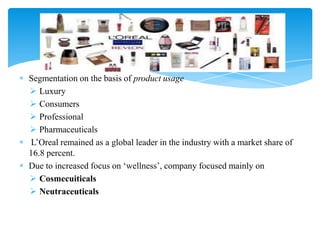
Segmentation on the basis of product usage
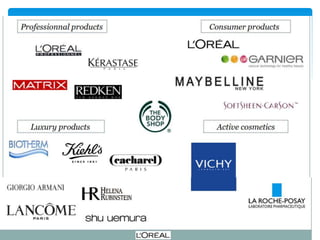
 Luxury
 Consumers
 Professional
 Pharmaceuticals
L‟Oreal remained as a global leader in the industry with a market share of
16.8 percent.
Due to increased focus on „wellness‟, company focused mainly on
 Cosmecuiticals
 Neutraceuticals
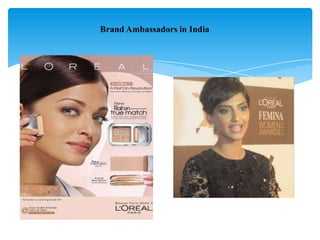
Brand Ambassadors in India
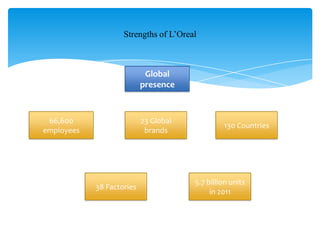
Strengths of L‟Oreal
66,600
employees
23 Global
brands
130 Countries
38 Factories
5.7 billion units
in 2011
Global
presence
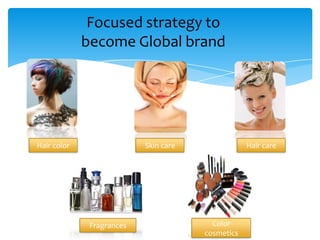
Focused strategy to
become Global brand
Hair color Skin care Hair care
Fragrances Color
cosmetics
Company Launched the legendary advertisement campaign “Because I am
worth it” for promotion of a hair color.
Extraordinary distribution channel to the US, South America, Russia and
the Far East.
Diversification into wide range of beauty products.
Expanded globally by introducing Maybelline in USA.
Relationship with its customers- Personal beauty advisers at department
stores.
Road To Success
Acquired in 1996, when lost its focus and band equity.
Tagline: “Maybe she’s born with it”. “Maybe its Maybelline”.
Already well known for ordinary color lipsticks and nail polishes in USA.
Promoted the products by adding a tagline “Urban American chic” .
Expanded to Japanese market as well, and captured nearly 56% outside the
US.
Celebrities for promoting brands.
Maybelline a Milestone
Maybelline's success proved L'Oreal's philosophy by embracing two
different cultures (French and American).
L'Oreal acquired different unknown brands and gave a facelift, repacked and
marketed them aggressively.
Promoted brands according to their national culture.
Maintained image with the help of research centers in Paris and New York.
Attained 493 patents registered on the company name in 2001.
Brand Strategy
PACKAGING
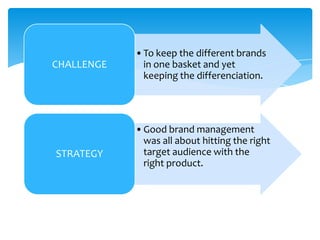
•To keep the different brands
in one basket and yet
keeping the differenciation.
CHALLENGE
•Good brand management
was all about hitting the right
target audience with the
right product.
STRATEGY
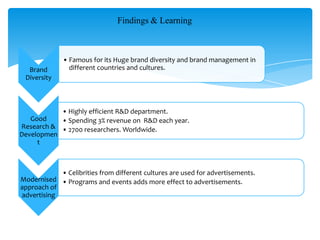
Brand
Diversity
• Famous for its Huge brand diversity and brand management in
different countries and cultures.
Good
Research &
Developmen
t
• Highly efficient R&D department.
• Spending 3% revenue on R&D each year.
• 2700 researchers. Worldwide.
Modernised
approach of
advertising
• Celibrities from different cultures are used for advertisements.
• Programs and events adds more effect to advertisements.
Findings & Learning
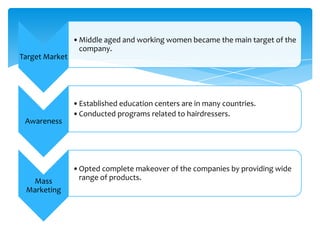
Target Market
•Middle aged and working women became the main target of the
company.
Awareness
•Established education centers are in many countries.
•Conducted programs related to hairdressers.
Mass
Marketing
•Opted complete makeover of the companies by providing wide
range of products.
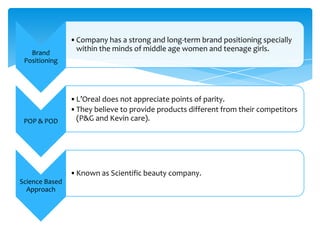
Brand
Positioning
•Company has a strong and long-term brand positioning specially
within the minds of middle age women and teenage girls.
POP & POD
•L’Oreal does not appreciate points of parity.
•They believe to provide products different from their competitors
(P&G and Kevin care).
Science Based
Approach
•Known as Scientific beauty company.
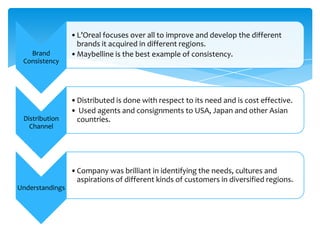
Brand
Consistency
•L’Oreal focuses over all to improve and develop the different
brands it acquired in different regions.
•Maybelline is the best example of consistency.
Distribution
Channel
•Distributed is done with respect to its need and is cost effective.
• Used agents and consignments to USA, Japan and other Asian
countries.
Understandings
•Company was brilliant in identifying the needs, cultures and
aspirations of different kinds of customers in diversified regions.
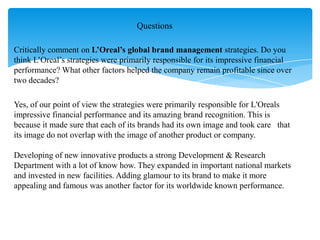
Critically comment on L’Oreal’s global brand management strategies. Do you
think L‟Oreal‟s strategies were primarily responsible for its impressive financial
performance? What other factors helped the company remain profitable since over
two decades?
Yes, of our point of view the strategies were primarily responsible for L'Oreals
impressive financial performance and its amazing brand recognition. This is
because it made sure that each of its brands had its own image and took care that
its image do not overlap with the image of another product or company.
Developing of new innovative products a strong Development & Research
Department with a lot of know how. They expanded in important national markets
and invested in new facilities. Adding glamour to its brand to make it more
appealing and famous was another factor for its worldwide known performance.
Questions
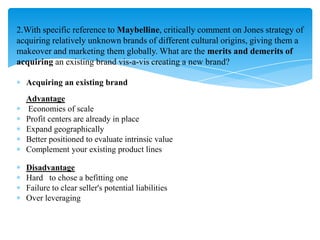
2.With specific reference to Maybelline, critically comment on Jones strategy of
acquiring relatively unknown brands of different cultural origins, giving them a
makeover and marketing them globally. What are the merits and demerits of
acquiring an existing brand vis-a-vis creating a new brand?
Acquiring an existing brand
Advantage
Economies of scale
Profit centers are already in place
Expand geographically
Better positioned to evaluate intrinsic value
Complement your existing product lines
Disadvantage
Hard to chose a befitting one
Failure to clear seller's potential liabilities
Over leveraging
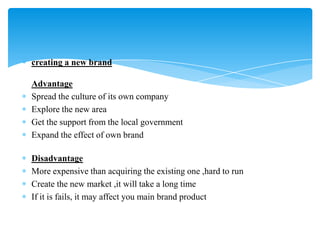
creating a new brand
Advantage
Spread the culture of its own company
Explore the new area
Get the support from the local government
Expand the effect of own brand
Disadvantage
More expensive than acquiring the existing one ,hard to run
Create the new market ,it will take a long time
If it is fails, it may affect you main brand product
Loreal followed a multi-brand stratergy
Adapt market share
Equal opportunities to al brands
Inter-brand (self) competition
Freedom to develop and innovate better product
Positioning Strategy:
Repositioning of brands
Repositioning according to :
Changing preferences
Opinions of customer
L‟Oreal maintained a large portfolio of brands and was present in all the
four segments of the cosmetic markets. What positioning strategy did the
company follow to ensure that the image of its brand did not overlap? How
and why L‟Oreal did encouraged competition among its brands in particular
segments and at the same time prevent the brands from cannibalizing each
other?
Loreal case study

Loreal case study

  • 1.
    L‟Oreal - Building A GlobalCosmetic Brand Presenting By, Subash Balasaheb Ashwini Bharath Bhasker
  • 3.
    Synopsis  France basedleading global cosmetic company.  Founded in 1909.  Led by Lindsey Owen Jones, the chairman and CEO of the Company.  Achieved double digit profit for eighteen consecutive years.  Business in 130 countries with a turnover of around 13.7 billion Euros.  Only cosmetic company in the world to own more than one brand franchisee.  Cosmetic industry refers to the cosmetics, toiletry and perfumery industry brands.
  • 4.
    Segmentation on thebasis of product usage  Luxury  Consumers  Professional  Pharmaceuticals L‟Oreal remained as a global leader in the industry with a market share of 16.8 percent. Due to increased focus on „wellness‟, company focused mainly on  Cosmecuiticals  Neutraceuticals
  • 5.
  • 6.
    Strengths of L‟Oreal 66,600 employees 23Global brands 130 Countries 38 Factories 5.7 billion units in 2011 Global presence
  • 7.
    Focused strategy to becomeGlobal brand Hair color Skin care Hair care Fragrances Color cosmetics
  • 8.
    Company Launched thelegendary advertisement campaign “Because I am worth it” for promotion of a hair color. Extraordinary distribution channel to the US, South America, Russia and the Far East. Diversification into wide range of beauty products. Expanded globally by introducing Maybelline in USA. Relationship with its customers- Personal beauty advisers at department stores. Road To Success
  • 9.
    Acquired in 1996,when lost its focus and band equity. Tagline: “Maybe she’s born with it”. “Maybe its Maybelline”. Already well known for ordinary color lipsticks and nail polishes in USA. Promoted the products by adding a tagline “Urban American chic” . Expanded to Japanese market as well, and captured nearly 56% outside the US. Celebrities for promoting brands. Maybelline a Milestone
  • 10.
    Maybelline's success provedL'Oreal's philosophy by embracing two different cultures (French and American). L'Oreal acquired different unknown brands and gave a facelift, repacked and marketed them aggressively. Promoted brands according to their national culture. Maintained image with the help of research centers in Paris and New York. Attained 493 patents registered on the company name in 2001. Brand Strategy PACKAGING
  • 12.
    •To keep thedifferent brands in one basket and yet keeping the differenciation. CHALLENGE •Good brand management was all about hitting the right target audience with the right product. STRATEGY
  • 13.
    Brand Diversity • Famous forits Huge brand diversity and brand management in different countries and cultures. Good Research & Developmen t • Highly efficient R&D department. • Spending 3% revenue on R&D each year. • 2700 researchers. Worldwide. Modernised approach of advertising • Celibrities from different cultures are used for advertisements. • Programs and events adds more effect to advertisements. Findings & Learning
  • 14.
    Target Market •Middle agedand working women became the main target of the company. Awareness •Established education centers are in many countries. •Conducted programs related to hairdressers. Mass Marketing •Opted complete makeover of the companies by providing wide range of products.
  • 15.
    Brand Positioning •Company has astrong and long-term brand positioning specially within the minds of middle age women and teenage girls. POP & POD •L’Oreal does not appreciate points of parity. •They believe to provide products different from their competitors (P&G and Kevin care). Science Based Approach •Known as Scientific beauty company.
  • 16.
    Brand Consistency •L’Oreal focuses overall to improve and develop the different brands it acquired in different regions. •Maybelline is the best example of consistency. Distribution Channel •Distributed is done with respect to its need and is cost effective. • Used agents and consignments to USA, Japan and other Asian countries. Understandings •Company was brilliant in identifying the needs, cultures and aspirations of different kinds of customers in diversified regions.
  • 17.
    Critically comment onL’Oreal’s global brand management strategies. Do you think L‟Oreal‟s strategies were primarily responsible for its impressive financial performance? What other factors helped the company remain profitable since over two decades? Yes, of our point of view the strategies were primarily responsible for L'Oreals impressive financial performance and its amazing brand recognition. This is because it made sure that each of its brands had its own image and took care that its image do not overlap with the image of another product or company. Developing of new innovative products a strong Development & Research Department with a lot of know how. They expanded in important national markets and invested in new facilities. Adding glamour to its brand to make it more appealing and famous was another factor for its worldwide known performance. Questions
  • 18.
    2.With specific referenceto Maybelline, critically comment on Jones strategy of acquiring relatively unknown brands of different cultural origins, giving them a makeover and marketing them globally. What are the merits and demerits of acquiring an existing brand vis-a-vis creating a new brand? Acquiring an existing brand Advantage Economies of scale Profit centers are already in place Expand geographically Better positioned to evaluate intrinsic value Complement your existing product lines Disadvantage Hard to chose a befitting one Failure to clear seller's potential liabilities Over leveraging
  • 19.
    creating a newbrand Advantage Spread the culture of its own company Explore the new area Get the support from the local government Expand the effect of own brand Disadvantage More expensive than acquiring the existing one ,hard to run Create the new market ,it will take a long time If it is fails, it may affect you main brand product
  • 20.
    Loreal followed amulti-brand stratergy Adapt market share Equal opportunities to al brands Inter-brand (self) competition Freedom to develop and innovate better product Positioning Strategy: Repositioning of brands Repositioning according to : Changing preferences Opinions of customer L‟Oreal maintained a large portfolio of brands and was present in all the four segments of the cosmetic markets. What positioning strategy did the company follow to ensure that the image of its brand did not overlap? How and why L‟Oreal did encouraged competition among its brands in particular segments and at the same time prevent the brands from cannibalizing each other?