Google BigTable
DS Seminar
23-05-2016
• A Short history of Google Motivation
• What is GFS ?
• What is Chubby ?
• What is Map Reduce ?
• What is BigTable ?
• Data Model
• API
• Building Blocks
• Implementation
Agenda
Introduction
Even though Google is best known for it’s
reliable and fast services, but what’s there
working behind the scene?
Google Motivation
 Undoubtedly, Google has a lot of data.
 Scale of data is too large
Even for commercial databases.
 GFS
 Chubby
 Map Reduce
 BigTable
Google Motivation
 Undoubtedly, there are number of aspects that matter behind this
(like Hardware, Software, Operating System, Best Staff in the world etc. )
 But, What I am going to explain here is the Software part.
What is GFS?
What is GFS ?
 GFS stands for Google File System.
 It’s a Proprietary(means for their personal use, not open source) distributed file system
developed by Google for their services.
 It is specially designed to provide efficient, reliable access to data using large clusters of
commodity hardware, means they are using low cost hardware, not state-of-the-art
computers. Google uses relatively inexpensive computers running Linux Operating System and
the GFS works just fine with them !
What is GFS?
What is Chubby ?
 Chubby is a Lock Service. (It’s related to gain access of Shared
resources)
 It is used to synchronize accesses to shared resources.
 It is now used as a replacement of Google’s Domain Name System.
 MapReduce is a software framework that process massive amounts of unstructured
data.
 It allows developers to write programs that process data in parallel across a
distributed cluster of processors or stand-alone computers.
 It is now used by Google mainly for their Web Indexing Service, applied since 2004.
 Map() procedure performs all the process related to Filtering and Sorting.
 Reduce() procedure performs all the Summary related operations.
What is Map Reduce?What is Map Reduce ?
What is Google BigTable ?
 BigTable is a distributed storage system for managing structured data built on
Google File System, Chubby Lock Service, SSTable (log-structured storage like LevelDB)
and a few other Google technologies.
 Designed to Scale to a very large size: petabytes of data across thousands of
commodity servers
 Most important point, It’s a Non-Relational Database.
 It uses amazing Load Balancing Structure so that it runs on Commodity Hardware.
 It uses Snappy compression utility for compacting the data.
What is BigTable?
What is Google BigTable ?
 Distributed
 Column – Oriented
 Multidimensional
 High Availability
 High Performance
 Store System
 Self-managing
What is BigTable?
What is Google BigTable ?What is BigTable?
 Used by more than 60 Google products
 Google Analytics
 Google Finance
 Personalized Search
 Google Documents
 Google Earth
 Google Fusion Tables
 …
 Used for variety of demanding workloads
 Throughput oriented batch processing
 Latency sensitive data serving
Structure of BigTableData Model
Structure of BigTable
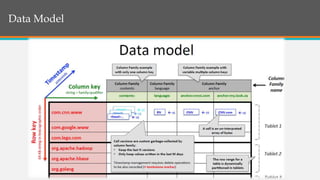
 Each table is a Multi-Dimensional Sparse Map ( Memory Efficient hash-map implementation).
 The table consists of
(1) Rows,
(2) Columns
(3) Each cell has a Time Version
(Time-Stamp).
 Time Version results in multiple copies
of each cell with different times,
Data Model
Structure of BigTable
 Time Version results in multiple copies of each cell with different times, resulting
Unimaginable Redundancy which is requirement for Google services, so don’t ever think
it as a drawback of this system.
 Google does Web Indexing to get the data of all the websites. They store all the URLs, their
titles, time-stamp and many more required fields
 Web Indexing :- indexing the contents of a website
Data Model
Structure of BigTable
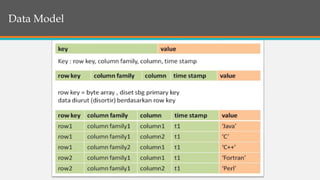
 The row keys in a table are arbitrary strings.
 Data is maintained in lexicographic order by row key
 Each row range is called a tablet, which is the unit of distribution and load balancing.
Data Model-Row
row
Structure of BigTableData Model-Column
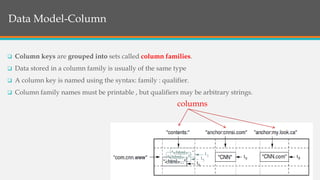
 Column keys are grouped into sets called column families.
 Data stored in a column family is usually of the same type
 A column key is named using the syntax: family : qualifier.
 Column family names must be printable , but qualifiers may be arbitrary strings.
columns
Structure of BigTableData Model-Timestamp
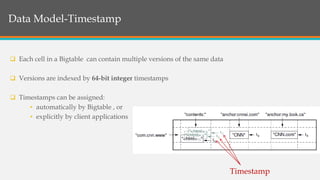
 Each cell in a Bigtable can contain multiple versions of the same data
 Versions are indexed by 64-bit integer timestamps
 Timestamps can be assigned:
▪ automatically by Bigtable , or
▪ explicitly by client applications
Timestamp
Structure of BigTableData Model
Structure of BigTableAPI
The Bigtable API provides functions :
• Creating and deleting tables and column families.
• Changing cluster , table and column family metadata.
• Support for single row transactions
• Allows cells to be used as integer counters
• Client supplied scripts can be executed in the address space of
servers
• Input and output of Map/Reduce jobs
Structure of BigTableAPI
Structure of BigTableBuilding Blocks
 BigTable is composed of several other innovative, distribution
oriented components.
 Google File System (GFS)
 SSTable
 Chubby
Structure of BigTableBuilding Blocks
 Google File System (GFS) :
Used to store log and data files
 SSTable (Sorted String Table) :
Used to store table data in GFS
used to store and retrieve the pairs <Key, Value>
Used as pointers to pairs <Key, Value>
Stored in GFS
Structure of BigTableBuilding Blocks
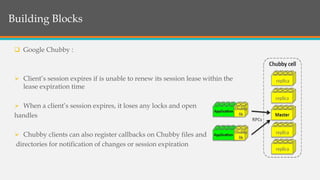
 Google Chubby :
 Chubby is High available and persistent distributes service
▪ Chubby service consists of 5 active replicas with one master to serve
requests
 Each directory or file can be used as a lock
 Reads and writes to a file are atomic
 Chubby client library provides consistent caching of Chubby files
 Each Chubby client maintains a session with a Chubby service
Structure of BigTableBuilding Blocks
 Google Chubby :
 Client’s session expires if is unable to renew its session lease within the
lease expiration time
 When a client’s session expires, it loses any locks and open
handles
 Chubby clients can also register callbacks on Chubby files and
directories for notification of changes or session expiration
Structure of BigTableBuilding Blocks
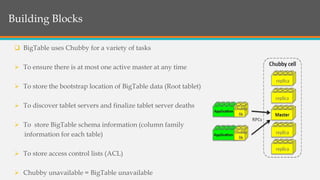
 BigTable uses Chubby for a variety of tasks
 To ensure there is at most one active master at any time
 To store the bootstrap location of BigTable data (Root tablet)
 To discover tablet servers and finalize tablet server deaths
 To store BigTable schema information (column family
information for each table)
 To store access control lists (ACL)
 Chubby unavailable = BigTable unavailable
Structure of BigTableImplementation
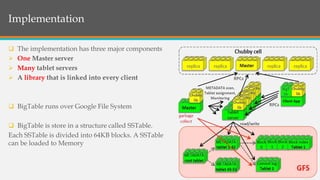
 The implementation has three major components
 One Master server
 Many tablet servers
 A library that is linked into every client
 BigTable runs over Google File System
 BigTable is store in a structure called SSTable.
Each SSTable is divided into 64KB blocks. A SSTable
can be loaded to Memory
Structure of BigTableImplementation
 One Master server
 Assigning tablets to tablet servers
 Detecting the addition and expiration of tablet servers
 Balancing tablet server load
 Garbage collecting of files in GFS
 Handling schema changes (table creation, column
family creation/deletion
Structure of BigTableImplementation
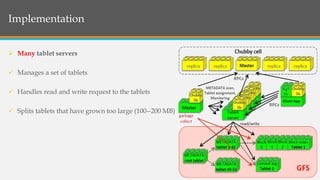
 Many tablet servers
 Manages a set of tablets
 Handles read and write request to the tablets
 Splits tablets that have grown too large (100-‐200 MB)
Structure of BigTableImplementation
 A library that is linked into every client
 Do not rely on the master for tablet location
information
 Communicates directly with tablet servers for reads
and writes
Structure of BigTableTablet Location
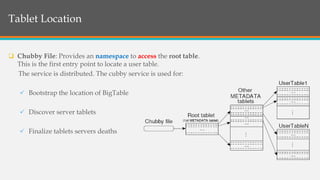
 Chubby File: Provides an namespace to access the root table.
This is the first entry point to locate a user table.
The service is distributed. The cubby service is used for:
 Bootstrap the location of BigTable
 Discover server tablets
 Finalize tablets servers deaths
Structure of BigTableTablet Location
 Three level hierarchy
 Level 1: Chubby file containing location of the root tablet
 Level 2: Root tablet contains the location of METADATA
tablets
 Level 3: Each METADATA tablet contains
the location of user tablets
 Location of tablet is stored under a row key that encodes table
identifier and its end row
Structure of BigTableTablet LookUp
 Lookup is a three-level system.
 Benefit :- NO Big Bottleneck in
the system and it also
make heavy use
of Pre-Fetching and Caching
Tablet Location Hierarchy
Chubby file
contains location
of the root
tablet.
Root tablet
contains all
tablet locations
in Metadata
table.
Metadata table stores
locations of actual
tablets.
Client moves up
the hierarchy
(Metadata -> Root -
> Chubby), if
location of tablet is
unknown or
incorrect.
Structure of BigTableActual Hierarchical Load Balancing Structure
Request arrives at
ROOT (Master
Computer).
ROOT checks its
master record and
sends the request to
the right PC.
SSTable contains
the records of
tablets.
This is how, it works
Via Meta Tablets, request is sent
to tablet containing original data
tablet and the data is fetched
then.
Structure of BigTableTablet Assignment
 Each tablet is assigned to one tablet server at a time
 Master keeps tracks of
– the set of live tablet servers (tracking via Chubby)
– the current assignment of tablet to tablet servers
– the current unassigned tablets
 When a tablet is unassigned, the master assigns the tablet to an
available tablet server by sending a tablet load request to that
tablet server
Structure of BigTableTablet Serving
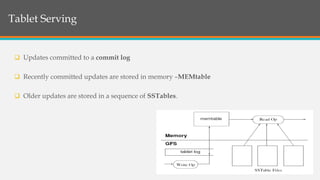
 Updates committed to a commit log
 Recently committed updates are stored in memory –MEMtable
 Older updates are stored in a sequence of SSTables.
Structure of BigTableTablet Serving
 Write operation:
1. Server checks that the request is well‐formed
2. Server checks that the sender is authorized to write (list of permitted writers in
a Chubby file)
3. A valid mutation is written to the commit log that stores redo records
(group commit to improve throughput)
4. After the mutation has been committed,
its contents are inserted into the
MEMtable (= in memory sorted buffer)
Structure of BigTableTablet Serving
 Read operation:
1. Server checks that the request is well‐formed
2. Server checks that the sender is authorized to read (list of permitted writers in a
Chubby file)
3. Valid read operation is executed on a merged view of the sequence of SSTables
and the MEMtable
Structure of BigTableTablet Serving
 Tablet Recovery
1. Tablet server reads its metadata from the METADATA table (lists of SSTables
that comprise a tablet and a set of a redo points, which are pointers into any
commit logs that may contain data for the tablet)
2. The tablet server reads the indices of the SSTables into memory and
reconstructs the MEMtable by applying all of the updates that
have a commted since the redo points
Structure of BigTableCompaction
 In order to control size of MEMtable, tablet log, and SSTable files,
“compaction” is used.
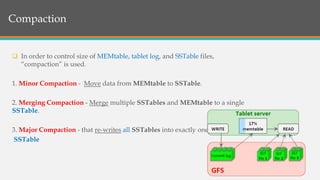
1. Minor Compaction - Move data from MEMtable to SSTable.
2. Merging Compaction - Merge multiple SSTables and MEMtable to a single
SSTable.
3. Major Compaction - that re-writes all SSTables into exactly one
SSTable
Structure of BigTableCompaction
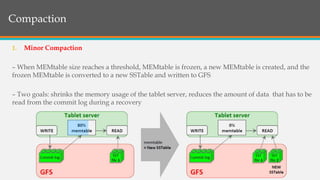
1. Minor Compaction
– When MEMtable size reaches a threshold, MEMtable is frozen, a new MEMtable is created, and the
frozen MEMtable is converted to a new SSTable and written to GFS
– Two goals: shrinks the memory usage of the tablet server, reduces the amount of data that has to be
read from the commit log during a recovery
Structure of BigTableCompaction
2. Merging Compaction
– Problem: every minor compaction creates a new SSTable (arbitrary number of SSTables !)
– Solution: periodic merging of a few SSTables and the MEMtable
Structure of BigTableCompaction
3. Major Compaction
– It is a merging compaction that rewrites all SSTables into exactly one SSTable that contains no
deletion information or deleted data
– BigTable cycles through all of it tablets and regularly applies major compaction to them (=reclaim
resources used by deleted data in a timely fashion)
Structure of BigTableConclusion
 BigTable has achieved its goals of high performance, data availability and
scalability.
 It has been successfully deployed in real apps (Personalized Search, Orkut,
Google Maps, …)
 Significant advantages of building own storage system like flexibility in
designing data model, control over implementation and other infrastructure on
which Bigtable relies on.
Thanks For Listening

Google Big Table

  • 1.
  • 2.
    • A Shorthistory of Google Motivation • What is GFS ? • What is Chubby ? • What is Map Reduce ? • What is BigTable ? • Data Model • API • Building Blocks • Implementation Agenda
  • 3.
    Introduction Even though Googleis best known for it’s reliable and fast services, but what’s there working behind the scene? Google Motivation  Undoubtedly, Google has a lot of data.  Scale of data is too large Even for commercial databases.
  • 4.
     GFS  Chubby Map Reduce  BigTable Google Motivation  Undoubtedly, there are number of aspects that matter behind this (like Hardware, Software, Operating System, Best Staff in the world etc. )  But, What I am going to explain here is the Software part.
  • 5.
    What is GFS? Whatis GFS ?  GFS stands for Google File System.  It’s a Proprietary(means for their personal use, not open source) distributed file system developed by Google for their services.  It is specially designed to provide efficient, reliable access to data using large clusters of commodity hardware, means they are using low cost hardware, not state-of-the-art computers. Google uses relatively inexpensive computers running Linux Operating System and the GFS works just fine with them !
  • 6.
    What is GFS? Whatis Chubby ?  Chubby is a Lock Service. (It’s related to gain access of Shared resources)  It is used to synchronize accesses to shared resources.  It is now used as a replacement of Google’s Domain Name System.
  • 7.
     MapReduce isa software framework that process massive amounts of unstructured data.  It allows developers to write programs that process data in parallel across a distributed cluster of processors or stand-alone computers.  It is now used by Google mainly for their Web Indexing Service, applied since 2004.  Map() procedure performs all the process related to Filtering and Sorting.  Reduce() procedure performs all the Summary related operations. What is Map Reduce?What is Map Reduce ?
  • 8.
    What is GoogleBigTable ?  BigTable is a distributed storage system for managing structured data built on Google File System, Chubby Lock Service, SSTable (log-structured storage like LevelDB) and a few other Google technologies.  Designed to Scale to a very large size: petabytes of data across thousands of commodity servers  Most important point, It’s a Non-Relational Database.  It uses amazing Load Balancing Structure so that it runs on Commodity Hardware.  It uses Snappy compression utility for compacting the data. What is BigTable?
  • 9.
    What is GoogleBigTable ?  Distributed  Column – Oriented  Multidimensional  High Availability  High Performance  Store System  Self-managing What is BigTable?
  • 10.
    What is GoogleBigTable ?What is BigTable?  Used by more than 60 Google products  Google Analytics  Google Finance  Personalized Search  Google Documents  Google Earth  Google Fusion Tables  …  Used for variety of demanding workloads  Throughput oriented batch processing  Latency sensitive data serving
  • 11.
  • 12.
    Structure of BigTable Each table is a Multi-Dimensional Sparse Map ( Memory Efficient hash-map implementation).  The table consists of (1) Rows, (2) Columns (3) Each cell has a Time Version (Time-Stamp).  Time Version results in multiple copies of each cell with different times, Data Model
  • 13.
    Structure of BigTable Time Version results in multiple copies of each cell with different times, resulting Unimaginable Redundancy which is requirement for Google services, so don’t ever think it as a drawback of this system.  Google does Web Indexing to get the data of all the websites. They store all the URLs, their titles, time-stamp and many more required fields  Web Indexing :- indexing the contents of a website Data Model
  • 14.
    Structure of BigTable The row keys in a table are arbitrary strings.  Data is maintained in lexicographic order by row key  Each row range is called a tablet, which is the unit of distribution and load balancing. Data Model-Row row
  • 15.
    Structure of BigTableDataModel-Column  Column keys are grouped into sets called column families.  Data stored in a column family is usually of the same type  A column key is named using the syntax: family : qualifier.  Column family names must be printable , but qualifiers may be arbitrary strings. columns
  • 16.
    Structure of BigTableDataModel-Timestamp  Each cell in a Bigtable can contain multiple versions of the same data  Versions are indexed by 64-bit integer timestamps  Timestamps can be assigned: ▪ automatically by Bigtable , or ▪ explicitly by client applications Timestamp
  • 17.
  • 18.
    Structure of BigTableAPI TheBigtable API provides functions : • Creating and deleting tables and column families. • Changing cluster , table and column family metadata. • Support for single row transactions • Allows cells to be used as integer counters • Client supplied scripts can be executed in the address space of servers • Input and output of Map/Reduce jobs
  • 19.
  • 20.
    Structure of BigTableBuildingBlocks  BigTable is composed of several other innovative, distribution oriented components.  Google File System (GFS)  SSTable  Chubby
  • 21.
    Structure of BigTableBuildingBlocks  Google File System (GFS) : Used to store log and data files  SSTable (Sorted String Table) : Used to store table data in GFS used to store and retrieve the pairs <Key, Value> Used as pointers to pairs <Key, Value> Stored in GFS
  • 22.
    Structure of BigTableBuildingBlocks  Google Chubby :  Chubby is High available and persistent distributes service ▪ Chubby service consists of 5 active replicas with one master to serve requests  Each directory or file can be used as a lock  Reads and writes to a file are atomic  Chubby client library provides consistent caching of Chubby files  Each Chubby client maintains a session with a Chubby service
  • 23.
    Structure of BigTableBuildingBlocks  Google Chubby :  Client’s session expires if is unable to renew its session lease within the lease expiration time  When a client’s session expires, it loses any locks and open handles  Chubby clients can also register callbacks on Chubby files and directories for notification of changes or session expiration
  • 24.
    Structure of BigTableBuildingBlocks  BigTable uses Chubby for a variety of tasks  To ensure there is at most one active master at any time  To store the bootstrap location of BigTable data (Root tablet)  To discover tablet servers and finalize tablet server deaths  To store BigTable schema information (column family information for each table)  To store access control lists (ACL)  Chubby unavailable = BigTable unavailable
  • 25.
    Structure of BigTableImplementation The implementation has three major components  One Master server  Many tablet servers  A library that is linked into every client  BigTable runs over Google File System  BigTable is store in a structure called SSTable. Each SSTable is divided into 64KB blocks. A SSTable can be loaded to Memory
  • 26.
    Structure of BigTableImplementation One Master server  Assigning tablets to tablet servers  Detecting the addition and expiration of tablet servers  Balancing tablet server load  Garbage collecting of files in GFS  Handling schema changes (table creation, column family creation/deletion
  • 27.
    Structure of BigTableImplementation Many tablet servers  Manages a set of tablets  Handles read and write request to the tablets  Splits tablets that have grown too large (100-‐200 MB)
  • 28.
    Structure of BigTableImplementation A library that is linked into every client  Do not rely on the master for tablet location information  Communicates directly with tablet servers for reads and writes
  • 29.
    Structure of BigTableTabletLocation  Chubby File: Provides an namespace to access the root table. This is the first entry point to locate a user table. The service is distributed. The cubby service is used for:  Bootstrap the location of BigTable  Discover server tablets  Finalize tablets servers deaths
  • 30.
    Structure of BigTableTabletLocation  Three level hierarchy  Level 1: Chubby file containing location of the root tablet  Level 2: Root tablet contains the location of METADATA tablets  Level 3: Each METADATA tablet contains the location of user tablets  Location of tablet is stored under a row key that encodes table identifier and its end row
  • 31.
    Structure of BigTableTabletLookUp  Lookup is a three-level system.  Benefit :- NO Big Bottleneck in the system and it also make heavy use of Pre-Fetching and Caching Tablet Location Hierarchy Chubby file contains location of the root tablet. Root tablet contains all tablet locations in Metadata table. Metadata table stores locations of actual tablets. Client moves up the hierarchy (Metadata -> Root - > Chubby), if location of tablet is unknown or incorrect.
  • 32.
    Structure of BigTableActualHierarchical Load Balancing Structure Request arrives at ROOT (Master Computer). ROOT checks its master record and sends the request to the right PC. SSTable contains the records of tablets. This is how, it works Via Meta Tablets, request is sent to tablet containing original data tablet and the data is fetched then.
  • 33.
    Structure of BigTableTabletAssignment  Each tablet is assigned to one tablet server at a time  Master keeps tracks of – the set of live tablet servers (tracking via Chubby) – the current assignment of tablet to tablet servers – the current unassigned tablets  When a tablet is unassigned, the master assigns the tablet to an available tablet server by sending a tablet load request to that tablet server
  • 34.
    Structure of BigTableTabletServing  Updates committed to a commit log  Recently committed updates are stored in memory –MEMtable  Older updates are stored in a sequence of SSTables.
  • 35.
    Structure of BigTableTabletServing  Write operation: 1. Server checks that the request is well‐formed 2. Server checks that the sender is authorized to write (list of permitted writers in a Chubby file) 3. A valid mutation is written to the commit log that stores redo records (group commit to improve throughput) 4. After the mutation has been committed, its contents are inserted into the MEMtable (= in memory sorted buffer)
  • 36.
    Structure of BigTableTabletServing  Read operation: 1. Server checks that the request is well‐formed 2. Server checks that the sender is authorized to read (list of permitted writers in a Chubby file) 3. Valid read operation is executed on a merged view of the sequence of SSTables and the MEMtable
  • 37.
    Structure of BigTableTabletServing  Tablet Recovery 1. Tablet server reads its metadata from the METADATA table (lists of SSTables that comprise a tablet and a set of a redo points, which are pointers into any commit logs that may contain data for the tablet) 2. The tablet server reads the indices of the SSTables into memory and reconstructs the MEMtable by applying all of the updates that have a commted since the redo points
  • 38.
    Structure of BigTableCompaction In order to control size of MEMtable, tablet log, and SSTable files, “compaction” is used. 1. Minor Compaction - Move data from MEMtable to SSTable. 2. Merging Compaction - Merge multiple SSTables and MEMtable to a single SSTable. 3. Major Compaction - that re-writes all SSTables into exactly one SSTable
  • 39.
    Structure of BigTableCompaction 1.Minor Compaction – When MEMtable size reaches a threshold, MEMtable is frozen, a new MEMtable is created, and the frozen MEMtable is converted to a new SSTable and written to GFS – Two goals: shrinks the memory usage of the tablet server, reduces the amount of data that has to be read from the commit log during a recovery
  • 40.
    Structure of BigTableCompaction 2.Merging Compaction – Problem: every minor compaction creates a new SSTable (arbitrary number of SSTables !) – Solution: periodic merging of a few SSTables and the MEMtable
  • 41.
    Structure of BigTableCompaction 3.Major Compaction – It is a merging compaction that rewrites all SSTables into exactly one SSTable that contains no deletion information or deleted data – BigTable cycles through all of it tablets and regularly applies major compaction to them (=reclaim resources used by deleted data in a timely fashion)
  • 42.
    Structure of BigTableConclusion BigTable has achieved its goals of high performance, data availability and scalability.  It has been successfully deployed in real apps (Personalized Search, Orkut, Google Maps, …)  Significant advantages of building own storage system like flexibility in designing data model, control over implementation and other infrastructure on which Bigtable relies on.
  • 43.