Tomcy Thankachan
   Introduction
   Data model
   Building Blocks
   Implementation
   Refinements
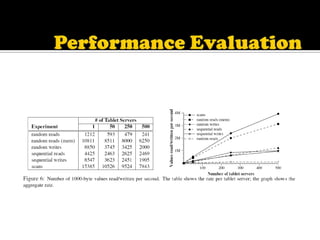
   Performance Evaluation
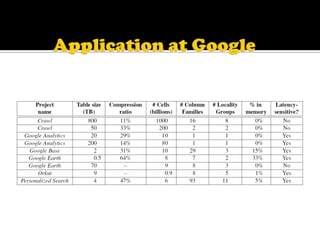
   Real applications
   Conclusion
   Scale is too large for most commercial Databases

   Cost would be very high

   Low-level storage optimizations help performance significantly

   Hard to map semi-structured data to relational database

   Non-uniform fields makes it difficult to insert/query data
   BigTable is a distributed storage system for managing structured data

   Bigtable does not support a full relational data model

   Scalable

   Self managing
   Used by more than 60 Google products
     Google Analytics
     Google Finance
     Personalized Search
     Google Documents
     Google Earth
     Google Fusion Tables
     …


   Used for variety of demanding workloads
     Throughput oriented batch processing
     Latency sensitive data serving
   Goals

       Wide applicability
       Scalability
       High performance
       High availability

   Simple data model that supports dynamic control over data layout and
    format
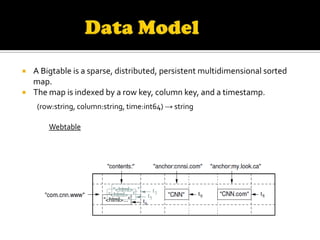
   A Bigtable is a sparse, distributed, persistent multidimensional sorted
    map.
   The map is indexed by a row key, column key, and a timestamp.
     (row:string, column:string, time:int64) → string

        Webtable
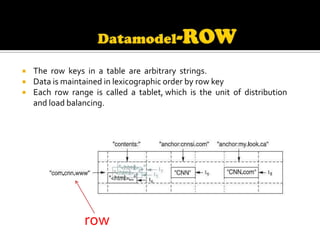
   The row keys in a table are arbitrary strings.
   Data is maintained in lexicographic order by row key
   Each row range is called a tablet, which is the unit of distribution
    and load balancing.


                 row
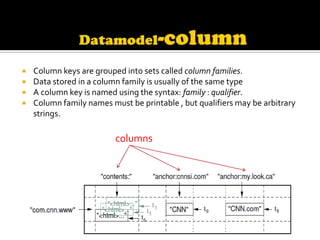
   Column keys are grouped into sets called column families.
   Data stored in a column family is usually of the same type
   A column key is named using the syntax: family : qualifier.
   Column family names must be printable , but qualifiers may be arbitrary
    strings.

                          columns
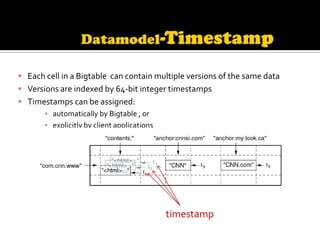
 Each cell in a Bigtable can contain multiple versions of the same data
 Versions are indexed by 64-bit integer timestamps
 Timestamps can be assigned:
       ▪ automatically by Bigtable , or
       ▪ explicitly by client applications


                                             timestamp
   The Bigtable API provides functions :

         Creating and deleting tables and column families.
         Changing cluster , table and column family metadata.
          Support for single row transactions
          Allows cells to be used as integer counters
          Client supplied scripts can be executed in the address space of
        servers
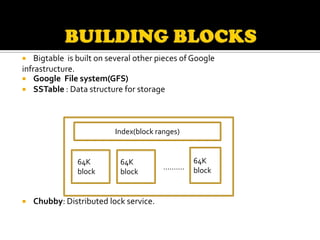
   Bigtable is built on several other pieces of Google
infrastructure.
 Google File system(GFS)
 SSTable : Data structure for storage


                          Index(block ranges)


                64K         64K                 64K
                                        ……….    block
                block       block


   Chubby: Distributed lock service.
   Three major components
     Library linked into every client
     Single master server
      ▪ Assigning tablets to tablet servers
      ▪ Detecting addition and expiration of tablet servers
      ▪ Balancing tablet-server load
      ▪ Garbage collection files in GFS
     Many tablet servers
      ▪ Manages a set of tablets
      ▪ Tablet servers handle read and write requests to its table
      ▪ Splits tablets that have grown too large
▪ Clients communicates directly with tablet servers for
    read/write

    Each table consists of a set of tablets
      Initially, each table have just one tablet
      Tablets are automatically split as the table grows

    Row size can be arbitrary (hundreds of GB)
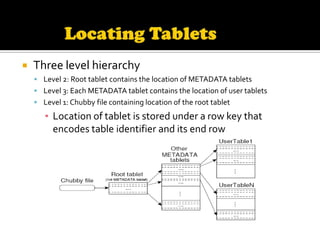
   Three level hierarchy
     Level 2: Root tablet contains the location of METADATA tablets
     Level 3: Each METADATA tablet contains the location of user tablets
     Level 1: Chubby file containing location of the root tablet

       ▪ Location of tablet is stored under a row key that
         encodes table identifier and its end row
   Tablet server startup
     It creates and acquires an exclusive lock on , a uniquely
      named file on Chubby.
     Master monitors this directory to discover tablet servers.


   Tablet server stops serving tablets
     If it loses its exclusive lock.
     Tries to reacquire the lock on its file as long as the file still
      exists.
     If file no longer exists, the tablet server will never be able
      to serve again.
   Master server startup
     Grabs unique master lock in Chubby.
     Scans the tablet server directory in Chubby.
     Communicates with every live tablet server
     Scans METADATA table to learn set of tablets.


   Master is responsible for finding when tablet server is no longer serving
    its tablets and reassigning those tablets as soon as possible.
     Periodically asks each tablet server for the status of its lock
     If no reply, master tries to acquire the lock itself
     If successful to acquire lock, then tablet server is either dead or having
       network trouble
   Updates committed to a commit log

   Recently committed updates are stored in memory –memtable

   Older updates are stored in a sequence of SSTables.
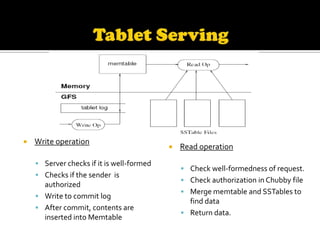
   Write operation
                                              Read operation
     Server checks if it is well-formed
                                                Check well-formedness of request.
     Checks if the sender is
                                                Check authorization in Chubby file
      authorized
                                                Merge memtable and SSTables to
     Write to commit log
                                                 find data
     After commit, contents are
                                                Return data.
      inserted into Memtable
In order to control size of memtable, tablet log, and SSTable
   files, “compaction” is used.


1. Minor Compaction.-             Move data from memtable to SSTable.


2. Merging Compaction. - Merge multiple SSTables and
  memtable to a single SSTable.
3. Major Compaction. - that re-writes all SSTables into exactly
  one SSTable
   Locality groups
     Clients can group multiple column families together into a locality
      group.


   Compression
     Compression applied to each SSTable block separately
     Uses Bentley and McIlroy's scheme and fast compression algorithm


   Bloom filters
     Reduce the number of disk accesses
   Caching
     Scan Cache: a high-level cache that caches key-value pairs returned by
      the SSTable interface
     Block Cache: a lower-level cache that caches SSTable blocks read from
      file system


   Commit-log implementation
     Suppose one log per tablet rather have one log per tablet server
   Satisfies goals of high-availability, high-performance, massively scalable
    data storage.
     -It has been successfully deployed in real apps (Personalized
      Search, Orkut, GoogleMaps, …)
   Successfully used by various Google products (>60).
   It’s a distributed systems, designed to store enormous volumes of data.
   Thesesystems can be easily scaled to accommodate peta-bytes of data
    across thousands of nodes.
   Bigtable: A Distributed Storage System for Structured Data by Fay Chang, Jeffrey
    Dean, Sanjay Ghemawat, Wilson C. Hsieh, Deborah A. Wallach, Mike Burrows,
    Tushar Chandra, Andrew Fikes, Robert E. Gruber

   http://glinden.blogspot.com/2006/08/google-bigtable-paper.html


   Dean, J. 2005. BigTable: A Distributed Structured Storage System. University of
    Washington CSE Colloquia (Oct. 2005).
    http://www.uwtv.org/programs/displayevent.aspx?rID=4188
GOOGLE BIGTABLE
GOOGLE BIGTABLE

GOOGLE BIGTABLE

  • 2.
  • 3.
    Introduction  Data model  Building Blocks  Implementation  Refinements  Performance Evaluation  Real applications  Conclusion
  • 4.
    Scale is too large for most commercial Databases  Cost would be very high  Low-level storage optimizations help performance significantly  Hard to map semi-structured data to relational database  Non-uniform fields makes it difficult to insert/query data
  • 5.
    BigTable is a distributed storage system for managing structured data  Bigtable does not support a full relational data model  Scalable  Self managing
  • 6.
    Used by more than 60 Google products  Google Analytics  Google Finance  Personalized Search  Google Documents  Google Earth  Google Fusion Tables  …  Used for variety of demanding workloads  Throughput oriented batch processing  Latency sensitive data serving
  • 7.
    Goals  Wide applicability  Scalability  High performance  High availability  Simple data model that supports dynamic control over data layout and format
  • 8.
    A Bigtable is a sparse, distributed, persistent multidimensional sorted map.  The map is indexed by a row key, column key, and a timestamp. (row:string, column:string, time:int64) → string Webtable
  • 9.
    The row keys in a table are arbitrary strings.  Data is maintained in lexicographic order by row key  Each row range is called a tablet, which is the unit of distribution and load balancing. row
  • 10.
    Column keys are grouped into sets called column families.  Data stored in a column family is usually of the same type  A column key is named using the syntax: family : qualifier.  Column family names must be printable , but qualifiers may be arbitrary strings. columns
  • 11.
     Each cellin a Bigtable can contain multiple versions of the same data  Versions are indexed by 64-bit integer timestamps  Timestamps can be assigned: ▪ automatically by Bigtable , or ▪ explicitly by client applications timestamp
  • 12.
    The Bigtable API provides functions :  Creating and deleting tables and column families.  Changing cluster , table and column family metadata.  Support for single row transactions  Allows cells to be used as integer counters  Client supplied scripts can be executed in the address space of servers
  • 13.
    Bigtable is built on several other pieces of Google infrastructure.  Google File system(GFS)  SSTable : Data structure for storage Index(block ranges) 64K 64K 64K ………. block block block  Chubby: Distributed lock service.
  • 14.
    Three major components  Library linked into every client  Single master server ▪ Assigning tablets to tablet servers ▪ Detecting addition and expiration of tablet servers ▪ Balancing tablet-server load ▪ Garbage collection files in GFS  Many tablet servers ▪ Manages a set of tablets ▪ Tablet servers handle read and write requests to its table ▪ Splits tablets that have grown too large
  • 15.
    ▪ Clients communicatesdirectly with tablet servers for read/write  Each table consists of a set of tablets  Initially, each table have just one tablet  Tablets are automatically split as the table grows  Row size can be arbitrary (hundreds of GB)
  • 16.
    Three level hierarchy  Level 2: Root tablet contains the location of METADATA tablets  Level 3: Each METADATA tablet contains the location of user tablets  Level 1: Chubby file containing location of the root tablet ▪ Location of tablet is stored under a row key that encodes table identifier and its end row
  • 17.
    Tablet server startup  It creates and acquires an exclusive lock on , a uniquely named file on Chubby.  Master monitors this directory to discover tablet servers.  Tablet server stops serving tablets  If it loses its exclusive lock.  Tries to reacquire the lock on its file as long as the file still exists.  If file no longer exists, the tablet server will never be able to serve again.
  • 18.
    Master server startup  Grabs unique master lock in Chubby.  Scans the tablet server directory in Chubby.  Communicates with every live tablet server  Scans METADATA table to learn set of tablets.  Master is responsible for finding when tablet server is no longer serving its tablets and reassigning those tablets as soon as possible.  Periodically asks each tablet server for the status of its lock  If no reply, master tries to acquire the lock itself  If successful to acquire lock, then tablet server is either dead or having network trouble
  • 19.
    Updates committed to a commit log  Recently committed updates are stored in memory –memtable  Older updates are stored in a sequence of SSTables.
  • 20.
    Write operation  Read operation  Server checks if it is well-formed  Check well-formedness of request.  Checks if the sender is  Check authorization in Chubby file authorized  Merge memtable and SSTables to  Write to commit log find data  After commit, contents are  Return data. inserted into Memtable
  • 21.
    In order tocontrol size of memtable, tablet log, and SSTable files, “compaction” is used. 1. Minor Compaction.- Move data from memtable to SSTable. 2. Merging Compaction. - Merge multiple SSTables and memtable to a single SSTable. 3. Major Compaction. - that re-writes all SSTables into exactly one SSTable
  • 22.
    Locality groups  Clients can group multiple column families together into a locality group.  Compression  Compression applied to each SSTable block separately  Uses Bentley and McIlroy's scheme and fast compression algorithm  Bloom filters  Reduce the number of disk accesses
  • 23.
    Caching  Scan Cache: a high-level cache that caches key-value pairs returned by the SSTable interface  Block Cache: a lower-level cache that caches SSTable blocks read from file system  Commit-log implementation  Suppose one log per tablet rather have one log per tablet server
  • 26.
    Satisfies goals of high-availability, high-performance, massively scalable data storage. -It has been successfully deployed in real apps (Personalized Search, Orkut, GoogleMaps, …)  Successfully used by various Google products (>60).  It’s a distributed systems, designed to store enormous volumes of data.  Thesesystems can be easily scaled to accommodate peta-bytes of data across thousands of nodes.
  • 27.
    Bigtable: A Distributed Storage System for Structured Data by Fay Chang, Jeffrey Dean, Sanjay Ghemawat, Wilson C. Hsieh, Deborah A. Wallach, Mike Burrows, Tushar Chandra, Andrew Fikes, Robert E. Gruber  http://glinden.blogspot.com/2006/08/google-bigtable-paper.html  Dean, J. 2005. BigTable: A Distributed Structured Storage System. University of Washington CSE Colloquia (Oct. 2005). http://www.uwtv.org/programs/displayevent.aspx?rID=4188

Editor's Notes

  • #21 The persistent state of a tablet is stored in GFS
  • #22 When memtable reaches thresholdFrozen memtable is converted to an SSTableSSTable written to file systemGoalsReduce memory usage of the tablet serverReduce the amount of data to read from commit log during recoveryMerging compactionReads the contents of a few SSTable and memtableWrites new SSTable