BigTable is a distributed storage system developed by Google for managing structured data at a massive scale. It uses a sparse, distributed, and persistent multidimensional sorted map to store data across thousands of commodity servers. BigTable's data model organizes information into rows, column families, columns, and versions, providing flexibility and high performance for applications like web indexing and analytics.
In this document
Powered by AI
Presented by Manuel Correa, the agenda includes discussing RDBMS issues, NoSQL, BigTable features, and applications.
RDBMS struggles with large datasets and lacks horizontal scaling. Intro to NoSQL databases as distributed storage alternatives.
BigTable is a distributed storage system designed by Google to manage structured data, scalable up to petabytes.
BigTable structure uses a multidimensional map indexed by keys, timestamps, with atomic operations and versioning.
BigTable uses Google File System and SSTable for data storage, and implements a reliable locking service called Chubby.
HBase, an open-source model of BigTable, supports large datasets in Hadoop and presents optimizations for queries.
Evaluation of BigTable's performance and examples of real-world applications.
Open floor for questions about BigTable, its implementations, and functionalities.
Presented by
Manuel Correa
BigTable:A Distributed StorageBigTable: A Distributed Storage
System for Structure DataSystem for Structure Data
Fay Chang, Jeffrey Dean, Sanjay Ghemawat, Wilson C. Hsieh, Deborah A. Wallach
Mike Burrows, Tushar Chandra, Andrew Fikes, Robert E. Gruber
Google, Inc.Google, Inc.
2.
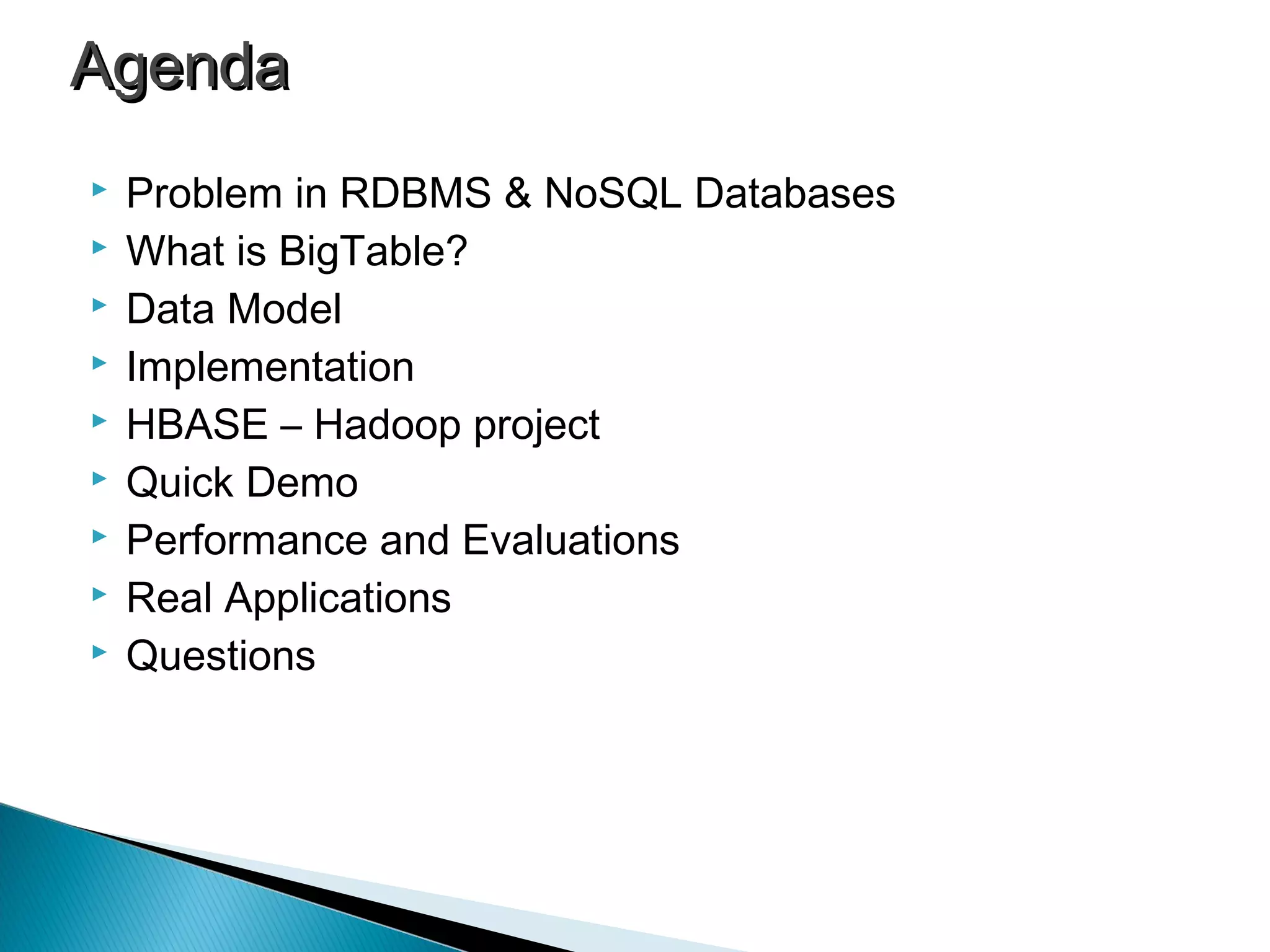
Problem inRDBMS & NoSQL Databases
What is BigTable?
Data Model
Implementation
HBASE – Hadoop project
Quick Demo
Performance and Evaluations
Real Applications
Questions
AgendaAgenda
3.
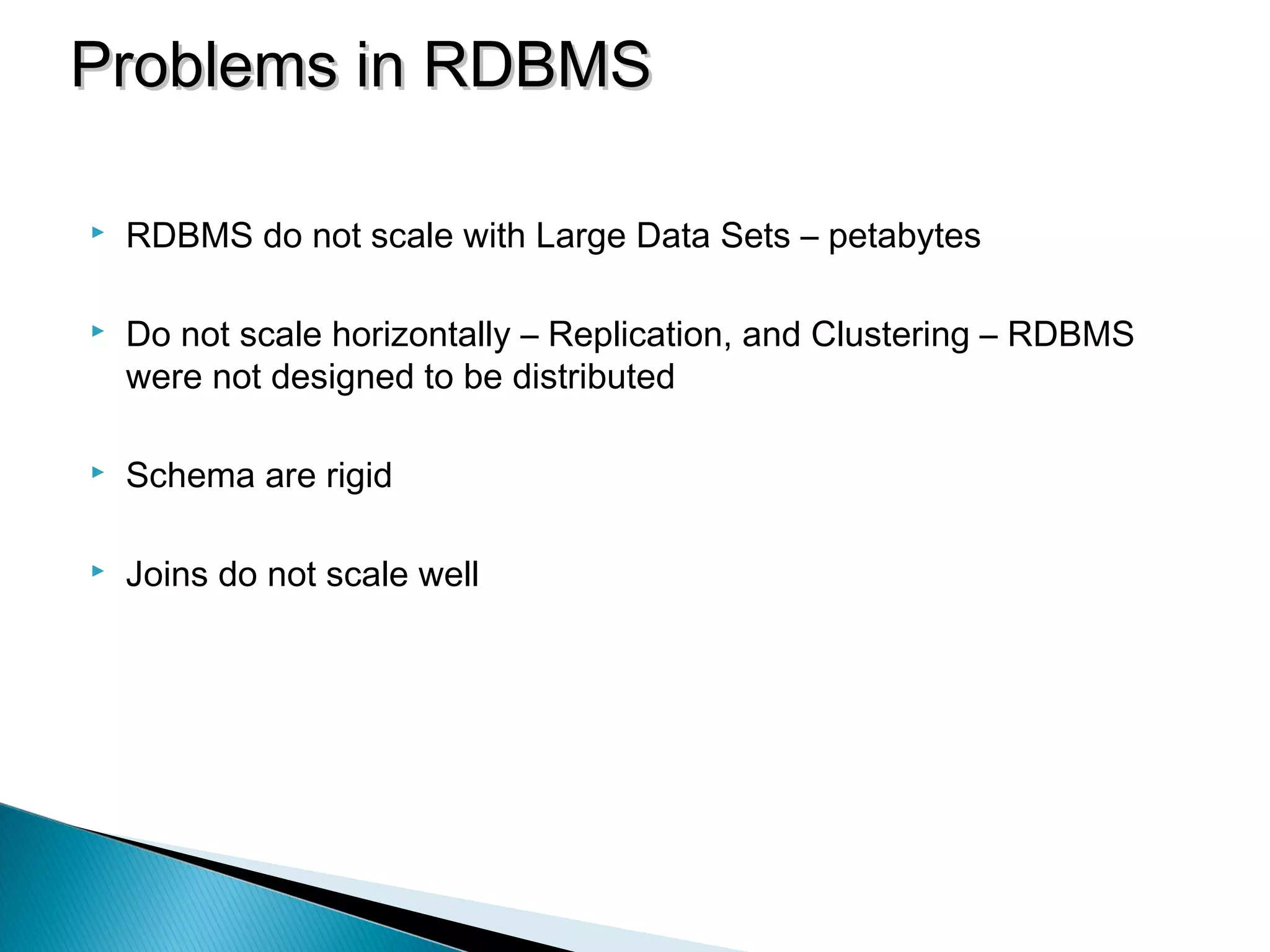
RDBMS donot scale with Large Data Sets – petabytes
Do not scale horizontally – Replication, and Clustering – RDBMS
were not designed to be distributed
Schema are rigid
Joins do not scale well
Problems in RDBMSProblems in RDBMS
4.
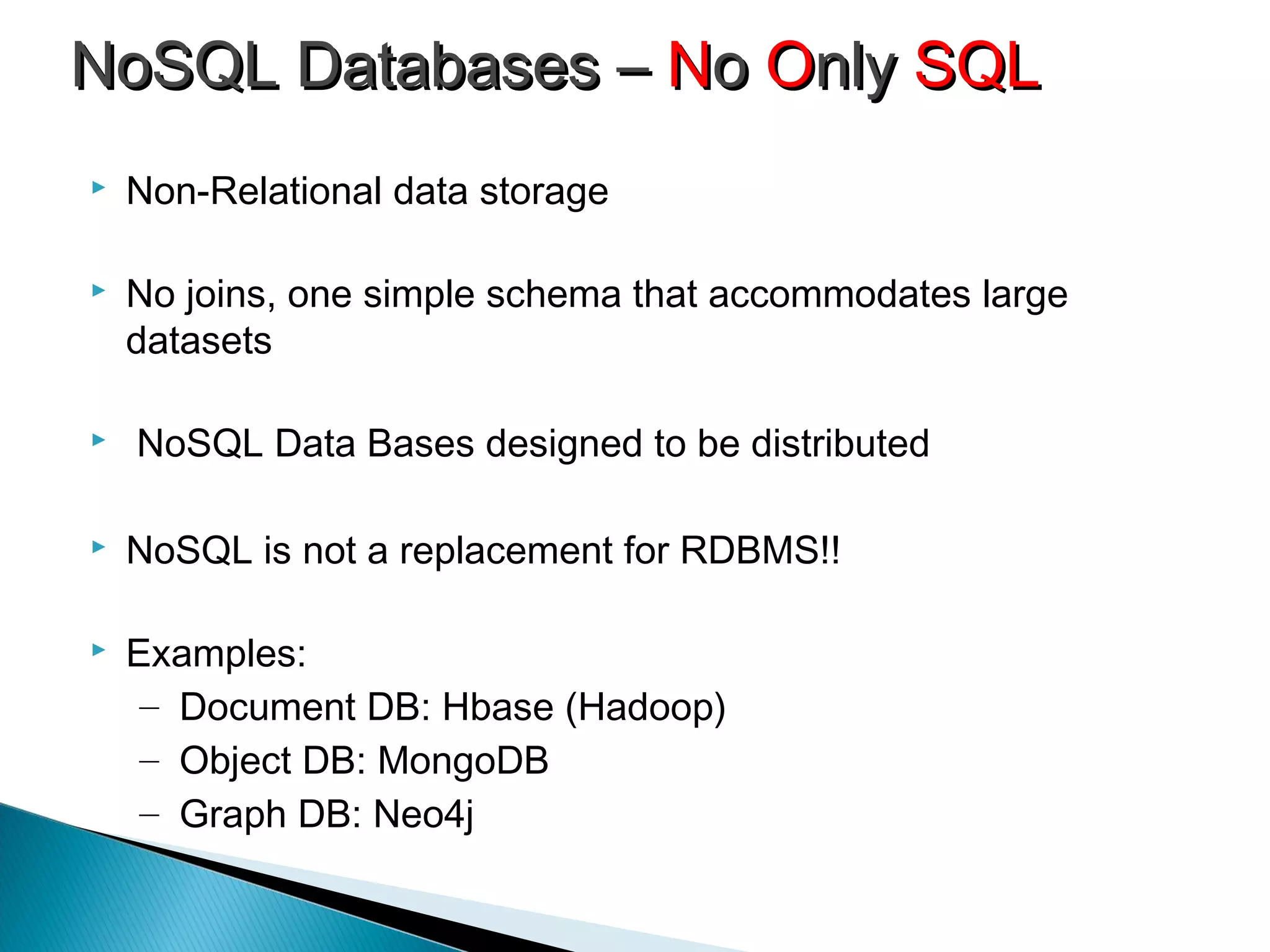
Non-Relational datastorage
No joins, one simple schema that accommodates large
datasets
NoSQL Data Bases designed to be distributed
NoSQL is not a replacement for RDBMS!!
Examples:
– Document DB: Hbase (Hadoop)
– Object DB: MongoDB
– Graph DB: Neo4j
NoSQL Databases –NoSQL Databases – NNoo OOnlynly SQLSQL
BigTable isa distributed storage system for managing structure
data
Designed by Google Inc. in 2006
BigTable was designed to scale to petabytes of data in thousands of
machines
BigTable has successfully provided a flexible, wide applicability,
scalability, high availability, and high-performance solution for all
Google products
What is BigTable?What is BigTable?
7.
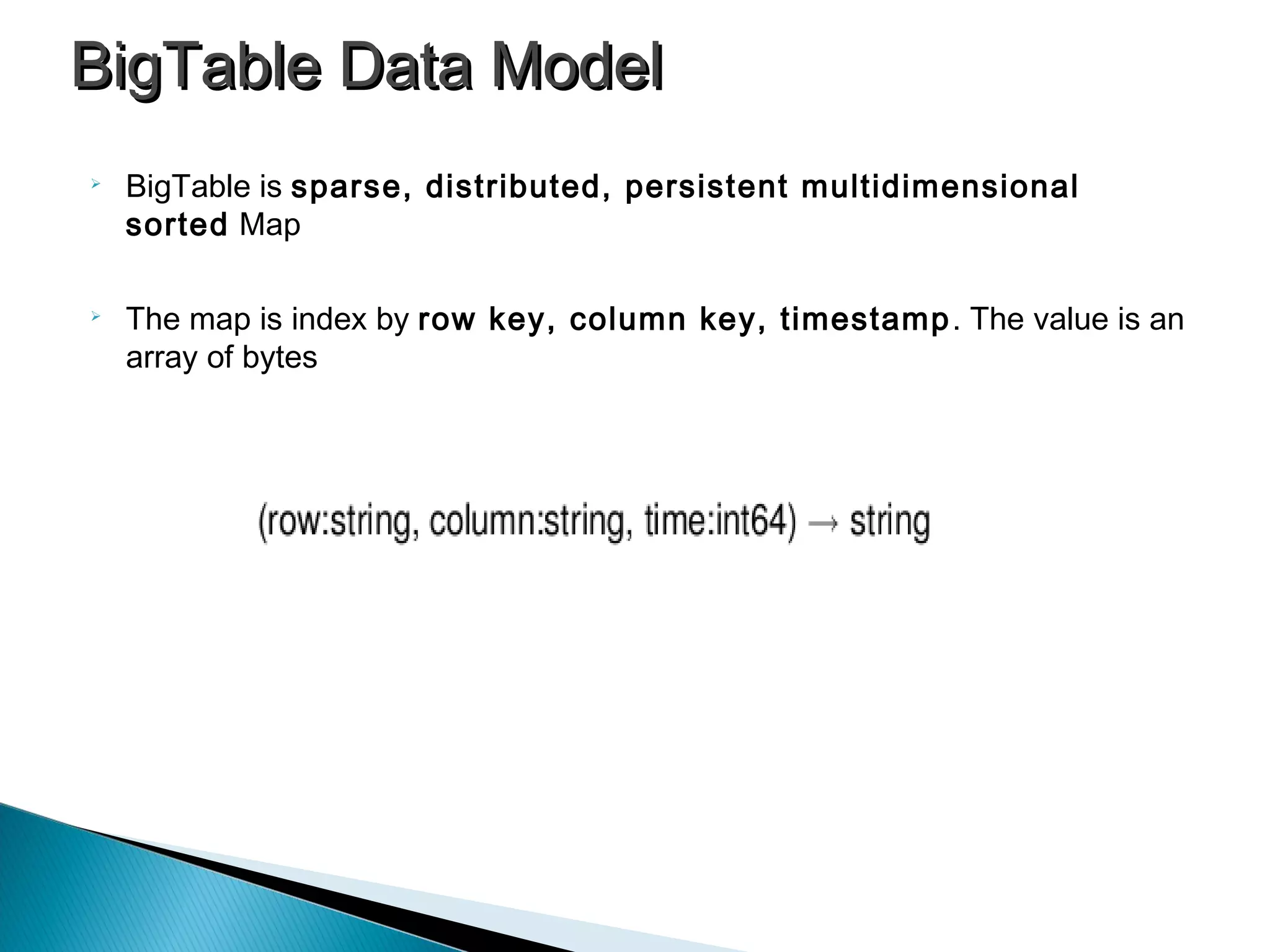
BigTable is sparse,distributed, persistent multidimensional
sorted Map
The map is index by row key, column key, timestamp. The value is an
array of bytes
BigTable Data ModelBigTable Data Model
8.
Rows keys arearbitrary strings (up to 64KB)
Every single Read/Write operation over a row is Atomic
BigTable data is ordered lexicographically by row key
A table is dynamically partitioned in row ranges called TabletTablet
A Tablet is the basic unit of distribution and load balancing
BigTable Model - RowsBigTable Model - Rows
9.
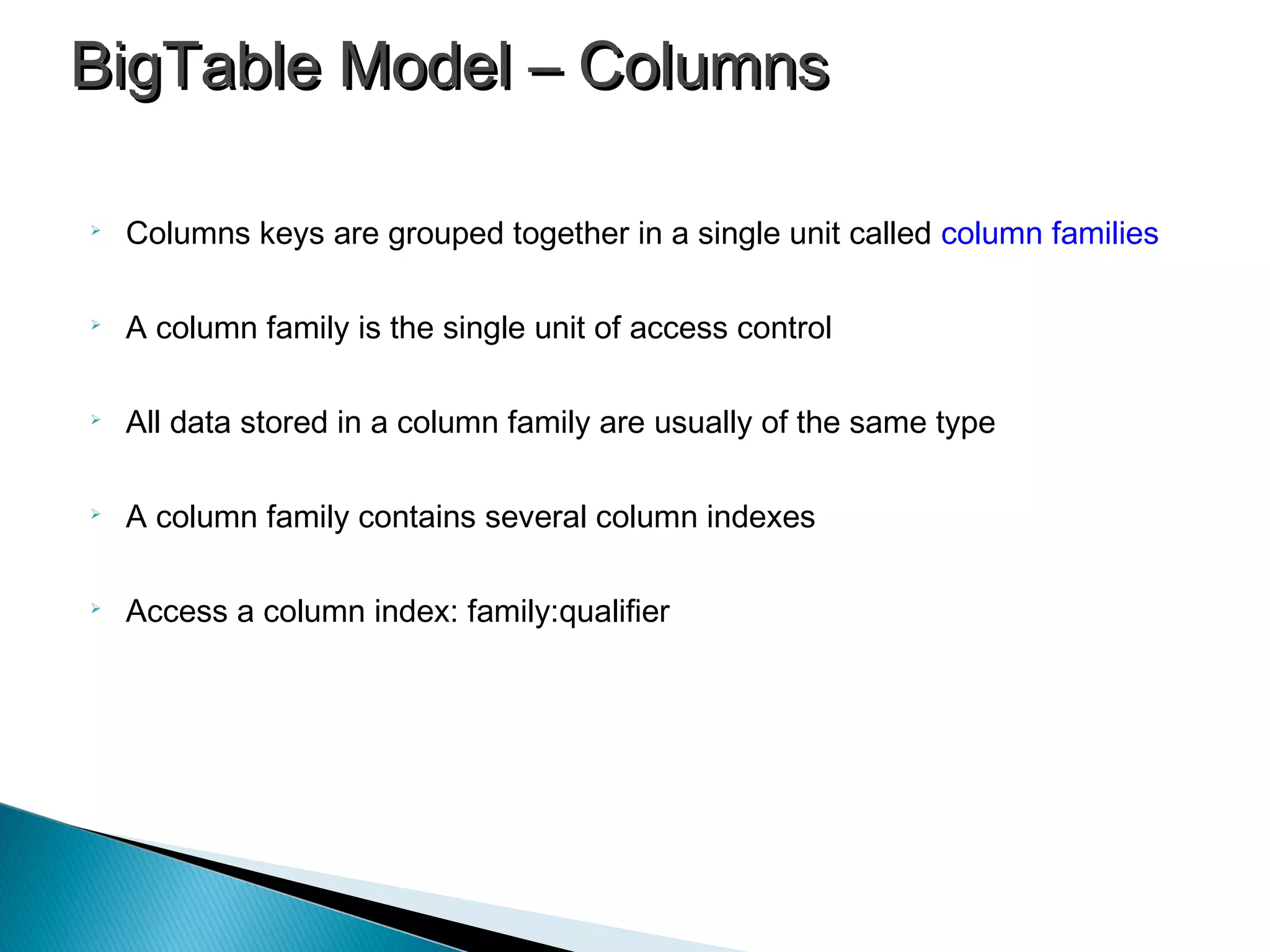
Columns keys aregrouped together in a single unit called column families
A column family is the single unit of access control
All data stored in a column family are usually of the same type
A column family contains several column indexes
Access a column index: family:qualifier
BigTable Model – ColumnsBigTable Model – Columns
10.
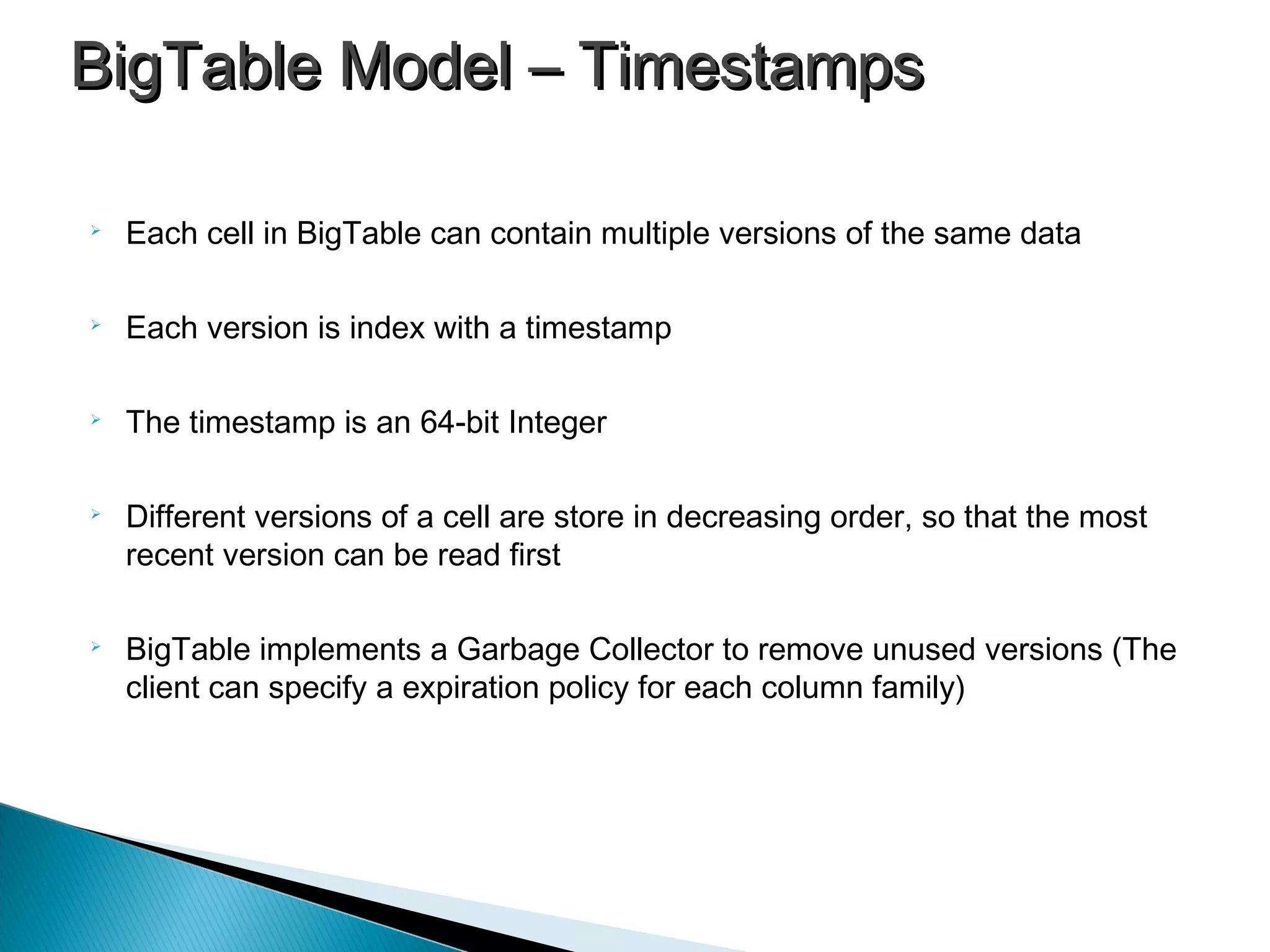
Each cell inBigTable can contain multiple versions of the same data
Each version is index with a timestamp
The timestamp is an 64-bit Integer
Different versions of a cell are store in decreasing order, so that the most
recent version can be read first
BigTable implements a Garbage Collector to remove unused versions (The
client can specify a expiration policy for each column family)
BigTable Model – TimestampsBigTable Model – Timestamps
11.
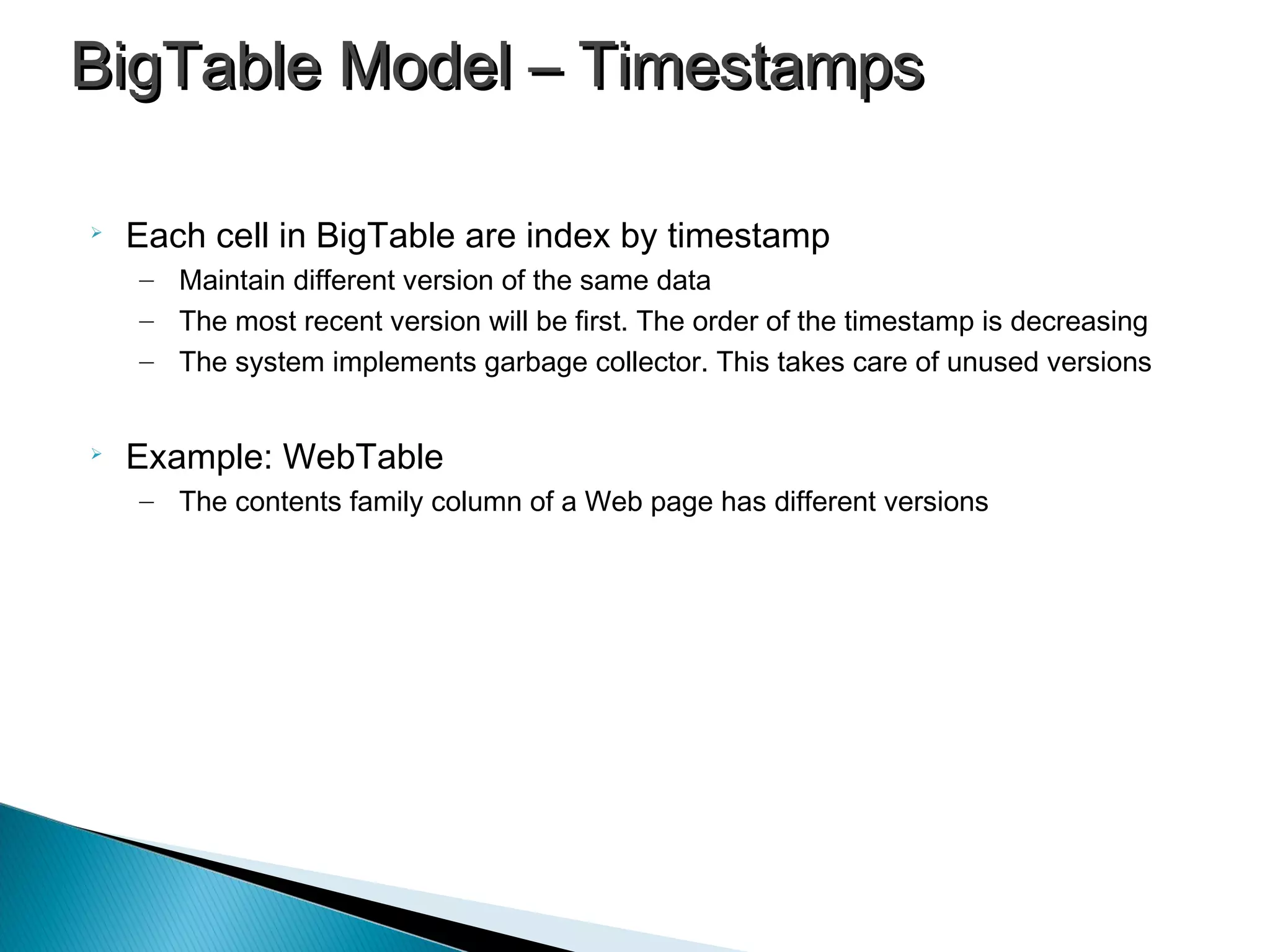
Each cell inBigTable are index by timestamp
– Maintain different version of the same data
– The most recent version will be first. The order of the timestamp is decreasing
– The system implements garbage collector. This takes care of unused versions
Example: WebTable
– The contents family column of a Web page has different versions
BigTable Model – TimestampsBigTable Model – Timestamps
12.
BigTable Model –Example: WebTableBigTable Model – Example: WebTable
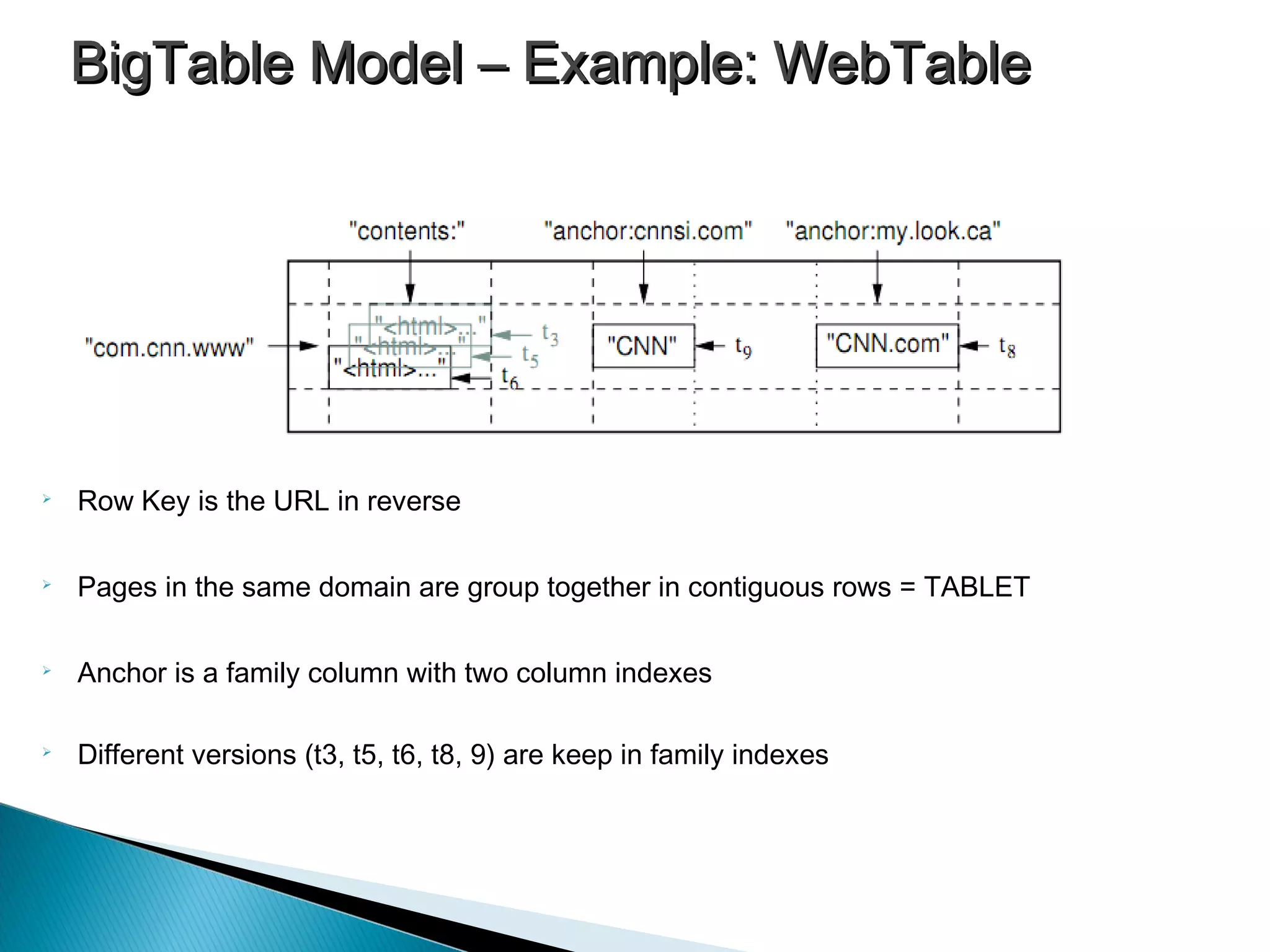
Row Key is the URL in reverse
Pages in the same domain are group together in contiguous rows = TABLET
Anchor is a family column with two column indexes
Different versions (t3, t5, t6, t8, 9) are keep in family indexes
13.
BigTable ImplementationBigTable Implementation
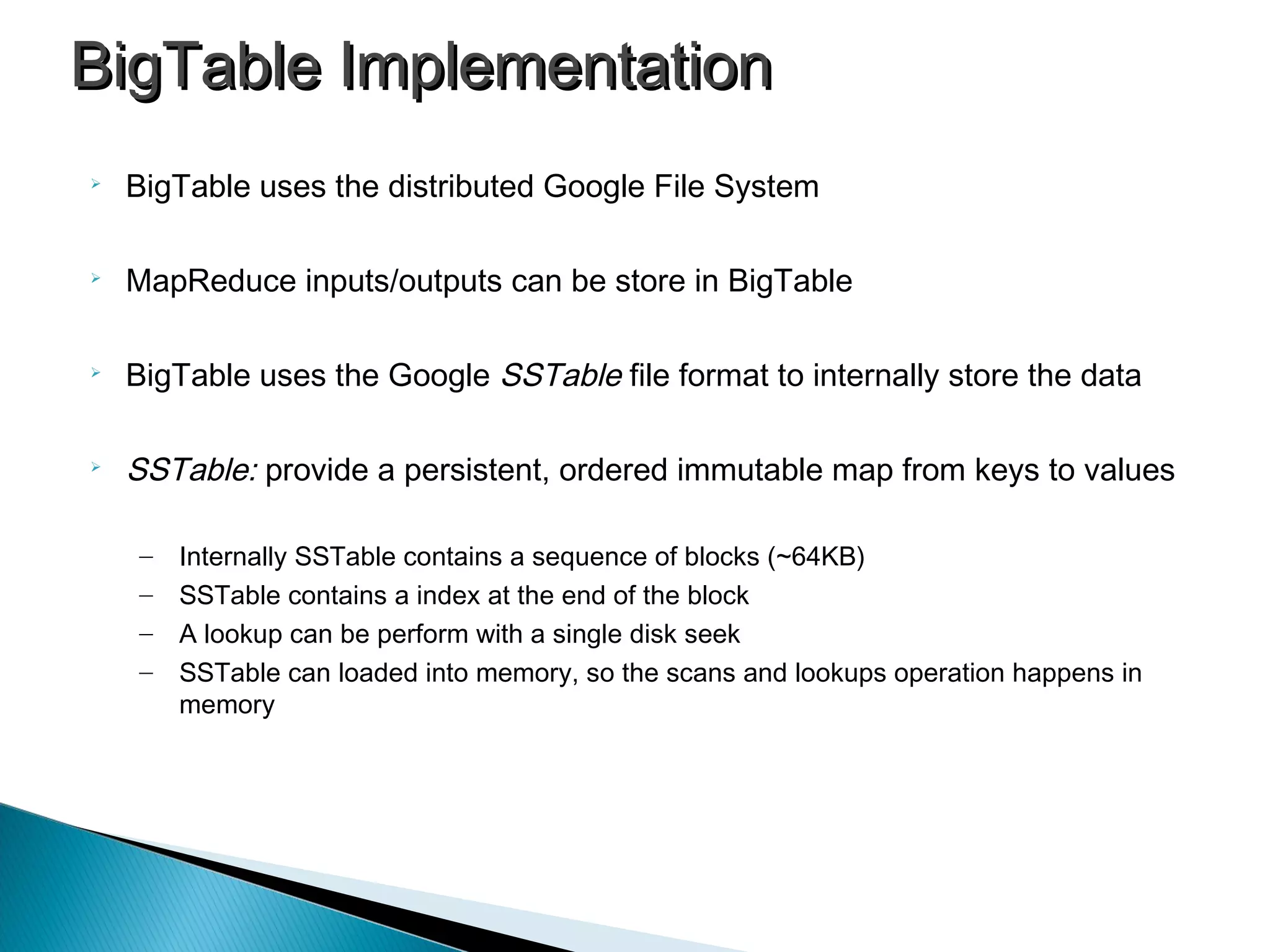
BigTableuses the distributed Google File System
MapReduce inputs/outputs can be store in BigTable
BigTable uses the Google SSTable file format to internally store the data
SSTable: provide a persistent, ordered immutable map from keys to values
– Internally SSTable contains a sequence of blocks (~64KB)
– SSTable contains a index at the end of the block
– A lookup can be perform with a single disk seek
– SSTable can loaded into memory, so the scans and lookups operation happens in
memory
14.
BigTable ImplementationBigTable Implementation
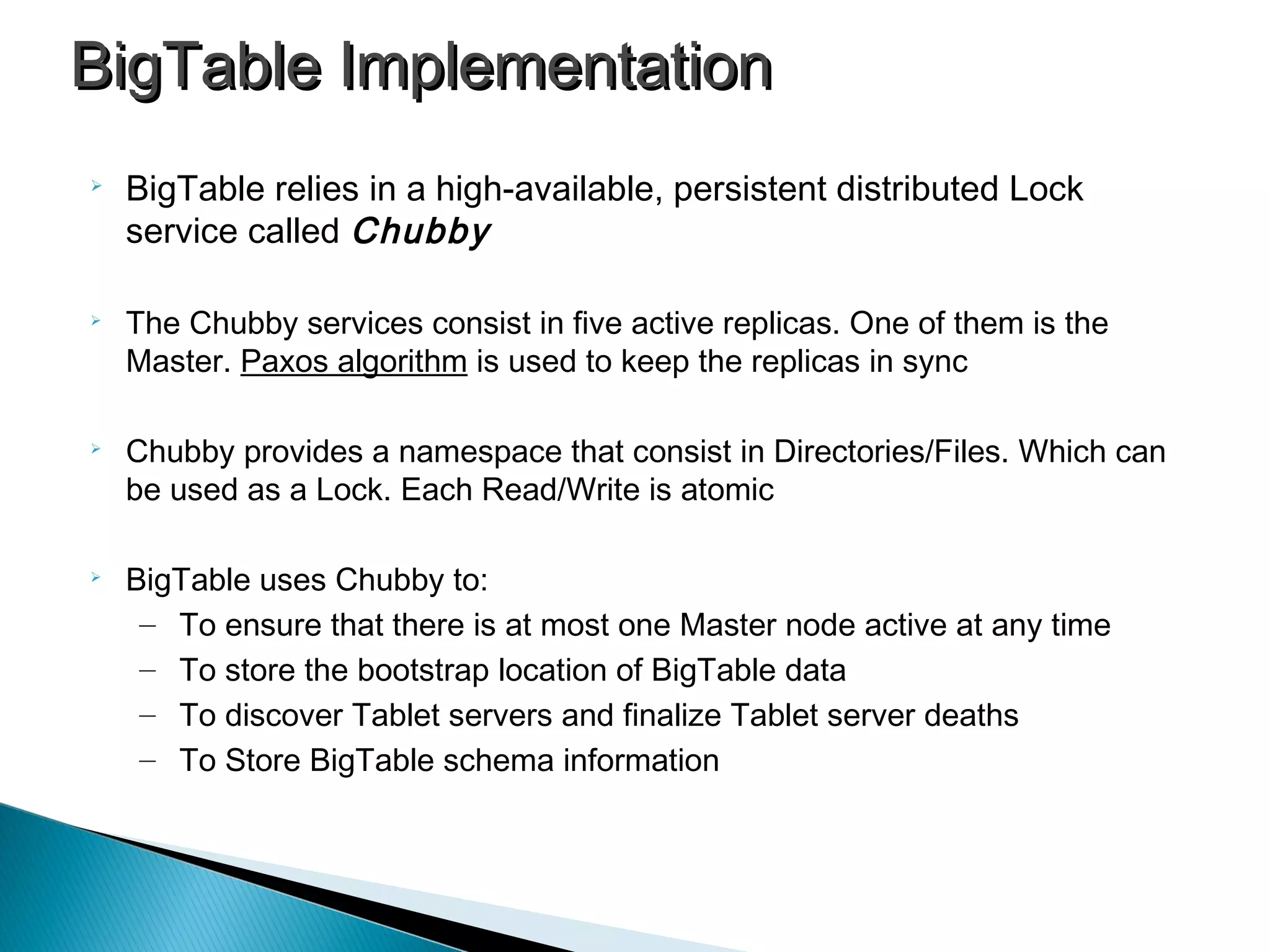
BigTablerelies in a high-available, persistent distributed Lock
service called Chubby
The Chubby services consist in five active replicas. One of them is the
Master. Paxos algorithm is used to keep the replicas in sync
Chubby provides a namespace that consist in Directories/Files. Which can
be used as a Lock. Each Read/Write is atomic
BigTable uses Chubby to:
– To ensure that there is at most one Master node active at any time
– To store the bootstrap location of BigTable data
– To discover Tablet servers and finalize Tablet server deaths
– To Store BigTable schema information
15.
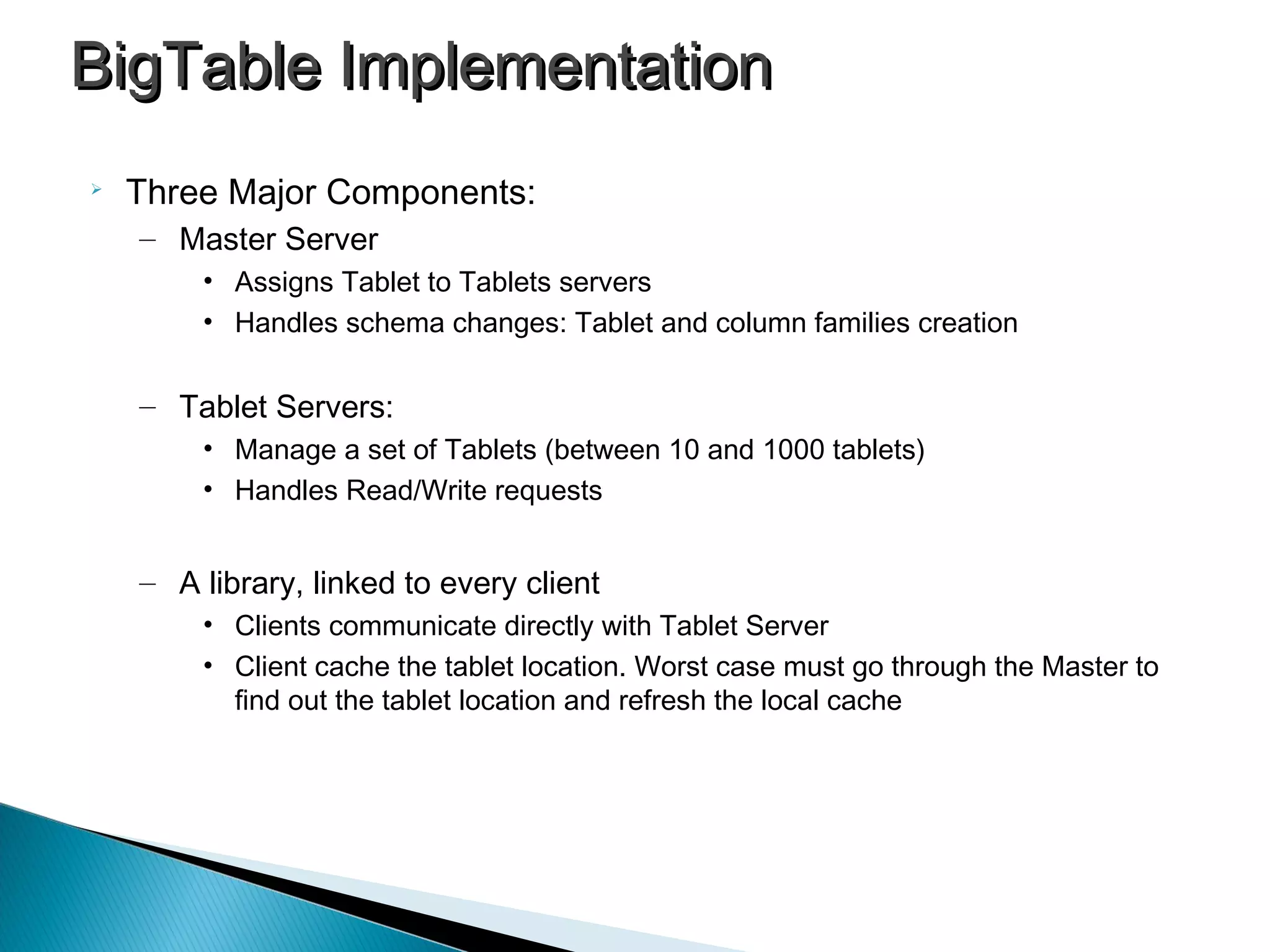
Three Major Components:
–Master Server
• Assigns Tablet to Tablets servers
• Handles schema changes: Tablet and column families creation
– Tablet Servers:
• Manage a set of Tablets (between 10 and 1000 tablets)
• Handles Read/Write requests
– A library, linked to every client
• Clients communicate directly with Tablet Server
• Client cache the tablet location. Worst case must go through the Master to
find out the tablet location and refresh the local cache
BigTable ImplementationBigTable Implementation
16.
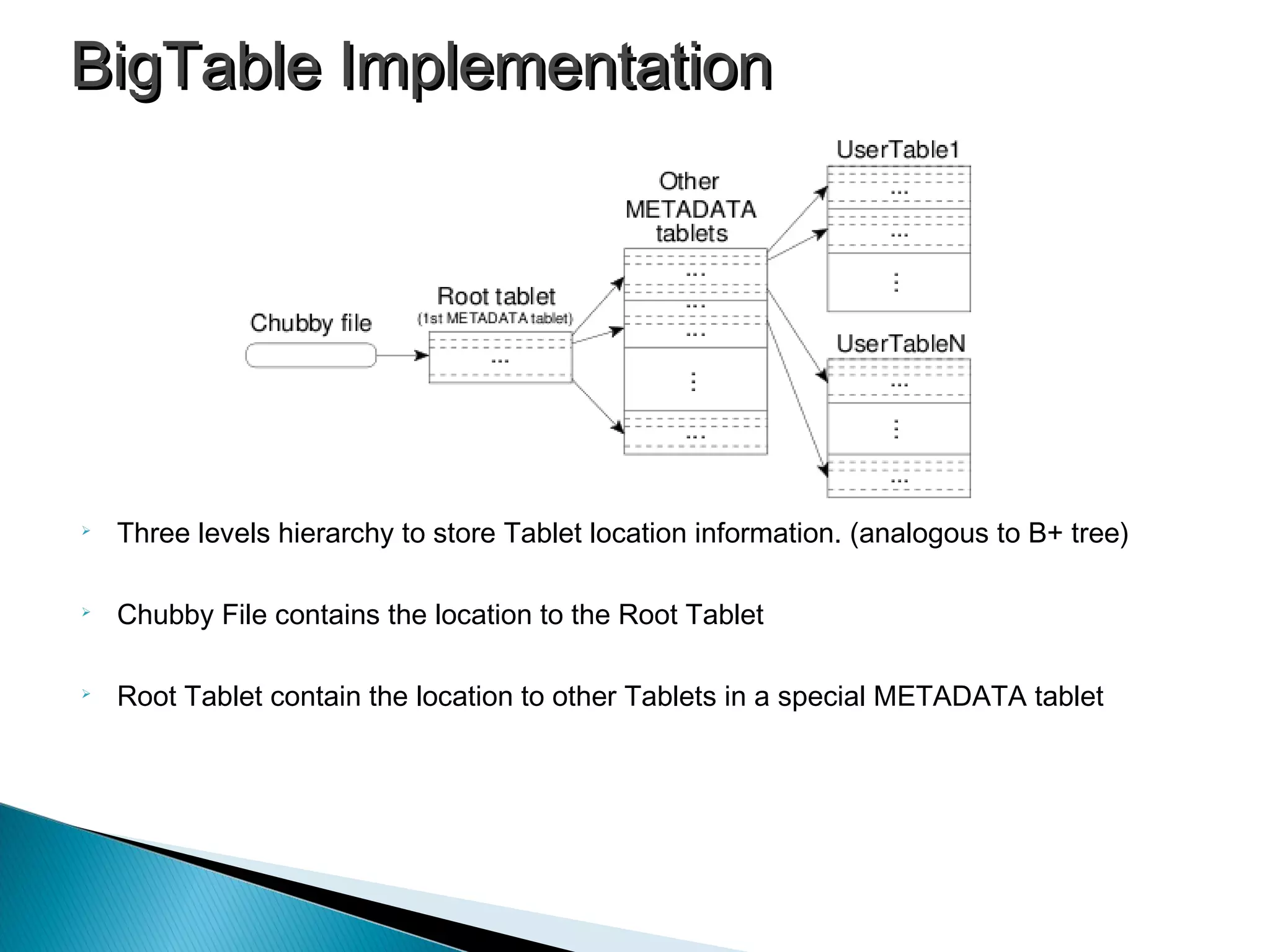
Three levels hierarchyto store Tablet location information. (analogous to B+ tree)
Chubby File contains the location to the Root Tablet
Root Tablet contain the location to other Tablets in a special METADATA tablet
BigTable ImplementationBigTable Implementation
17.
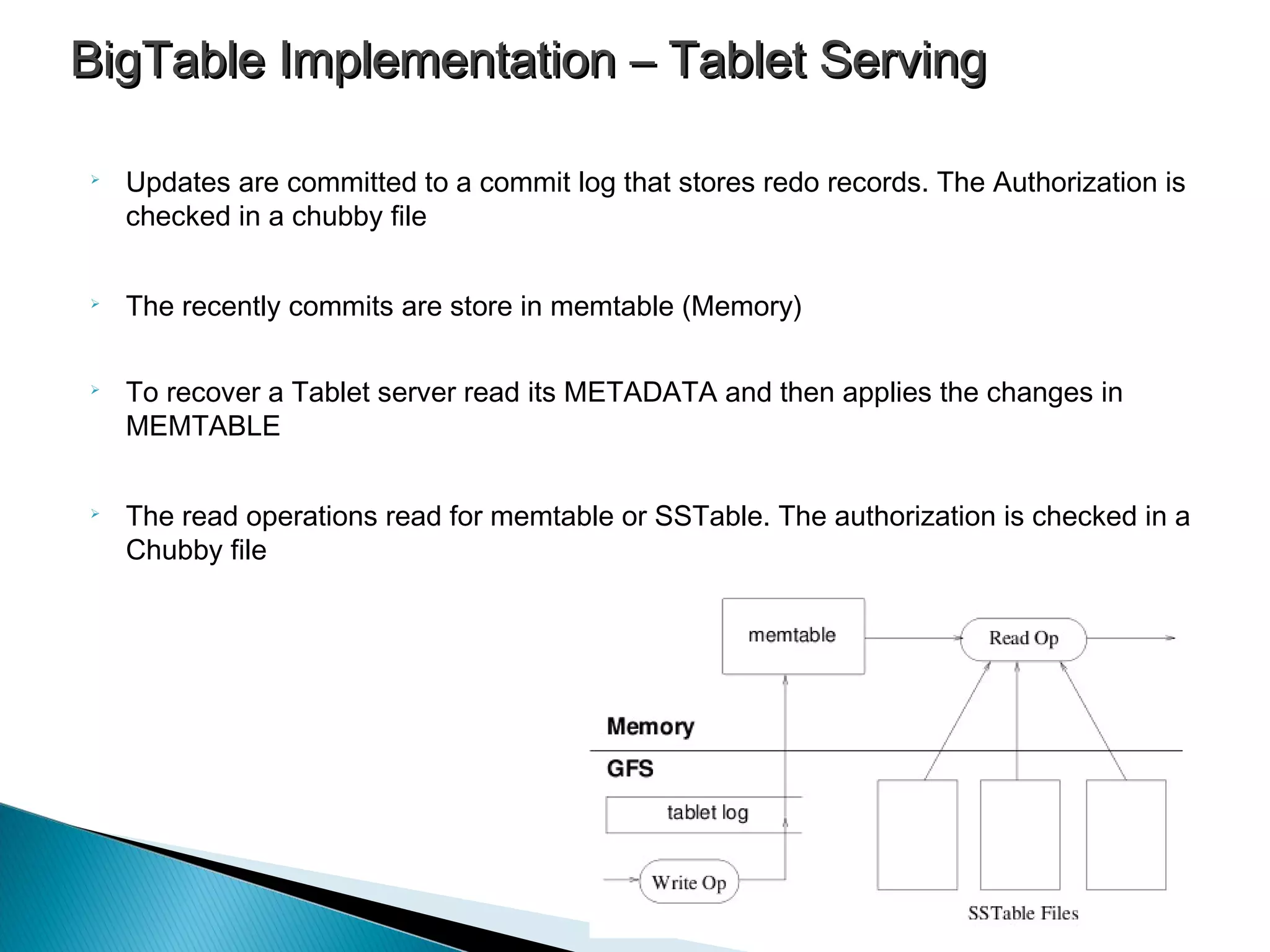
Updates are committedto a commit log that stores redo records. The Authorization is
checked in a chubby file
The recently commits are store in memtable (Memory)
To recover a Tablet server read its METADATA and then applies the changes in
MEMTABLE
The read operations read for memtable or SSTable. The authorization is checked in a
Chubby file
BigTable Implementation – Tablet ServingBigTable Implementation – Tablet Serving
18.
This project's goalis the hosting of very large tables -- billions of rows X millions of
columns -- atop clusters of commodity hardware
HBase is an open-source, distributed, versioned, column-oriented store modeled
after Google's BigTable
Hbase includes:
– Convenient base classes for backing Hadoop MapReduce jobs with HBase tables
including cascading, hive and pig source and sink modules
– Query predicate push down via server side scan and get filters
– Optimizations for real time queries
– A Thrift gateway and a REST-ful Web service that supports XML, Protobuf, and binary
data encoding options
– Extensible jruby-based (JIRB) shell
HBase – The Hadoop DBHBase – The Hadoop DB