Learning objectives:To know the difference between Bentham’s Act Utilitarianism and Mill’s Rule UtilitarianismTo begin to understand the requirements for writing an AS level essay with the focus on AO1 objectives
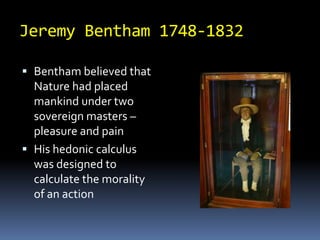
Jeremy Bentham 1748-1832Bentham believed that Nature had placed mankind under two sovereign masters – pleasure and painHis hedonic calculus was designed to calculate the morality of an action
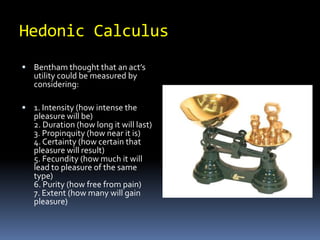
Hedonic CalculusBentham thought that an act’s utility could be measured by considering:
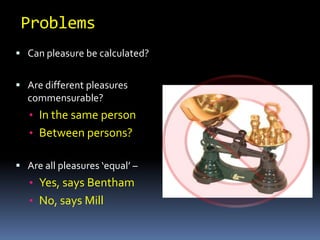
1. Intensity (how intense the pleasure will be)2. Duration (how long it will last)3. Propinquity (how near it is)4. Certainty (how certain that pleasure will result)5. Fecundity (how much it will lead to pleasure of the same type)6. Purity (how free from pain)7. Extent (how many will gain pleasure)ProblemsCan pleasure be calculated?Are different pleasures commensurable?	In the same person
Between persons?Are all pleasures ‘equal’ – Yes, says Bentham
No, says MillProblems Can justify any indiscriminate act if it leads to a desirable outcome for the majority eg Murder a patient for organs, sacrifice someone for the good of the majorityCan lead to persecution of minoritiesCan lead to counter intuitive decisions being morally justified eg Torture/Rape etc
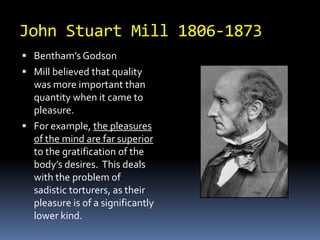
John Stuart Mill 1806-1873Bentham’s GodsonMill believed that quality was more important than quantity when it came to pleasure.
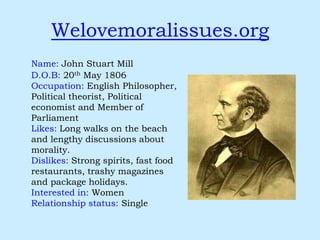
For example, the pleasures of the mind are far superior to the gratification of the body’s desires.  This deals with the problem of sadistic torturers, as their pleasure is of a significantly lower kind.   Welovemoralissues.orgName: John Stuart MillD.O.B: 20th May 1806Occupation: English Philosopher, 	Political theorist, Political 	economist and Member of 	ParliamentLikes: Long walks on the beach 	and lengthy discussions about 	morality.Dislikes: Strong spirits, fast food 	restaurants, trashy magazines 	and package holidays.Interested in: WomenRelationship status: Single
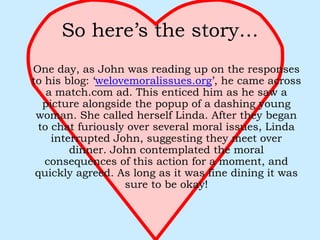
So here’s the story…	One day, as John was reading up on the responses to his blog: ‘welovemoralissues.org’, he came across a match.com ad. This enticed him as he saw a picture alongside the popup of a dashing young woman. She called herself Linda. After they began to chat furiously over several moral issues, Linda interrupted John, suggesting they meet over dinner. John contemplated the moral consequences of this action for a moment, and quickly agreed. As long as it was fine dining it was sure to be okay!
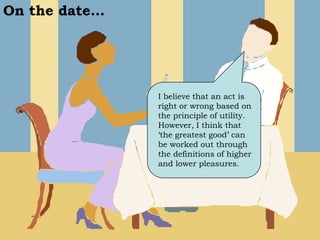
On the date…I believe that an act is right or wrong based on the principle of utility. However, I think that ‘the greatest good’ can be worked out through the definitions of higher and lower pleasures.
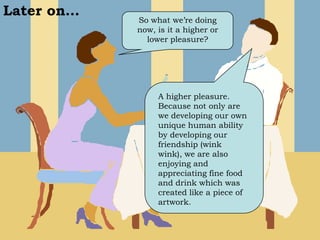
Later on…So what we’re doing now, is it a higher or lower pleasure?A higher pleasure. Because not only are we developing our own unique human ability by developing our friendship (wink wink), we are also enjoying and appreciating fine food and drink which was created like a piece of artwork.
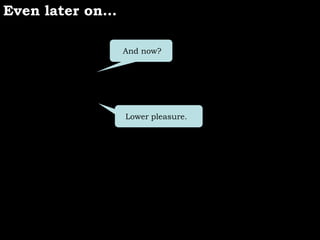
Even later on…And now?Lower pleasure.
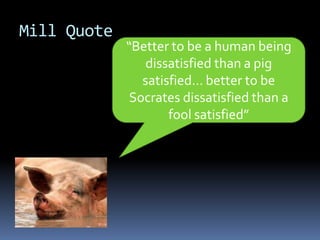
Mill Quote“Better to be a human being dissatisfied than a pig satisfied… better to be Socrates dissatisfied than a fool satisfied”
Act and Rule UtilitarianismAct utilitarianismLooks at the consequences of each individual  act and calculates  utility each time the act  is performedRule utilitarianismLooks at  the consequences of  having everyone follow a particular rule and calculatesthe  overall utility of acceptingor  rejecting the rule
An ExampleImagine the following scenario. A prominent and much-loved leader has been rushed to the hospital, grievously wounded by an assassin’s bullet. He needs a heart and lung transplant immediately to survive. No suitable donors are available, but there is a homeless person in the emergency room who is being kept alive on a respirator, who probably has only a few days to live, and who is a perfect donor. Without the transplant, the leader will die; the homeless person will die in a few days anyway. Security at the hospital is very well controlled. The transplant team could hasten the death of the homeless person and carry out the transplant without the public ever knowing that they killed the homeless person for his organs. What should they do?For rule utilitarians, this is an easy choice. No one could approve a general rule that lets hospitals kill patients for their organs when they are going to die anyway. The consequences of adopting such a general rule would be highly negative and would certainly undermine public trust in the medical establishment.For act utilitarians, the situation is more complex. If secrecy were guaranteed, the overall consequences might be such that in this particular instance  greater utility is produced by hastening the death of the homeless person and using his organs for the transplant.
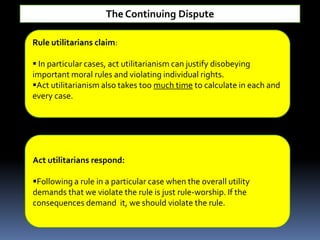
The Continuing DisputeRule utilitarians claim: In particular cases, act utilitarianism can justify disobeying important moral rules and violating individual rights.
Act utilitarianism also takes too much time to calculate in each and every case.Act utilitarians respond:Following a rule in a particular case when the overall utility demands that we violate the rule is just rule-worship. If the consequences demand  it, we should violate the rule.Essay  - part a questionGive an account of Bentham’s Utilitarianism.							(30 marks)Due:  21st October

Good recap and rule utilitarianism

  • 1.
    Learning objectives:To knowthe difference between Bentham’s Act Utilitarianism and Mill’s Rule UtilitarianismTo begin to understand the requirements for writing an AS level essay with the focus on AO1 objectives
  • 2.
    Jeremy Bentham 1748-1832Benthambelieved that Nature had placed mankind under two sovereign masters – pleasure and painHis hedonic calculus was designed to calculate the morality of an action
  • 3.
    Hedonic CalculusBentham thoughtthat an act’s utility could be measured by considering:
  • 4.
    1. Intensity (howintense the pleasure will be)2. Duration (how long it will last)3. Propinquity (how near it is)4. Certainty (how certain that pleasure will result)5. Fecundity (how much it will lead to pleasure of the same type)6. Purity (how free from pain)7. Extent (how many will gain pleasure)ProblemsCan pleasure be calculated?Are different pleasures commensurable? In the same person
  • 5.
    Between persons?Are allpleasures ‘equal’ – Yes, says Bentham
  • 6.
    No, says MillProblemsCan justify any indiscriminate act if it leads to a desirable outcome for the majority eg Murder a patient for organs, sacrifice someone for the good of the majorityCan lead to persecution of minoritiesCan lead to counter intuitive decisions being morally justified eg Torture/Rape etc
  • 7.
    John Stuart Mill1806-1873Bentham’s GodsonMill believed that quality was more important than quantity when it came to pleasure.
  • 8.
    For example, thepleasures of the mind are far superior to the gratification of the body’s desires. This deals with the problem of sadistic torturers, as their pleasure is of a significantly lower kind.  Welovemoralissues.orgName: John Stuart MillD.O.B: 20th May 1806Occupation: English Philosopher, Political theorist, Political economist and Member of ParliamentLikes: Long walks on the beach and lengthy discussions about morality.Dislikes: Strong spirits, fast food restaurants, trashy magazines and package holidays.Interested in: WomenRelationship status: Single
  • 9.
    So here’s thestory… One day, as John was reading up on the responses to his blog: ‘welovemoralissues.org’, he came across a match.com ad. This enticed him as he saw a picture alongside the popup of a dashing young woman. She called herself Linda. After they began to chat furiously over several moral issues, Linda interrupted John, suggesting they meet over dinner. John contemplated the moral consequences of this action for a moment, and quickly agreed. As long as it was fine dining it was sure to be okay!
  • 10.
    On the date…Ibelieve that an act is right or wrong based on the principle of utility. However, I think that ‘the greatest good’ can be worked out through the definitions of higher and lower pleasures.
  • 11.
    Later on…So whatwe’re doing now, is it a higher or lower pleasure?A higher pleasure. Because not only are we developing our own unique human ability by developing our friendship (wink wink), we are also enjoying and appreciating fine food and drink which was created like a piece of artwork.
  • 12.
    Even later on…Andnow?Lower pleasure.
  • 13.
    Mill Quote“Better tobe a human being dissatisfied than a pig satisfied… better to be Socrates dissatisfied than a fool satisfied”
  • 14.
    Act and RuleUtilitarianismAct utilitarianismLooks at the consequences of each individual act and calculates utility each time the act is performedRule utilitarianismLooks at the consequences of having everyone follow a particular rule and calculatesthe overall utility of acceptingor rejecting the rule
  • 15.
    An ExampleImagine thefollowing scenario. A prominent and much-loved leader has been rushed to the hospital, grievously wounded by an assassin’s bullet. He needs a heart and lung transplant immediately to survive. No suitable donors are available, but there is a homeless person in the emergency room who is being kept alive on a respirator, who probably has only a few days to live, and who is a perfect donor. Without the transplant, the leader will die; the homeless person will die in a few days anyway. Security at the hospital is very well controlled. The transplant team could hasten the death of the homeless person and carry out the transplant without the public ever knowing that they killed the homeless person for his organs. What should they do?For rule utilitarians, this is an easy choice. No one could approve a general rule that lets hospitals kill patients for their organs when they are going to die anyway. The consequences of adopting such a general rule would be highly negative and would certainly undermine public trust in the medical establishment.For act utilitarians, the situation is more complex. If secrecy were guaranteed, the overall consequences might be such that in this particular instance greater utility is produced by hastening the death of the homeless person and using his organs for the transplant.
  • 16.
    The Continuing DisputeRuleutilitarians claim: In particular cases, act utilitarianism can justify disobeying important moral rules and violating individual rights.
  • 17.
    Act utilitarianism alsotakes too much time to calculate in each and every case.Act utilitarians respond:Following a rule in a particular case when the overall utility demands that we violate the rule is just rule-worship. If the consequences demand it, we should violate the rule.Essay - part a questionGive an account of Bentham’s Utilitarianism. (30 marks)Due: 21st October