
ARISTOTLE’S
ETHICSBy: John Paul Espino
De La Salle University – Dasmarinas
Facebook.com/Johnpaul.dss
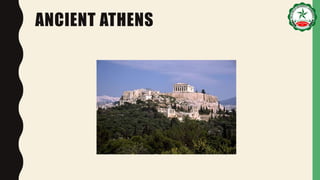
ANCIENT ATHENS
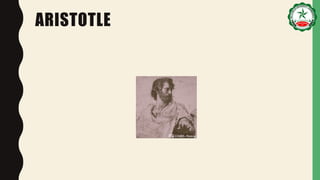
ARISTOTLE
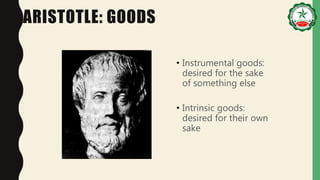
ARISTOTLE: GOODS
• Instrumental goods:
desired for the sake
of something else
• Intrinsic goods:
desired for their own
sake
HAPPINESS
• One thing is always desired for its own sake, never for the sake of something else:
happiness
HAPPINESS
• One thing is always desired for its own sake, never for the sake of something else:
happiness
• Happiness (eudaimonia) = living well = flourishing
HAPPINESS
• One thing is always desired for its own sake, never for the sake of something else:
happiness
• Happiness (eudaimonia) = living well = flourishing
• What does that require? Prosperity and luck, yes, but more
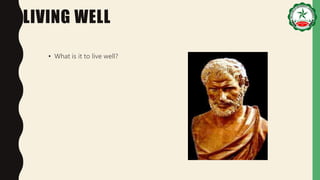
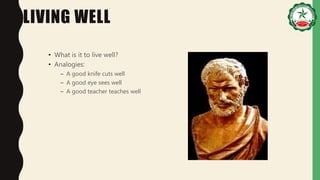
LIVING WELL
• What is it to live well?
LIVING WELL
• What is it to live well?
• Analogies:
– A good knife cuts well
– A good eye sees well
– A good teacher teaches well
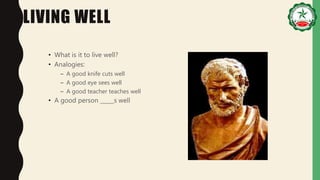
LIVING WELL
• What is it to live well?
• Analogies:
– A good knife cuts well
– A good eye sees well
– A good teacher teaches well
• A good person _____s well
FUNCTION
• A thing’s function stems from what is special about it: what distinguishes
it from other things
– Knives cut: sharpness —> cutting
– Eyes see: ability to see —> seeing
– Teachers teach: ability to teach —> teaching
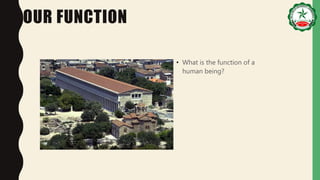
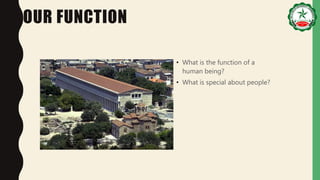
OUR FUNCTION
• What is the function of a
human being?
OUR FUNCTION
• What is the function of a
human being?
• What is special about people?
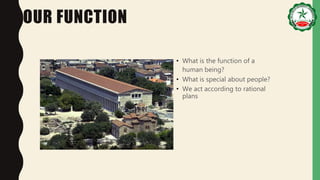
OUR FUNCTION
• What is the function of a
human being?
• What is special about people?
• We act according to rational
plans
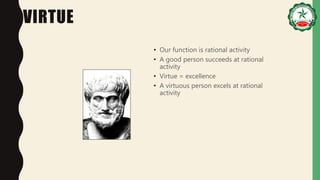
VIRTUE
• Our function is rational activity
• A good person succeeds at rational
activity
• Virtue = excellence
• A virtuous person excels at rational
activity
TWO KINDS OF VIRTUE
• Virtue = rational activity
• Excellence in rationality: intellectual virtue
• Excellence in activity: moral virtue
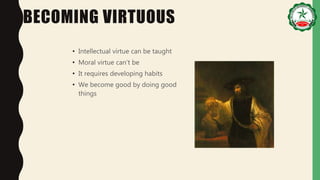
BECOMING VIRTUOUS
• Intellectual virtue can be taught
• Moral virtue can’t be
• It requires developing habits
• We become good by doing good
things
RIGHT AND WRONG
• An act is right if it is something a virtuous person would tend to
do
CIRCULAR?
• Moderns: A virtuous person is one who tends
to do the right thing.
CIRCULAR?
• Moderns: A virtuous person is one who tends
to do the right thing.
• Aristotle: That’s not enough. A virtuous person
tends to do the right thing as virtuous people
do them.
• A good person consistently does the right
thing at the right time, in the right way, and for
the right reason.
• Virtuous people do the right thing for the right
reason: because it’s the right thing to do.
VIRTUE AS A MEAN
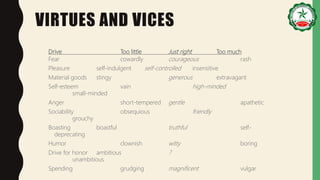
• Virtues are means between extremes
• Virtues constrain desires
• But we may constrain too little or too much
VIRTUES AND VICES
Drive Too little Just right Too much
Fear cowardly courageous rash
Pleasure self-indulgent self-controlled insensitive
Material goods stingy generous extravagant
Self-esteem vain high-minded
small-minded
Anger short-tempered gentle apathetic
Sociability obsequious friendly
grouchy
Boasting boastful truthful self-
deprecating
Humor clownish witty boring
Drive for honor ambitious ?
unambitious
Spending grudging magnificent vulgar
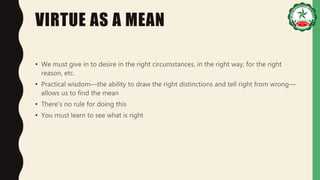
VIRTUE AS A MEAN
• We must give in to desire in the right circumstances, in the right way, for the right
reason, etc.
• Practical wisdom—the ability to draw the right distinctions and tell right from wrong—
allows us to find the mean
• There’s no rule for doing this
• You must learn to see what is right
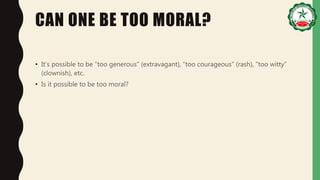
CAN ONE BE TOO MORAL?
• It’s possible to be “too generous” (extravagant), “too courageous” (rash), “too witty”
(clownish), etc.
• Is it possible to be too moral?
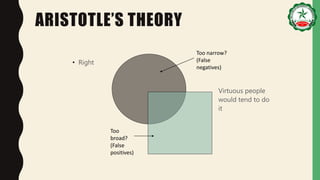
Too narrow?
(False
negatives)
Too
broad?
(False
positives)
ARISTOTLE’S THEORY
• Right
Virtuous people
would tend to do
it

Ethics - aristotle's ethics

  • 1.
    ARISTOTLE’S ETHICSBy: John PaulEspino De La Salle University – Dasmarinas Facebook.com/Johnpaul.dss
  • 2.
  • 3.
  • 4.
    ARISTOTLE: GOODS • Instrumentalgoods: desired for the sake of something else • Intrinsic goods: desired for their own sake
  • 5.
    HAPPINESS • One thingis always desired for its own sake, never for the sake of something else: happiness
  • 6.
    HAPPINESS • One thingis always desired for its own sake, never for the sake of something else: happiness • Happiness (eudaimonia) = living well = flourishing
  • 7.
    HAPPINESS • One thingis always desired for its own sake, never for the sake of something else: happiness • Happiness (eudaimonia) = living well = flourishing • What does that require? Prosperity and luck, yes, but more
  • 8.
    LIVING WELL • Whatis it to live well?
  • 9.
    LIVING WELL • Whatis it to live well? • Analogies: – A good knife cuts well – A good eye sees well – A good teacher teaches well
  • 10.
    LIVING WELL • Whatis it to live well? • Analogies: – A good knife cuts well – A good eye sees well – A good teacher teaches well • A good person _____s well
  • 11.
    FUNCTION • A thing’sfunction stems from what is special about it: what distinguishes it from other things – Knives cut: sharpness —> cutting – Eyes see: ability to see —> seeing – Teachers teach: ability to teach —> teaching
  • 12.
    OUR FUNCTION • Whatis the function of a human being?
  • 13.
    OUR FUNCTION • Whatis the function of a human being? • What is special about people?
  • 14.
    OUR FUNCTION • Whatis the function of a human being? • What is special about people? • We act according to rational plans
  • 15.
    VIRTUE • Our functionis rational activity • A good person succeeds at rational activity • Virtue = excellence • A virtuous person excels at rational activity
  • 16.
    TWO KINDS OFVIRTUE • Virtue = rational activity • Excellence in rationality: intellectual virtue • Excellence in activity: moral virtue
  • 17.
    BECOMING VIRTUOUS • Intellectualvirtue can be taught • Moral virtue can’t be • It requires developing habits • We become good by doing good things
  • 18.
    RIGHT AND WRONG •An act is right if it is something a virtuous person would tend to do
  • 19.
    CIRCULAR? • Moderns: Avirtuous person is one who tends to do the right thing.
  • 20.
    CIRCULAR? • Moderns: Avirtuous person is one who tends to do the right thing. • Aristotle: That’s not enough. A virtuous person tends to do the right thing as virtuous people do them. • A good person consistently does the right thing at the right time, in the right way, and for the right reason. • Virtuous people do the right thing for the right reason: because it’s the right thing to do.
  • 21.
    VIRTUE AS AMEAN • Virtues are means between extremes • Virtues constrain desires • But we may constrain too little or too much
  • 22.
    VIRTUES AND VICES DriveToo little Just right Too much Fear cowardly courageous rash Pleasure self-indulgent self-controlled insensitive Material goods stingy generous extravagant Self-esteem vain high-minded small-minded Anger short-tempered gentle apathetic Sociability obsequious friendly grouchy Boasting boastful truthful self- deprecating Humor clownish witty boring Drive for honor ambitious ? unambitious Spending grudging magnificent vulgar
  • 23.
    VIRTUE AS AMEAN • We must give in to desire in the right circumstances, in the right way, for the right reason, etc. • Practical wisdom—the ability to draw the right distinctions and tell right from wrong— allows us to find the mean • There’s no rule for doing this • You must learn to see what is right
  • 24.
    CAN ONE BETOO MORAL? • It’s possible to be “too generous” (extravagant), “too courageous” (rash), “too witty” (clownish), etc. • Is it possible to be too moral?
  • 25.