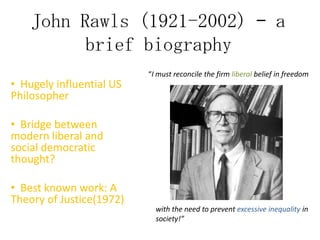
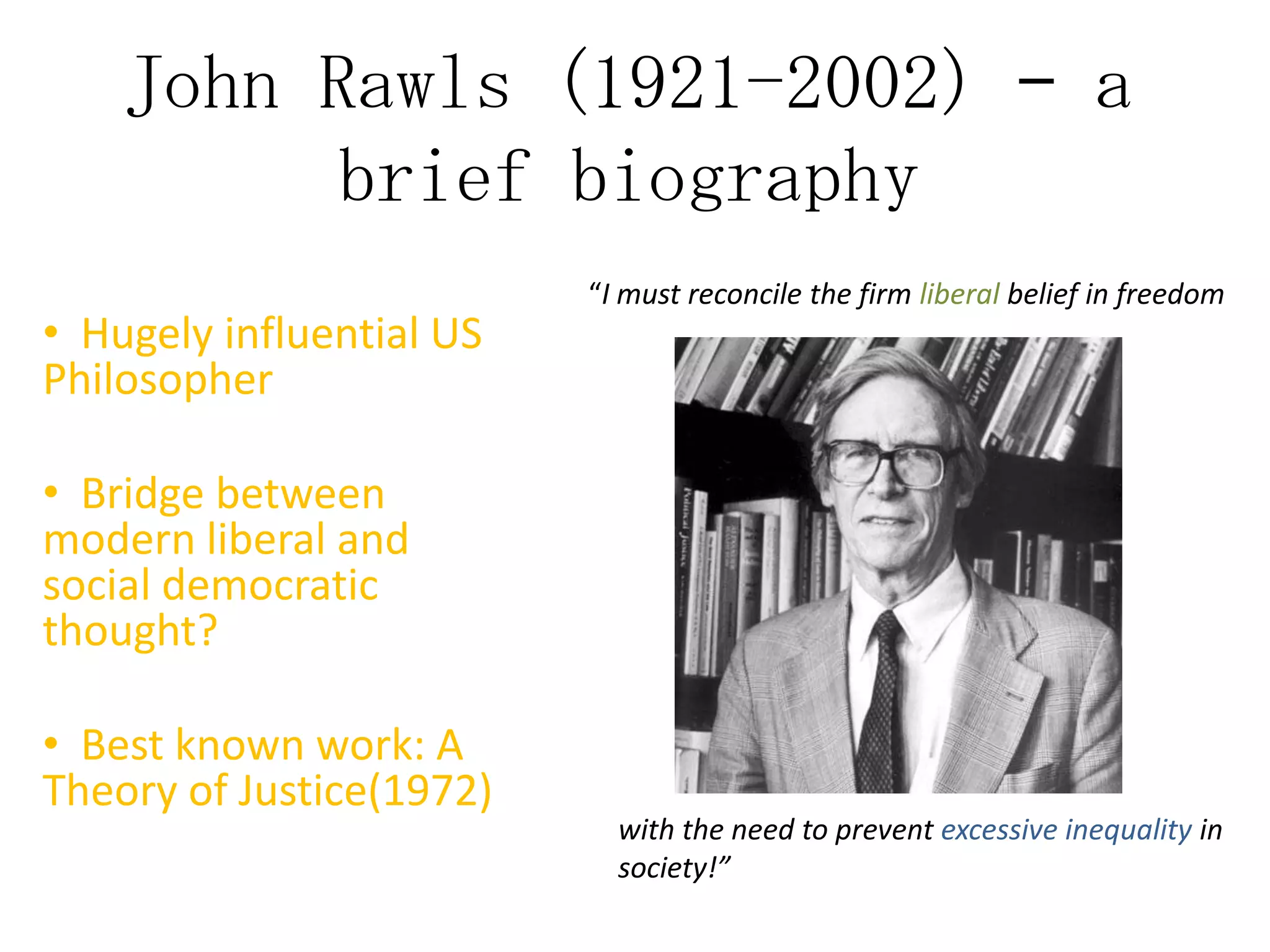
John Rawls (1921-2002) – a
brief biography
• Hugely influential US
Philosopher

“I must reconcile the firm liberal belief in freedom

• Bridge between
modern liberal and
social democratic
thought?
• Best known work: A
Theory of Justice(1972)

with the need to prevent excessive inequality in
society!”
Q. What needs
reconciling?

A. Any measures introduced to reduce
or prevent inequality will inevitably
result in a loss of liberty for some.
Examples?

If income is
more evenly
spread, there
must be higher
taxation for the
wealthy.

Introduction
of minimum
wage
interferes
with labour
markets and
curtails the
free market.
Try out Rawls’ thought experiment
1. Imagine humankind before society came
into being – a natural state.

Rawls calls this
the ‘original
position’

2. People then asked to create a
society which decides how wealth
and goods are to be distributed.

3. However, before they make any decisions they
are placed behind a ‘veil of ignorance’...which
means they do not have any idea of how
successful they will be, or how wealthy they will
become. Life is a lottery!
So...what did Rawls think we would do?
 We would reject Utilitarianism (the greatest
good for the greatest number), as we might be
the one at the bottom of the pile
 We would have equal rights and respect for all
as we might be part of a minority group
 We would reject Marxism, as human instinct is
to strive for reward.
 However, we would create a society with a
minimum stand of living – no-one should be
allowed so much wealth that the worst off in
society would fall below that level
So, in practice this means...
• Individuals should be as free as is possible
• But these freedoms should not be enjoyed at
the expense of others
• Inequalities are allowed, but have to be
justified.
• Inequalities can be justified if it increaese the
prosperity of society as a whole.
Rawls’ ‘difference principle’
“Large inequalities can be, but are
not necessarily ‘evil’ and can be
justified if these inequalities do not
disadvantage the least well off.
Individual freedom is not universally
good – it can only be enjoyed if all
have a minimum standard of living.”
So what state intervention could you justify using Rawls’ principle?

John rawls (1921 2002) – a brief

  • 1.
    John Rawls (1921-2002)– a brief biography • Hugely influential US Philosopher “I must reconcile the firm liberal belief in freedom • Bridge between modern liberal and social democratic thought? • Best known work: A Theory of Justice(1972) with the need to prevent excessive inequality in society!”
  • 2.
    Q. What needs reconciling? A.Any measures introduced to reduce or prevent inequality will inevitably result in a loss of liberty for some. Examples? If income is more evenly spread, there must be higher taxation for the wealthy. Introduction of minimum wage interferes with labour markets and curtails the free market.
  • 3.
    Try out Rawls’thought experiment 1. Imagine humankind before society came into being – a natural state. Rawls calls this the ‘original position’ 2. People then asked to create a society which decides how wealth and goods are to be distributed. 3. However, before they make any decisions they are placed behind a ‘veil of ignorance’...which means they do not have any idea of how successful they will be, or how wealthy they will become. Life is a lottery!
  • 4.
    So...what did Rawlsthink we would do?  We would reject Utilitarianism (the greatest good for the greatest number), as we might be the one at the bottom of the pile  We would have equal rights and respect for all as we might be part of a minority group  We would reject Marxism, as human instinct is to strive for reward.  However, we would create a society with a minimum stand of living – no-one should be allowed so much wealth that the worst off in society would fall below that level
  • 5.
    So, in practicethis means... • Individuals should be as free as is possible • But these freedoms should not be enjoyed at the expense of others • Inequalities are allowed, but have to be justified. • Inequalities can be justified if it increaese the prosperity of society as a whole.
  • 6.
    Rawls’ ‘difference principle’ “Largeinequalities can be, but are not necessarily ‘evil’ and can be justified if these inequalities do not disadvantage the least well off. Individual freedom is not universally good – it can only be enjoyed if all have a minimum standard of living.” So what state intervention could you justify using Rawls’ principle?