TOPIC
UTILITARIANISM
Group Members
1. Habib Ur Rehman
2. Muhammad Ammar
3. Absar Ahmed
4. Taimoor Ali
5. Zahid Ali Nagri
Agenda
• Definition
• Types
• Examples
• Origination
• Historical Background
• Books
Definition
• Utilitarianism:
• Doctrine
• Actions are right
1. If they are useful .
2. Benefit of a majority.
3. Happiness of majority.
Types
• Act Utilitarianism
 An action is morally
right if and only if
it produces the best
possible results in
that specific situation.
• Rule Utilitarianism
 An action is right as it
conforms to a rule that
leads to the greatest good
Example
•Act Utilitarianism
• An example of act utilitarianism is a
pharmaceutical company releasing a drug
that has been governmentally approved with
known side effects because the drug is able
to help more people than are bothered by the
minor side effects.
Example
•Rule Utilitarianism
• An Airline industry offers different types of
seats on many of their airplanes .Customers
in first or business class pay a much higher
rate than those in economy seats to get more
amenities. However ,their ticket price ease
the airline’s financial burden created by
making room for economy class seats.
Case Study
• “Sam, a basically normal, rather nondescript
but ‘nice’ human being, goes to the hospital
to visit his only living relative, his senile, sick
aunt. His visit coincides with five medical
emergencies at the hospital. One person
needs a liver transplant, another a spleen
transplant, another a lung transplant, another
a new heart, and a fifth a new pineal gland.
Contd…
• Each of the five patients is a tremendously
important, much-loved person whose death
would bring a great deal of grief and actual
physical discomfort to a great number of
people. Sam’s death, on the other hand,
would be mourned by no one (except
possibly his aunt in her lucid moments).
Contd……….
• The top members of the hospital
administration, all strict utilitarian's, lure Sam
into an operating room, remove all his vital
organs, and distribute them to the other
needy patients, thereby operating (literally) in
accordance with the principle of utility: the
greatest amount of happiness for the greatest
number of people.” Donald Palmer, Does the
Center Hold,
Origination
• Founder :
“Jeremy Bentham”.
• 1789.
• Book :
“Principles Of Morals And
Legislation”.
Historical Background
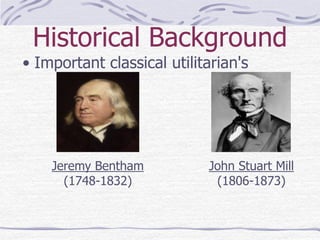
• Important classical utilitarian's
Jeremy Bentham
(1748-1832)
John Stuart Mill
(1806-1873)
Historical Background
• Important theorists and social
reformers.
• Approaches to economic, political, and
social policies.
Jeremy Bentham’s Utilitarianism
• Father of Utilitarianism
• Later criticized by his wayward disciple,
John Stuart Mill.
• Similar to Hedonism, as both center on
pleasure as the good .
• However, Greek Hedonism is essentially
egoist in nature; while Utilitarianism is social
in nature.
Jeremy Bentham’s Utilitarianism
• Bentham assumes that we humans are all
governed by the desire for pleasure and the
aversion to pain. He seeks to give advice on
how one should pursue the goal of pleasure .
His advice on pursuing pleasure is called the
Calculus of Felicity.
Jeremy Bentham’s Utilitarianism
• It provides a rational analysis of pleasure.
Whenever one considers performing any
action one can analyze its value in terms of
the Calculus of Felicity and contrast it with
alternatives.
• Bentham claims that there are seven
categories to examine when utilizing the
Calculus of Felicity:
Calculus of Felicity
1. Intensity: How intense is the
pleasure?
2. Duration: How long does it last?
3. Certainty: How sure is the pleasure?
4. Propinquity: How soon will it occur?
5. Fecundity: How many more?
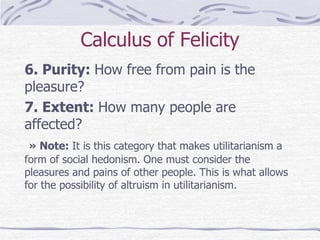
Calculus of Felicity
6. Purity: How free from pain is the
pleasure?
7. Extent: How many people are
affected?
» Note: It is this category that makes utilitarianism a
form of social hedonism. One must consider the
pleasures and pains of other people. This is what allows
for the possibility of altruism in utilitarianism.
John Stuart Mill’s Utilitarianism
• According to Mill, is the Calculus of Felicity
generates a purely quantitative analysis, and
pays no attention to the “quality” of the
pleasure
• Mill feared that over time, the Calculus of
Felicity would gradually erode culture, leaving
behind a society of belching enthusiasts
John Stuart Mill’s Utilitarianism
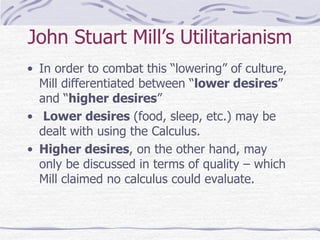
• In order to combat this “lowering” of culture,
Mill differentiated between “lower desires”
and “higher desires”
• Lower desires (food, sleep, etc.) may be
dealt with using the Calculus.
• Higher desires, on the other hand, may
only be discussed in terms of quality – which
Mill claimed no calculus could evaluate.
John Stuart Mill’s Utilitarianism
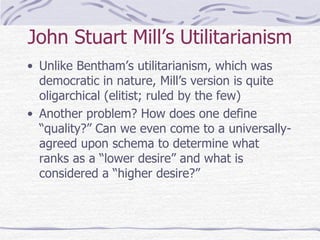
• Unlike Bentham’s utilitarianism, which was
democratic in nature, Mill’s version is quite
oligarchical (elitist; ruled by the few)
• Another problem? How does one define
“quality?” Can we even come to a universally-
agreed upon schema to determine what
ranks as a “lower desire” and what is
considered a “higher desire?”
Books
• Classical
1789 19071861
Conclusion!!
Normal person
THANK YOU!!

Utilitarianism

  • 1.
  • 2.
    Group Members 1. HabibUr Rehman 2. Muhammad Ammar 3. Absar Ahmed 4. Taimoor Ali 5. Zahid Ali Nagri
  • 3.
    Agenda • Definition • Types •Examples • Origination • Historical Background • Books
  • 4.
    Definition • Utilitarianism: • Doctrine •Actions are right 1. If they are useful . 2. Benefit of a majority. 3. Happiness of majority.
  • 5.
    Types • Act Utilitarianism An action is morally right if and only if it produces the best possible results in that specific situation. • Rule Utilitarianism  An action is right as it conforms to a rule that leads to the greatest good
  • 6.
    Example •Act Utilitarianism • Anexample of act utilitarianism is a pharmaceutical company releasing a drug that has been governmentally approved with known side effects because the drug is able to help more people than are bothered by the minor side effects.
  • 7.
    Example •Rule Utilitarianism • AnAirline industry offers different types of seats on many of their airplanes .Customers in first or business class pay a much higher rate than those in economy seats to get more amenities. However ,their ticket price ease the airline’s financial burden created by making room for economy class seats.
  • 8.
    Case Study • “Sam,a basically normal, rather nondescript but ‘nice’ human being, goes to the hospital to visit his only living relative, his senile, sick aunt. His visit coincides with five medical emergencies at the hospital. One person needs a liver transplant, another a spleen transplant, another a lung transplant, another a new heart, and a fifth a new pineal gland.
  • 9.
    Contd… • Each ofthe five patients is a tremendously important, much-loved person whose death would bring a great deal of grief and actual physical discomfort to a great number of people. Sam’s death, on the other hand, would be mourned by no one (except possibly his aunt in her lucid moments).
  • 10.
    Contd………. • The topmembers of the hospital administration, all strict utilitarian's, lure Sam into an operating room, remove all his vital organs, and distribute them to the other needy patients, thereby operating (literally) in accordance with the principle of utility: the greatest amount of happiness for the greatest number of people.” Donald Palmer, Does the Center Hold,
  • 11.
    Origination • Founder : “JeremyBentham”. • 1789. • Book : “Principles Of Morals And Legislation”.
  • 12.
    Historical Background • Importantclassical utilitarian's Jeremy Bentham (1748-1832) John Stuart Mill (1806-1873)
  • 13.
    Historical Background • Importanttheorists and social reformers. • Approaches to economic, political, and social policies.
  • 14.
    Jeremy Bentham’s Utilitarianism •Father of Utilitarianism • Later criticized by his wayward disciple, John Stuart Mill. • Similar to Hedonism, as both center on pleasure as the good . • However, Greek Hedonism is essentially egoist in nature; while Utilitarianism is social in nature.
  • 15.
    Jeremy Bentham’s Utilitarianism •Bentham assumes that we humans are all governed by the desire for pleasure and the aversion to pain. He seeks to give advice on how one should pursue the goal of pleasure . His advice on pursuing pleasure is called the Calculus of Felicity.
  • 16.
    Jeremy Bentham’s Utilitarianism •It provides a rational analysis of pleasure. Whenever one considers performing any action one can analyze its value in terms of the Calculus of Felicity and contrast it with alternatives. • Bentham claims that there are seven categories to examine when utilizing the Calculus of Felicity:
  • 17.
    Calculus of Felicity 1.Intensity: How intense is the pleasure? 2. Duration: How long does it last? 3. Certainty: How sure is the pleasure? 4. Propinquity: How soon will it occur? 5. Fecundity: How many more?
  • 18.
    Calculus of Felicity 6.Purity: How free from pain is the pleasure? 7. Extent: How many people are affected? » Note: It is this category that makes utilitarianism a form of social hedonism. One must consider the pleasures and pains of other people. This is what allows for the possibility of altruism in utilitarianism.
  • 19.
    John Stuart Mill’sUtilitarianism • According to Mill, is the Calculus of Felicity generates a purely quantitative analysis, and pays no attention to the “quality” of the pleasure • Mill feared that over time, the Calculus of Felicity would gradually erode culture, leaving behind a society of belching enthusiasts
  • 20.
    John Stuart Mill’sUtilitarianism • In order to combat this “lowering” of culture, Mill differentiated between “lower desires” and “higher desires” • Lower desires (food, sleep, etc.) may be dealt with using the Calculus. • Higher desires, on the other hand, may only be discussed in terms of quality – which Mill claimed no calculus could evaluate.
  • 21.
    John Stuart Mill’sUtilitarianism • Unlike Bentham’s utilitarianism, which was democratic in nature, Mill’s version is quite oligarchical (elitist; ruled by the few) • Another problem? How does one define “quality?” Can we even come to a universally- agreed upon schema to determine what ranks as a “lower desire” and what is considered a “higher desire?”
  • 22.
  • 23.
  • 24.