BUILDING AN EFFECTIVE FRAMEWORK
IN GOOD GOVERNANCE
LEARNING OBJECTIVE:
At the end of this presentation, it is expected that the
participants will be able to :
UNDERSTAND THE CONCEPTS OF GOVERNANCE
AND GOOD GOVERNANCE
THE CONCEPT OF GOVERNANCE
EFFECTIVE CITIZEN PARTICIPATION ARE
INDEED PRACTICES REGARDING GOOD
GOVERNANCE
In distinguishing between Government Activity and
governance, we will first state what Governance comprises:
“The formal and informal institutions that determine how
power is exercised in society, how decisions are taken and how
citizens have their say in the process of governing.
Therefore, GOVERNANCE is not the sole concern of
Government but of all those involved in public decision
making”
UNDESA Public Administration
THE CONCEPT OF GOVERNANCE
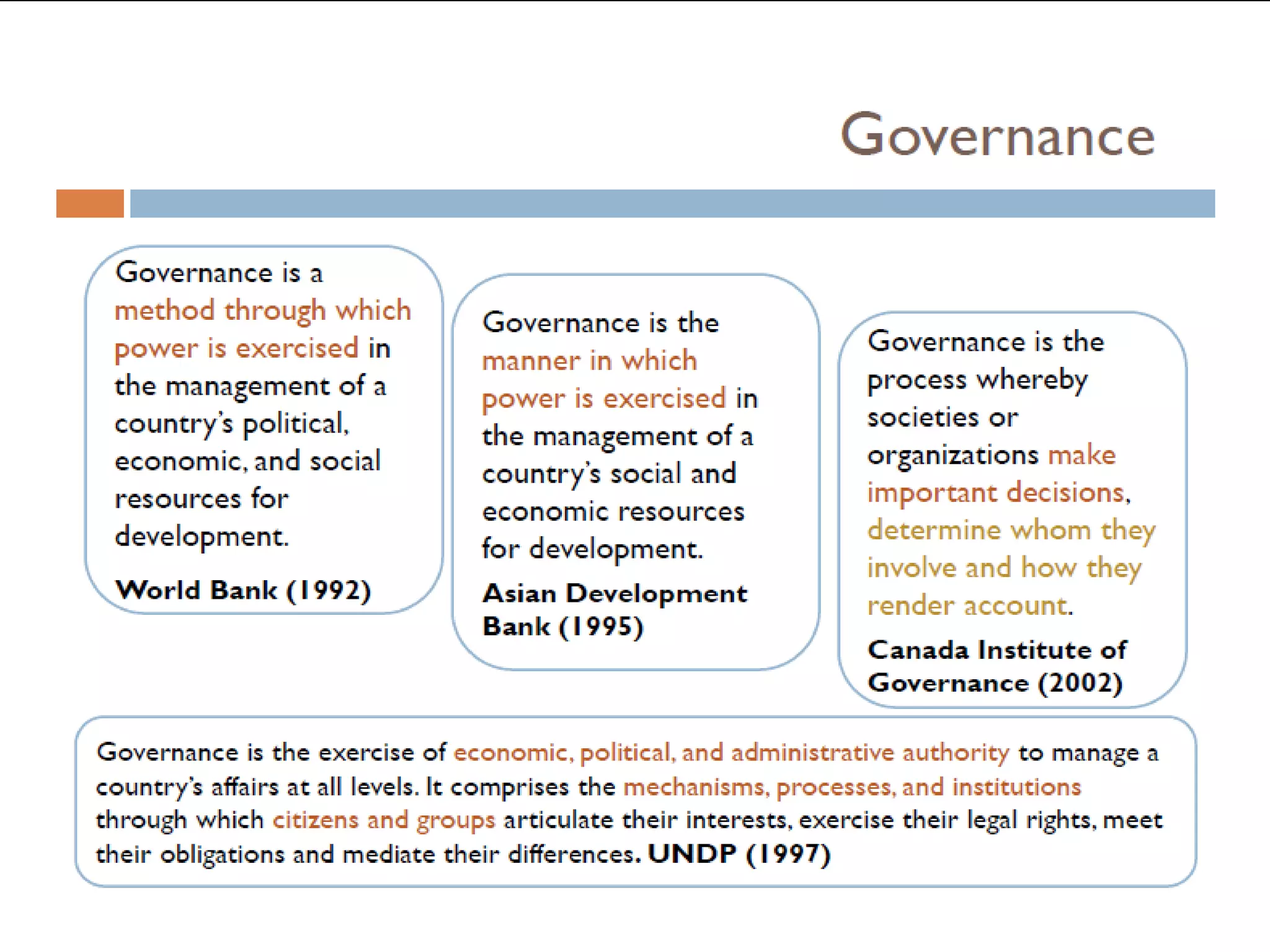
GOVERNANCE is
“ the exercise of Economic, Political and
Administrative authority to manage a country’s
affairs at all levels. It comprises the mechanisms,
processes and institutions through which citizens
and groups articulate their interests, exercise their
legal rights, meet their obligations and mediate
their differences.” (UNDP , 1997)
THE CONCEPT OF GOVERNANCE
AN ELUSIVE CONCEPT IN POLITICAL
SCIENCE.
It is because Governance PRACTICES and
ADMINISTRATIVE STRUCTURES are
GEOGRAPHICALLY, HISTORICALLY and
CULTURALLY BOUND.
THE CONCEPT OF GOVERNANCE
GOVERNMENT and GOVERNANCE have
different meanings across geographical space and
time.
Differences aside, certain elements of Good
Governance common to all and these are:
1. OWNERSHIP/EMPOWERMENT OF
CITIZENS
2. EFFECTIVENESS IN ECONOMIC, SOCIAL
and POLITICAL SPHERES
THE CONCEPT OF GOVERNANCE
“The Quality and Effectiveness of Government
enhance the State’s capacity in strategic areas that
are vital to the process of Development.
The JUST EXERCISE of AUTHORITY is one.
A CAPACITY for PROBLEM SOLVING and
CONFLICT RESOLUTION is one.
And the PERFORMANCE of its FUNCTIONS
based on the INVOLVEMENT of a SOCIETAL
COALITION is another.”
THE CONCEPT OF GOVERNANCE
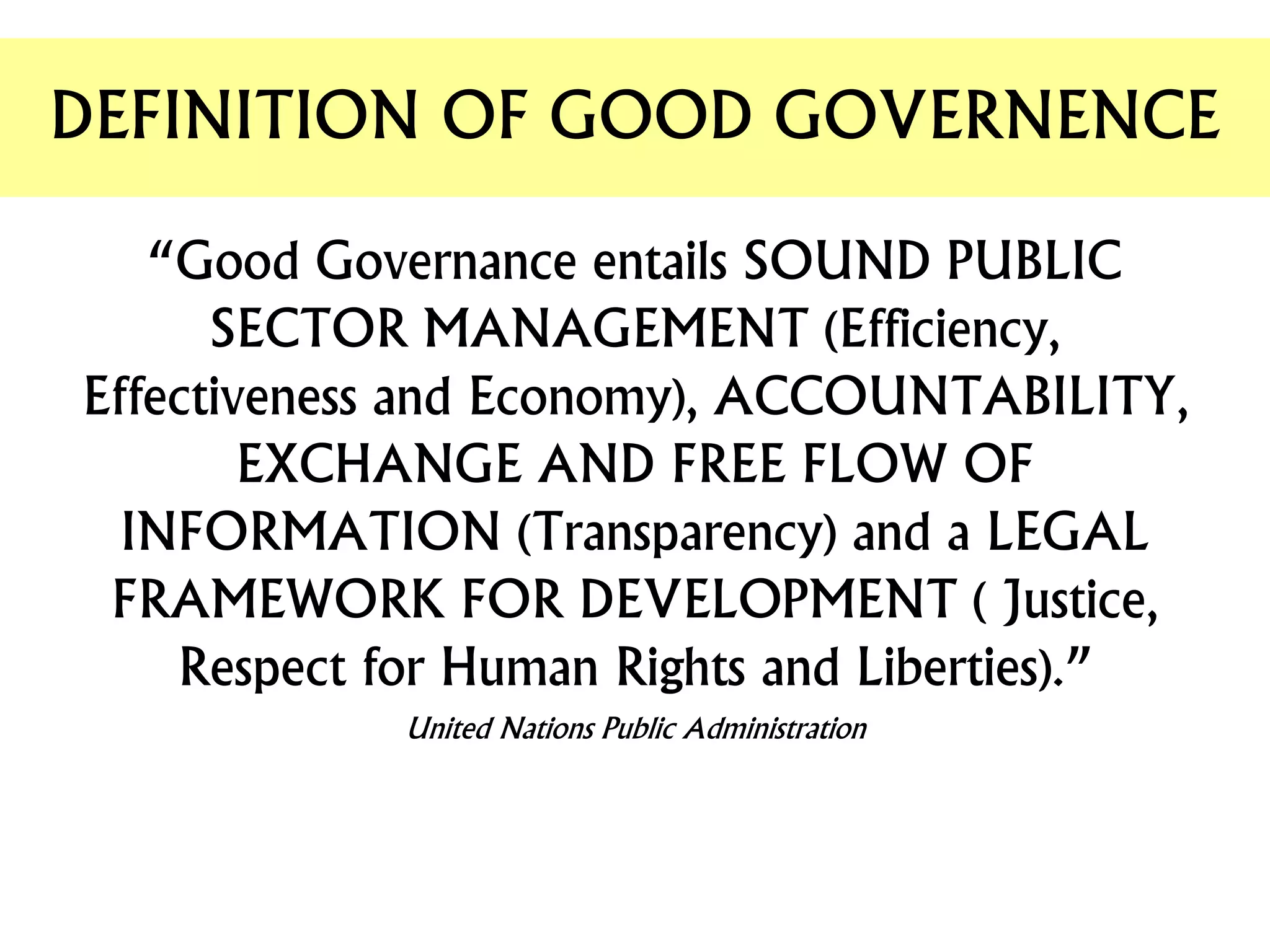
DEFINITION OF GOOD GOVERNENCE
“Good Governance entails SOUND PUBLIC
SECTOR MANAGEMENT (Efficiency,
Effectiveness and Economy), ACCOUNTABILITY,
EXCHANGE AND FREE FLOW OF
INFORMATION (Transparency) and a LEGAL
FRAMEWORK FOR DEVELOPMENT ( Justice,
Respect for Human Rights and Liberties).”
United Nations Public Administration
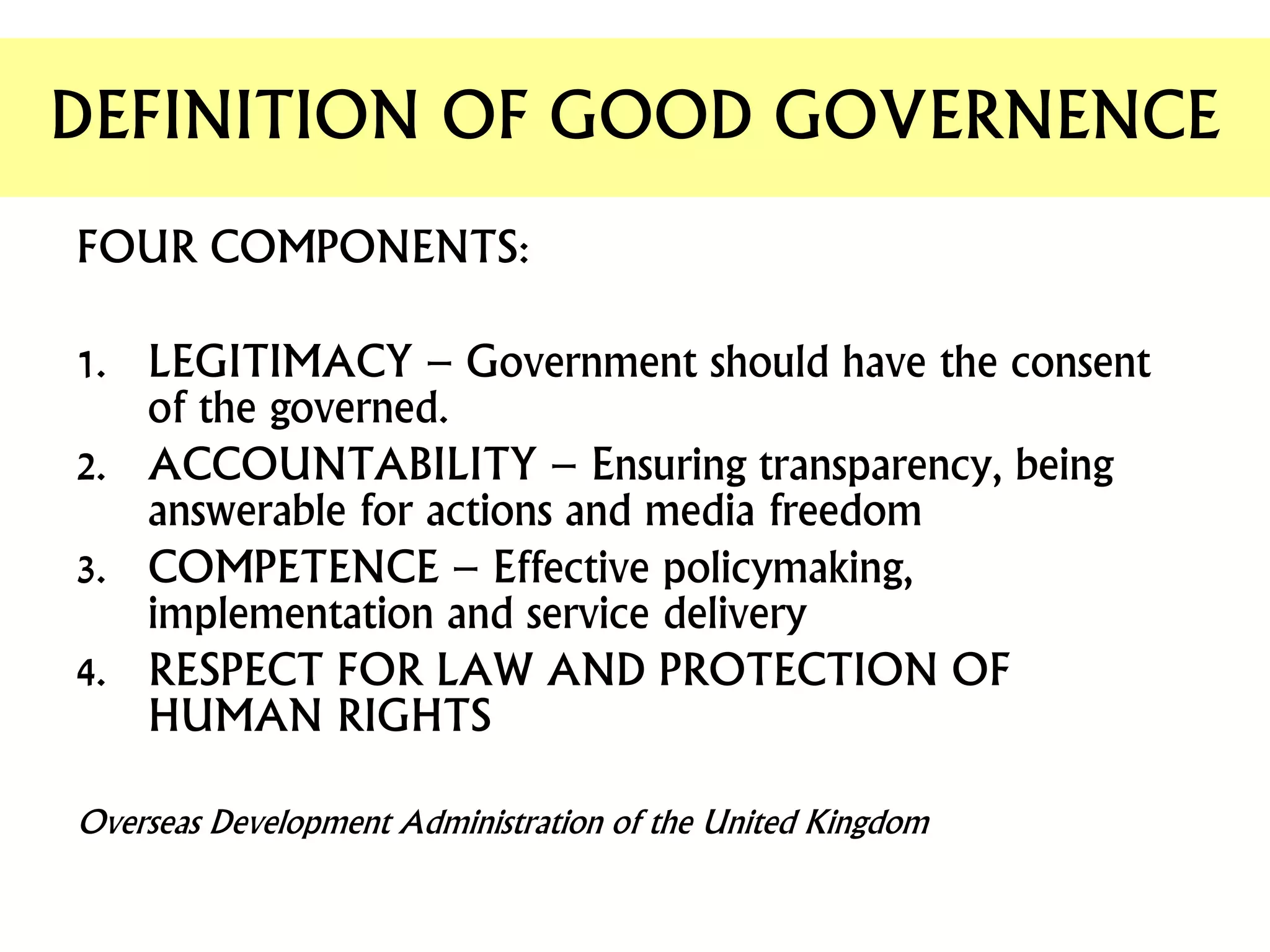
FOUR COMPONENTS:
1. LEGITIMACY – Government should have the consent
of the governed.
2. ACCOUNTABILITY – Ensuring transparency, being
answerable for actions and media freedom
3. COMPETENCE – Effective policymaking,
implementation and service delivery
4. RESPECT FOR LAW AND PROTECTION OF
HUMAN RIGHTS
Overseas Development Administration of the United Kingdom
DEFINITION OF GOOD GOVERNENCE
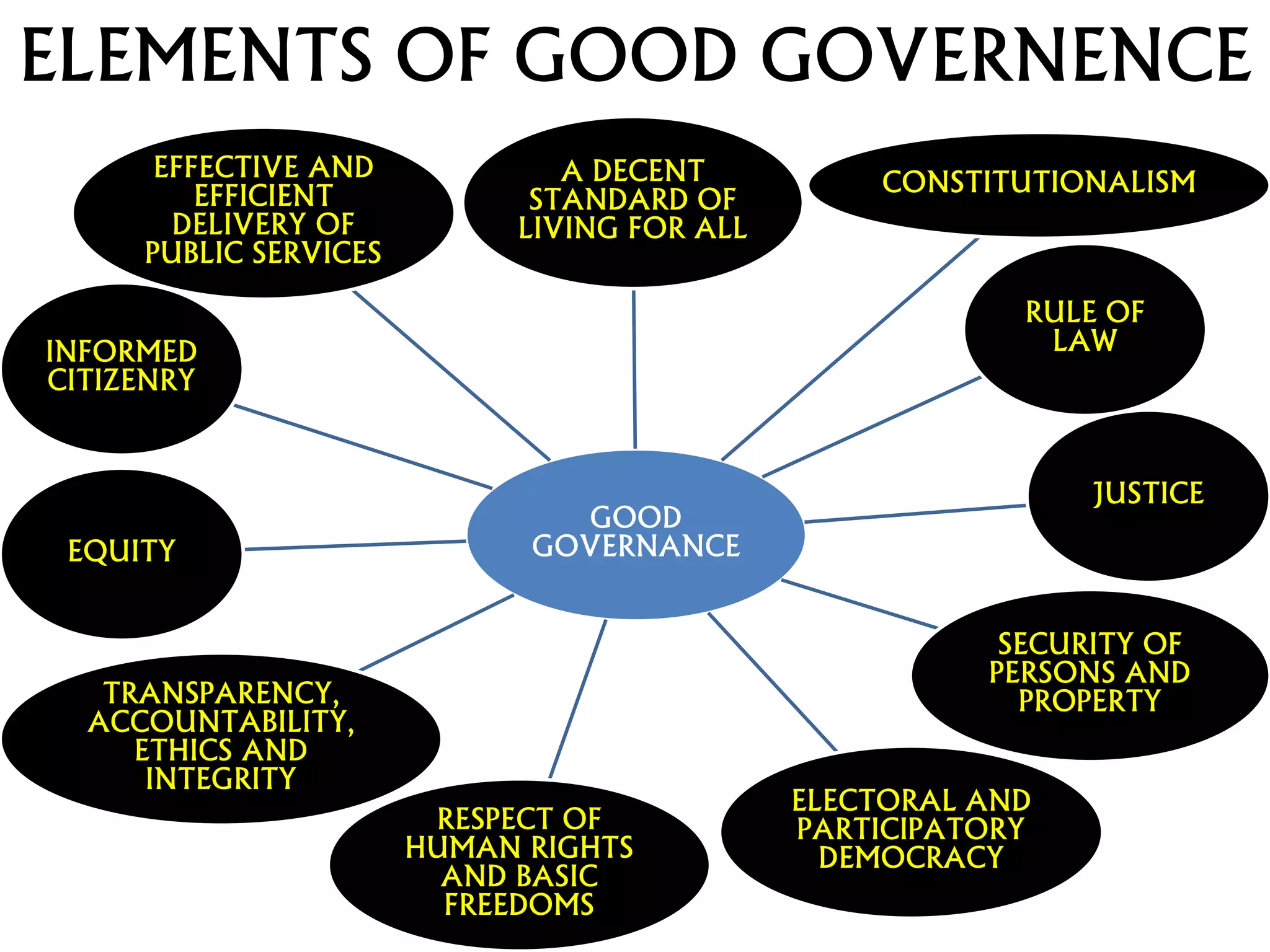
ELEMENTS OF GOOD GOVERNENCE
GOOD
GOVERNANCE
A DECENT
STANDARD OF
LIVING FOR ALL
CONSTITUTIONALISM
RULE OF
LAW
JUSTICE
SECURITY OF
PERSONS AND
PROPERTY
ELECTORAL AND
PARTICIPATORY
DEMOCRACY
RESPECT OF
HUMAN RIGHTS
AND BASIC
FREEDOMS
TRANSPARENCY,
ACCOUNTABILITY,
ETHICS AND
INTEGRITY
EQUITY
INFORMED
CITIZENRY
EFFECTIVE AND
EFFICIENT
DELIVERY OF
PUBLIC SERVICES
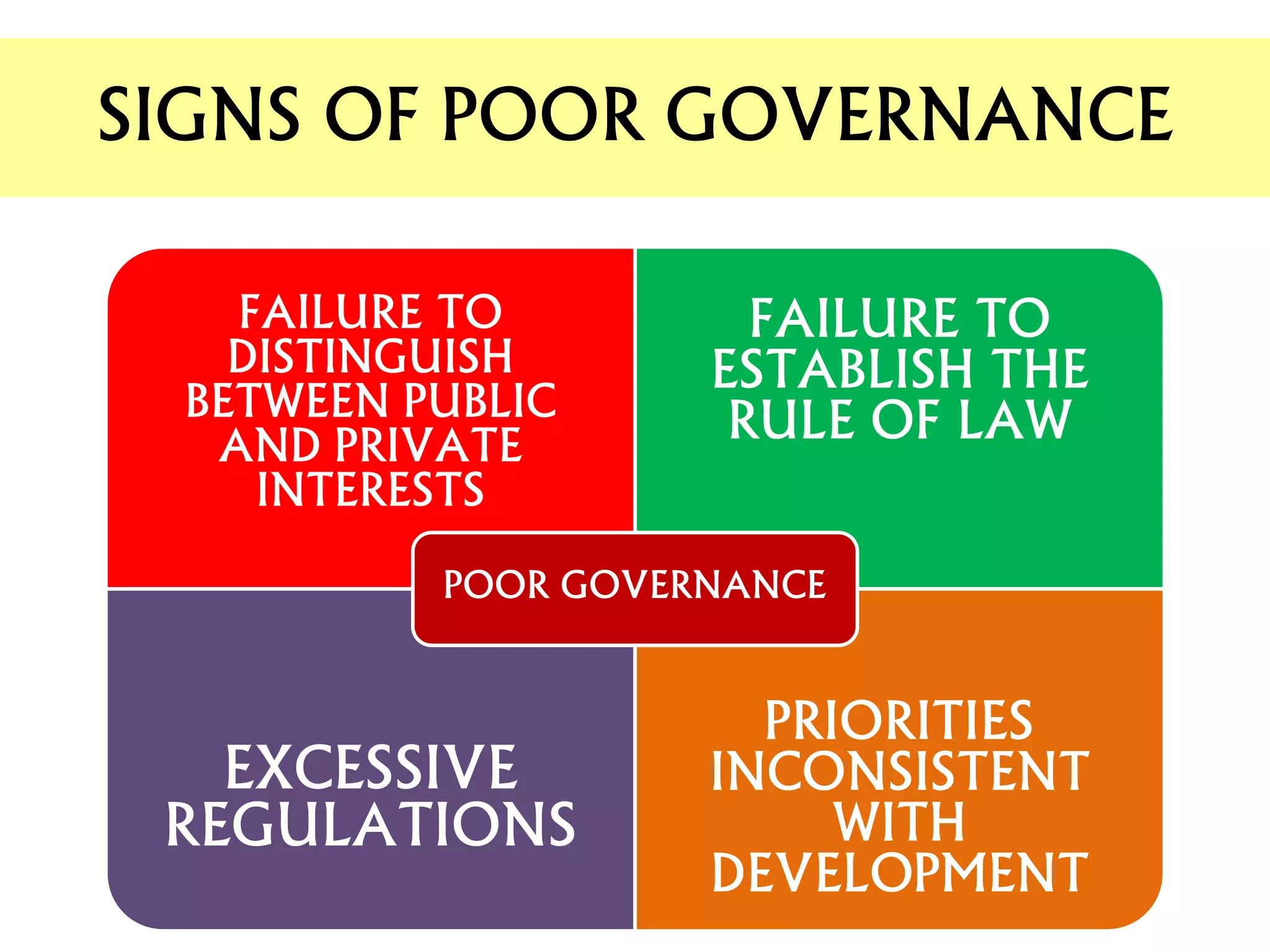
SIGNS OF POOR GOVERNANCE
FAILURE TO
DISTINGUISH
BETWEEN PUBLIC
AND PRIVATE
INTERESTS
FAILURE TO
ESTABLISH THE
RULE OF LAW
EXCESSIVE
REGULATIONS
PRIORITIES
INCONSISTENT
WITH
DEVELOPMENT
POOR GOVERNANCE
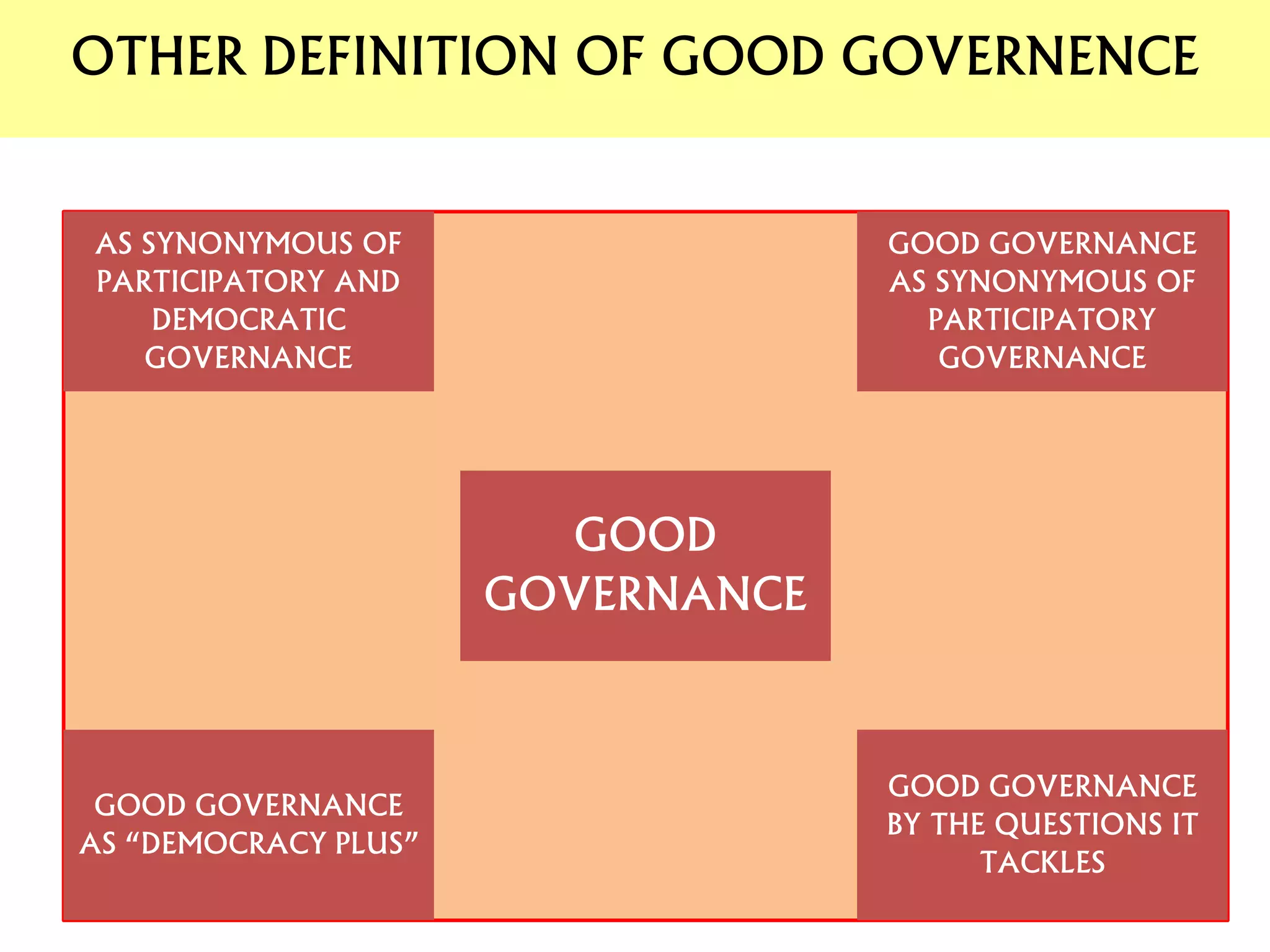
OTHER DEFINITION OF GOOD GOVERNENCE
AS SYNONYMOUS OF
PARTICIPATORY AND
DEMOCRATIC
GOVERNANCE
GOOD GOVERNANCE
AS SYNONYMOUS OF
PARTICIPATORY
GOVERNANCE
GOOD GOVERNANCE
BY THE QUESTIONS IT
TACKLES
GOOD GOVERNANCE
AS “DEMOCRACY PLUS”
GOOD
GOVERNANCE
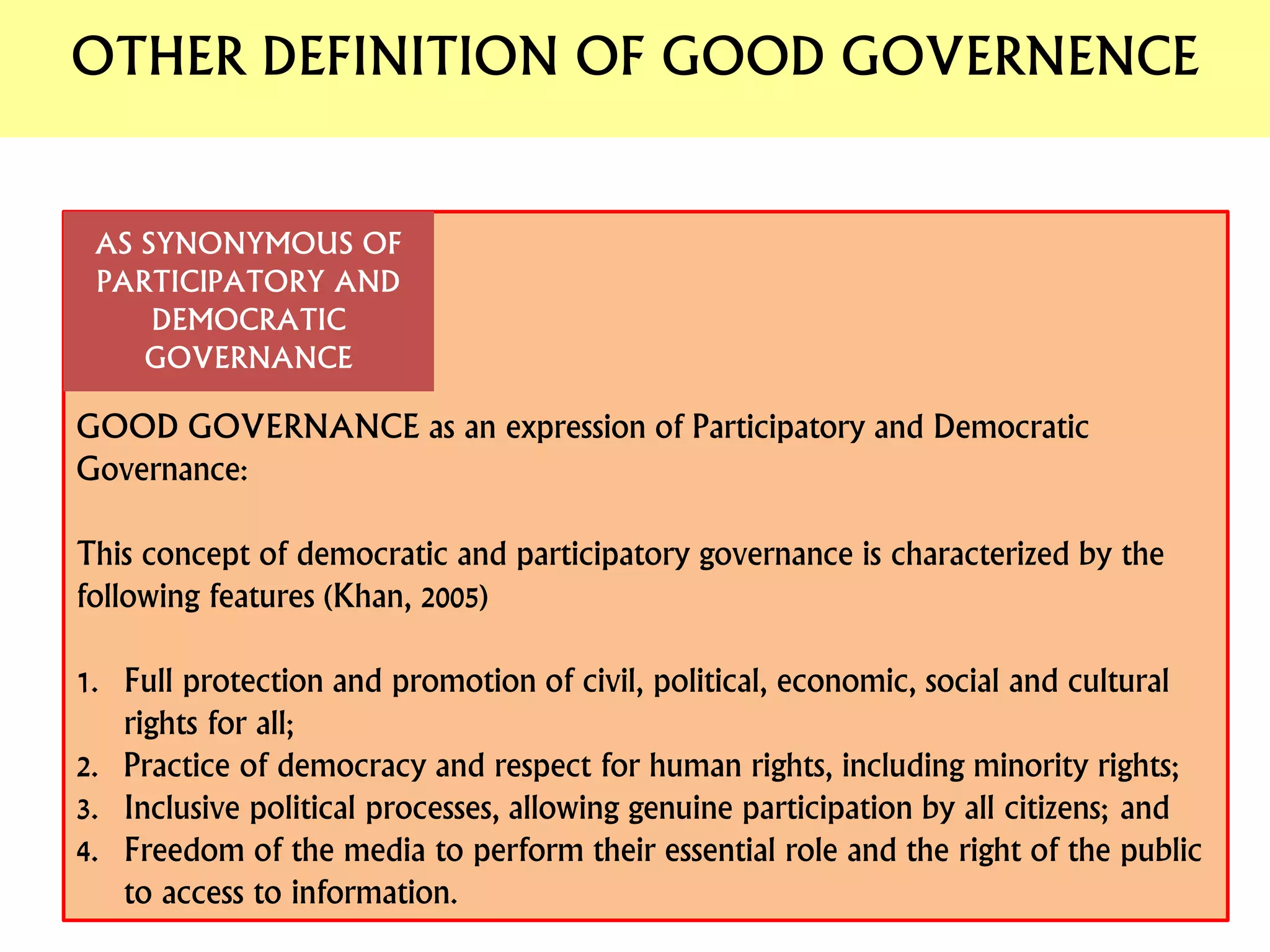
GOOD GOVERNANCE as an expression of Participatory and Democratic
Governance:
This concept of democratic and participatory governance is characterized by the
following features (Khan, 2005)
1. Full protection and promotion of civil, political, economic, social and cultural
rights for all;
2. Practice of democracy and respect for human rights, including minority rights;
3. Inclusive political processes, allowing genuine participation by all citizens; and
4. Freedom of the media to perform their essential role and the right of the public
to access to information.
AS SYNONYMOUS OF
PARTICIPATORY AND
DEMOCRATIC
GOVERNANCE
OTHER DEFINITION OF GOOD GOVERNENCE
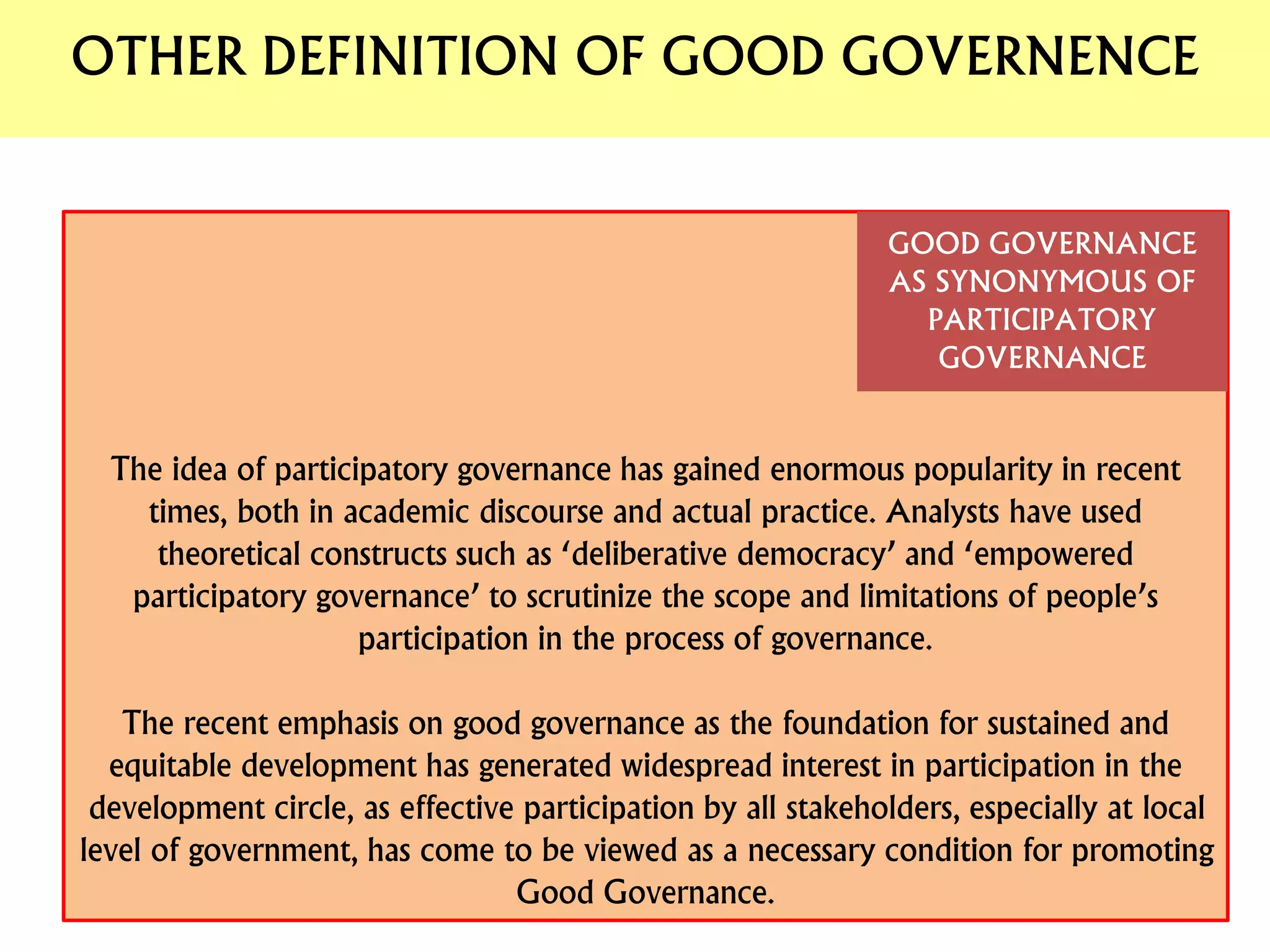
The idea of participatory governance has gained enormous popularity in recent
times, both in academic discourse and actual practice. Analysts have used
theoretical constructs such as ‘deliberative democracy’ and ‘empowered
participatory governance’ to scrutinize the scope and limitations of people’s
participation in the process of governance.
The recent emphasis on good governance as the foundation for sustained and
equitable development has generated widespread interest in participation in the
development circle, as effective participation by all stakeholders, especially at local
level of government, has come to be viewed as a necessary condition for promoting
Good Governance.
GOOD GOVERNANCE
AS SYNONYMOUS OF
PARTICIPATORY
GOVERNANCE
OTHER DEFINITION OF GOOD GOVERNENCE
Good Governance must tackle the following:
1. How best to build trust, participation, legitimacy, accountability and
efficacy in public governance;
2. How to incorporate competing demands of various stakeholders,
including businesses and local communities, so that they complement
one another – in short, how to balance Relations within the governance
processes;
3. How to introduce engagement practices in communities to achieve
sustainable economic, social, cultural and environmental development;
and
4. How to transform public administration from an isolated techno-
bureaucratic institution to a more engaging and accountable citizen-
based institution, thereby making it more transparent, responsive,
effective and perhaps above all, TRUSTED.
GOOD GOVERNANCE
BY THE QUESTIONS IT
TACKLES
OTHER DEFINITION OF GOOD GOVERNENCE
The concept of Good Governance Incorporates the following:
DEMOCRATIC GOVERNANCE FOR SUSTAINABLE HUMAN DEVELOPMENT.
Democratic Governance means that:
1. People’s human rights and fundamental freedoms are respected, allowing them to live in
Dignity.
2. People have a say in decisions that affect their lives.
3. People can hold decision-makers accountable.
4. Social interactions are governed by inclusive and fair rues, institutions and practices;
5. Women are equal partners with men in both the private and public spheres of life and
decision making.
6. People are free from discrimination based on race, color, ethnicity, class, gender, religion
[or any other attributes, such as physical disability, ageing, etc.
7. The needs of the future generations are reflected in current policies.
8. Economic and social policies are responsible to people needs
and aspirations.
9. Economic and social policies are aimed at eradicating
10. poverty and expanding the choices that all people
should have in their lives.
GOOD GOVERNANCE
AS “DEMOCRACY PLUS”
OTHER DEFINITION OF GOOD GOVERNENCE
INDISPENSABLE CHARACTERISTICS
GOOD GOVERNENCE
1. Protection and promotion of civil, political,
economic, social and cultural rights for all.
2. Practice of democracy and respect for human
rights including minority rights.
3. Inclusive political processes, allowing genuine
participation by all citizens in all countries; and
4. Freedom of the media to perform their essential
role and the right of the public to have access
to information.
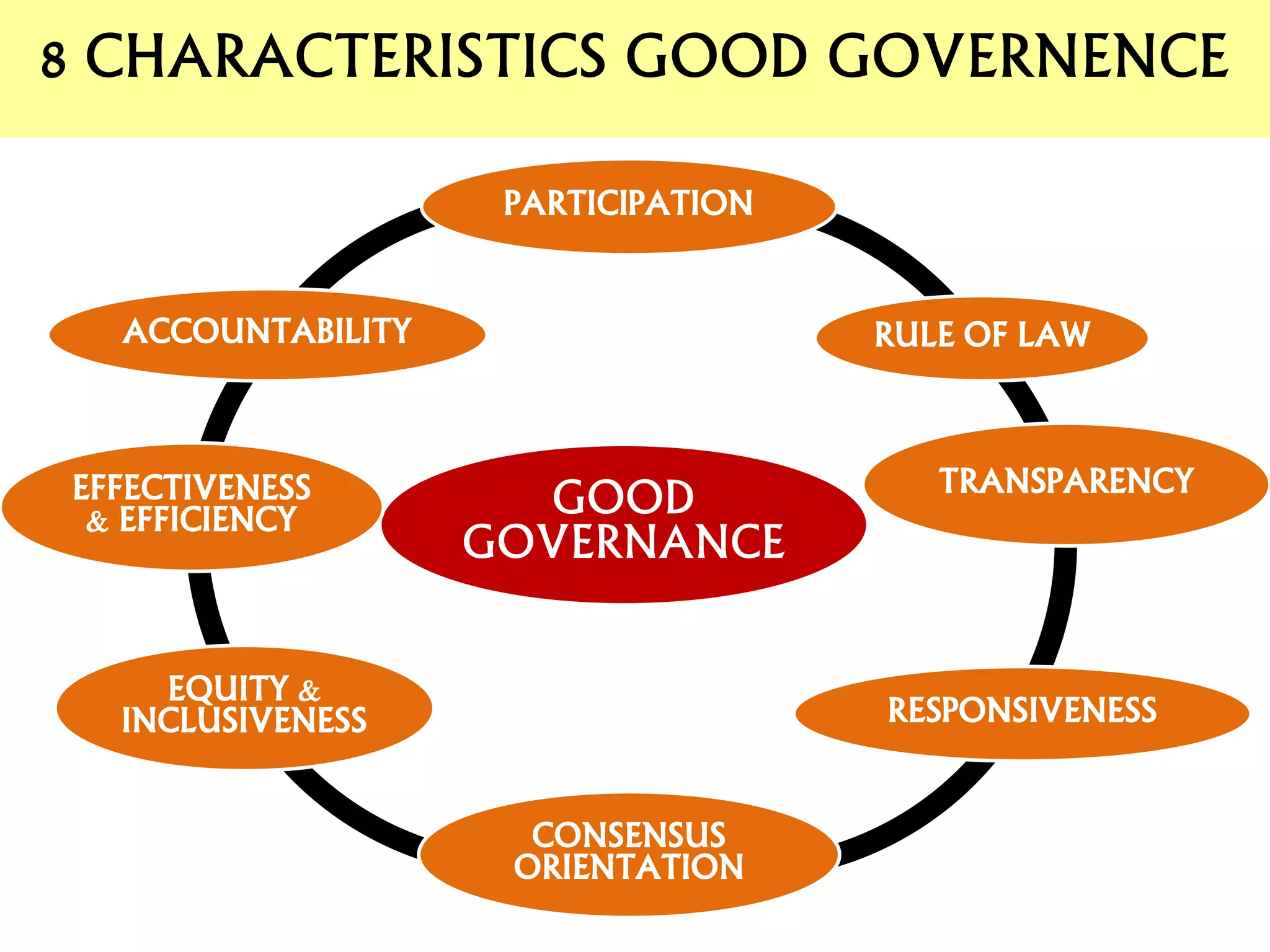
8 CHARACTERISTICS GOOD GOVERNENCE
GOOD
GOVERNANCE
PARTICIPATION
RULE OF LAW
TRANSPARENCY
RESPONSIVENESS
CONSENSUS
ORIENTATION
EQUITY &
INCLUSIVENESS
EFFECTIVENESS
& EFFICIENCY
ACCOUNTABILITY
GOOD GOVERNANCE
GOOD GOVERNANCE
GOOD GOVERNANCE
GOOD GOVERNANCE
GOOD GOVERNANCE
GOOD GOVERNANCE
GOOD GOVERNANCE
GOOD GOVERNANCE
GOOD GOVERNANCE

GOOD GOVERNANCE

  • 1.
    BUILDING AN EFFECTIVEFRAMEWORK IN GOOD GOVERNANCE
  • 2.
    LEARNING OBJECTIVE: At theend of this presentation, it is expected that the participants will be able to : UNDERSTAND THE CONCEPTS OF GOVERNANCE AND GOOD GOVERNANCE
  • 4.
    THE CONCEPT OFGOVERNANCE EFFECTIVE CITIZEN PARTICIPATION ARE INDEED PRACTICES REGARDING GOOD GOVERNANCE
  • 5.
    In distinguishing betweenGovernment Activity and governance, we will first state what Governance comprises: “The formal and informal institutions that determine how power is exercised in society, how decisions are taken and how citizens have their say in the process of governing. Therefore, GOVERNANCE is not the sole concern of Government but of all those involved in public decision making” UNDESA Public Administration THE CONCEPT OF GOVERNANCE
  • 6.
    GOVERNANCE is “ theexercise of Economic, Political and Administrative authority to manage a country’s affairs at all levels. It comprises the mechanisms, processes and institutions through which citizens and groups articulate their interests, exercise their legal rights, meet their obligations and mediate their differences.” (UNDP , 1997) THE CONCEPT OF GOVERNANCE
  • 7.
    AN ELUSIVE CONCEPTIN POLITICAL SCIENCE. It is because Governance PRACTICES and ADMINISTRATIVE STRUCTURES are GEOGRAPHICALLY, HISTORICALLY and CULTURALLY BOUND. THE CONCEPT OF GOVERNANCE
  • 8.
    GOVERNMENT and GOVERNANCEhave different meanings across geographical space and time. Differences aside, certain elements of Good Governance common to all and these are: 1. OWNERSHIP/EMPOWERMENT OF CITIZENS 2. EFFECTIVENESS IN ECONOMIC, SOCIAL and POLITICAL SPHERES THE CONCEPT OF GOVERNANCE
  • 9.
    “The Quality andEffectiveness of Government enhance the State’s capacity in strategic areas that are vital to the process of Development. The JUST EXERCISE of AUTHORITY is one. A CAPACITY for PROBLEM SOLVING and CONFLICT RESOLUTION is one. And the PERFORMANCE of its FUNCTIONS based on the INVOLVEMENT of a SOCIETAL COALITION is another.” THE CONCEPT OF GOVERNANCE
  • 13.
    DEFINITION OF GOODGOVERNENCE “Good Governance entails SOUND PUBLIC SECTOR MANAGEMENT (Efficiency, Effectiveness and Economy), ACCOUNTABILITY, EXCHANGE AND FREE FLOW OF INFORMATION (Transparency) and a LEGAL FRAMEWORK FOR DEVELOPMENT ( Justice, Respect for Human Rights and Liberties).” United Nations Public Administration
  • 14.
    FOUR COMPONENTS: 1. LEGITIMACY– Government should have the consent of the governed. 2. ACCOUNTABILITY – Ensuring transparency, being answerable for actions and media freedom 3. COMPETENCE – Effective policymaking, implementation and service delivery 4. RESPECT FOR LAW AND PROTECTION OF HUMAN RIGHTS Overseas Development Administration of the United Kingdom DEFINITION OF GOOD GOVERNENCE
  • 15.
    ELEMENTS OF GOODGOVERNENCE GOOD GOVERNANCE A DECENT STANDARD OF LIVING FOR ALL CONSTITUTIONALISM RULE OF LAW JUSTICE SECURITY OF PERSONS AND PROPERTY ELECTORAL AND PARTICIPATORY DEMOCRACY RESPECT OF HUMAN RIGHTS AND BASIC FREEDOMS TRANSPARENCY, ACCOUNTABILITY, ETHICS AND INTEGRITY EQUITY INFORMED CITIZENRY EFFECTIVE AND EFFICIENT DELIVERY OF PUBLIC SERVICES
  • 16.
    SIGNS OF POORGOVERNANCE FAILURE TO DISTINGUISH BETWEEN PUBLIC AND PRIVATE INTERESTS FAILURE TO ESTABLISH THE RULE OF LAW EXCESSIVE REGULATIONS PRIORITIES INCONSISTENT WITH DEVELOPMENT POOR GOVERNANCE
  • 17.
    OTHER DEFINITION OFGOOD GOVERNENCE AS SYNONYMOUS OF PARTICIPATORY AND DEMOCRATIC GOVERNANCE GOOD GOVERNANCE AS SYNONYMOUS OF PARTICIPATORY GOVERNANCE GOOD GOVERNANCE BY THE QUESTIONS IT TACKLES GOOD GOVERNANCE AS “DEMOCRACY PLUS” GOOD GOVERNANCE
  • 18.
    GOOD GOVERNANCE asan expression of Participatory and Democratic Governance: This concept of democratic and participatory governance is characterized by the following features (Khan, 2005) 1. Full protection and promotion of civil, political, economic, social and cultural rights for all; 2. Practice of democracy and respect for human rights, including minority rights; 3. Inclusive political processes, allowing genuine participation by all citizens; and 4. Freedom of the media to perform their essential role and the right of the public to access to information. AS SYNONYMOUS OF PARTICIPATORY AND DEMOCRATIC GOVERNANCE OTHER DEFINITION OF GOOD GOVERNENCE
  • 19.
    The idea ofparticipatory governance has gained enormous popularity in recent times, both in academic discourse and actual practice. Analysts have used theoretical constructs such as ‘deliberative democracy’ and ‘empowered participatory governance’ to scrutinize the scope and limitations of people’s participation in the process of governance. The recent emphasis on good governance as the foundation for sustained and equitable development has generated widespread interest in participation in the development circle, as effective participation by all stakeholders, especially at local level of government, has come to be viewed as a necessary condition for promoting Good Governance. GOOD GOVERNANCE AS SYNONYMOUS OF PARTICIPATORY GOVERNANCE OTHER DEFINITION OF GOOD GOVERNENCE
  • 20.
    Good Governance musttackle the following: 1. How best to build trust, participation, legitimacy, accountability and efficacy in public governance; 2. How to incorporate competing demands of various stakeholders, including businesses and local communities, so that they complement one another – in short, how to balance Relations within the governance processes; 3. How to introduce engagement practices in communities to achieve sustainable economic, social, cultural and environmental development; and 4. How to transform public administration from an isolated techno- bureaucratic institution to a more engaging and accountable citizen- based institution, thereby making it more transparent, responsive, effective and perhaps above all, TRUSTED. GOOD GOVERNANCE BY THE QUESTIONS IT TACKLES OTHER DEFINITION OF GOOD GOVERNENCE
  • 21.
    The concept ofGood Governance Incorporates the following: DEMOCRATIC GOVERNANCE FOR SUSTAINABLE HUMAN DEVELOPMENT. Democratic Governance means that: 1. People’s human rights and fundamental freedoms are respected, allowing them to live in Dignity. 2. People have a say in decisions that affect their lives. 3. People can hold decision-makers accountable. 4. Social interactions are governed by inclusive and fair rues, institutions and practices; 5. Women are equal partners with men in both the private and public spheres of life and decision making. 6. People are free from discrimination based on race, color, ethnicity, class, gender, religion [or any other attributes, such as physical disability, ageing, etc. 7. The needs of the future generations are reflected in current policies. 8. Economic and social policies are responsible to people needs and aspirations. 9. Economic and social policies are aimed at eradicating 10. poverty and expanding the choices that all people should have in their lives. GOOD GOVERNANCE AS “DEMOCRACY PLUS” OTHER DEFINITION OF GOOD GOVERNENCE
  • 23.
    INDISPENSABLE CHARACTERISTICS GOOD GOVERNENCE 1.Protection and promotion of civil, political, economic, social and cultural rights for all. 2. Practice of democracy and respect for human rights including minority rights. 3. Inclusive political processes, allowing genuine participation by all citizens in all countries; and 4. Freedom of the media to perform their essential role and the right of the public to have access to information.
  • 28.
    8 CHARACTERISTICS GOODGOVERNENCE GOOD GOVERNANCE PARTICIPATION RULE OF LAW TRANSPARENCY RESPONSIVENESS CONSENSUS ORIENTATION EQUITY & INCLUSIVENESS EFFECTIVENESS & EFFICIENCY ACCOUNTABILITY