Unit-2
CONCEPT OF GOVERNANCE
Hagos Gemechu (PhD)
1
Learning outcomes of the Unit
 After completing this unit, students will be able to:-
 Explain the concepts and significance of governance
 Explain the evolution of the concept of governance
 Describe the major pillars of good governance
 explains the challenges of governance
 Explain the cost of bad and benefit of good governance
 Analyze the existing governance structure in Ethiopia
ECSU 2020
Hagos G. (Dr.) 2
Why we should properly understand
governance?
Hagos G. (Dr.) 3
Introduction
 Governance nowadays occupies a central stage in
the development discourse.
 Governance is considered as an crucial element to
be incorporated in the development strategy.
 Governance symbolizes the paradigm shift of the
role of government.
 Governance is not only about the ‘organ’ or actors,
most importantly, it is about the quality of
governance.
 It has become a truism to say that ‘good
governance is essential for successful
development’.
 ‘Governance’ means different things for different
people. Why?????
Hagos G. (Dr.) 4
Introduction ….
Why should we worry about good
governance now?
ECSU 2021
Hagos G. (Dr.) 5
Introduction ….
 We should worry about good governance now, Because
First, good governance is vital now because of the turbulent
environment, interconnected, complex, and fast
moving in which we find ourselves.
Second, we are increasingly living in an imperfect word.
Third, Globalization. That is asymmetric/irregular globalization
– where information and market have globalized but
democracy has not.
Fourth, Good governance is made up of complex
relationships of the three leged stool – public
sector, private sector, and civil society- ‘ Three
healthy legs’.
Fifth, Governance cuts across all facets of human life
Hagos G. (Dr.) 6
What is governance?
Hagos G. (Dr.)
7
What is Governance?
 The idea of governance came in to picture in the development
programs of major donors and International Financial
Institutions following the Cold War period.
 This does not mean that the concept of governance is new. It is
as old as the human civilization.
ERCS-2021
Hagos G. (Dr.) 8
……What is Governance?
 The concept governance have been defined by different scholars and
institutions in different contexts.
 According to World Bank, governance refers to ‘the manner in which
power is exercised in the management of a country’s economic & social
resources’.
 World Bank publication “Sub-Sahara Africa – from crisis to sustainable”
1989
 Failure of public institutions cited as reason for weak performance.
 Term “governance” first used to describe the need for instotutional reform
and a better and mor efficient public sector I Sub-Saharan countries.
 Defined governance as “ the exercise of political power to manage a nations'
affairs”
“ Africa requires not just less government but better government” Do
you agree?
ECSU-2021
Hagos G. (Dr.) 9
……What is Governance?
2021
Hagos Gemechu
10
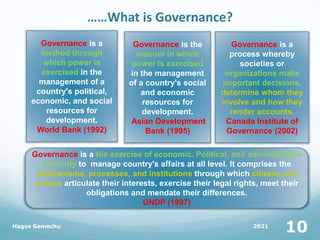
Governance is a the exercise of economic. Political, and administrative
authority to manage country's affairs at all level. It comprises the
mechanisms, processes, and institutions through which citizens and
groups articulate their interests, exercise their legal rights, meet their
obligations and mendate their differences.
UNDP (1997)
Governance is the
manner in which
power is exercised
in the management
of a country's social
and economic
resources for
development.
Asian Development
Bank (1995)
Governance is a
process whereby
societies or
organizations make
important decisions,
determine whom they
involve and how they
render accounts.
Canada Institute of
Governance (2002)
Governance is a
method through
which power is
exercised in the
management of a
country's political,
economic, and social
resources for
development.
World Bank (1992)
……What is Governance?
 For UNDP governance means ‘ exercising economic, political
and administrative authority to manage a country’s affairs at
all levels.’
 The concept governance is understood by many other
institutions as ‘the use of political accountability and exercise of
control in the process of managing resources to brining social
and economic developments.
ECSU-2011
Hagos G. (Dr.) 11
…What is Governance?
Shortly put, governance can refer to:-
 The way and process of decision- making and the
process by which the decisions are
implemented or not implemented.
 the way organizations are directed and controlled
to ensure that they are effective in achieving
their objectives.
ECSU-2021
Hagos G. (Dr.) 12
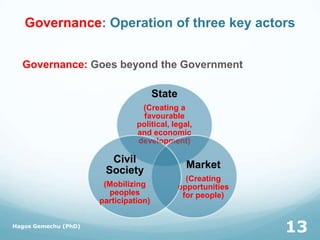
Governance: Operation of three key actors
Governance: Goes beyond the Government
Hagos Gemechu (PhD)
13
State
(Creating a
favourable
political, legal,
and economic
development)
Market
(Creating
opportunities
for people)
Civil
Society
(Mobilizing
peoples
participation)
What is the difference b/n government and
governance?
Hagos G. (Dr.) 14
Governance Vs Government
a) Government refers to:
 Persons (Officials, managers, experts,
civil servants….) in all the public,
private sectors, and civil societies.
 Actors in all governance which
comprises constitution, other laws,
institutions, structures, management
mechanisms and administrative
process.
Hagos G. (Dr.) 15
…Governance Vs Government
b)Governance refers to:-
all cumulative practices of behavior, skills and attitude of
government as seen in the manner:-
- they create different instruments and tools
- they use the different instruments and tools.
in carrying out government duties, patterns of governance
reflect in all the:-
- form and styles
- systems,
- methods,
- procedures……
Hagos G. (Dr) 16
……………..Governance Vs Government
Shortly put, governance refers to the manners
and ways managing the relations and interactions
b/n the government and the society.
So long as governance is directly related to the
behavior, skill and attitude of persons that run the
government, it can be practiced correctly or
wrongly.
This takes us to the qualities of governance as
good and/or bad.
Hagos G. (Dr.) 17
What is good governance?
Hagos G. (Dr.) 18
Qualities of governance
Hagos G. (Dr.) 19
Qualities of governance
 Based on different practical parameters, governance
can be classified as good and bad/poor governance.
A) Good governance
 good governance is a concept on which major donors and
international financial institutions are increasingly basing their aid
and loans.
 good governance refers to the processes and qualities that
enables to produce results to meet the needs of society by
making the best use of resources at the disposal of the
government.
Hagos G. (Dr.) 20
………Qualities of governance
• Good governance is an indeterminate term used in
international development literature to describe
how public institutions conduct public affairs and
manage public resources
• The concept of "good governance" often emerges
as a model to compare and replace ineffective
economies or political bodies with viable and
effective economies and political bodies.
Hagos G. (Dr.) 21
…….Qualities of governance
 Good governance is a political system in which all activities are
done transparently, Political leaders at all levels are held
accountable, all citizens are treated equally and fairly, rule of law
is respected and the people participation actively…………….
 Good governance means focusing on the organization's
purpose and on outcomes for citizens and service users
 Good governance means developing the capacity and
capability of the governing body to be effective
 Good governance means performing effectively in
clearly defined functions and roles
 Good governance means engaging stakeholders and
making accountability real
Hagos G. (Dr.) 22
What is bad/poor governance?
Hagos G. (Dr.) 23
…..Qualities of governance
B) Bad/poor governance
 Bad governance is being increasingly regarded in many developing countries as one of
the root causes of all evils and problems within societies.
 Bad governance refers to any malpractice and maladministration which may result
from:-
- denial of all rights
- administrative in-efficiency
- corruption and rent seeking
- lack of legal protections
 Bad governance entails problems like:-
- wastage both human and natural resources
- environmental degradations and pollutions
- lack of preventing sustainable development.
Hagos G. (Dr.) 24
……Qualities of governance
World bank characterized bad/poor
governance as the :-
1) Failure to make clear separation between what is
public and what is private, hence a tendency to ‘rent
seeking behavior’.
2) Failure to establish a predictable framework of law
and government behavior conducive to development or
arbitrariness in the application of rules and laws
3) Existence of executive rules, regulations, licensing
requirements ……which impede functioning of markets
and encourage rent seeking.
Hagos G. (Dr.) 25
……Qualities of governance
4) Existence of inconsistent with development as a result of
misuse and misallocation of resources.
5) The existence of excessive and narrow decision making based
on non-transparence.
All the above points define the major bad qualities of
governance.
Hagos G. (Dr.) 26
……Qualities of governance
What is the cost of bad/poor governance?
Hagos G. (Dr.) 27
……Qualities of governance
 Bad/poor governance leads to:
 Insecurity
 High transaction cost
 Reduce privet sector involvement
 Corruption
 Conflict
 Inequitable resource distribution
 Social instability
 Erosion of ethics and standard of behaviors
 Unsustainable development
Hagos G. (Dr.) 28
……Qualities of governance
What are the benefits of good governance?
Hagos G. (Dr.) 29
……Qualities of governance
 What are the benefits of good governance?
 Enhances inclusive economic growth
 Better conflict prevention and resolution
 Environment-Balance of interest- ‘Is responsive to
present and future needs of society.
 Safety and security of the society
 society trust and confidence
Hagos G. (Dr.) 30
What could be the possible solution to
improve the quality of governance?
Hagos G. (Dr.) 31
……Qualities of governance
To solve these problems,Traditional bureacratic
public management was replaced by the New
Public Management (NPM) with main goals of:-
 Squeezing the size of government;
 privatazing government enterprizes;
 transfering supply of public goods to private
companies;
 introducing competition where it is possible;
 Good leadersship- leadership and governance are
twin concepts
 But, the New Public Management NPM had brought both
Negative and Positive outputs.
Hagos G. (DR.) 32
What could be the negative out puts of NPM?
Hagos G. (Dr.) 33
New Public Management (NPM)
Hagos G. (Dr.) 34
Definition of NPM
Mebrahtu W.
35
…Qualities of governance
Negative outputs of NPM
Public institutions became more
commercilized.
Many people suffered from cutting of
social programes.
The bureaucrats kept their rent
seeking
There created corruption practices
NGOs were not real partners.
Hagos G. (Dr.) 36
What could be the positive out puts of NPM?
Hagos G. (Dr.) 37
……Qualities of governance
Positive outputs of NPM
 Government institutions became more
efficient at the beginning.
 Companies got more space for market
adjustment
Large part of public services have been
delivered by private companies;
Government management became more
professional.
MebrahtuHagos G. (Dr.) W. 38
………Qualities of governance
General impression:-
market driven changes contributed for more efficiency,
but created dissatisfaction for many social groups and
the public at large.
Main lesson:-
The gap between governments and citizens became
wider. People were not satisfied from the management
of their governments.
As a result, the market and the private companies failed
to meet public objectives.
Hagos G. (Dr.) 39
……Qualities of governance
In searching more adequate government,
there came the need of re-thinking the old
questions such as:-
- what government should do?
- how government should do?
- for whom government should do?
The debate was not for large or small
state, but for a bad or good management
of government!
Hagos G. (Dr.) 40
……Qualities of governance
 It is obvious that good government requires elements
good governance which aimes to reach efficiency,
sustainable growth and better satisfaction of citizens
needs.
 Good governance combines short and Medium term
policy
A) Short term:- more cares and investments for solving the
current needs of societies (job, education, health).
Hagos G. (Dr.) 41
……Qualities of governance
B) Medium term:- coping with common society major
challenges such as lack of resources, ageing population,
pollution, climate changes, quality of life, intensive
migration and so on.
Good governance as process and instrument can
adjust development of a country towards the:-
- changing world:
- dynamic technological advance,
- openess of markets,
- global competition,
- higher citizens expectations for better life
Hagos G. (Dr.) 42
What are the major principles of good governance?
Hagos G. (Dr.) 43
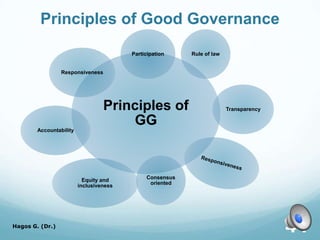
Principles of Good Governance
Principles of
GG
Participation Rule of law
Transparency
Consensus
oriented
Equity and
inclusiveness
Accountability
Responsiveness
Hagos G. (Dr.)
44
4.1 .4. Principles of Governance
 The major and common principles of good governance are:-
1. Participation
2. Rule of law
3. Transparency
4. Responsiveness
5. Consensus oriented
6. Equity and inclusiveness
7. Effectiveness and efficiency
8. Accountability
9. Strategic vision-UNDP
Hagos G. (Dr.) 45
4.1 .4. Principles of Governance
Why good governance preached over the last
decades but not improved significantly in our
country?
Hagos G. (Dr.) 46
4.1 .4. Principles of Governance
What could be the possible solutions to improve
GG significantly in our country?
Hagos G. (Dr.) 47
4.1 .4. Principles of Governance
Does the principles of GG competing or
complementing each other?
Why?
Hagos G. (Dr.) 48
……..Principles of Governance
1. Good governance is participatory.
Participation refers to the right of anyone who
can be affected by or interested in:-
- initiating policies and program ideas, options
- preparing plans
- implementing policies plans………
- taking measures, making decisions
- reviewing an action that might affect me.
- having a voice and choice.
Hagos G. (Dr.) 49
……..Principles of Governance
Participation can be carried out in several ways such
as by organizing:-
- local communities,
- different mass associations
- professional associations,
- business communities
- academic communities…….for different purposes and agenda
Participation can be direct by the actors themselves
or indirect through legitimate representatives
Hagos G. (Dr.) 50
……..Principles of Governance
If a government at any level is participatory, then
there is good governance.
Participation when?
Participation refers to the actual involvement or
engagement of society starting from the initiation,
throughout the process and outcome of any
development.
Participation in what way?
Hagos G. (Dr.) 51
……..Principles of Governance
2. Good governance is accountable
 Accountability" stems from late Latin accomptare (to
account), a prefixed form of computare (to calculate).
 Accountability is a fundamental requirement of good
governance.
Hagos G. (Dr.) 52
……..Principles of Governance
 In governance, accountability has expanded beyond
the basic definition of "being answerable for one's
actions".
 Accountability in governance is frequently described
as an account-giving relationship between individuals.
 For instance if "A is accountable to B, then A is obliged
to inform B about A’s actions and decisions which:-
 may include justification
may result in punishment in the case of eventual misconduct“.
Hagos G. (Dr.) 53
……..Principles of Governance
There are scholars like Jabbra who list a number of
types of accountability, namely:-
 Moral,
Administrative,
Political,
Managerial,
legal/judicial,
Professional…………...
 Leadership accountability cross cuts many of these
distinctions.
Hagos G. (Dr.) 54
……..Principles of Governance
 Political
 Political accountability is the accountability of the government, civil
servants and politicians to the public and to legislative bodies such as
a congress or a parliament.
 Citizens can put any elected official under accountable by using Recall
elections when they feel they do not protect their interests.
 In the case of appointment, a legislature representing the people at
large may have the power to:-
- impeach individual officials
- remove individual officials.
- suspend them from office for a period of time.
- resign individual officials before his/her term.
Hagos G. (Dr.) 55
……..Principles of Governance
 Administrative
 Internal rules and norms as well as some independent
commission are mechanisms to hold civil servants within the
administration of government accountable. Within
department or ministry:-
 firstly, behavior is bound by rules and regulations;
 secondly, civil servants are subordinates in a hierarchy and
accountable to superior
Hagos G. (Dr.) 56
……..Principles of Governance
3. Governance is transparent
 People should be able to follow and understand the
decision-making process.
 This means that they will be able to clearly see how and
why a decision was made – what information, advice and
consultation council considered, and which legislative
requirements (when relevant) council followed.
Hagos G. (Dr.) 57
……..Principles of Governance
 Transparency has numerous benefits:
1. Transparency for accountability: The public has the right to
hold the government and public officials to account for
how they act and for the decisions they take.
 To do this information is needed. The role of media is
particularly important here because journalists play the role
of “public watchdogs” – something which they have a right to
do as confirmed repeatedly by the European Court of Human
Rights.
Hagos G. (Dr.) 58
……..Principles of Governance
2. Transparency for participation: In a democracy it is essential
that people can access a wide range of information in order
to participate in a real and effective way in the matters that
affect them. That means not just participating in elections
but also participating in public debate and decision-making
between elections, and in order to participate in a
meaningful way we need information.
Hagos G. (Dr.) 59
……..Principles of Governance
3. Transparency for efficiency: Responding to
requests for information also has the benefit of
encouraging public institutions to organize their
information. In particular, proactive disclosure of
information encourages better information
management. This in turn should result in better,
more fact-based decision-making inside each
institution, as well as more effective
communication between public bodies.
Hagos G. (Dr.) 60
……..Principles of Governance
4. Good governance follows the rule of law
 This means that decisions are consistent with relevant
legislation or common law and are within the powers of
council. In the case of Victorian local government, relevant
legislation includes the Local Government Act 1989 and
other legislation such as the Public Health and Wellbeing Act
2008, and the Equal Opportunity Act 2010.
Hagos G. (Dr.) 61
……..Principles of Governance
5. Good governance is responsive
 A democratic government should always try to serve the
needs of the entire community while balancing competing
interests in a timely, appropriate and responsive manner.
Hagos G. (Dr.) 62
……..Principles of Governance
6. Good governance is equitable and inclusive
 A community’s wellbeing results from all of its members
feeling their interests have been considered by council in
the decision-making process. This means that all groups,
particularly the most vulnerable, should have
opportunities to participate in the process.
Hagos G. (Dr.) 63
……..Principles of Governance
7. Good governance is effective and efficient
 A democratic government should implement decisions and
follow processes that make the best use of the available
people, resources and time to ensure the best possible
results for their community.
Hagos G. (Dr.) 64
……..Principles of Governance
8. Good governance is consensus oriented
 Good governance allows to mediate different interests in a
society to reach a broad consensus on what is in the best
interest of the whole community and how ths can be
achieved.
 Good governance also helps to have long term
perspectives on what is needed for sustainable human
development and how to achieve such development.
 This can only result from an understanding of the
historical, cultural and social context of a society.
Hagos G. (Dr.) 65
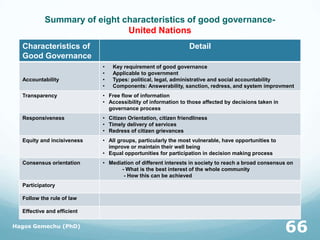
Summary of eight characteristics of good governance-
United Nations
Characteristics of
Good Governance
Detail
Accountability
• Key requirement of good governance
• Applicable to government
• Types: political, legal, administrative and social accountability
• Components: Answerability, sanction, redress, and system improvment
Transparency • Free flow of information
• Accessibility of information to those affected by decisions taken in
governance process
Responsiveness • Citizen Orientation, citizen friendliness
• Timely delivery of services
• Redress of citizen grievances
Equity and incisiveness • All groups, particularly the most vulnerable, have opportunities to
improve or maintain their well being
• Equal opportunities for participation in decision making process
Consensus orientation • Mediation of different interests in society to reach a broad consensus on
- What is the best interest of the whole community
- How this can be achieved
Participatory
Follow the rule of law
Effective and efficient
Hagos Gemechu (PhD)
66
Good Governance
From concept to practice
HOW??????
Hagos G. (Dr.) 67
Governance-From concept to practice
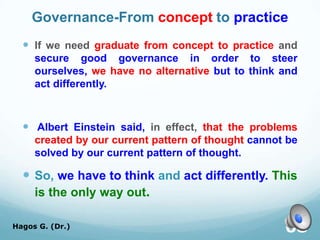
 If we need graduate from concept to practice and
secure good governance in order to steer
ourselves, we have no alternative but to think and
act differently.
 Albert Einstein said, in effect, that the problems
created by our current pattern of thought cannot be
solved by our current pattern of thought.
 So, we have to think and act differently. This
is the only way out.
Hagos G. (Dr.) 68
From concept to practice
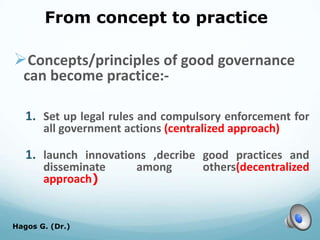
Concepts/principles of good governance
can become practice:-
1. Set up legal rules and compulsory enforcement for
all government actions (centralized approach)
1. launch innovations ,decribe good practices and
disseminate among others(decentralized
approach)
Hagos G. (Dr.) 69
………From concept to practice
Both options are workable, depends
from the national culture of politicians
and bureaucrats,as well as NGO-s
development;recommended way: start
with voluntary approach and create
legal base for all(expl. Internet site!
International dimensions: learn the
best practices from advanced
countries: UK,USA, Danmark,Estonia
and other
Hagos G. (Dr.) 70
…….From concept to practice
Key factors for success:-
1. Political decisiveness for changes which
requires educated and inteligent politicians
2. Professional,not politically manipulated,
administration
3. Dialog and consultations with society,
business organizations, civil societies and
NGOs
4. Active role of other stakeholders such as
voters, political parties in oppositions, NGOs
pressure of civil society members
Hagos G. (Dr.) 71
End of chapter two
Mebrahtu W.
72

CONCEPT OF GOVERNANCE.ppt

  • 1.
  • 2.
    Learning outcomes ofthe Unit  After completing this unit, students will be able to:-  Explain the concepts and significance of governance  Explain the evolution of the concept of governance  Describe the major pillars of good governance  explains the challenges of governance  Explain the cost of bad and benefit of good governance  Analyze the existing governance structure in Ethiopia ECSU 2020 Hagos G. (Dr.) 2
  • 3.
    Why we shouldproperly understand governance? Hagos G. (Dr.) 3
  • 4.
    Introduction  Governance nowadaysoccupies a central stage in the development discourse.  Governance is considered as an crucial element to be incorporated in the development strategy.  Governance symbolizes the paradigm shift of the role of government.  Governance is not only about the ‘organ’ or actors, most importantly, it is about the quality of governance.  It has become a truism to say that ‘good governance is essential for successful development’.  ‘Governance’ means different things for different people. Why????? Hagos G. (Dr.) 4
  • 5.
    Introduction …. Why shouldwe worry about good governance now? ECSU 2021 Hagos G. (Dr.) 5
  • 6.
    Introduction ….  Weshould worry about good governance now, Because First, good governance is vital now because of the turbulent environment, interconnected, complex, and fast moving in which we find ourselves. Second, we are increasingly living in an imperfect word. Third, Globalization. That is asymmetric/irregular globalization – where information and market have globalized but democracy has not. Fourth, Good governance is made up of complex relationships of the three leged stool – public sector, private sector, and civil society- ‘ Three healthy legs’. Fifth, Governance cuts across all facets of human life Hagos G. (Dr.) 6
  • 7.
  • 8.
    What is Governance? The idea of governance came in to picture in the development programs of major donors and International Financial Institutions following the Cold War period.  This does not mean that the concept of governance is new. It is as old as the human civilization. ERCS-2021 Hagos G. (Dr.) 8
  • 9.
    ……What is Governance? The concept governance have been defined by different scholars and institutions in different contexts.  According to World Bank, governance refers to ‘the manner in which power is exercised in the management of a country’s economic & social resources’.  World Bank publication “Sub-Sahara Africa – from crisis to sustainable” 1989  Failure of public institutions cited as reason for weak performance.  Term “governance” first used to describe the need for instotutional reform and a better and mor efficient public sector I Sub-Saharan countries.  Defined governance as “ the exercise of political power to manage a nations' affairs” “ Africa requires not just less government but better government” Do you agree? ECSU-2021 Hagos G. (Dr.) 9
  • 10.
    ……What is Governance? 2021 HagosGemechu 10 Governance is a the exercise of economic. Political, and administrative authority to manage country's affairs at all level. It comprises the mechanisms, processes, and institutions through which citizens and groups articulate their interests, exercise their legal rights, meet their obligations and mendate their differences. UNDP (1997) Governance is the manner in which power is exercised in the management of a country's social and economic resources for development. Asian Development Bank (1995) Governance is a process whereby societies or organizations make important decisions, determine whom they involve and how they render accounts. Canada Institute of Governance (2002) Governance is a method through which power is exercised in the management of a country's political, economic, and social resources for development. World Bank (1992)
  • 11.
    ……What is Governance? For UNDP governance means ‘ exercising economic, political and administrative authority to manage a country’s affairs at all levels.’  The concept governance is understood by many other institutions as ‘the use of political accountability and exercise of control in the process of managing resources to brining social and economic developments. ECSU-2011 Hagos G. (Dr.) 11
  • 12.
    …What is Governance? Shortlyput, governance can refer to:-  The way and process of decision- making and the process by which the decisions are implemented or not implemented.  the way organizations are directed and controlled to ensure that they are effective in achieving their objectives. ECSU-2021 Hagos G. (Dr.) 12
  • 13.
    Governance: Operation ofthree key actors Governance: Goes beyond the Government Hagos Gemechu (PhD) 13 State (Creating a favourable political, legal, and economic development) Market (Creating opportunities for people) Civil Society (Mobilizing peoples participation)
  • 14.
    What is thedifference b/n government and governance? Hagos G. (Dr.) 14
  • 15.
    Governance Vs Government a)Government refers to:  Persons (Officials, managers, experts, civil servants….) in all the public, private sectors, and civil societies.  Actors in all governance which comprises constitution, other laws, institutions, structures, management mechanisms and administrative process. Hagos G. (Dr.) 15
  • 16.
    …Governance Vs Government b)Governancerefers to:- all cumulative practices of behavior, skills and attitude of government as seen in the manner:- - they create different instruments and tools - they use the different instruments and tools. in carrying out government duties, patterns of governance reflect in all the:- - form and styles - systems, - methods, - procedures…… Hagos G. (Dr) 16
  • 17.
    ……………..Governance Vs Government Shortlyput, governance refers to the manners and ways managing the relations and interactions b/n the government and the society. So long as governance is directly related to the behavior, skill and attitude of persons that run the government, it can be practiced correctly or wrongly. This takes us to the qualities of governance as good and/or bad. Hagos G. (Dr.) 17
  • 18.
    What is goodgovernance? Hagos G. (Dr.) 18
  • 19.
  • 20.
    Qualities of governance Based on different practical parameters, governance can be classified as good and bad/poor governance. A) Good governance  good governance is a concept on which major donors and international financial institutions are increasingly basing their aid and loans.  good governance refers to the processes and qualities that enables to produce results to meet the needs of society by making the best use of resources at the disposal of the government. Hagos G. (Dr.) 20
  • 21.
    ………Qualities of governance •Good governance is an indeterminate term used in international development literature to describe how public institutions conduct public affairs and manage public resources • The concept of "good governance" often emerges as a model to compare and replace ineffective economies or political bodies with viable and effective economies and political bodies. Hagos G. (Dr.) 21
  • 22.
    …….Qualities of governance Good governance is a political system in which all activities are done transparently, Political leaders at all levels are held accountable, all citizens are treated equally and fairly, rule of law is respected and the people participation actively…………….  Good governance means focusing on the organization's purpose and on outcomes for citizens and service users  Good governance means developing the capacity and capability of the governing body to be effective  Good governance means performing effectively in clearly defined functions and roles  Good governance means engaging stakeholders and making accountability real Hagos G. (Dr.) 22
  • 23.
    What is bad/poorgovernance? Hagos G. (Dr.) 23
  • 24.
    …..Qualities of governance B)Bad/poor governance  Bad governance is being increasingly regarded in many developing countries as one of the root causes of all evils and problems within societies.  Bad governance refers to any malpractice and maladministration which may result from:- - denial of all rights - administrative in-efficiency - corruption and rent seeking - lack of legal protections  Bad governance entails problems like:- - wastage both human and natural resources - environmental degradations and pollutions - lack of preventing sustainable development. Hagos G. (Dr.) 24
  • 25.
    ……Qualities of governance Worldbank characterized bad/poor governance as the :- 1) Failure to make clear separation between what is public and what is private, hence a tendency to ‘rent seeking behavior’. 2) Failure to establish a predictable framework of law and government behavior conducive to development or arbitrariness in the application of rules and laws 3) Existence of executive rules, regulations, licensing requirements ……which impede functioning of markets and encourage rent seeking. Hagos G. (Dr.) 25
  • 26.
    ……Qualities of governance 4)Existence of inconsistent with development as a result of misuse and misallocation of resources. 5) The existence of excessive and narrow decision making based on non-transparence. All the above points define the major bad qualities of governance. Hagos G. (Dr.) 26
  • 27.
    ……Qualities of governance Whatis the cost of bad/poor governance? Hagos G. (Dr.) 27
  • 28.
    ……Qualities of governance Bad/poor governance leads to:  Insecurity  High transaction cost  Reduce privet sector involvement  Corruption  Conflict  Inequitable resource distribution  Social instability  Erosion of ethics and standard of behaviors  Unsustainable development Hagos G. (Dr.) 28
  • 29.
    ……Qualities of governance Whatare the benefits of good governance? Hagos G. (Dr.) 29
  • 30.
    ……Qualities of governance What are the benefits of good governance?  Enhances inclusive economic growth  Better conflict prevention and resolution  Environment-Balance of interest- ‘Is responsive to present and future needs of society.  Safety and security of the society  society trust and confidence Hagos G. (Dr.) 30
  • 31.
    What could bethe possible solution to improve the quality of governance? Hagos G. (Dr.) 31
  • 32.
    ……Qualities of governance Tosolve these problems,Traditional bureacratic public management was replaced by the New Public Management (NPM) with main goals of:-  Squeezing the size of government;  privatazing government enterprizes;  transfering supply of public goods to private companies;  introducing competition where it is possible;  Good leadersship- leadership and governance are twin concepts  But, the New Public Management NPM had brought both Negative and Positive outputs. Hagos G. (DR.) 32
  • 33.
    What could bethe negative out puts of NPM? Hagos G. (Dr.) 33
  • 34.
    New Public Management(NPM) Hagos G. (Dr.) 34
  • 35.
  • 36.
    …Qualities of governance Negativeoutputs of NPM Public institutions became more commercilized. Many people suffered from cutting of social programes. The bureaucrats kept their rent seeking There created corruption practices NGOs were not real partners. Hagos G. (Dr.) 36
  • 37.
    What could bethe positive out puts of NPM? Hagos G. (Dr.) 37
  • 38.
    ……Qualities of governance Positiveoutputs of NPM  Government institutions became more efficient at the beginning.  Companies got more space for market adjustment Large part of public services have been delivered by private companies; Government management became more professional. MebrahtuHagos G. (Dr.) W. 38
  • 39.
    ………Qualities of governance Generalimpression:- market driven changes contributed for more efficiency, but created dissatisfaction for many social groups and the public at large. Main lesson:- The gap between governments and citizens became wider. People were not satisfied from the management of their governments. As a result, the market and the private companies failed to meet public objectives. Hagos G. (Dr.) 39
  • 40.
    ……Qualities of governance Insearching more adequate government, there came the need of re-thinking the old questions such as:- - what government should do? - how government should do? - for whom government should do? The debate was not for large or small state, but for a bad or good management of government! Hagos G. (Dr.) 40
  • 41.
    ……Qualities of governance It is obvious that good government requires elements good governance which aimes to reach efficiency, sustainable growth and better satisfaction of citizens needs.  Good governance combines short and Medium term policy A) Short term:- more cares and investments for solving the current needs of societies (job, education, health). Hagos G. (Dr.) 41
  • 42.
    ……Qualities of governance B)Medium term:- coping with common society major challenges such as lack of resources, ageing population, pollution, climate changes, quality of life, intensive migration and so on. Good governance as process and instrument can adjust development of a country towards the:- - changing world: - dynamic technological advance, - openess of markets, - global competition, - higher citizens expectations for better life Hagos G. (Dr.) 42
  • 43.
    What are themajor principles of good governance? Hagos G. (Dr.) 43
  • 44.
    Principles of GoodGovernance Principles of GG Participation Rule of law Transparency Consensus oriented Equity and inclusiveness Accountability Responsiveness Hagos G. (Dr.) 44
  • 45.
    4.1 .4. Principlesof Governance  The major and common principles of good governance are:- 1. Participation 2. Rule of law 3. Transparency 4. Responsiveness 5. Consensus oriented 6. Equity and inclusiveness 7. Effectiveness and efficiency 8. Accountability 9. Strategic vision-UNDP Hagos G. (Dr.) 45
  • 46.
    4.1 .4. Principlesof Governance Why good governance preached over the last decades but not improved significantly in our country? Hagos G. (Dr.) 46
  • 47.
    4.1 .4. Principlesof Governance What could be the possible solutions to improve GG significantly in our country? Hagos G. (Dr.) 47
  • 48.
    4.1 .4. Principlesof Governance Does the principles of GG competing or complementing each other? Why? Hagos G. (Dr.) 48
  • 49.
    ……..Principles of Governance 1.Good governance is participatory. Participation refers to the right of anyone who can be affected by or interested in:- - initiating policies and program ideas, options - preparing plans - implementing policies plans……… - taking measures, making decisions - reviewing an action that might affect me. - having a voice and choice. Hagos G. (Dr.) 49
  • 50.
    ……..Principles of Governance Participationcan be carried out in several ways such as by organizing:- - local communities, - different mass associations - professional associations, - business communities - academic communities…….for different purposes and agenda Participation can be direct by the actors themselves or indirect through legitimate representatives Hagos G. (Dr.) 50
  • 51.
    ……..Principles of Governance Ifa government at any level is participatory, then there is good governance. Participation when? Participation refers to the actual involvement or engagement of society starting from the initiation, throughout the process and outcome of any development. Participation in what way? Hagos G. (Dr.) 51
  • 52.
    ……..Principles of Governance 2.Good governance is accountable  Accountability" stems from late Latin accomptare (to account), a prefixed form of computare (to calculate).  Accountability is a fundamental requirement of good governance. Hagos G. (Dr.) 52
  • 53.
    ……..Principles of Governance In governance, accountability has expanded beyond the basic definition of "being answerable for one's actions".  Accountability in governance is frequently described as an account-giving relationship between individuals.  For instance if "A is accountable to B, then A is obliged to inform B about A’s actions and decisions which:-  may include justification may result in punishment in the case of eventual misconduct“. Hagos G. (Dr.) 53
  • 54.
    ……..Principles of Governance Thereare scholars like Jabbra who list a number of types of accountability, namely:-  Moral, Administrative, Political, Managerial, legal/judicial, Professional…………...  Leadership accountability cross cuts many of these distinctions. Hagos G. (Dr.) 54
  • 55.
    ……..Principles of Governance Political  Political accountability is the accountability of the government, civil servants and politicians to the public and to legislative bodies such as a congress or a parliament.  Citizens can put any elected official under accountable by using Recall elections when they feel they do not protect their interests.  In the case of appointment, a legislature representing the people at large may have the power to:- - impeach individual officials - remove individual officials. - suspend them from office for a period of time. - resign individual officials before his/her term. Hagos G. (Dr.) 55
  • 56.
    ……..Principles of Governance Administrative  Internal rules and norms as well as some independent commission are mechanisms to hold civil servants within the administration of government accountable. Within department or ministry:-  firstly, behavior is bound by rules and regulations;  secondly, civil servants are subordinates in a hierarchy and accountable to superior Hagos G. (Dr.) 56
  • 57.
    ……..Principles of Governance 3.Governance is transparent  People should be able to follow and understand the decision-making process.  This means that they will be able to clearly see how and why a decision was made – what information, advice and consultation council considered, and which legislative requirements (when relevant) council followed. Hagos G. (Dr.) 57
  • 58.
    ……..Principles of Governance Transparency has numerous benefits: 1. Transparency for accountability: The public has the right to hold the government and public officials to account for how they act and for the decisions they take.  To do this information is needed. The role of media is particularly important here because journalists play the role of “public watchdogs” – something which they have a right to do as confirmed repeatedly by the European Court of Human Rights. Hagos G. (Dr.) 58
  • 59.
    ……..Principles of Governance 2.Transparency for participation: In a democracy it is essential that people can access a wide range of information in order to participate in a real and effective way in the matters that affect them. That means not just participating in elections but also participating in public debate and decision-making between elections, and in order to participate in a meaningful way we need information. Hagos G. (Dr.) 59
  • 60.
    ……..Principles of Governance 3.Transparency for efficiency: Responding to requests for information also has the benefit of encouraging public institutions to organize their information. In particular, proactive disclosure of information encourages better information management. This in turn should result in better, more fact-based decision-making inside each institution, as well as more effective communication between public bodies. Hagos G. (Dr.) 60
  • 61.
    ……..Principles of Governance 4.Good governance follows the rule of law  This means that decisions are consistent with relevant legislation or common law and are within the powers of council. In the case of Victorian local government, relevant legislation includes the Local Government Act 1989 and other legislation such as the Public Health and Wellbeing Act 2008, and the Equal Opportunity Act 2010. Hagos G. (Dr.) 61
  • 62.
    ……..Principles of Governance 5.Good governance is responsive  A democratic government should always try to serve the needs of the entire community while balancing competing interests in a timely, appropriate and responsive manner. Hagos G. (Dr.) 62
  • 63.
    ……..Principles of Governance 6.Good governance is equitable and inclusive  A community’s wellbeing results from all of its members feeling their interests have been considered by council in the decision-making process. This means that all groups, particularly the most vulnerable, should have opportunities to participate in the process. Hagos G. (Dr.) 63
  • 64.
    ……..Principles of Governance 7.Good governance is effective and efficient  A democratic government should implement decisions and follow processes that make the best use of the available people, resources and time to ensure the best possible results for their community. Hagos G. (Dr.) 64
  • 65.
    ……..Principles of Governance 8.Good governance is consensus oriented  Good governance allows to mediate different interests in a society to reach a broad consensus on what is in the best interest of the whole community and how ths can be achieved.  Good governance also helps to have long term perspectives on what is needed for sustainable human development and how to achieve such development.  This can only result from an understanding of the historical, cultural and social context of a society. Hagos G. (Dr.) 65
  • 66.
    Summary of eightcharacteristics of good governance- United Nations Characteristics of Good Governance Detail Accountability • Key requirement of good governance • Applicable to government • Types: political, legal, administrative and social accountability • Components: Answerability, sanction, redress, and system improvment Transparency • Free flow of information • Accessibility of information to those affected by decisions taken in governance process Responsiveness • Citizen Orientation, citizen friendliness • Timely delivery of services • Redress of citizen grievances Equity and incisiveness • All groups, particularly the most vulnerable, have opportunities to improve or maintain their well being • Equal opportunities for participation in decision making process Consensus orientation • Mediation of different interests in society to reach a broad consensus on - What is the best interest of the whole community - How this can be achieved Participatory Follow the rule of law Effective and efficient Hagos Gemechu (PhD) 66
  • 67.
    Good Governance From conceptto practice HOW?????? Hagos G. (Dr.) 67
  • 68.
    Governance-From concept topractice  If we need graduate from concept to practice and secure good governance in order to steer ourselves, we have no alternative but to think and act differently.  Albert Einstein said, in effect, that the problems created by our current pattern of thought cannot be solved by our current pattern of thought.  So, we have to think and act differently. This is the only way out. Hagos G. (Dr.) 68
  • 69.
    From concept topractice Concepts/principles of good governance can become practice:- 1. Set up legal rules and compulsory enforcement for all government actions (centralized approach) 1. launch innovations ,decribe good practices and disseminate among others(decentralized approach) Hagos G. (Dr.) 69
  • 70.
    ………From concept topractice Both options are workable, depends from the national culture of politicians and bureaucrats,as well as NGO-s development;recommended way: start with voluntary approach and create legal base for all(expl. Internet site! International dimensions: learn the best practices from advanced countries: UK,USA, Danmark,Estonia and other Hagos G. (Dr.) 70
  • 71.
    …….From concept topractice Key factors for success:- 1. Political decisiveness for changes which requires educated and inteligent politicians 2. Professional,not politically manipulated, administration 3. Dialog and consultations with society, business organizations, civil societies and NGOs 4. Active role of other stakeholders such as voters, political parties in oppositions, NGOs pressure of civil society members Hagos G. (Dr.) 71
  • 72.
    End of chaptertwo Mebrahtu W. 72