The Executive Department
and Powers of the President
Constitutional Law 1
EXECUTIVE POWER!
• It is the power to enforce
and administer the laws
(Cooley, Constitutional Limitation, 8th
ed., p. 183)
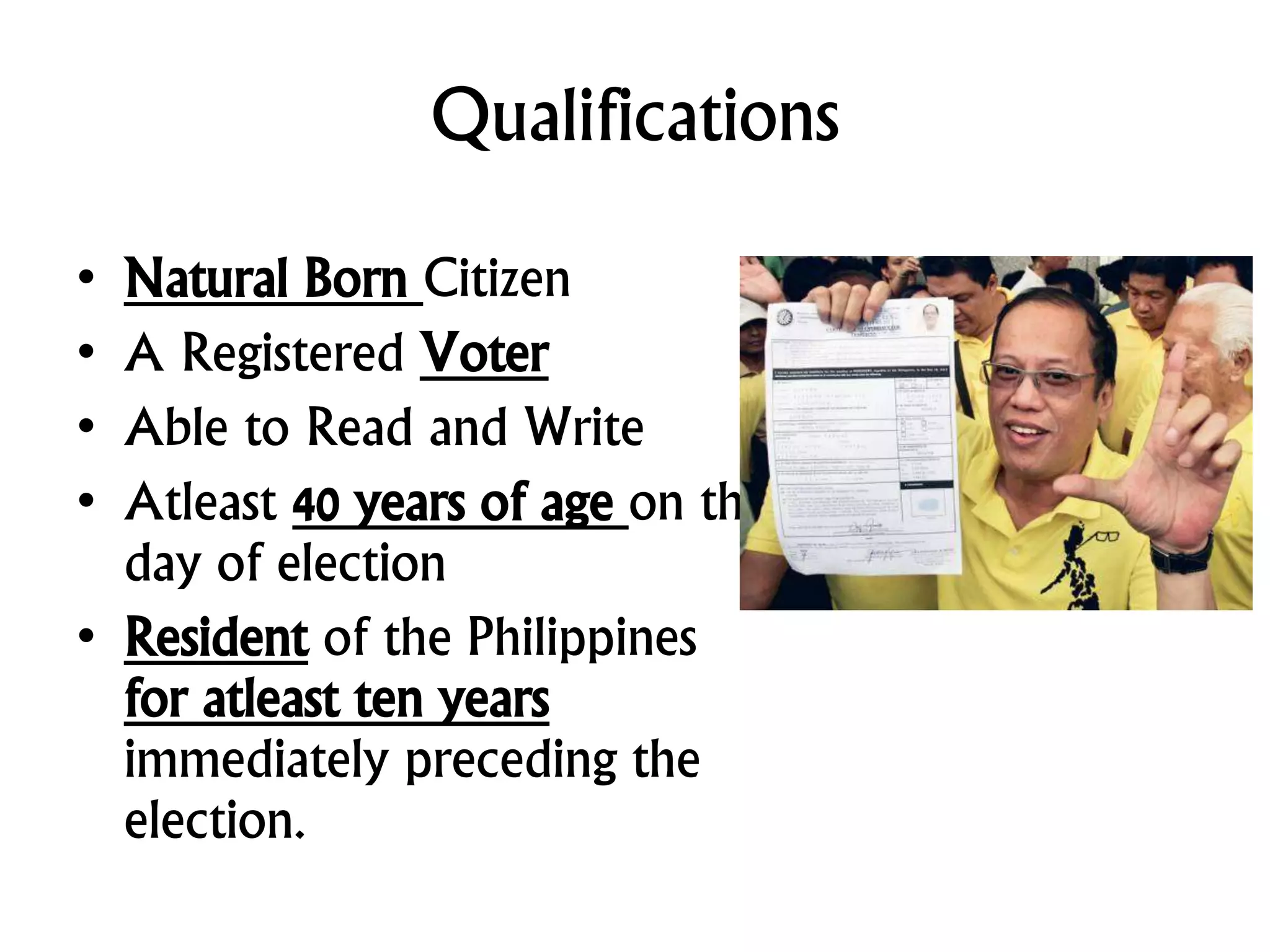
• The executive power is
vested in the President of the
Philippines (Art. VII, Sec. 1)
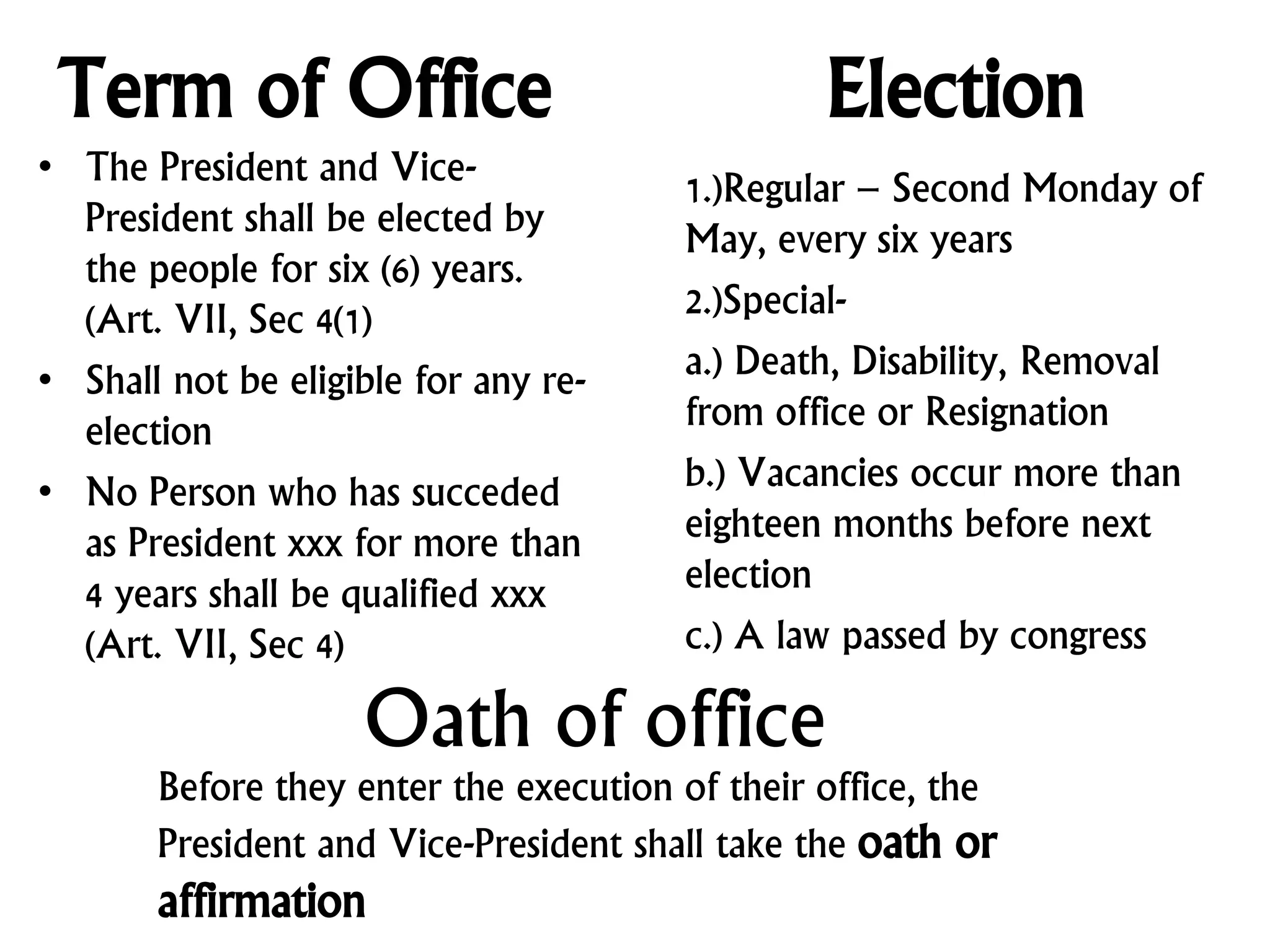
Qualifications
• Natural Born Citizen
• A Registered Voter
• Able to Read and Write
• Atleast 40 years of age on the
day of election
• Resident of the Philippines
for atleast ten years
immediately preceding the
election.
Term of Office
• The President and Vice-
President shall be elected by
the people for six (6) years.
(Art. VII, Sec 4(1)
• Shall not be eligible for any re-
election
• No Person who has succeded
as President xxx for more than
4 years shall be qualified xxx
(Art. VII, Sec 4)
Election
1.)Regular – Second Monday of
May, every six years
2.)Special-
a.) Death, Disability, Removal
from office or Resignation
b.) Vacancies occur more than
eighteen months before next
election
c.) A law passed by congress
Oath of office
Before they enter the execution of their office, the
President and Vice-President shall take the oath or
affirmation
Oath- an outward pledge made under an
immediate sense of responsibility to God(Cruz,
2002)
“I, do solemnly swear that I will faithfully and
conscientiously fulfill my duties as President of
the Philippines, preserve and defend its
Constitution, execute its laws, do justice to every
man, and consecrate myself to the service of the
Nation. So help me God.”
Vice-President
• Qualifications are same
with the President.
• Eligible for the position of
member of the Cabinet(no
need for CA confirmation)
• Allowed to serve for two
successive terms.
Presidential Succession(Sec
7-8)
2 sets of rule:
a.) Occuring before the term
– Death/Permanent Disability
– Failure to elect the President
– Failure to qualify
b.) Occuring mid-term
– Death/Permanent Disability
– Removal
– Resignation
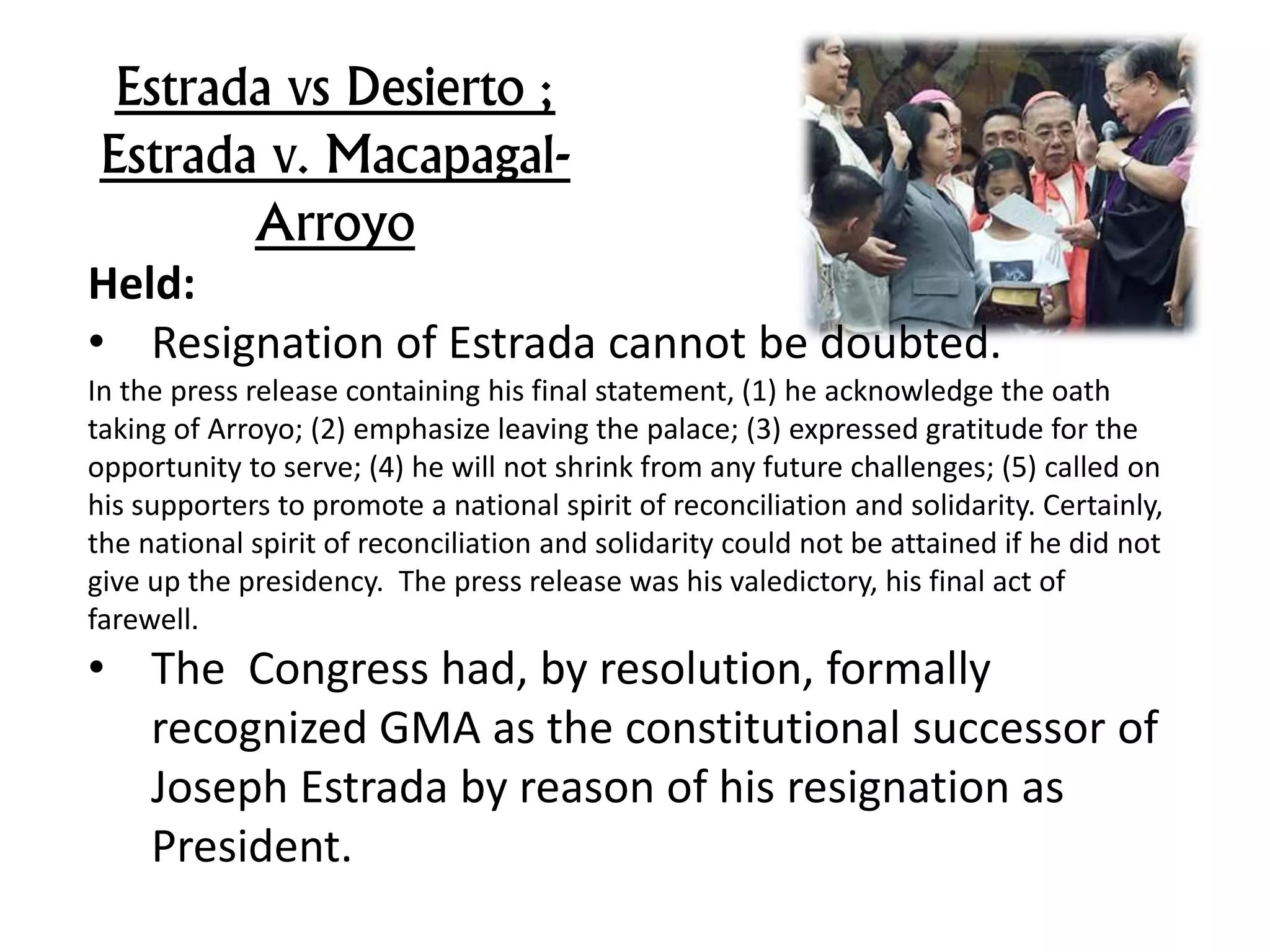
Estrada vs Desierto ;
Estrada v. Macapagal-
Arroyo
Held:
• Resignation of Estrada cannot be doubted.
In the press release containing his final statement, (1) he acknowledge the oath
taking of Arroyo; (2) emphasize leaving the palace; (3) expressed gratitude for the
opportunity to serve; (4) he will not shrink from any future challenges; (5) called on
his supporters to promote a national spirit of reconciliation and solidarity. Certainly,
the national spirit of reconciliation and solidarity could not be attained if he did not
give up the presidency. The press release was his valedictory, his final act of
farewell.
• The Congress had, by resolution, formally
recognized GMA as the constitutional successor of
Joseph Estrada by reason of his resignation as
President.
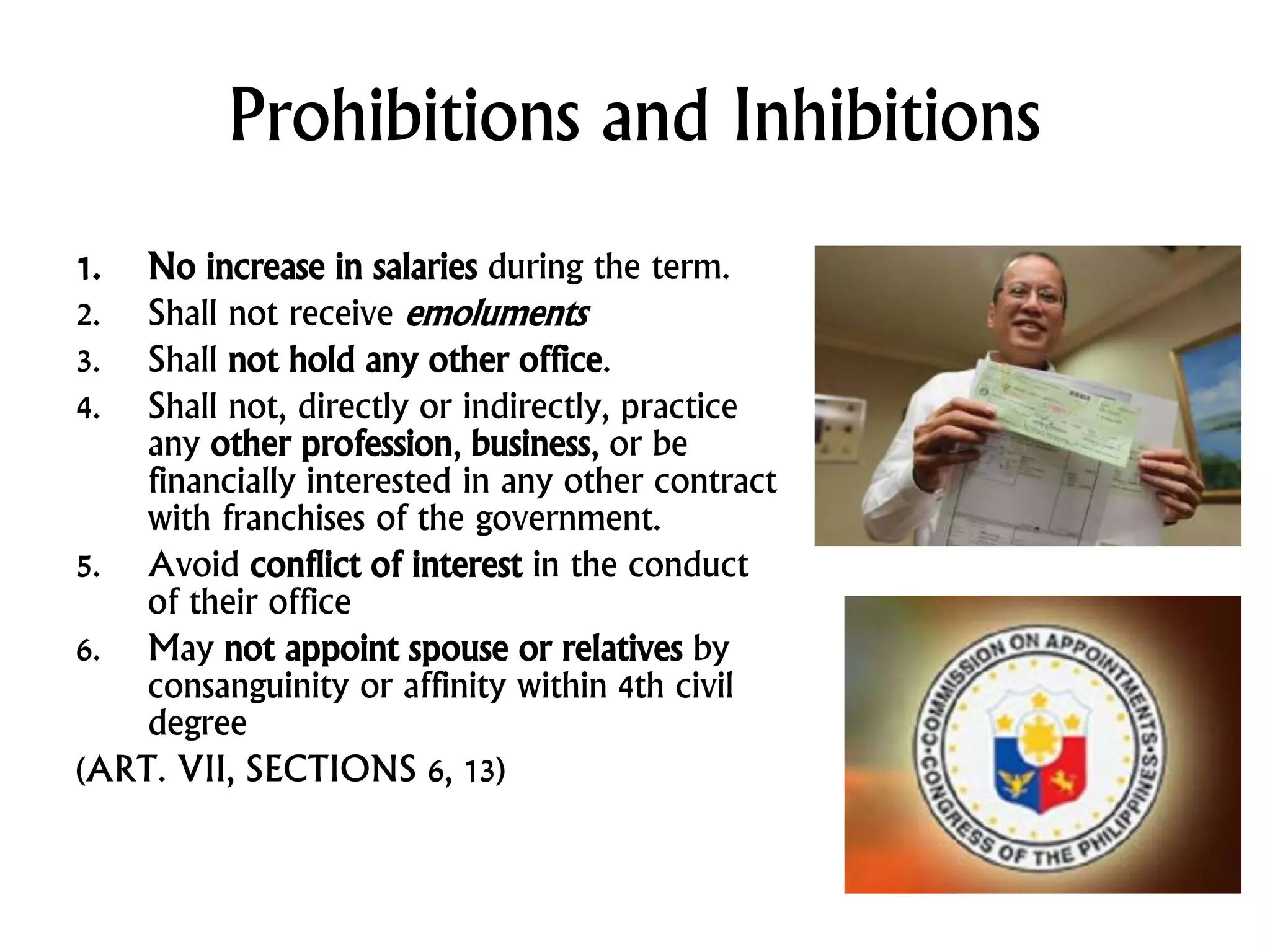
Prohibitions and Inhibitions
1. No increase in salaries during the term.
2. Shall not receive emoluments
3. Shall not hold any other office.
4. Shall not, directly or indirectly, practice
any other profession, business, or be
financially interested in any other contract
with franchises of the government.
5. Avoid conflict of interest in the conduct
of their office
6. May not appoint spouse or relatives by
consanguinity or affinity within 4th civil
degree
(ART. VII, SECTIONS 6, 13)
POWERS OF THE PRESIDENT
1.) Executive Power
2.) Power of
Appointment
3.) Power of Removal
4.) Power of Control
5.) Military Powers
6.) Pardoning Power
7.) Borrowing Power
8.) Diplomatic Power
9.) Budgetary Power
10.)Informing Power
11.)Residual Power
• Other Powers
Executive Power
• President shall have the control of all executive
departments, bureaus, and offices. He shall
ensure that laws are faithfull executed (Art. VII,
Sec.17)
• Until and unless a law is declared
unconstitutional, the President has a duty to
execute it regardless of his doubts as to its
validity(Faithful Execution Clause) (Cruz, Phil. Political Law)
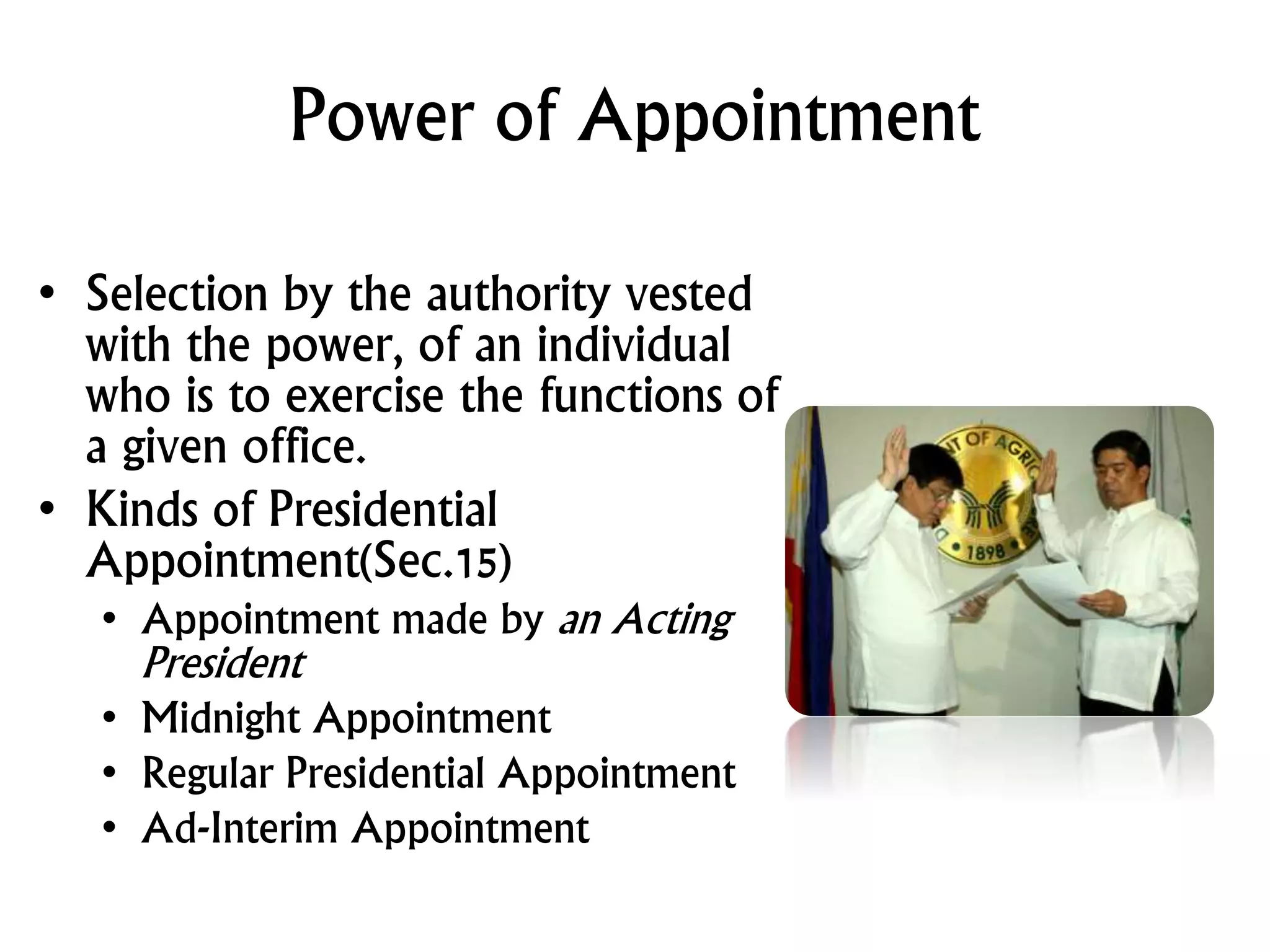
Power of Appointment
• Selection by the authority vested
with the power, of an individual
who is to exercise the functions of
a given office.
• Kinds of Presidential
Appointment(Sec.15)
• Appointment made by an Acting
President
• Midnight Appointment
• Regular Presidential Appointment
• Ad-Interim Appointment
Power of Appointment
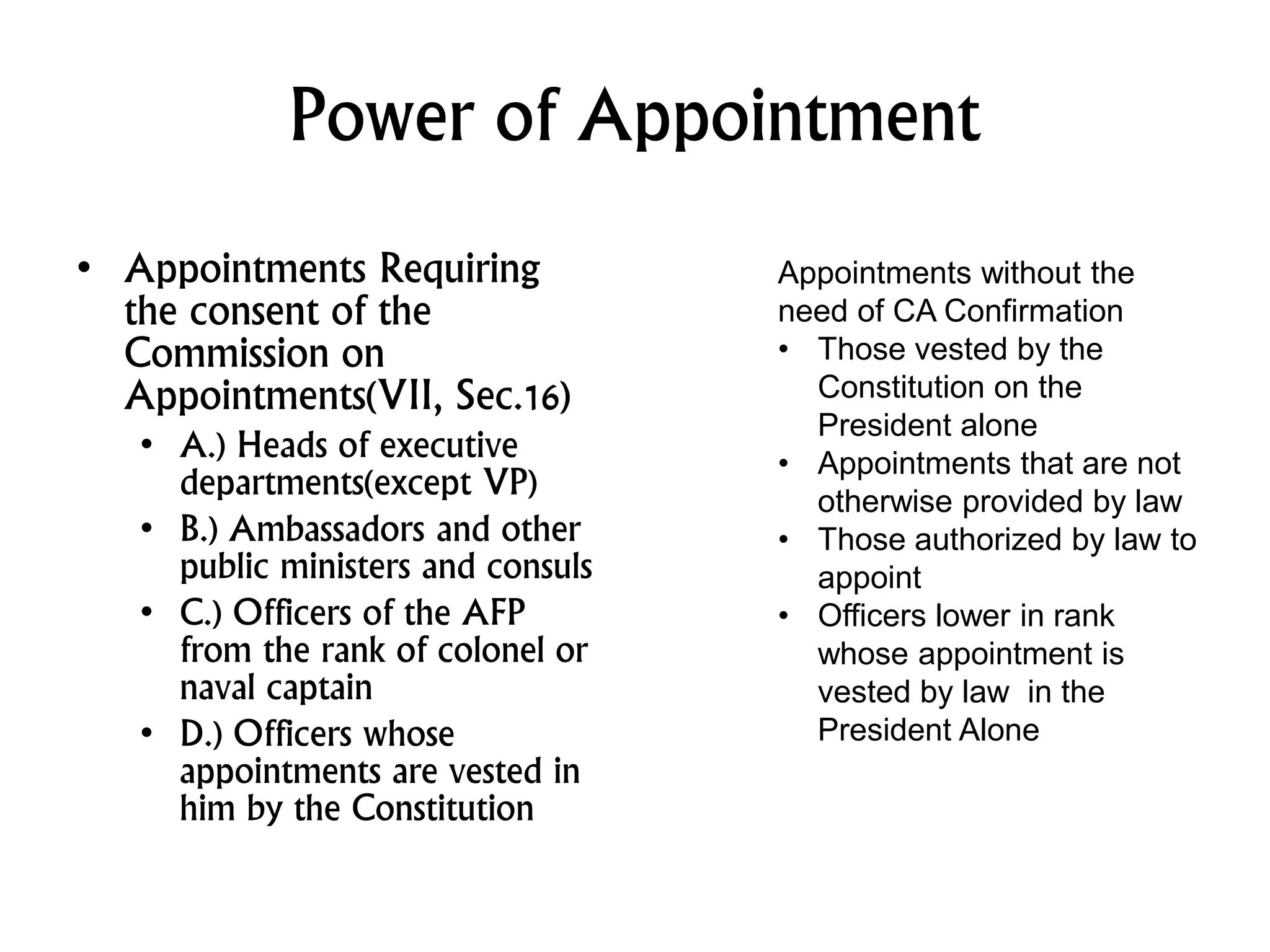
• Appointments Requiring
the consent of the
Commission on
Appointments(VII, Sec.16)
• A.) Heads of executive
departments(except VP)
• B.) Ambassadors and other
public ministers and consuls
• C.) Officers of the AFP
from the rank of colonel or
naval captain
• D.) Officers whose
appointments are vested in
him by the Constitution
Appointments without the
need of CA Confirmation
• Those vested by the
Constitution on the
President alone
• Appointments that are not
otherwise provided by law
• Those authorized by law to
appoint
• Officers lower in rank
whose appointment is
vested by law in the
President Alone
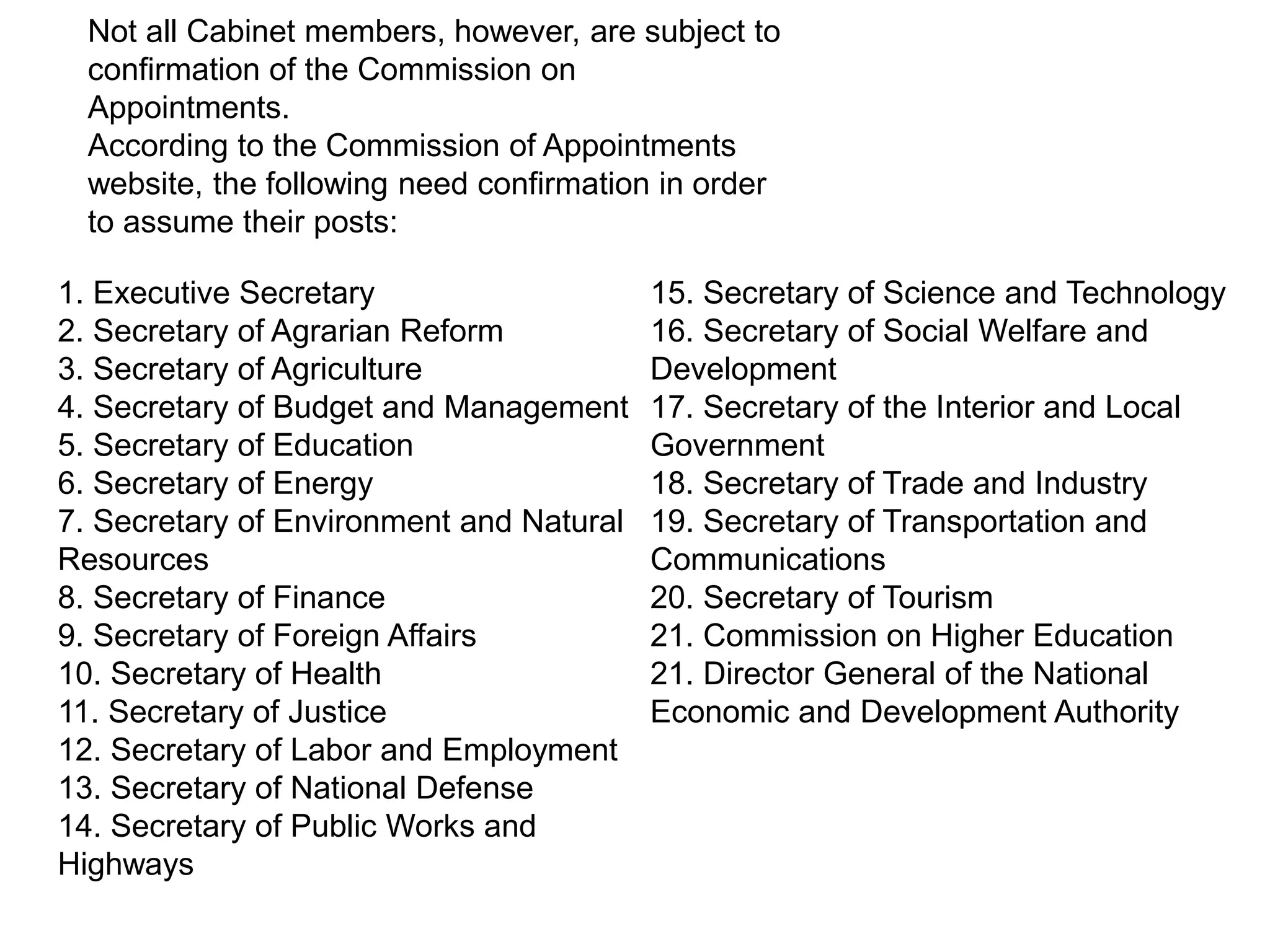
1. Executive Secretary
2. Secretary of Agrarian Reform
3. Secretary of Agriculture
4. Secretary of Budget and Management
5. Secretary of Education
6. Secretary of Energy
7. Secretary of Environment and Natural
Resources
8. Secretary of Finance
9. Secretary of Foreign Affairs
10. Secretary of Health
11. Secretary of Justice
12. Secretary of Labor and Employment
13. Secretary of National Defense
14. Secretary of Public Works and
Highways
15. Secretary of Science and Technology
16. Secretary of Social Welfare and
Development
17. Secretary of the Interior and Local
Government
18. Secretary of Trade and Industry
19. Secretary of Transportation and
Communications
20. Secretary of Tourism
21. Commission on Higher Education
21. Director General of the National
Economic and Development Authority
Not all Cabinet members, however, are subject to
confirmation of the Commission on
Appointments.
According to the Commission of Appointments
website, the following need confirmation in order
to assume their posts:
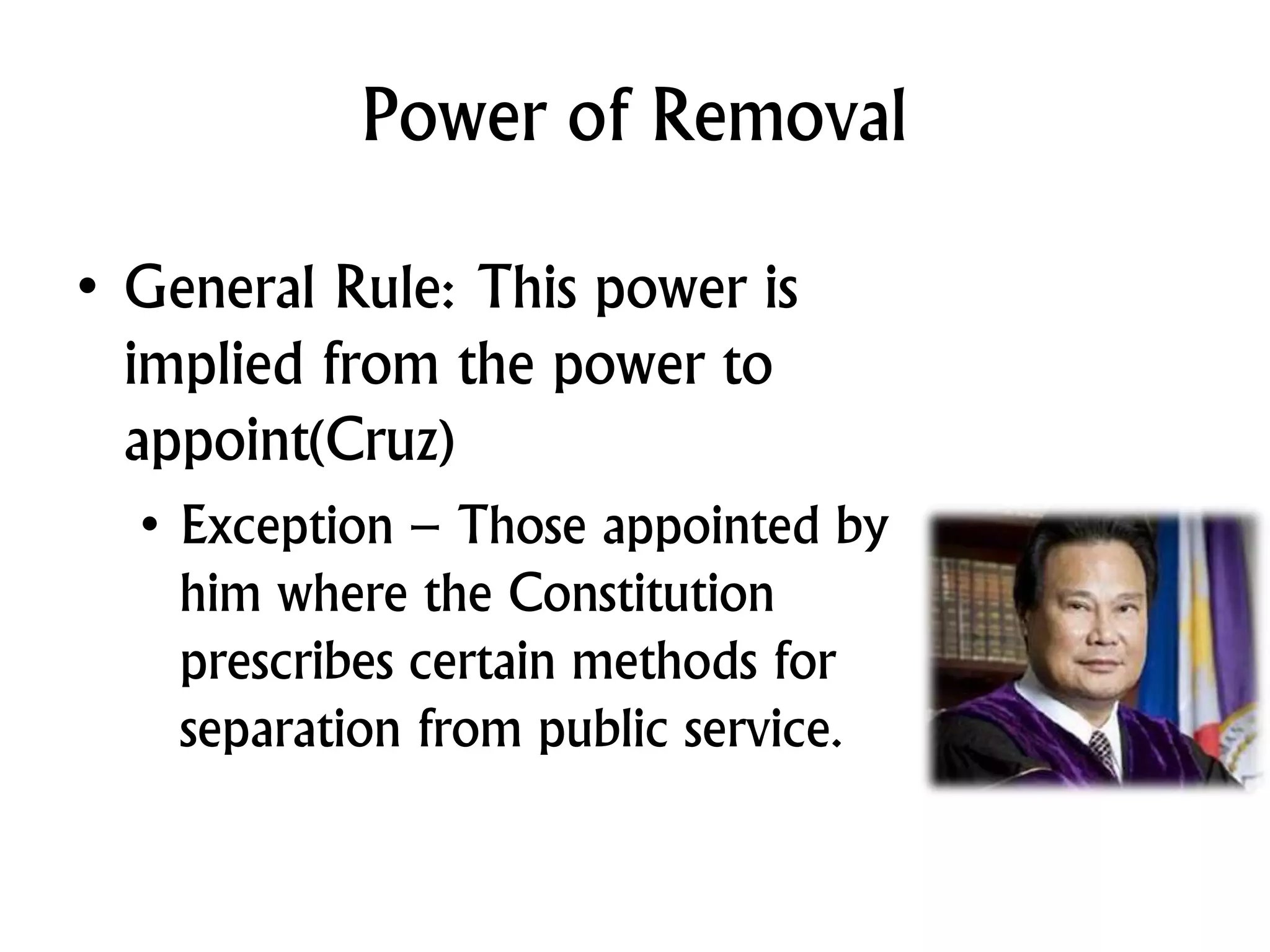
Power of Removal
• General Rule: This power is
implied from the power to
appoint(Cruz)
• Exception – Those appointed by
him where the Constitution
prescribes certain methods for
separation from public service.
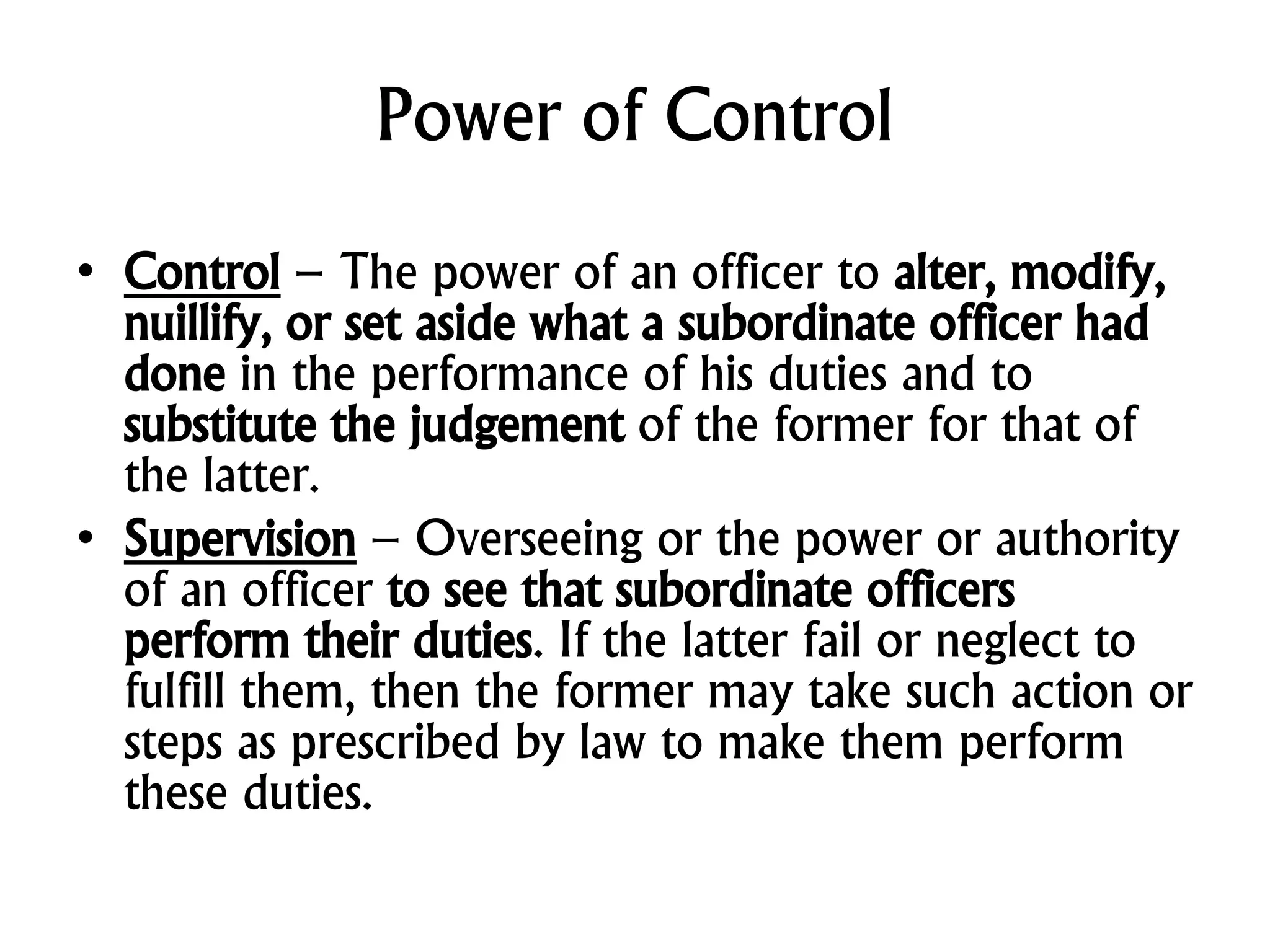
Power of Control
• Control – The power of an officer to alter, modify,
nuillify, or set aside what a subordinate officer had
done in the performance of his duties and to
substitute the judgement of the former for that of
the latter.
• Supervision – Overseeing or the power or authority
of an officer to see that subordinate officers
perform their duties. If the latter fail or neglect to
fulfill them, then the former may take such action or
steps as prescribed by law to make them perform
these duties.
Doctrine of Qualified Political
Agency or Alter Ego Principle
The multifarious executive and
administrative functions of the Chief
Executive are performed by and through
the executive departments. The acts of the
Secretaries of Executive departments xxx in
the regular course of business or unless
dispproved xxx are presumptively the acts
of the Chief Executive.
Military Powers
1.) Commander-in-Chief clause
• To call out the Armed Forces to prevent or
suppress lawless violence, invasion or
rebellion(whenever it becomes neccessary);
• Vested directly by the Constitution
• Authority to declare a state of rebellion
• Military Tribunals are simply instrumentalities of
the executive power provided by the legislature for
the Commander-in-Chief to aid him in enforcing
discipline in the armed forces.
Military Powers
2.) Suspension of writ of Habeas Corpus
– A writ directed to the person detaining another, commanding
him to produce the body of the prisoner at a designated time
and place xxx the object of which is the liberation of those
who may be in prison without sufficient cause.
– Ground for suspension: invasion, rebellion, when public
safety requires it
Effects of suspension of Writ:
• does not affect the right to bail
• Applies only to persons facing charges of rebellion
• The arrested must be charged within 3 days; if not
they must be released
• Does not supersede civilian authority.
Military Powers
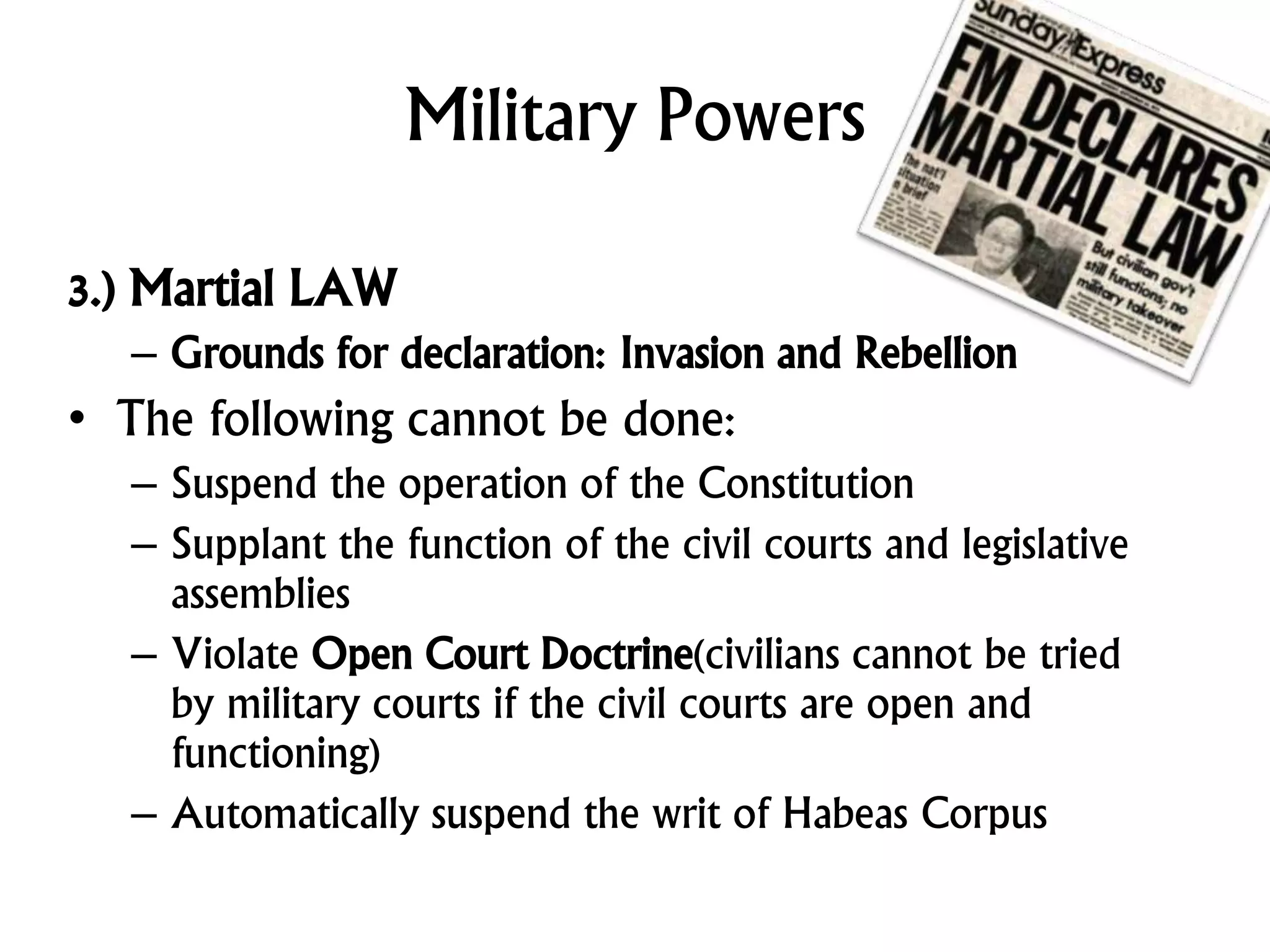
3.) Martial LAW
– Grounds for declaration: Invasion and Rebellion
• The following cannot be done:
– Suspend the operation of the Constitution
– Supplant the function of the civil courts and legislative
assemblies
– Violate Open Court Doctrine(civilians cannot be tried
by military courts if the civil courts are open and
functioning)
– Automatically suspend the writ of Habeas Corpus
Military Powers
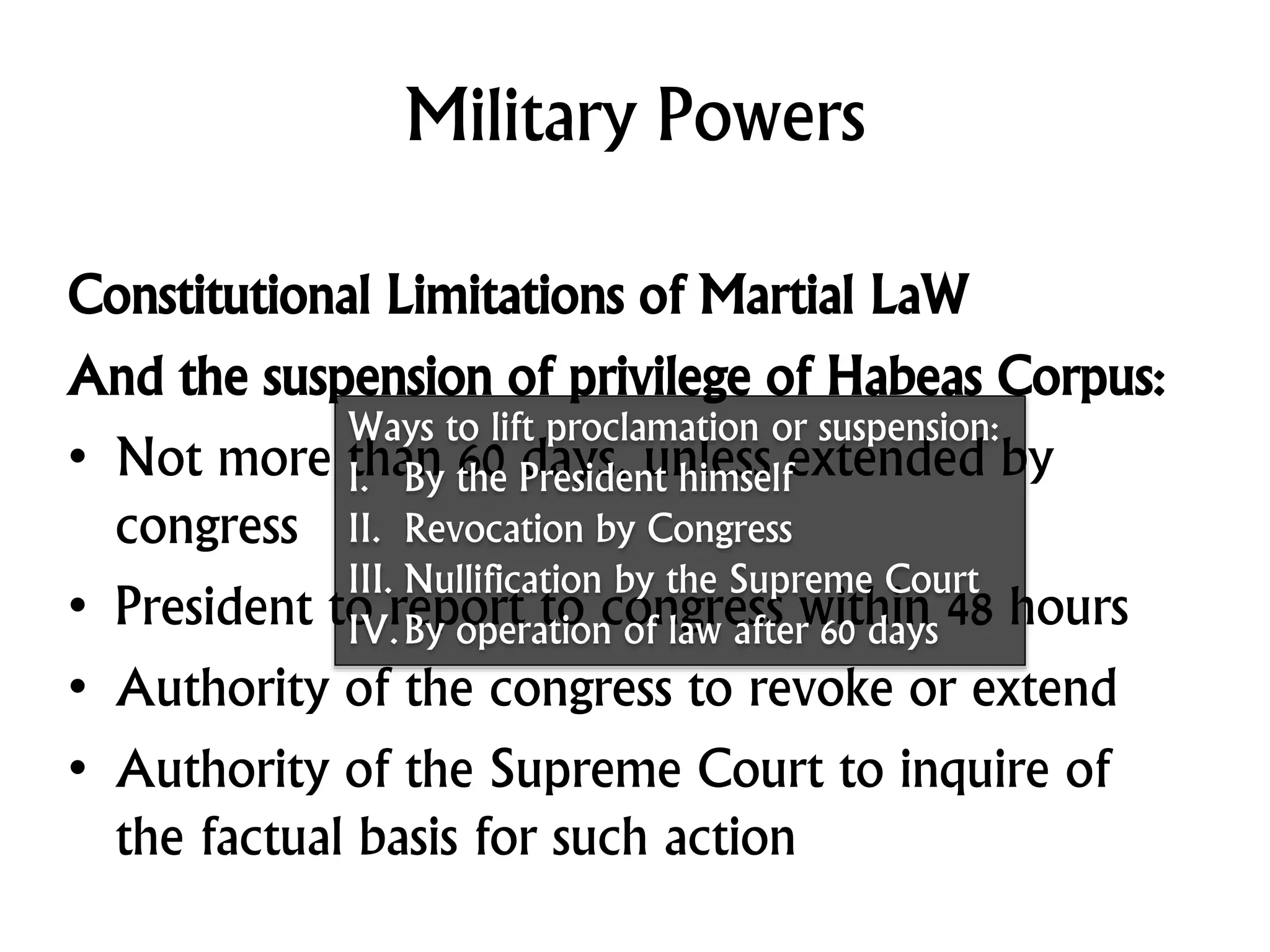
Constitutional Limitations of Martial LaW
And the suspension of privilege of Habeas Corpus:
• Not more than 60 days, unless extended by
congress
• President to report to congress within 48 hours
• Authority of the congress to revoke or extend
• Authority of the Supreme Court to inquire of
the factual basis for such action
Ways to lift proclamation or suspension:
I. By the President himself
II. Revocation by Congress
III. Nullification by the Supreme Court
IV.By operation of law after 60 days
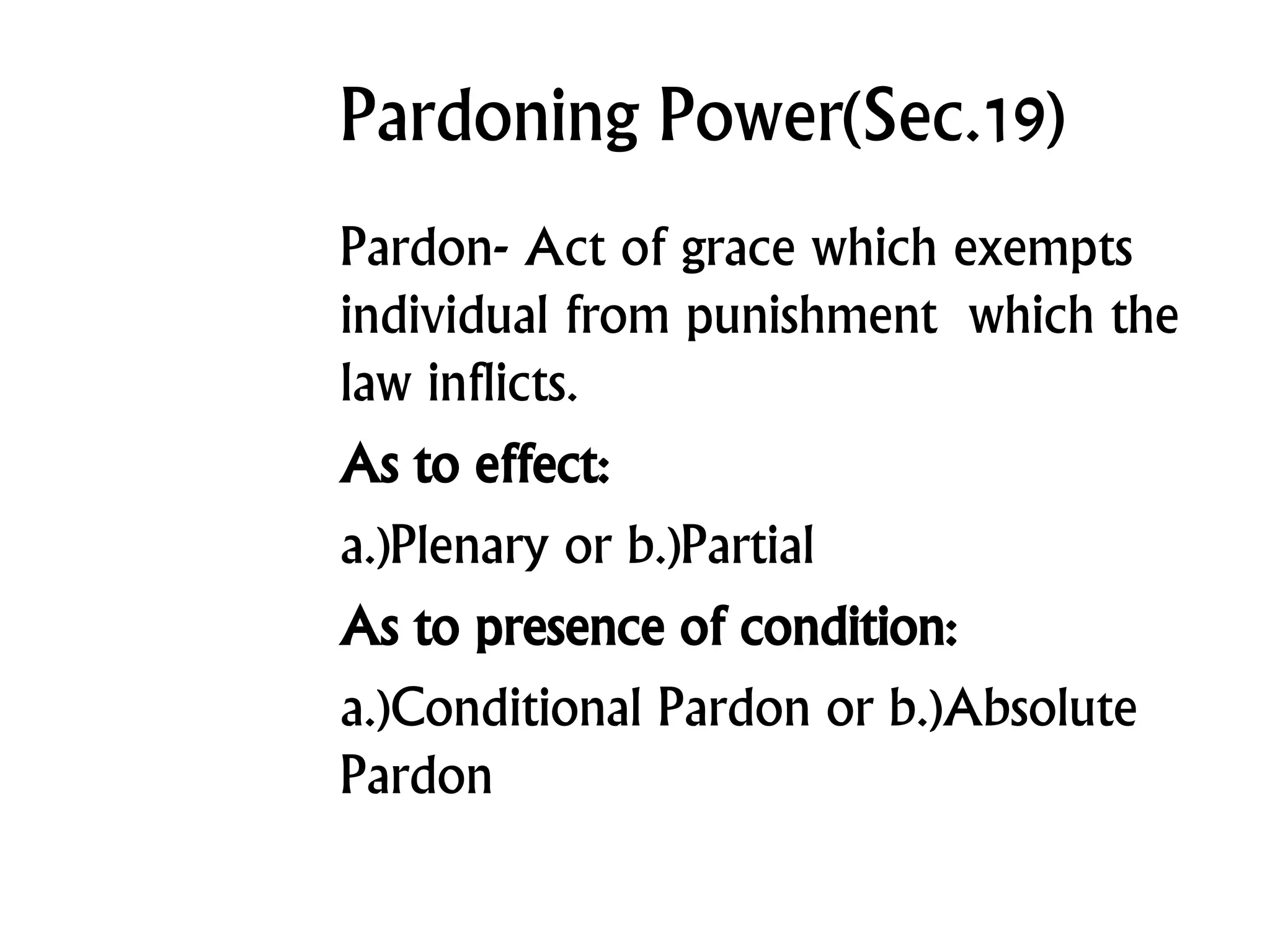
Pardoning Power(Sec.19)
Pardon- Act of grace which exempts
individual from punishment which the
law inflicts.
As to effect:
a.)Plenary or b.)Partial
As to presence of condition:
a.)Conditional Pardon or b.)Absolute
Pardon
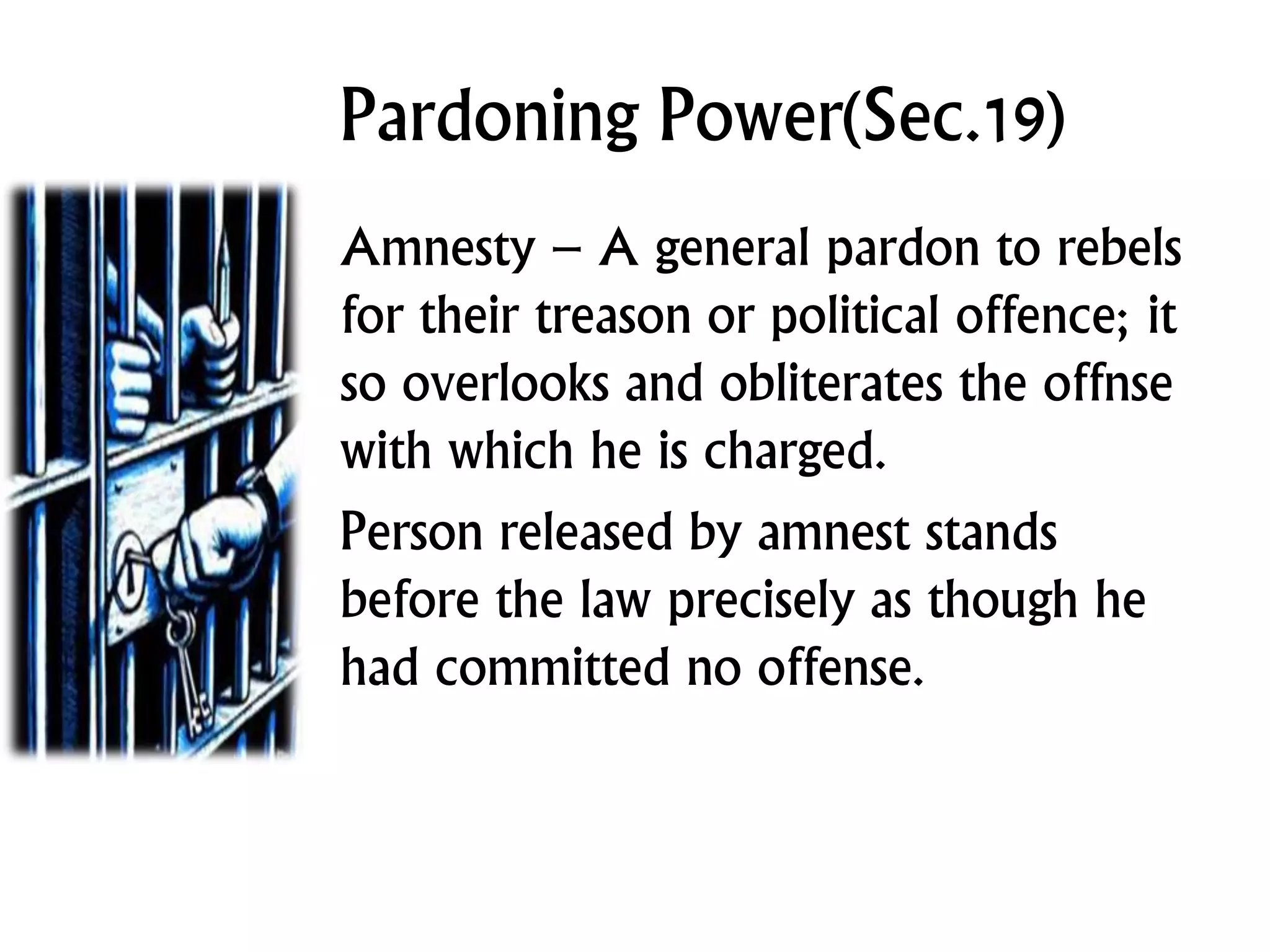
Pardoning Power(Sec.19)
Amnesty – A general pardon to rebels
for their treason or political offence; it
so overlooks and obliterates the offnse
with which he is charged.
Person released by amnest stands
before the law precisely as though he
had committed no offense.
Other forms of executive clemency:
• Commutation – reduction or mitigation of penalty
• Reprieve – postponement of sentence or stay of
execution
• Parole – release from imprisonment, but without full
restoration of liberty(in custody of law although not
in confinement
• Remission of fines and forfeiture – Prevents the
collection of fines and confiscation of forfeited
property; cannot affect rights of third party and
money already in the treasury.
Borrowing Power(Sec. 20)
• The President may contract or
guarantee foreign loans on behalf of the
Republic with the concurrence of the
Monetary Board, subject to such
limitations as may be provided by law.
• The Monetary board shall submit to the
Congress report on loans within 30 days
from the end of every quarter.
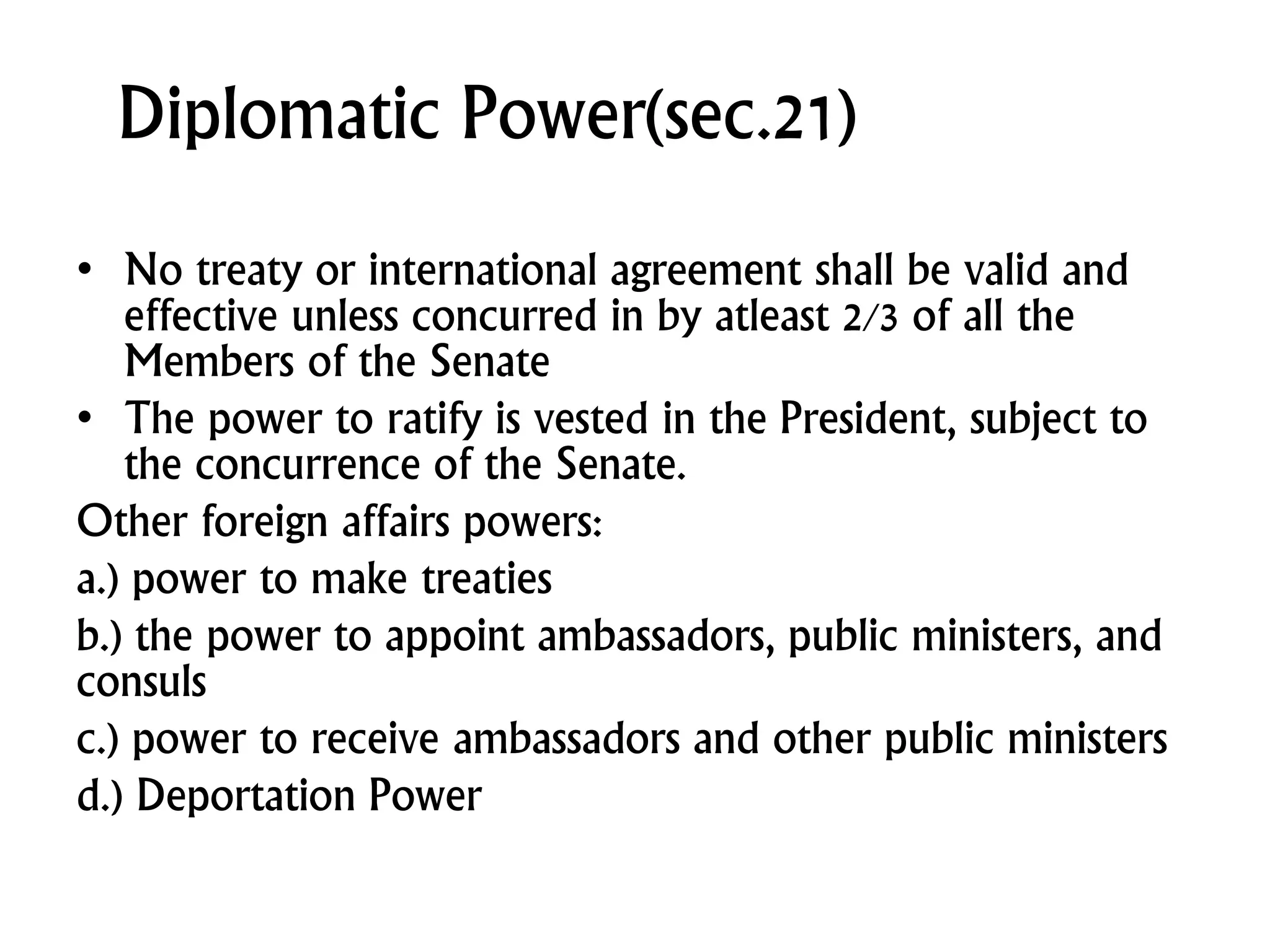
Diplomatic Power(sec.21)
• No treaty or international agreement shall be valid and
effective unless concurred in by atleast 2/3 of all the
Members of the Senate
• The power to ratify is vested in the President, subject to
the concurrence of the Senate.
Other foreign affairs powers:
a.) power to make treaties
b.) the power to appoint ambassadors, public ministers, and
consuls
c.) power to receive ambassadors and other public ministers
d.) Deportation Power
Budgetary Power
• Within 30 days from the opening of every regular
session, President shall submit to Congress a
budget or expenditures and sources of financing,
including receipts from existing and proposed
revenue measure.
• Congress may not increase the appropriation
recommended by the President for the operation
of the Government as specified in the budget.
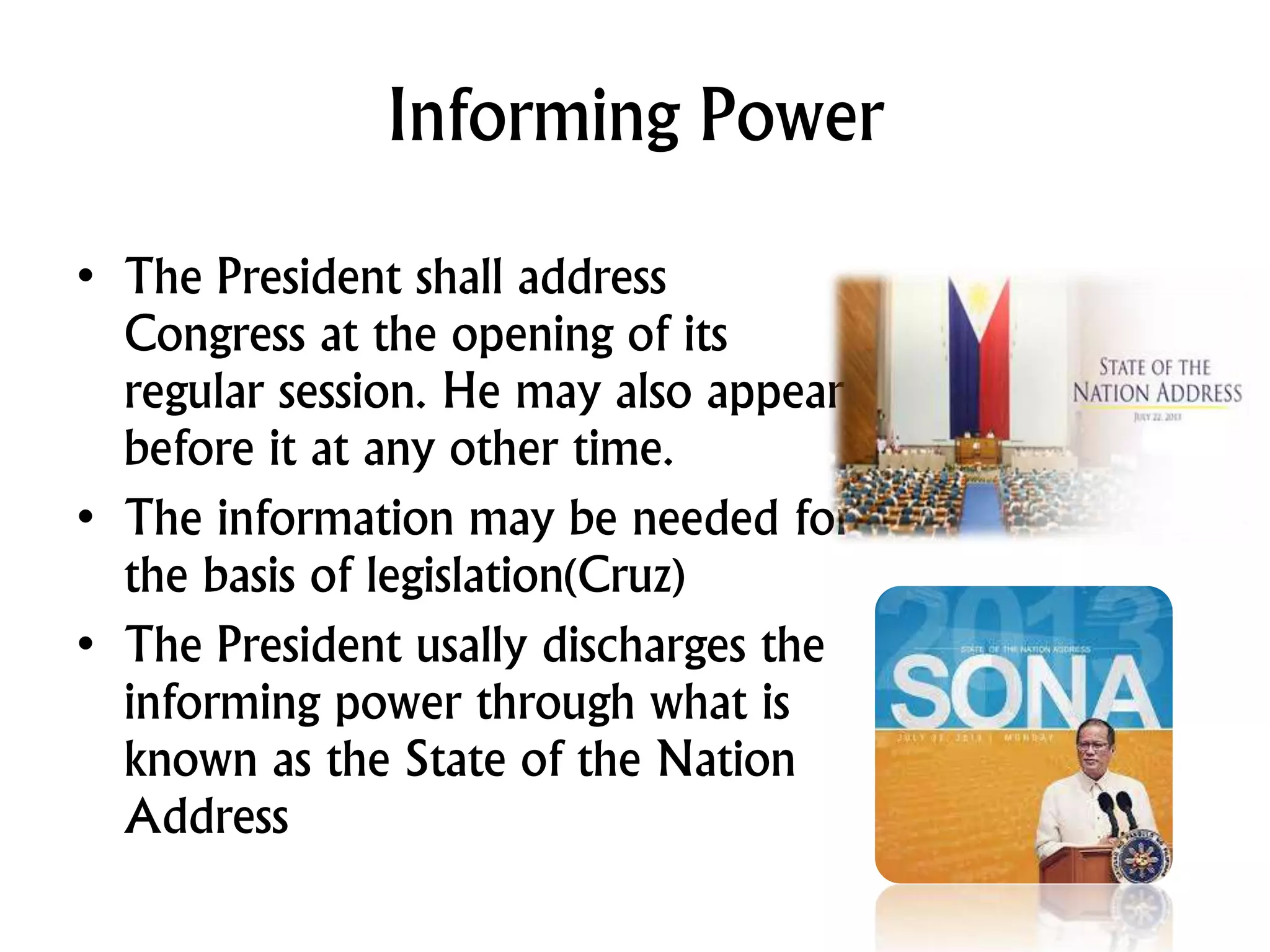
Informing Power
• The President shall address
Congress at the opening of its
regular session. He may also appear
before it at any other time.
• The information may be needed for
the basis of legislation(Cruz)
• The President usally discharges the
informing power through what is
known as the State of the Nation
Address
Marcos v. Maglapus
Held:
The powers of the President cannot be said to
be limited only to the specific powers enumerated in
the Constitution. Executive power is more than the
sum of specific powers so enumerated.
Residual unstated powers of the President are
implicit in and correlative to the paramount duty
residing in that office to safeguard and protect
general welfare.
The President xxx has unstated residual power
xx which are necessary for her to comply with her
duties.
Residual Power
Other Powers
a.) Call to Congress to a special session
b.) Approve or veto bills
c.) Deport Aliens
d.) Consent to deputization of government
personnel by COMELEC and discipline them
e.) Exercise emergency(war, law, limited, necessary)
and Tariff powers
f.) Power to classify or reclassify lands

ARTICLE 7. EXECUTIVE DEPARTMENTt

  • 1.
    The Executive Department andPowers of the President Constitutional Law 1
  • 2.
    EXECUTIVE POWER! • Itis the power to enforce and administer the laws (Cooley, Constitutional Limitation, 8th ed., p. 183) • The executive power is vested in the President of the Philippines (Art. VII, Sec. 1)
  • 3.
    Qualifications • Natural BornCitizen • A Registered Voter • Able to Read and Write • Atleast 40 years of age on the day of election • Resident of the Philippines for atleast ten years immediately preceding the election.
  • 4.
    Term of Office •The President and Vice- President shall be elected by the people for six (6) years. (Art. VII, Sec 4(1) • Shall not be eligible for any re- election • No Person who has succeded as President xxx for more than 4 years shall be qualified xxx (Art. VII, Sec 4) Election 1.)Regular – Second Monday of May, every six years 2.)Special- a.) Death, Disability, Removal from office or Resignation b.) Vacancies occur more than eighteen months before next election c.) A law passed by congress Oath of office Before they enter the execution of their office, the President and Vice-President shall take the oath or affirmation
  • 5.
    Oath- an outwardpledge made under an immediate sense of responsibility to God(Cruz, 2002) “I, do solemnly swear that I will faithfully and conscientiously fulfill my duties as President of the Philippines, preserve and defend its Constitution, execute its laws, do justice to every man, and consecrate myself to the service of the Nation. So help me God.”
  • 6.
    Vice-President • Qualifications aresame with the President. • Eligible for the position of member of the Cabinet(no need for CA confirmation) • Allowed to serve for two successive terms.
  • 7.
    Presidential Succession(Sec 7-8) 2 setsof rule: a.) Occuring before the term – Death/Permanent Disability – Failure to elect the President – Failure to qualify b.) Occuring mid-term – Death/Permanent Disability – Removal – Resignation
  • 8.
    Estrada vs Desierto; Estrada v. Macapagal- Arroyo Held: • Resignation of Estrada cannot be doubted. In the press release containing his final statement, (1) he acknowledge the oath taking of Arroyo; (2) emphasize leaving the palace; (3) expressed gratitude for the opportunity to serve; (4) he will not shrink from any future challenges; (5) called on his supporters to promote a national spirit of reconciliation and solidarity. Certainly, the national spirit of reconciliation and solidarity could not be attained if he did not give up the presidency. The press release was his valedictory, his final act of farewell. • The Congress had, by resolution, formally recognized GMA as the constitutional successor of Joseph Estrada by reason of his resignation as President.
  • 9.
    Prohibitions and Inhibitions 1.No increase in salaries during the term. 2. Shall not receive emoluments 3. Shall not hold any other office. 4. Shall not, directly or indirectly, practice any other profession, business, or be financially interested in any other contract with franchises of the government. 5. Avoid conflict of interest in the conduct of their office 6. May not appoint spouse or relatives by consanguinity or affinity within 4th civil degree (ART. VII, SECTIONS 6, 13)
  • 10.
    POWERS OF THEPRESIDENT 1.) Executive Power 2.) Power of Appointment 3.) Power of Removal 4.) Power of Control 5.) Military Powers 6.) Pardoning Power 7.) Borrowing Power 8.) Diplomatic Power 9.) Budgetary Power 10.)Informing Power 11.)Residual Power • Other Powers
  • 11.
    Executive Power • Presidentshall have the control of all executive departments, bureaus, and offices. He shall ensure that laws are faithfull executed (Art. VII, Sec.17) • Until and unless a law is declared unconstitutional, the President has a duty to execute it regardless of his doubts as to its validity(Faithful Execution Clause) (Cruz, Phil. Political Law)
  • 12.
    Power of Appointment •Selection by the authority vested with the power, of an individual who is to exercise the functions of a given office. • Kinds of Presidential Appointment(Sec.15) • Appointment made by an Acting President • Midnight Appointment • Regular Presidential Appointment • Ad-Interim Appointment
  • 13.
    Power of Appointment •Appointments Requiring the consent of the Commission on Appointments(VII, Sec.16) • A.) Heads of executive departments(except VP) • B.) Ambassadors and other public ministers and consuls • C.) Officers of the AFP from the rank of colonel or naval captain • D.) Officers whose appointments are vested in him by the Constitution Appointments without the need of CA Confirmation • Those vested by the Constitution on the President alone • Appointments that are not otherwise provided by law • Those authorized by law to appoint • Officers lower in rank whose appointment is vested by law in the President Alone
  • 14.
    1. Executive Secretary 2.Secretary of Agrarian Reform 3. Secretary of Agriculture 4. Secretary of Budget and Management 5. Secretary of Education 6. Secretary of Energy 7. Secretary of Environment and Natural Resources 8. Secretary of Finance 9. Secretary of Foreign Affairs 10. Secretary of Health 11. Secretary of Justice 12. Secretary of Labor and Employment 13. Secretary of National Defense 14. Secretary of Public Works and Highways 15. Secretary of Science and Technology 16. Secretary of Social Welfare and Development 17. Secretary of the Interior and Local Government 18. Secretary of Trade and Industry 19. Secretary of Transportation and Communications 20. Secretary of Tourism 21. Commission on Higher Education 21. Director General of the National Economic and Development Authority Not all Cabinet members, however, are subject to confirmation of the Commission on Appointments. According to the Commission of Appointments website, the following need confirmation in order to assume their posts:
  • 15.
    Power of Removal •General Rule: This power is implied from the power to appoint(Cruz) • Exception – Those appointed by him where the Constitution prescribes certain methods for separation from public service.
  • 16.
    Power of Control •Control – The power of an officer to alter, modify, nuillify, or set aside what a subordinate officer had done in the performance of his duties and to substitute the judgement of the former for that of the latter. • Supervision – Overseeing or the power or authority of an officer to see that subordinate officers perform their duties. If the latter fail or neglect to fulfill them, then the former may take such action or steps as prescribed by law to make them perform these duties.
  • 17.
    Doctrine of QualifiedPolitical Agency or Alter Ego Principle The multifarious executive and administrative functions of the Chief Executive are performed by and through the executive departments. The acts of the Secretaries of Executive departments xxx in the regular course of business or unless dispproved xxx are presumptively the acts of the Chief Executive.
  • 18.
    Military Powers 1.) Commander-in-Chiefclause • To call out the Armed Forces to prevent or suppress lawless violence, invasion or rebellion(whenever it becomes neccessary); • Vested directly by the Constitution • Authority to declare a state of rebellion • Military Tribunals are simply instrumentalities of the executive power provided by the legislature for the Commander-in-Chief to aid him in enforcing discipline in the armed forces.
  • 19.
    Military Powers 2.) Suspensionof writ of Habeas Corpus – A writ directed to the person detaining another, commanding him to produce the body of the prisoner at a designated time and place xxx the object of which is the liberation of those who may be in prison without sufficient cause. – Ground for suspension: invasion, rebellion, when public safety requires it Effects of suspension of Writ: • does not affect the right to bail • Applies only to persons facing charges of rebellion • The arrested must be charged within 3 days; if not they must be released • Does not supersede civilian authority.
  • 20.
    Military Powers 3.) MartialLAW – Grounds for declaration: Invasion and Rebellion • The following cannot be done: – Suspend the operation of the Constitution – Supplant the function of the civil courts and legislative assemblies – Violate Open Court Doctrine(civilians cannot be tried by military courts if the civil courts are open and functioning) – Automatically suspend the writ of Habeas Corpus
  • 21.
    Military Powers Constitutional Limitationsof Martial LaW And the suspension of privilege of Habeas Corpus: • Not more than 60 days, unless extended by congress • President to report to congress within 48 hours • Authority of the congress to revoke or extend • Authority of the Supreme Court to inquire of the factual basis for such action Ways to lift proclamation or suspension: I. By the President himself II. Revocation by Congress III. Nullification by the Supreme Court IV.By operation of law after 60 days
  • 22.
    Pardoning Power(Sec.19) Pardon- Actof grace which exempts individual from punishment which the law inflicts. As to effect: a.)Plenary or b.)Partial As to presence of condition: a.)Conditional Pardon or b.)Absolute Pardon
  • 23.
    Pardoning Power(Sec.19) Amnesty –A general pardon to rebels for their treason or political offence; it so overlooks and obliterates the offnse with which he is charged. Person released by amnest stands before the law precisely as though he had committed no offense.
  • 24.
    Other forms ofexecutive clemency: • Commutation – reduction or mitigation of penalty • Reprieve – postponement of sentence or stay of execution • Parole – release from imprisonment, but without full restoration of liberty(in custody of law although not in confinement • Remission of fines and forfeiture – Prevents the collection of fines and confiscation of forfeited property; cannot affect rights of third party and money already in the treasury.
  • 25.
    Borrowing Power(Sec. 20) •The President may contract or guarantee foreign loans on behalf of the Republic with the concurrence of the Monetary Board, subject to such limitations as may be provided by law. • The Monetary board shall submit to the Congress report on loans within 30 days from the end of every quarter.
  • 26.
    Diplomatic Power(sec.21) • Notreaty or international agreement shall be valid and effective unless concurred in by atleast 2/3 of all the Members of the Senate • The power to ratify is vested in the President, subject to the concurrence of the Senate. Other foreign affairs powers: a.) power to make treaties b.) the power to appoint ambassadors, public ministers, and consuls c.) power to receive ambassadors and other public ministers d.) Deportation Power
  • 27.
    Budgetary Power • Within30 days from the opening of every regular session, President shall submit to Congress a budget or expenditures and sources of financing, including receipts from existing and proposed revenue measure. • Congress may not increase the appropriation recommended by the President for the operation of the Government as specified in the budget.
  • 28.
    Informing Power • ThePresident shall address Congress at the opening of its regular session. He may also appear before it at any other time. • The information may be needed for the basis of legislation(Cruz) • The President usally discharges the informing power through what is known as the State of the Nation Address
  • 29.
    Marcos v. Maglapus Held: Thepowers of the President cannot be said to be limited only to the specific powers enumerated in the Constitution. Executive power is more than the sum of specific powers so enumerated. Residual unstated powers of the President are implicit in and correlative to the paramount duty residing in that office to safeguard and protect general welfare. The President xxx has unstated residual power xx which are necessary for her to comply with her duties. Residual Power
  • 30.
    Other Powers a.) Callto Congress to a special session b.) Approve or veto bills c.) Deport Aliens d.) Consent to deputization of government personnel by COMELEC and discipline them e.) Exercise emergency(war, law, limited, necessary) and Tariff powers f.) Power to classify or reclassify lands