Good Documentation Practice
Objective
• To lay down a Corporate Standard Operating Procedure (CSOP) for Good
Documentation Practice
Scope
• The scope of this Corporate Standard Operating Procedure (CSOP) is to
provide the procedure for Good Documentation Practice(GDP) for recording of
data in various documents like Batch Manufacturing Record (BMR), Batch
Packaging Record (BPR), Standard Operating Procedure (SOP), Protocols and
Reports Analytical Procedure, Certificate of Analysis, Stability Documents,
Calibration Documents, Log book, Format and training documentation.
Responsibility
• Doer & reviewer
All person involved in cGMP activity to follow this CSOP
To ensure online documentation & timely review of completed documents
• Unit Head/ Department Head
To ensure GDP are followed & ensure data reliability
• Location QA Head
To ensure training to all concerned
There are three type of documents used in
pharmaceutical industries
1. Commitment Documents- Represent corporate goals, expectations,
standards, commitments and agreements.
2. Directive Documents- Provide directions. Ensure that the commitments
are fulfilled during routine operation
3. Data Collection Documents- Provide evidence to demonstrate that
directive documents have been followed. These are written to facilitate the
collection of raw data.
• Data- Information derived or obtained from raw data
• Raw data- Raw data is traceable information in the form of result output,
equipment print outs, spectra, chromatograms etc.
Raw data must be contemporaneously & accurately recorded by
permanent means.
• Record- collection of raw data in a structured format, work sheet, BMR/BPR,
OOS reports, OOT reports, stability study report COA etc.
• Report- document that provide conclusive information drawn from raw data
and corresponding record such as certificate of analysis, validation report,
investigation report etc.
• Meta data- describes the attributes of other data, and provide cntext and
meaning. Meta data form an integral part of original record. Without meta
data, the data has no meaning.
Procedure
• Recording of data must be done on real time basis.
• Data entries should be traceable to the person who made the entry.
• Attachments shall be identified with number of mother documents.
• All involved personnel shall be retained for handling and usage of documents.
• In case of manual recording, all personnel shall avoid errors and/or mistakes
during data entry.
Procedure for left over spaces.
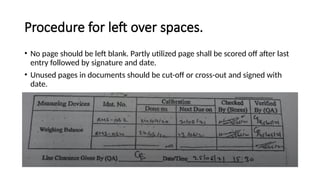
• No page should be left blank. Partly utilized page shall be scored off after last
entry followed by signature and date.
• Unused pages in documents should be cut-off or cross-out and signed with
date.
Steps taken if an entire line/paragraph/page is
to be deleted from a sequential record
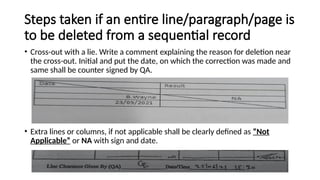
• Cross-out with a lie. Write a comment explaining the reason for deletion near
the cross-out. Initial and put the date, on which the correction was made and
same shall be counter signed by QA.
• Extra lines or columns, if not applicable shall be clearly defined as “Not
Applicable” or NA with sign and date.
Do’s
• Enter detailed, completed and accurate information at the time of work.
• Put signature or initials with date on real time basis.
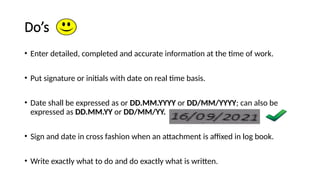
• Date shall be expressed as or DD.MM.YYYY or DD/MM/YYYY; can also be
expressed as DD.MM.YY or DD/MM/YY.
• Sign and date in cross fashion when an attachment is affixed in log book.
• Write exactly what to do and do exactly what is written.
Don’ts
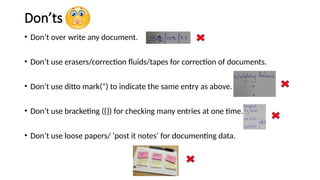
• Don’t over write any document.
• Don’t use erasers/correction fluids/tapes for correction of documents.
• Don’t use ditto mark(“) to indicate the same entry as above.
• Don’t use bracketing ({}) for checking many entries at one time.
• Don’t use loose papers/ ‘post it notes’ for documenting data.
Abbrevation(s)
• BMR : Batch Manufacturing Record
• BPR : Batch Packing Record
• NA : Not applicable
• No : Number
• ALCOA : attributable legible contemporaneous original accurate
• COA : Certificate of Analysis
Good Documentation Practice gdp and glp .pptx

Good Documentation Practice gdp and glp .pptx

  • 1.
  • 2.
    Objective • To laydown a Corporate Standard Operating Procedure (CSOP) for Good Documentation Practice
  • 3.
    Scope • The scopeof this Corporate Standard Operating Procedure (CSOP) is to provide the procedure for Good Documentation Practice(GDP) for recording of data in various documents like Batch Manufacturing Record (BMR), Batch Packaging Record (BPR), Standard Operating Procedure (SOP), Protocols and Reports Analytical Procedure, Certificate of Analysis, Stability Documents, Calibration Documents, Log book, Format and training documentation.
  • 4.
    Responsibility • Doer &reviewer All person involved in cGMP activity to follow this CSOP To ensure online documentation & timely review of completed documents • Unit Head/ Department Head To ensure GDP are followed & ensure data reliability • Location QA Head To ensure training to all concerned
  • 5.
    There are threetype of documents used in pharmaceutical industries 1. Commitment Documents- Represent corporate goals, expectations, standards, commitments and agreements. 2. Directive Documents- Provide directions. Ensure that the commitments are fulfilled during routine operation 3. Data Collection Documents- Provide evidence to demonstrate that directive documents have been followed. These are written to facilitate the collection of raw data.
  • 6.
    • Data- Informationderived or obtained from raw data • Raw data- Raw data is traceable information in the form of result output, equipment print outs, spectra, chromatograms etc. Raw data must be contemporaneously & accurately recorded by permanent means. • Record- collection of raw data in a structured format, work sheet, BMR/BPR, OOS reports, OOT reports, stability study report COA etc. • Report- document that provide conclusive information drawn from raw data and corresponding record such as certificate of analysis, validation report, investigation report etc. • Meta data- describes the attributes of other data, and provide cntext and meaning. Meta data form an integral part of original record. Without meta data, the data has no meaning.
  • 7.
    Procedure • Recording ofdata must be done on real time basis. • Data entries should be traceable to the person who made the entry. • Attachments shall be identified with number of mother documents. • All involved personnel shall be retained for handling and usage of documents. • In case of manual recording, all personnel shall avoid errors and/or mistakes during data entry.
  • 8.
    Procedure for leftover spaces. • No page should be left blank. Partly utilized page shall be scored off after last entry followed by signature and date. • Unused pages in documents should be cut-off or cross-out and signed with date.
  • 9.
    Steps taken ifan entire line/paragraph/page is to be deleted from a sequential record • Cross-out with a lie. Write a comment explaining the reason for deletion near the cross-out. Initial and put the date, on which the correction was made and same shall be counter signed by QA. • Extra lines or columns, if not applicable shall be clearly defined as “Not Applicable” or NA with sign and date.
  • 10.
    Do’s • Enter detailed,completed and accurate information at the time of work. • Put signature or initials with date on real time basis. • Date shall be expressed as or DD.MM.YYYY or DD/MM/YYYY; can also be expressed as DD.MM.YY or DD/MM/YY. • Sign and date in cross fashion when an attachment is affixed in log book. • Write exactly what to do and do exactly what is written.
  • 11.
    Don’ts • Don’t overwrite any document. • Don’t use erasers/correction fluids/tapes for correction of documents. • Don’t use ditto mark(“) to indicate the same entry as above. • Don’t use bracketing ({}) for checking many entries at one time. • Don’t use loose papers/ ‘post it notes’ for documenting data.
  • 12.
    Abbrevation(s) • BMR :Batch Manufacturing Record • BPR : Batch Packing Record • NA : Not applicable • No : Number • ALCOA : attributable legible contemporaneous original accurate • COA : Certificate of Analysis