SO, you wanna be great?
Golden Apple
EIU Summer Institute
June 27, 2013
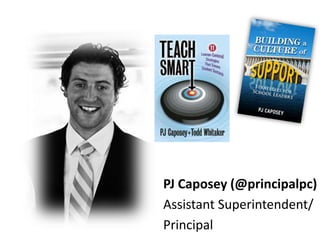
PJ Caposey (@principalpc)
Assistant Superintendent/
Principal
Author
Big Ideas
• Teacher Identity Crisis
• Big picture – what is a great teacher?
– Concrete ideas for you to take forward
• Before you can teach kids, you must. . .
– Get a job
– Interview prep
– FAQs
• What else can I do for you?
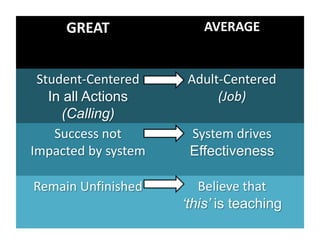
GREAT AVERAGE
Student-Centered
In all Actions
(Calling)
Adult-Centered
(Job)
Success not
Impacted by system
System drives
Effectiveness
Remain Unfinished Believe that
‘this’ is teaching
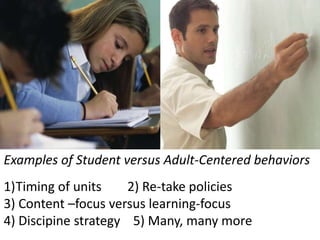
Examples of Student versus Adult-Centered behaviors
1)Timing of units 2) Re-take policies
3) Content –focus versus learning-focus
4) Discipine strategy 5) Many, many more
1920
2013
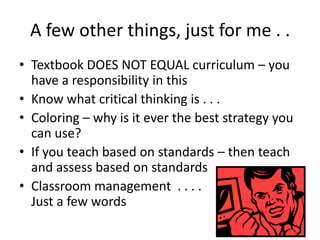
A few other things, just for me . .
• Textbook DOES NOT EQUAL curriculum – you
have a responsibility in this
• Know what critical thinking is . . .
• Coloring – why is it ever the best strategy you
can use?
• If you teach based on standards – then teach
and assess based on standards
• Classroom management . . . .
Just a few words
Now, Let’s
Get You
a Job
While you are sweating out your application process,
this is what I am doing
The unfortunate truth is that a great kid
with an application with zero errors will
get called for an interview less than 5%
of the time in my experience – I have
hired one (Student Taught in District)
1)Call
2)Cash in Favors
3)Commiserate

(network) –
How many
principals do
you know right
now?
4)Coach – then
call
Increased Specialization =
Increased Chances as well
(AP Experience, Dual
Cert., etc.)
Tell me what you
think you know
about constructing a
good résumé?
I KNOW THE
JOB
DESCRIPTION
OF A
TEACHER!!
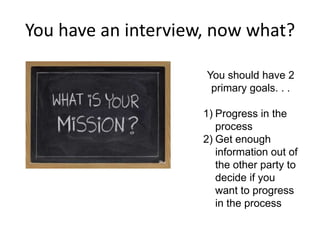
You have an interview, now what?
You should have 2
primary goals. . .
1) Progress in the
process
2) Get enough
information out of
the other party to
decide if you
want to progress
in the process
Group Activity, 5 minutes
Part 1:
• Predict 3 to 5
questions that you
will be asked during
an interview
Part 2:
• Create 3 to 5
questions that you
should ask of them
or statements you
should make during
an interview
Group Activity, Correct Answers, IMO
Part 1:
• Tell us a little about
yourself?
• What distinguishes
you from other
candidates?
• Do you have any
questions for us?
Part 2:
• Reference their data
• Ask about goals moving
forward
• Vision/Mission/Core Values
• Culture and Climate
• Biggest strength/Biggest
barrier
• Bring up what you read
• What should I know that I
could not find examining
your website and IIRC
Interview Prep
(25 minutes – time allowing)
• 90 seconds each – I will keep time
• Question 1 – One thing nobody at table knows
about you
• Question 2 – Person most influential in your
choice to be a teacher
• Question 3 – Life changing event
• Strength bombardment
The Day of the Interview
Importance of secretary
Body language and relationships
Have extra materials on hand
Ask for clarification on confusing questions
Admit it if you do not know what they are talking about
Be yourself – humor = ok as long as it is natural
Ask for timelines and protocols
Ask for additional details about open position
Be afraid
Swear
Be underdressed
Ramble – if your answer is short that is ok
Chew gum
Oppressive cologne or perfume
“Good question”
Be on time - - on time is LATE!!
For me – and I cannot speak for
other principals
I hire based on fit, talent, and potential
and/or willingness to be coached as
opposed to correct answers on
technical questions
BUT, Technical Answers are Still Important
SOME SAMPLE QUESTIONS TO
DISCUSS
Sample Questions
Evaluate your understanding of Bloom’s Taxonomy and if it
impacts your professional practice. If it does, how? What level
of Bloom’s does the majority of your instruction take place in?
Explain what best practice curriculum development is.
Entering a new building, what would be some of the first
questions you would ask your departmental colleagues?
If we came to watch you for a day, what would we denote as
far as how and why you differentiate instruction?
Sample Questions
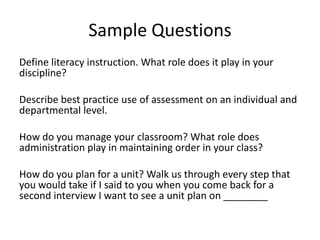
Define literacy instruction. What role does it play in your
discipline?
Describe best practice use of assessment on an individual and
departmental level.
How do you manage your classroom? What role does
administration play in maintaining order in your class?
How do you plan for a unit? Walk us through every step that
you would take if I said to you when you come back for a
second interview I want to see a unit plan on ________
Sample Questions
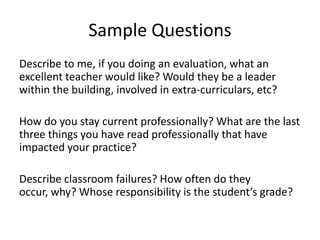
Describe to me, if you doing an evaluation, what an
excellent teacher would like? Would they be a leader
within the building, involved in extra-curriculars, etc?
How do you stay current professionally? What are the last
three things you have read professionally that have
impacted your practice?
Describe classroom failures? How often do they
occur, why? Whose responsibility is the student’s grade?
So, you got the job – now what?
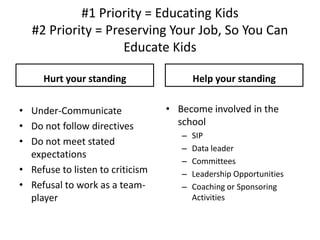
#1 Priority = Educating Kids
#2 Priority = Preserving Your Job, So You Can
Educate Kids
Hurt your standing
• Under-Communicate
• Do not follow directives
• Do not meet stated
expectations
• Refuse to listen to criticism
• Refusal to work as a team-
player
Help your standing
• Become involved in the
school
– SIP
– Data leader
– Committees
– Leadership Opportunities
– Coaching or Sponsoring
Activities
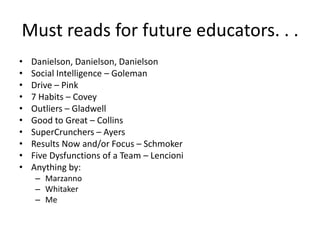
Must reads for future educators. . .
• Danielson, Danielson, Danielson
• Social Intelligence – Goleman
• Drive – Pink
• 7 Habits – Covey
• Outliers – Gladwell
• Good to Great – Collins
• SuperCrunchers – Ayers
• Results Now and/or Focus – Schmoker
• Five Dysfunctions of a Team – Lencioni
• Anything by:
– Marzanno
– Whitaker
– Me

Golden Apple, EIU presentation

  • 1.
    SO, you wannabe great? Golden Apple EIU Summer Institute June 27, 2013
  • 3.
    PJ Caposey (@principalpc) AssistantSuperintendent/ Principal Author
  • 4.
    Big Ideas • TeacherIdentity Crisis • Big picture – what is a great teacher? – Concrete ideas for you to take forward • Before you can teach kids, you must. . . – Get a job – Interview prep – FAQs • What else can I do for you?
  • 10.
    GREAT AVERAGE Student-Centered In allActions (Calling) Adult-Centered (Job) Success not Impacted by system System drives Effectiveness Remain Unfinished Believe that ‘this’ is teaching
  • 11.
    Examples of Studentversus Adult-Centered behaviors 1)Timing of units 2) Re-take policies 3) Content –focus versus learning-focus 4) Discipine strategy 5) Many, many more
  • 13.
  • 14.
  • 16.
    A few otherthings, just for me . . • Textbook DOES NOT EQUAL curriculum – you have a responsibility in this • Know what critical thinking is . . . • Coloring – why is it ever the best strategy you can use? • If you teach based on standards – then teach and assess based on standards • Classroom management . . . . Just a few words
  • 17.
  • 19.
    While you aresweating out your application process, this is what I am doing The unfortunate truth is that a great kid with an application with zero errors will get called for an interview less than 5% of the time in my experience – I have hired one (Student Taught in District)
  • 20.
    1)Call 2)Cash in Favors 3)Commiserate (network)– How many principals do you know right now? 4)Coach – then call Increased Specialization = Increased Chances as well (AP Experience, Dual Cert., etc.)
  • 21.
    Tell me whatyou think you know about constructing a good résumé?
  • 22.
  • 23.
    You have aninterview, now what? You should have 2 primary goals. . . 1) Progress in the process 2) Get enough information out of the other party to decide if you want to progress in the process
  • 24.
    Group Activity, 5minutes Part 1: • Predict 3 to 5 questions that you will be asked during an interview Part 2: • Create 3 to 5 questions that you should ask of them or statements you should make during an interview
  • 25.
    Group Activity, CorrectAnswers, IMO Part 1: • Tell us a little about yourself? • What distinguishes you from other candidates? • Do you have any questions for us? Part 2: • Reference their data • Ask about goals moving forward • Vision/Mission/Core Values • Culture and Climate • Biggest strength/Biggest barrier • Bring up what you read • What should I know that I could not find examining your website and IIRC
  • 26.
    Interview Prep (25 minutes– time allowing) • 90 seconds each – I will keep time • Question 1 – One thing nobody at table knows about you • Question 2 – Person most influential in your choice to be a teacher • Question 3 – Life changing event • Strength bombardment
  • 27.
    The Day ofthe Interview
  • 28.
    Importance of secretary Bodylanguage and relationships Have extra materials on hand Ask for clarification on confusing questions Admit it if you do not know what they are talking about Be yourself – humor = ok as long as it is natural Ask for timelines and protocols Ask for additional details about open position
  • 29.
    Be afraid Swear Be underdressed Ramble– if your answer is short that is ok Chew gum Oppressive cologne or perfume “Good question” Be on time - - on time is LATE!!
  • 30.
    For me –and I cannot speak for other principals I hire based on fit, talent, and potential and/or willingness to be coached as opposed to correct answers on technical questions BUT, Technical Answers are Still Important
  • 31.
  • 32.
    Sample Questions Evaluate yourunderstanding of Bloom’s Taxonomy and if it impacts your professional practice. If it does, how? What level of Bloom’s does the majority of your instruction take place in? Explain what best practice curriculum development is. Entering a new building, what would be some of the first questions you would ask your departmental colleagues? If we came to watch you for a day, what would we denote as far as how and why you differentiate instruction?
  • 33.
    Sample Questions Define literacyinstruction. What role does it play in your discipline? Describe best practice use of assessment on an individual and departmental level. How do you manage your classroom? What role does administration play in maintaining order in your class? How do you plan for a unit? Walk us through every step that you would take if I said to you when you come back for a second interview I want to see a unit plan on ________
  • 34.
    Sample Questions Describe tome, if you doing an evaluation, what an excellent teacher would like? Would they be a leader within the building, involved in extra-curriculars, etc? How do you stay current professionally? What are the last three things you have read professionally that have impacted your practice? Describe classroom failures? How often do they occur, why? Whose responsibility is the student’s grade?
  • 35.
    So, you gotthe job – now what?
  • 37.
    #1 Priority =Educating Kids #2 Priority = Preserving Your Job, So You Can Educate Kids Hurt your standing • Under-Communicate • Do not follow directives • Do not meet stated expectations • Refuse to listen to criticism • Refusal to work as a team- player Help your standing • Become involved in the school – SIP – Data leader – Committees – Leadership Opportunities – Coaching or Sponsoring Activities
  • 39.
    Must reads forfuture educators. . . • Danielson, Danielson, Danielson • Social Intelligence – Goleman • Drive – Pink • 7 Habits – Covey • Outliers – Gladwell • Good to Great – Collins • SuperCrunchers – Ayers • Results Now and/or Focus – Schmoker • Five Dysfunctions of a Team – Lencioni • Anything by: – Marzanno – Whitaker – Me

Editor's Notes

  • #3 Tell us a bit about yourself . . .
  • #4 Introduction – Talk about who am I – a little about my experienceGood morning, my name is PJ Caposey – I always find the introductions of people at conferences or webinars a bit awkward as the presenter works to convince the audience that they are indeed qualified. I believe you are in good hands today – in most part because this is something that I personally worked through – failed at many times – reflected and re-worked – and was able to achieve a great deal of success for my school and those within my school. In four years as OHS principal we went from one of the lowest achieving schools in the county to be recognized as one of the best in the country --- through today you will learn a lot more about me and my philosophies as well as best practice strategies and methodologies for changing culture