Welcome
Week 17

Today’sAgenda
 PBP by Lauren and Tyler and Maira
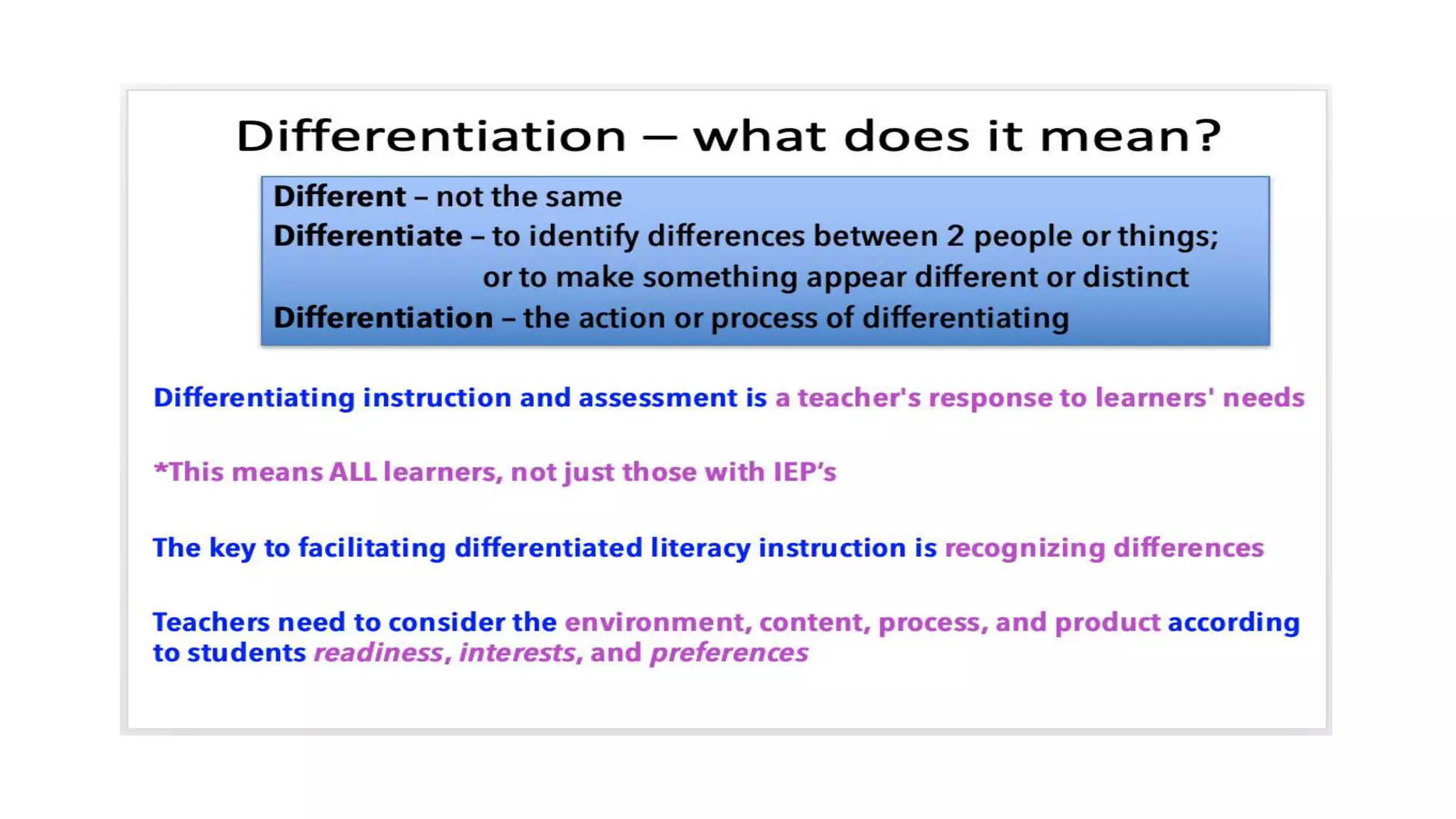
 What is differentiated Instruction?
 Differentiation brainstorm
 Monograph Work Time: quick look and Focus on
Layout
 Portfolio, Cover Letter, Resume, Interview
SJBP
Presenter:____ My Name: _____
During this presentation…
I noticed…
I felt…
I learned…
One thing I would like to
incorporate into my
teaching from this
presentation would be…
Break:
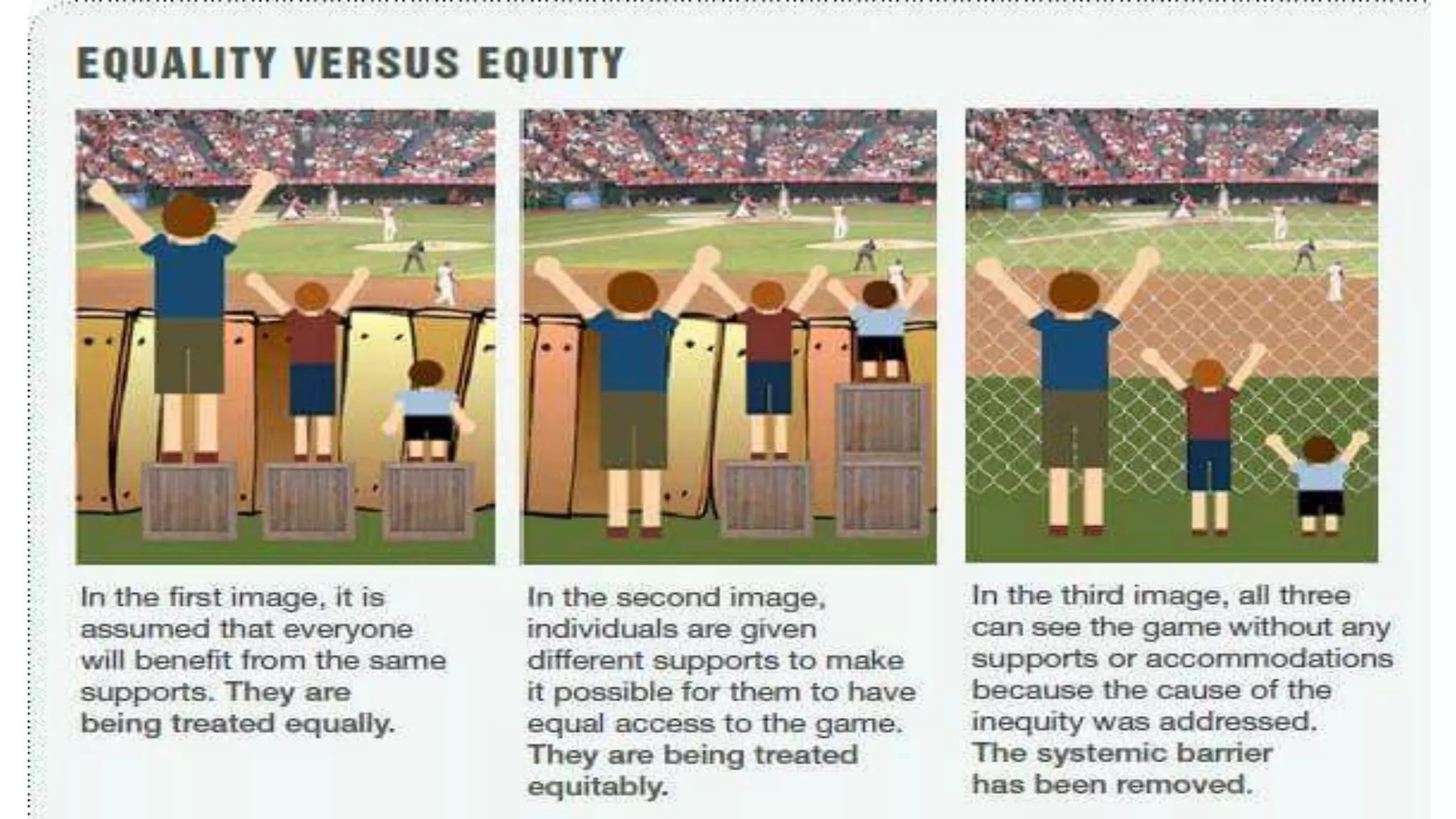
Differentiation
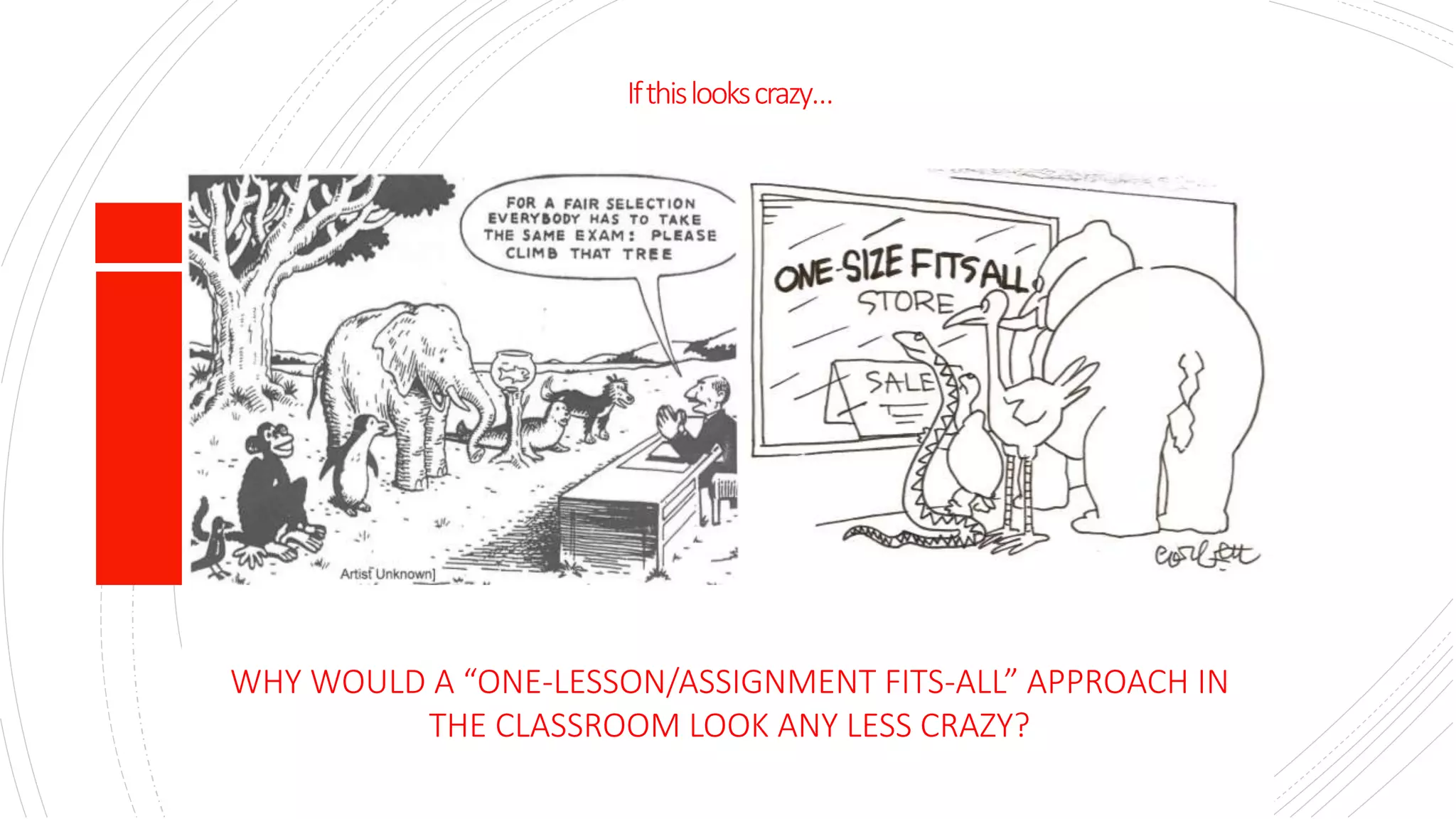
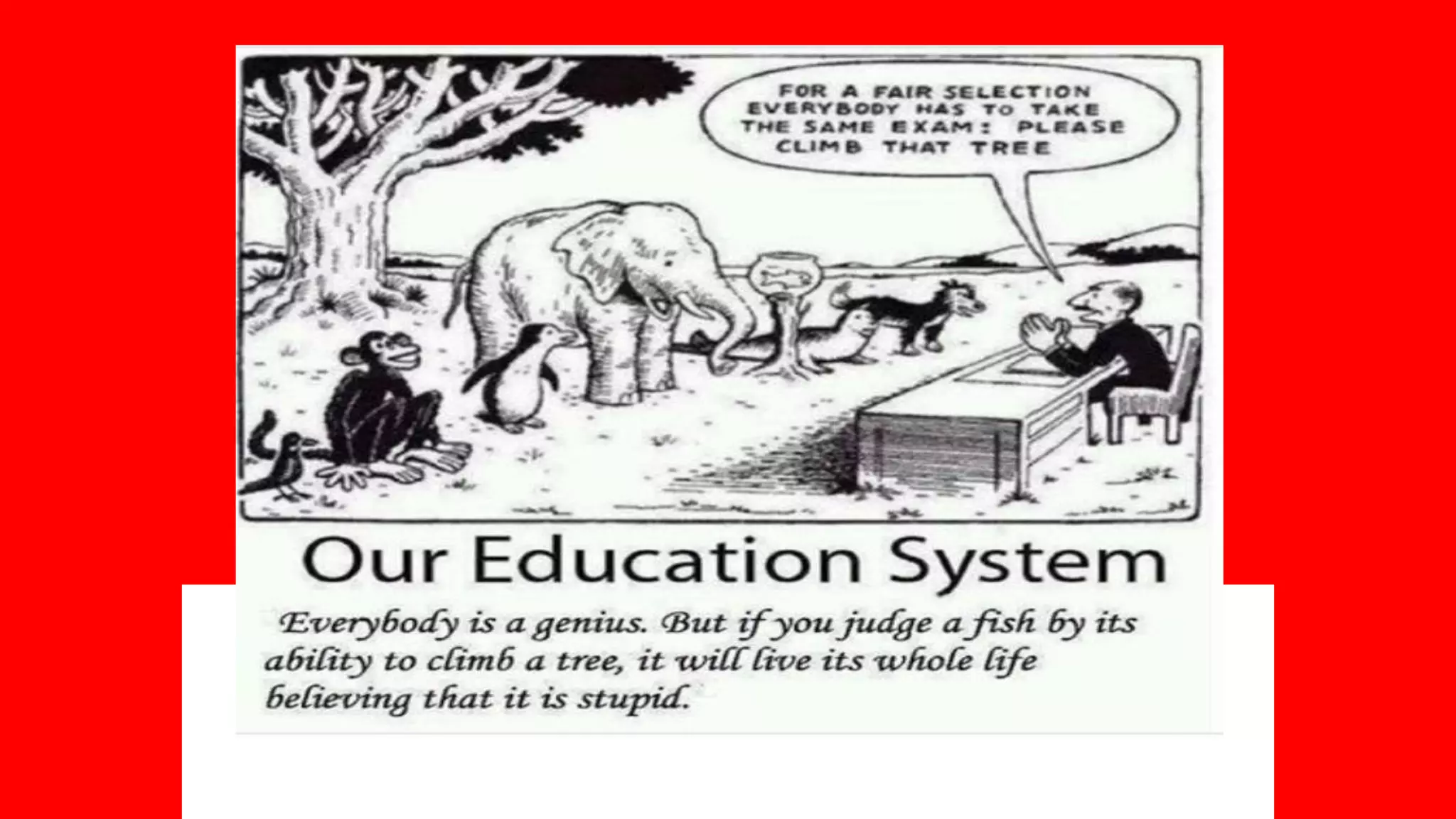
Ifthislookscrazy…
WHY WOULD A “ONE-LESSON/ASSIGNMENT FITS-ALL” APPROACH IN
THE CLASSROOM LOOK ANY LESS CRAZY?
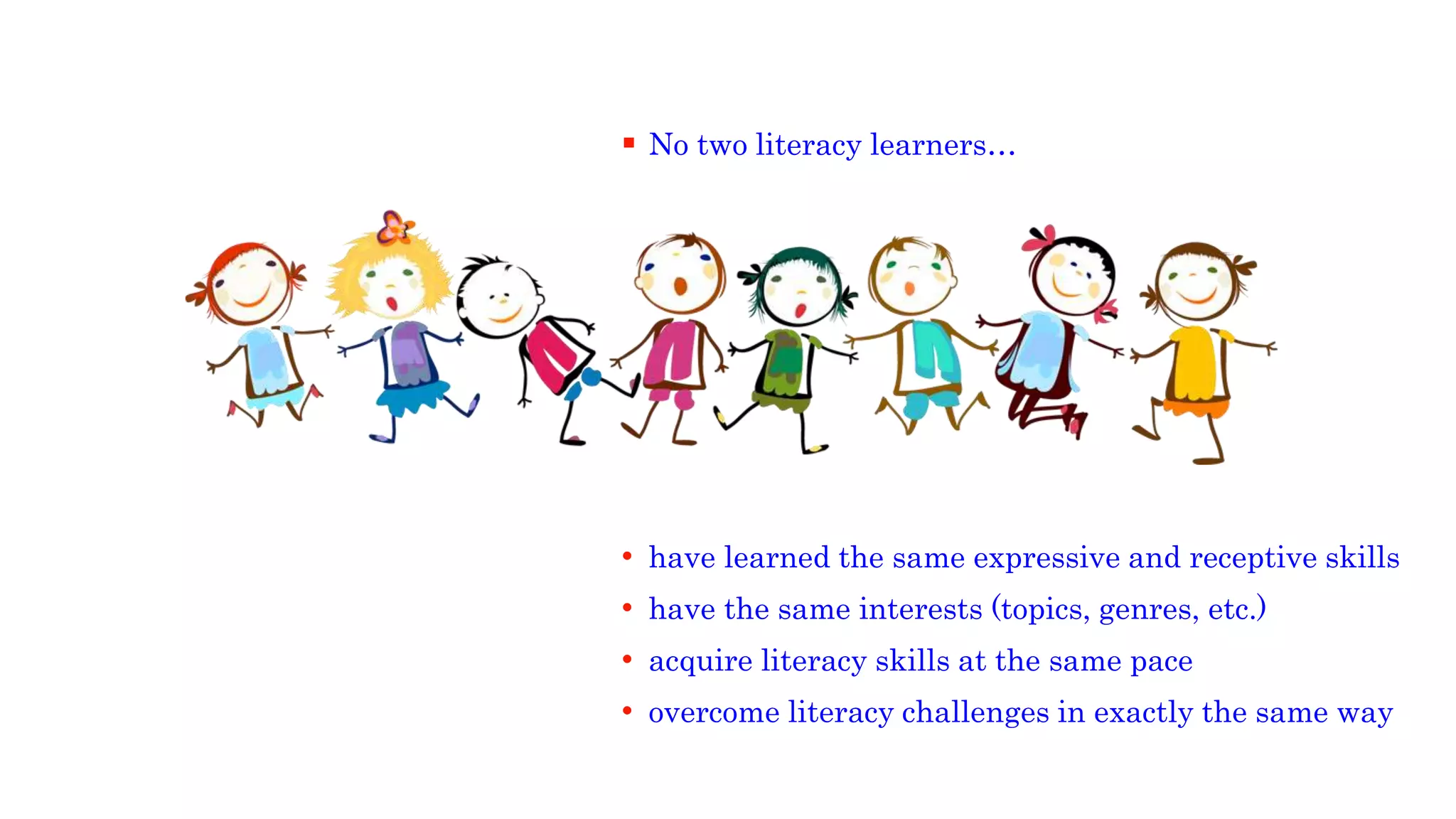
 No two literacy learners…
• have learned the same expressive and receptive skills
• have the same interests (topics, genres, etc.)
• acquire literacy skills at the same pace
• overcome literacy challenges in exactly the same way
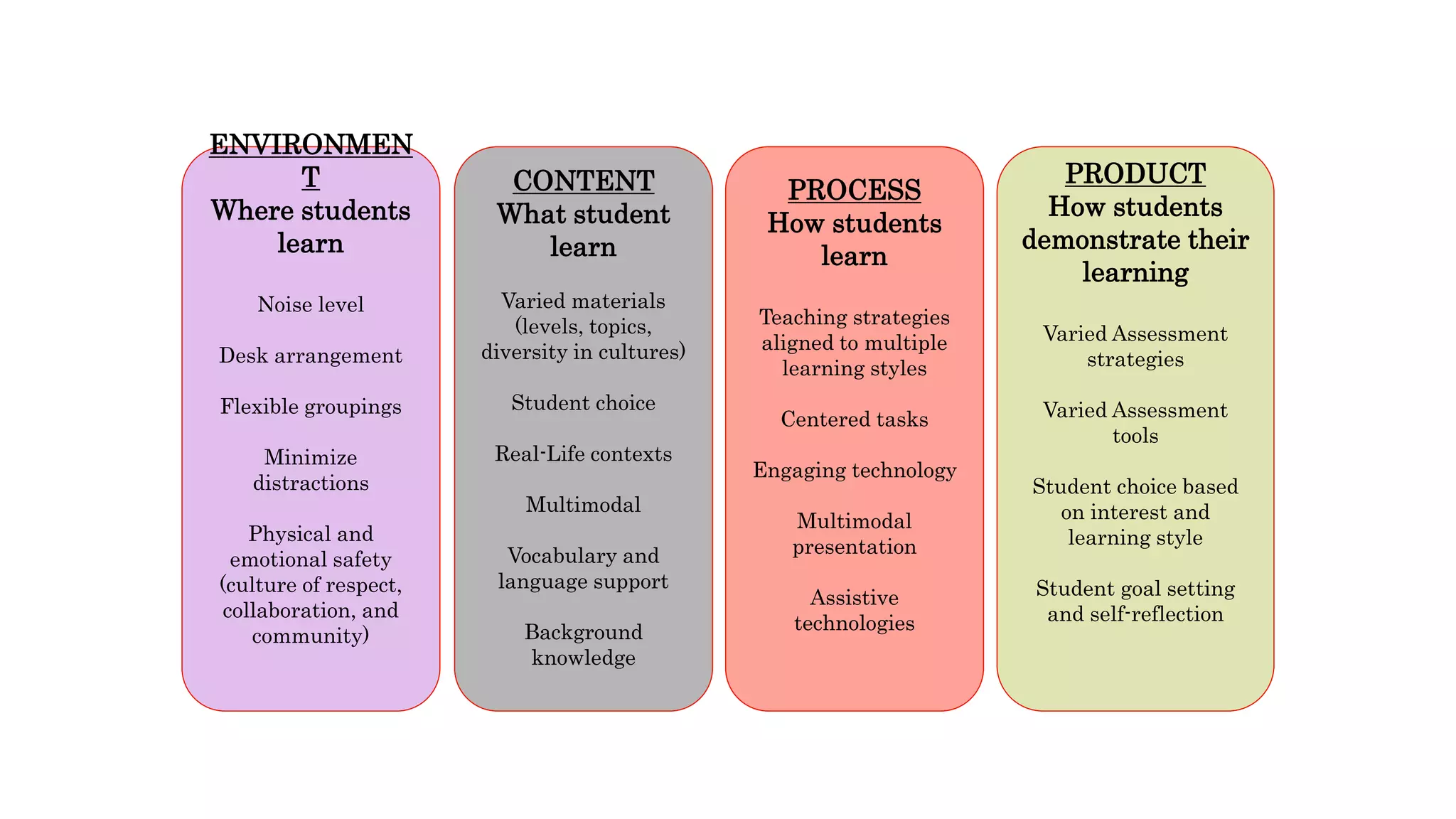
ENVIRONMEN
T
Where students
learn
Noise level
Desk arrangement
Flexible groupings
Minimize
distractions
Physical and
emotional safety
(culture of respect,
collaboration, and
community)
CONTENT
What student
learn
Varied materials
(levels, topics,
diversity in cultures)
Student choice
Real-Life contexts
Multimodal
Vocabulary and
language support
Background
knowledge
PROCESS
How students
learn
Teaching strategies
aligned to multiple
learning styles
Centered tasks
Engaging technology
Multimodal
presentation
Assistive
technologies
PRODUCT
How students
demonstrate their
learning
Varied Assessment
strategies
Varied Assessment
tools
Student choice based
on interest and
learning style
Student goal setting
and self-reflection
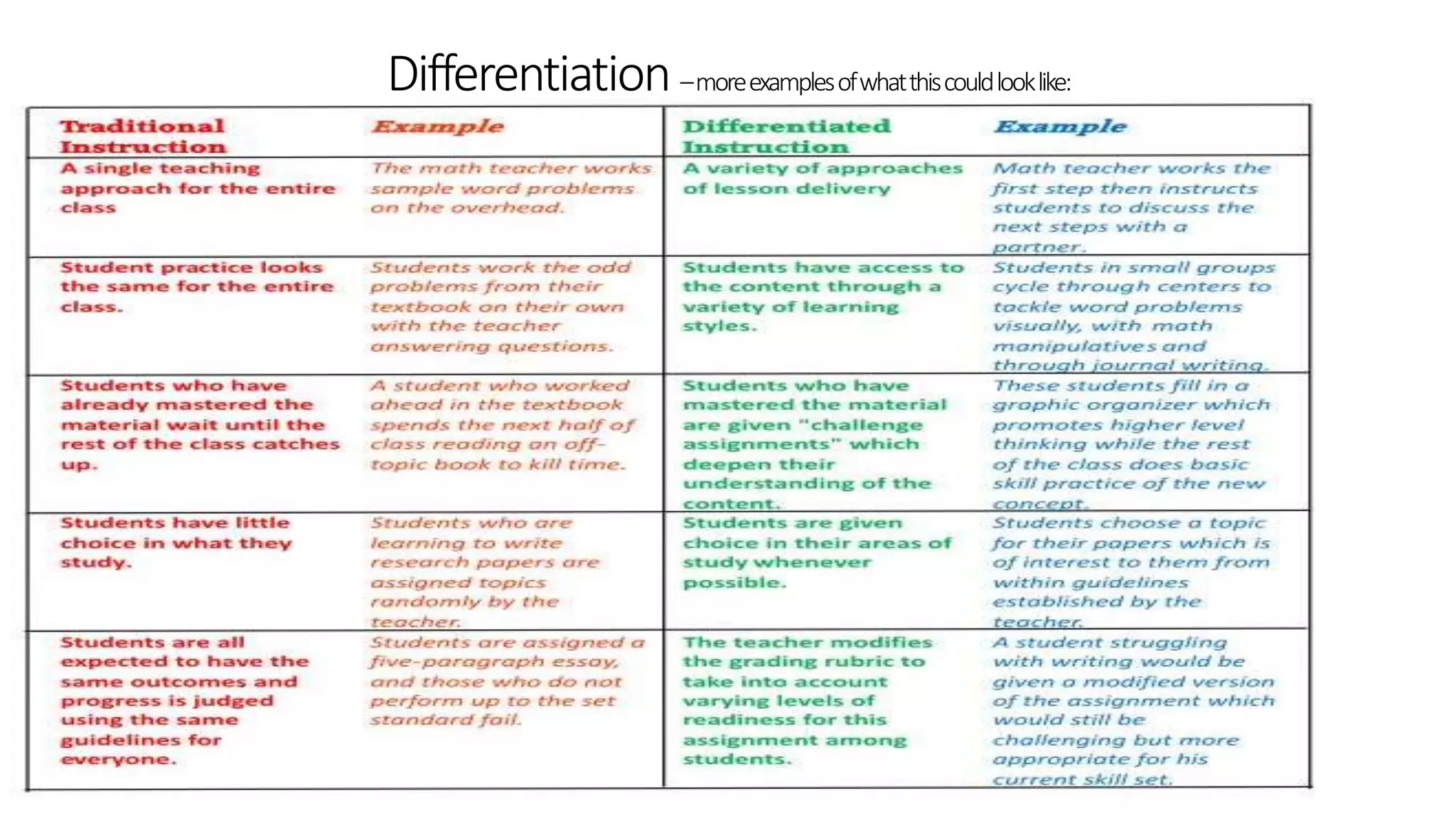
Differentiation –moreexamplesofwhatthiscouldlooklike:
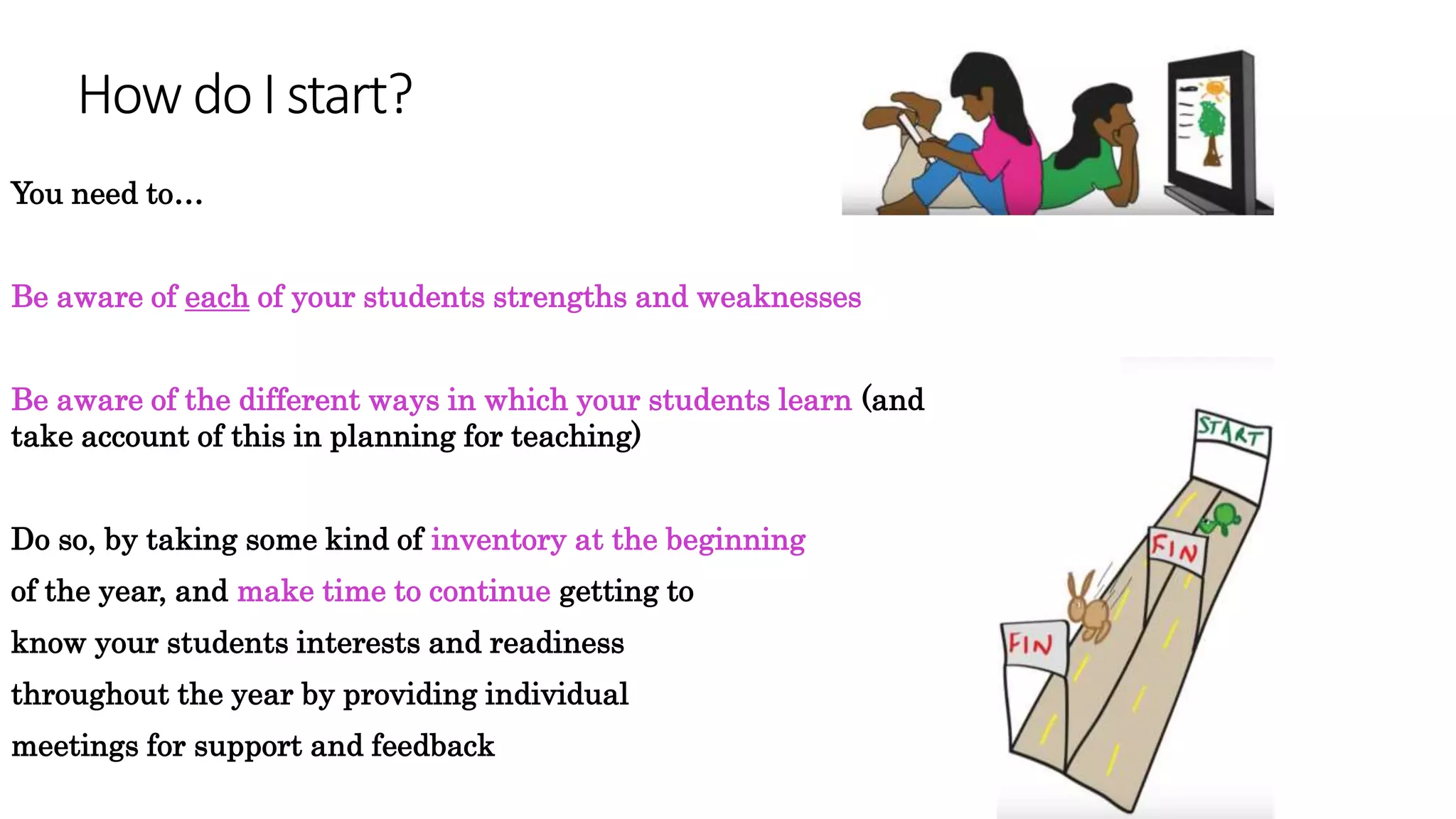
How doI start?
You need to…
Be aware of each of your students strengths and weaknesses
Be aware of the different ways in which your students learn (and
take account of this in planning for teaching)
Do so, by taking some kind of inventory at the beginning
of the year, and make time to continue getting to
know your students interests and readiness
throughout the year by providing individual
meetings for support and feedback
How doI start?
You could…
Set slightly different tasks for each student / groups of students
depending on their skill, interest, or ways of working
Set the same task for every student, but give a variety of contexts
or a variety of degrees of difficulty to extend the scope of the task
or activity
Develop related activities that could be handed to students upon
completion of work to extend their learning
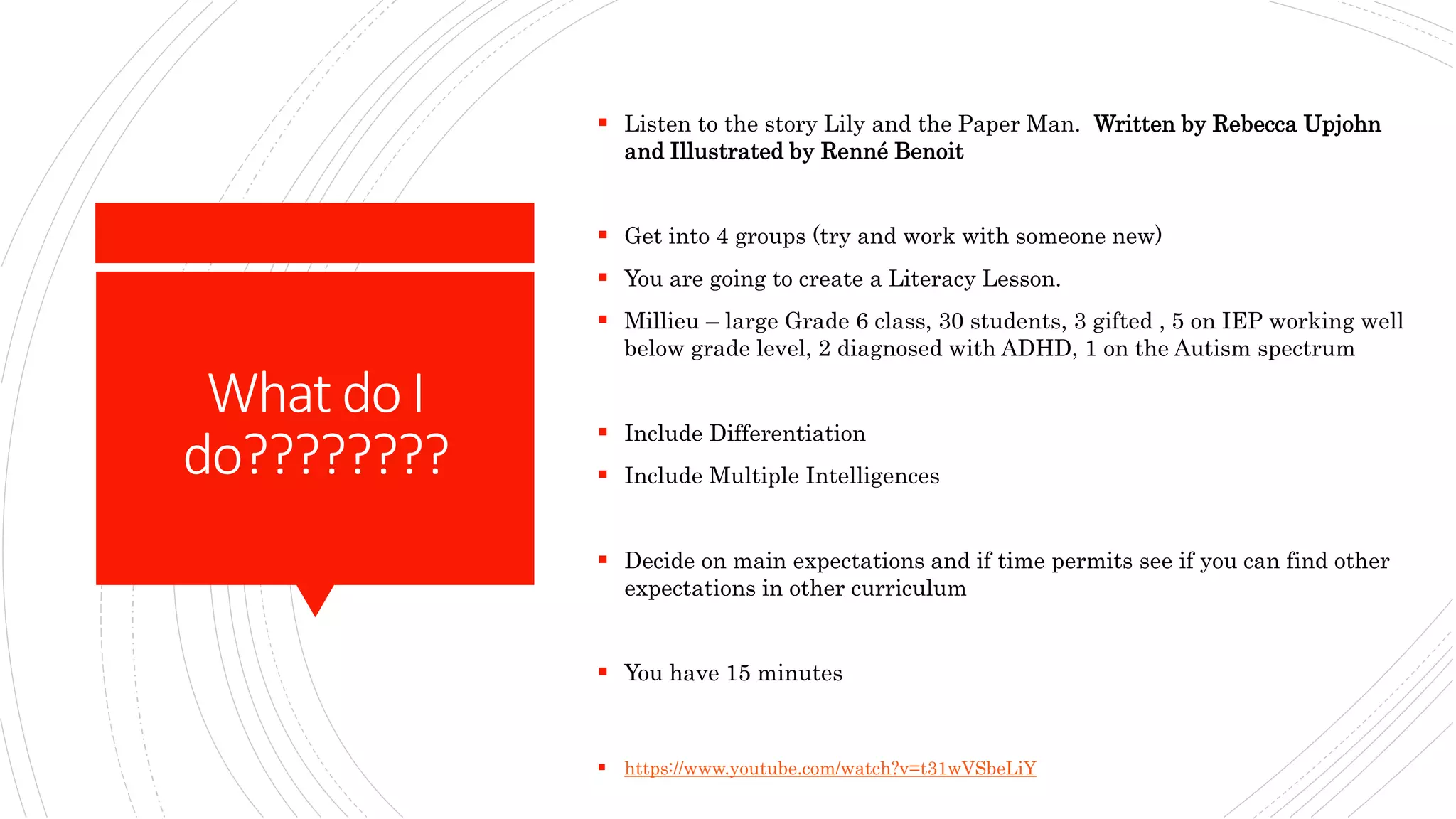
WhatdoI
do????????
 Listen to the story Lily and the Paper Man. Written by Rebecca Upjohn
and Illustrated by Renné Benoit
 Get into 4 groups (try and work with someone new)
 You are going to create a Literacy Lesson.
 Millieu – large Grade 6 class, 30 students, 3 gifted , 5 on IEP working well
below grade level, 2 diagnosed with ADHD, 1 on the Autism spectrum
 Include Differentiation
 Include Multiple Intelligences
 Decide on main expectations and if time permits see if you can find other
expectations in other curriculum
 You have 15 minutes
 https://www.youtube.com/watch?v=t31wVSbeLiY
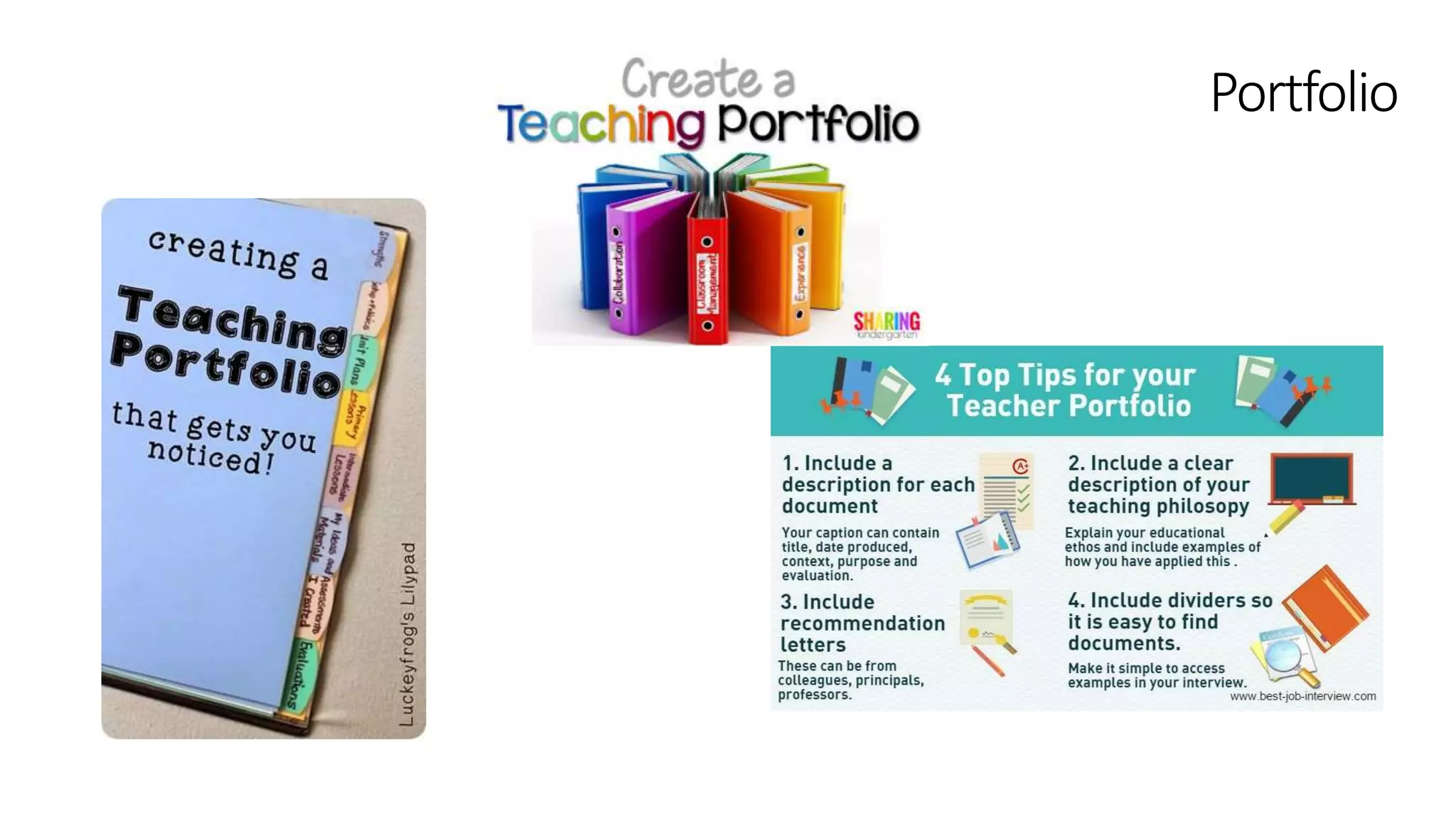
Portfolio
Buildingyour
Portfolio
Gather any letters, photos, lesson plans,
camp activities, volunteer hours,
placements, previous work experience,
awards, etc.
Include: resume, certificates, references,
related work experience, lesson plans and
assignments, pictures of your classroom
setup, parent communication etc.
Decide how you want to display/share
This is a continuous story of your journey
as an educator
It will be added to throughout your career
Usingyour
Portfolio
It is unlikely there will be time
to go through every page in an
interview.
These pages can be useful to
open to when answering a
question to both job your
memory, and provide evidence
of your response!
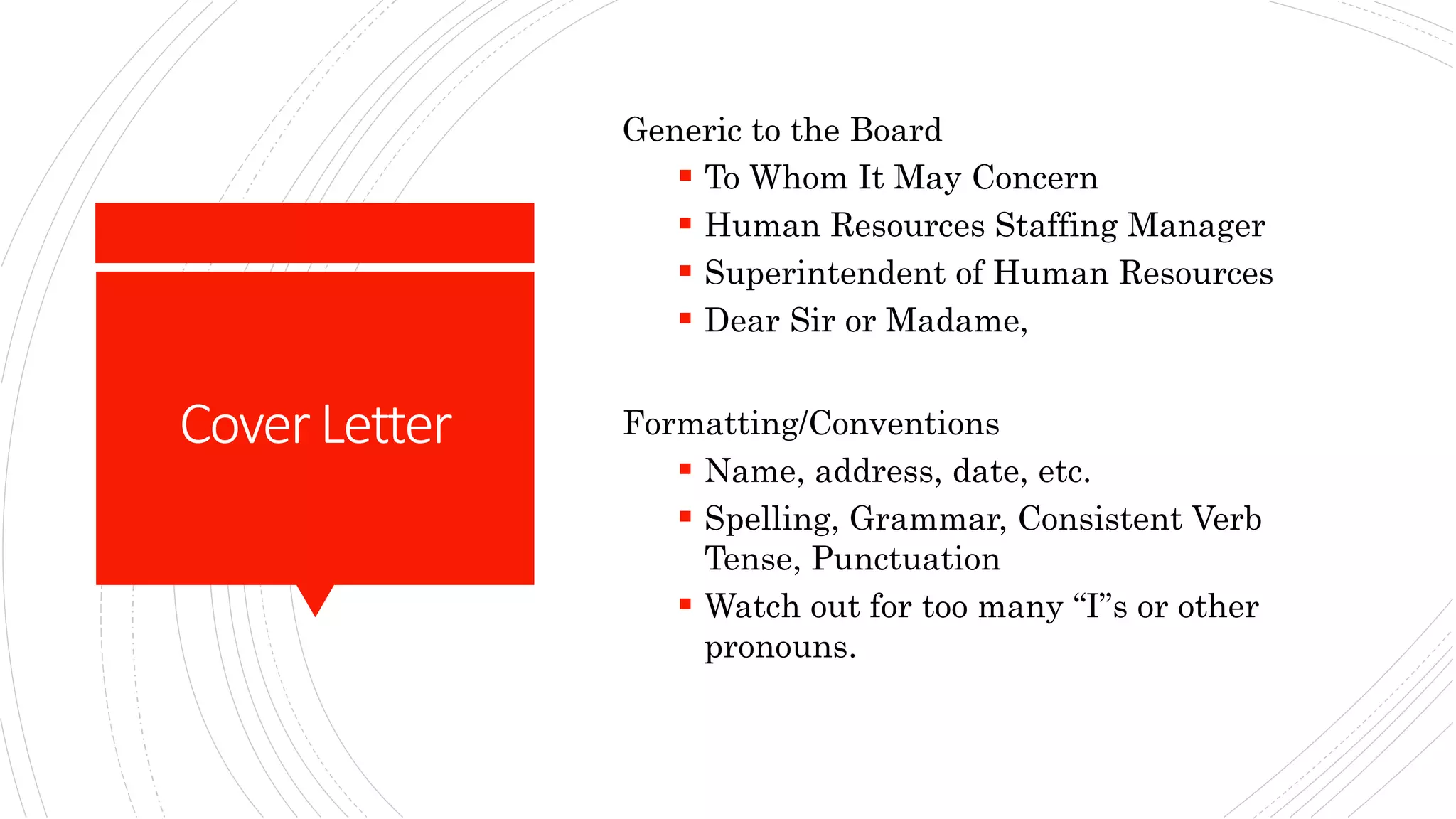
CoverLetter
Generic to the Board
 To Whom It May Concern
 Human Resources Staffing Manager
 Superintendent of Human Resources
 Dear Sir or Madame,
Formatting/Conventions
 Name, address, date, etc.
 Spelling, Grammar, Consistent Verb
Tense, Punctuation
 Watch out for too many “I”s or other
pronouns.
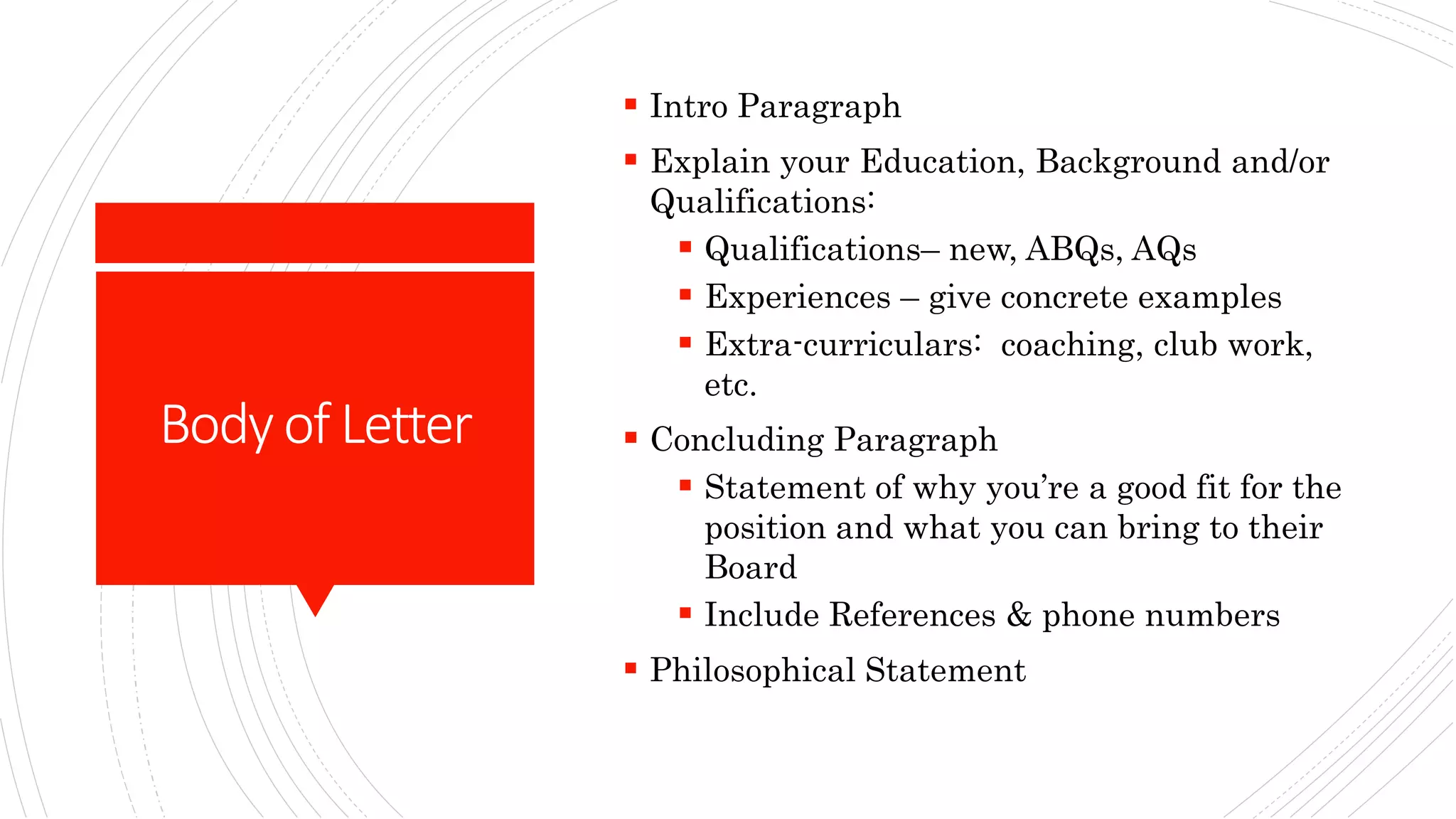
Bodyof Letter
 Intro Paragraph
 Explain your Education, Background and/or
Qualifications:
 Qualifications– new, ABQs, AQs
 Experiences – give concrete examples
 Extra-curriculars: coaching, club work,
etc.
 Concluding Paragraph
 Statement of why you’re a good fit for the
position and what you can bring to their
Board
 Include References & phone numbers
 Philosophical Statement
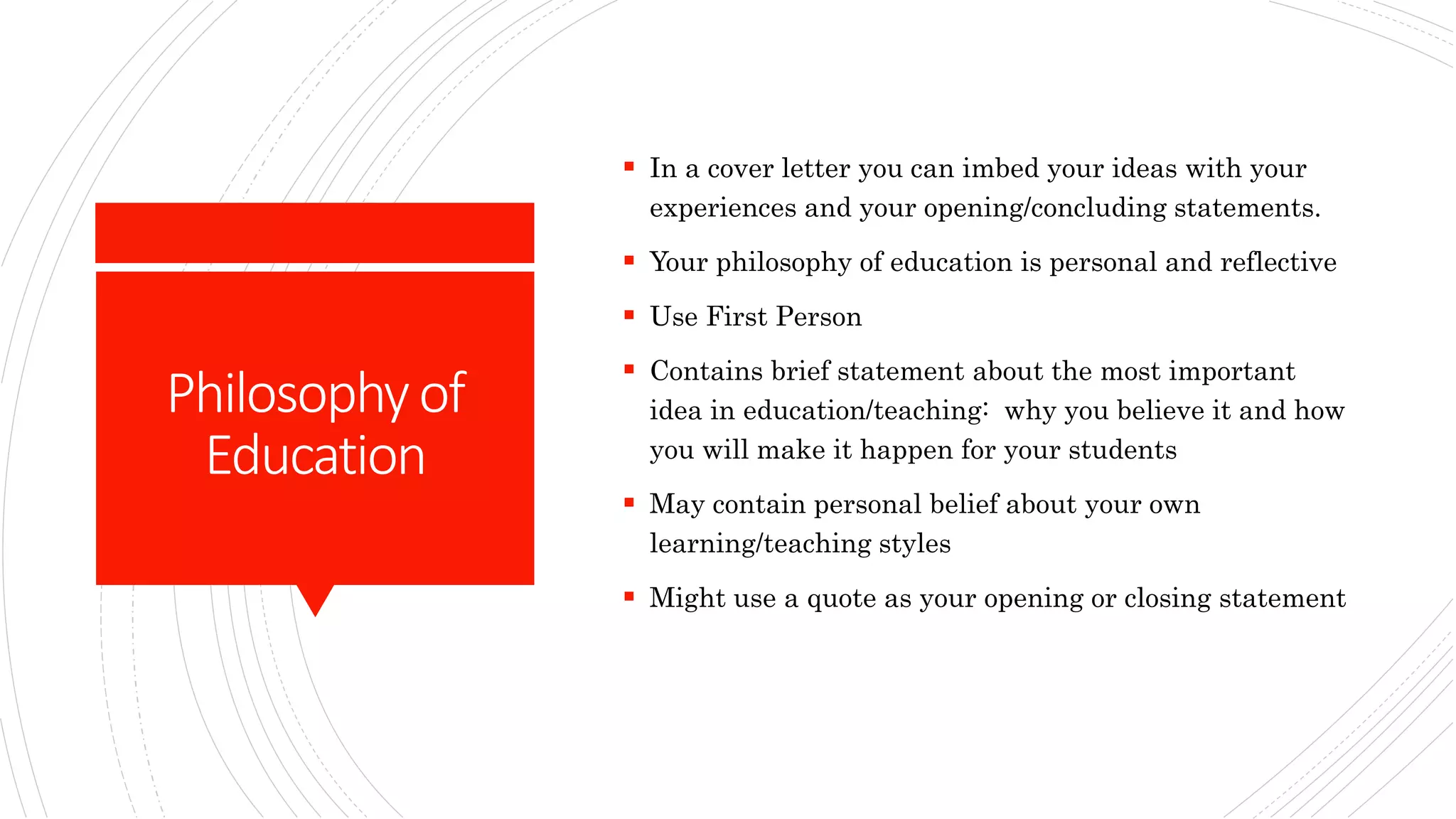
Philosophyof
Education
 In a cover letter you can imbed your ideas with your
experiences and your opening/concluding statements.
 Your philosophy of education is personal and reflective
 Use First Person
 Contains brief statement about the most important
idea in education/teaching: why you believe it and how
you will make it happen for your students
 May contain personal belief about your own
learning/teaching styles
 Might use a quote as your opening or closing statement
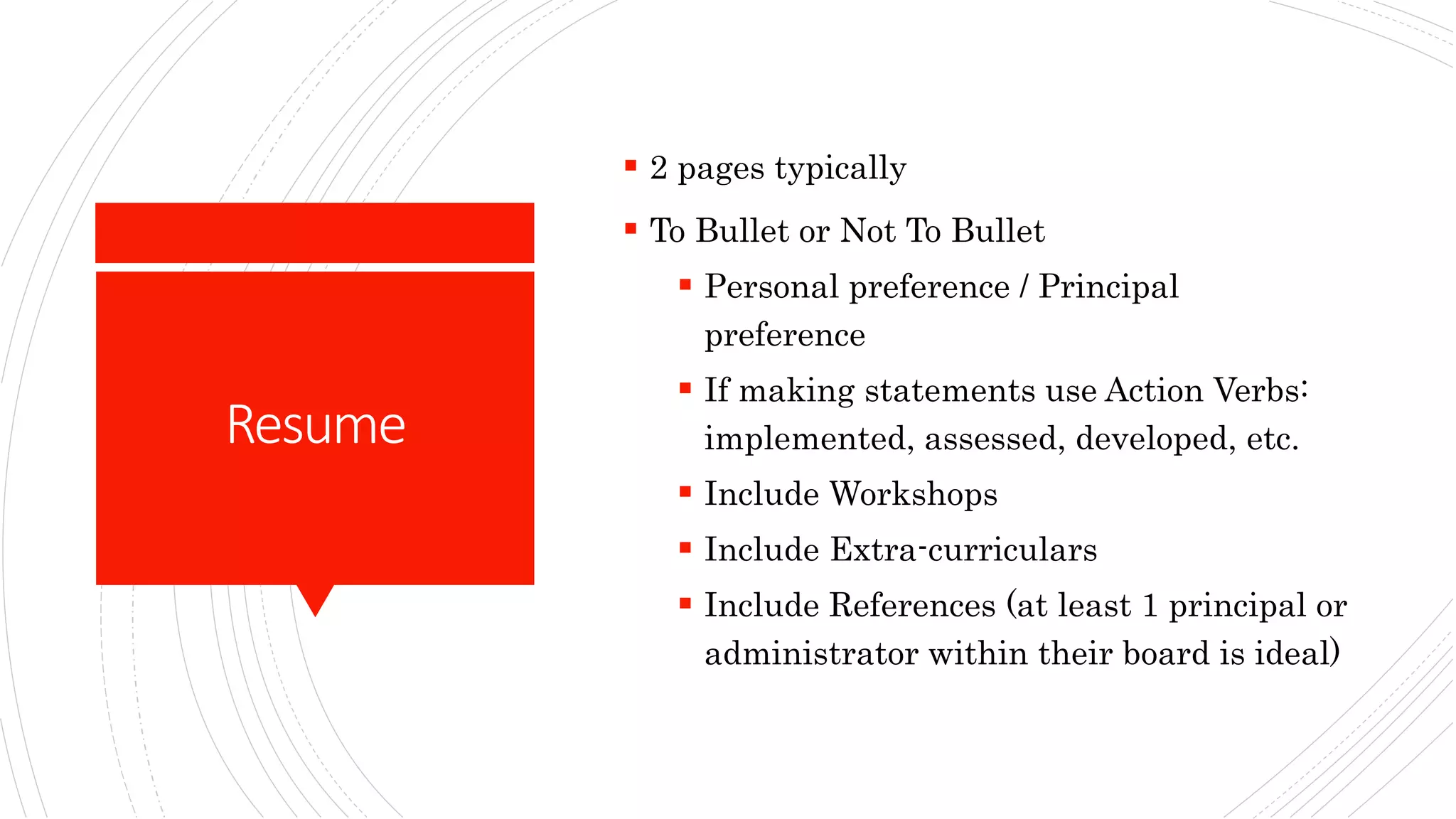
Resume
 2 pages typically
 To Bullet or Not To Bullet
 Personal preference / Principal
preference
 If making statements use Action Verbs:
implemented, assessed, developed, etc.
 Include Workshops
 Include Extra-curriculars
 Include References (at least 1 principal or
administrator within their board is ideal)
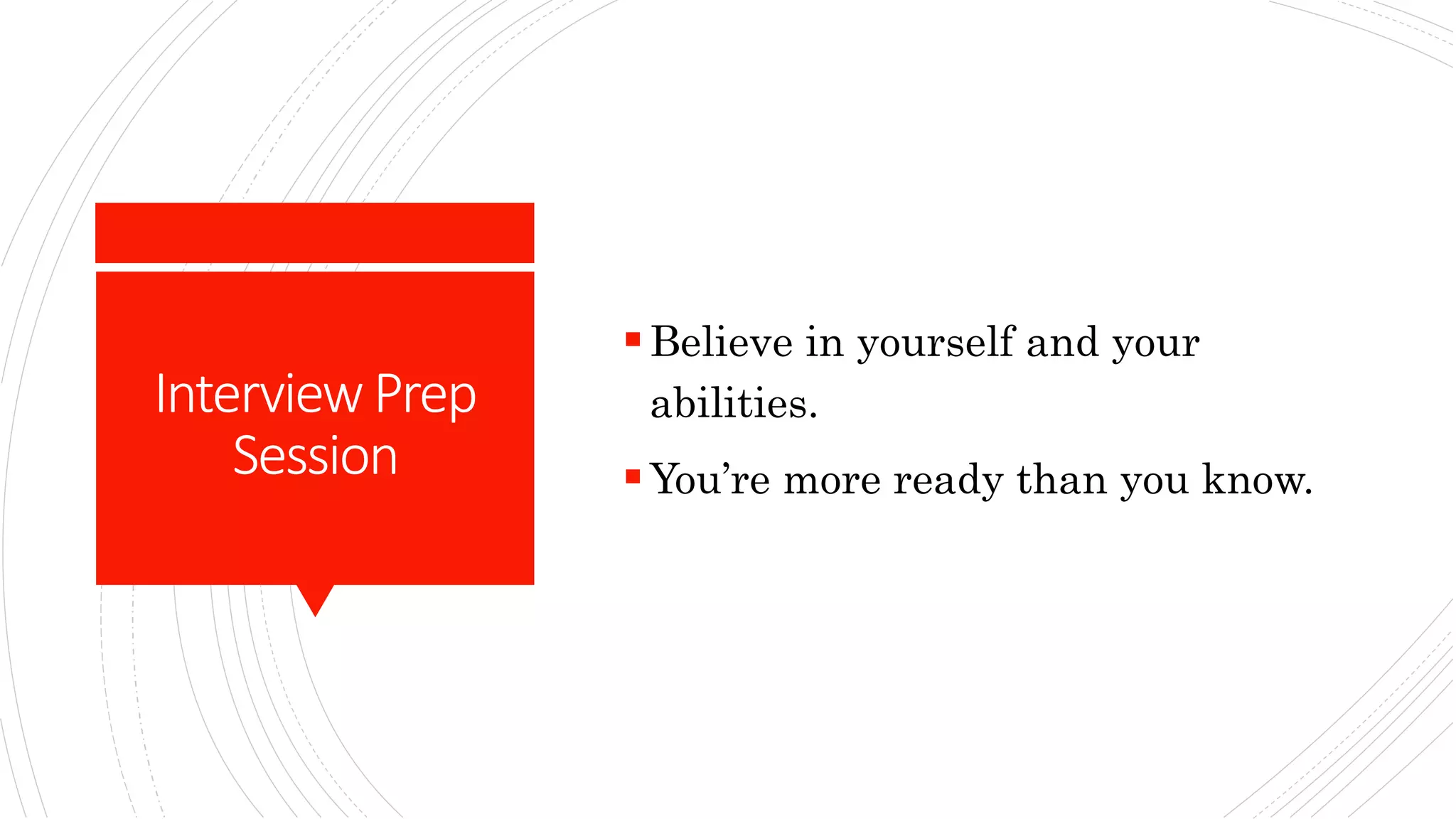
InterviewPrep
Session
Believe in yourself and your
abilities.
You’re more ready than you know.
TheInterview
 25 minutes, typically 5 questions, usually strict time
limit
 Environment – Board office vs hotel conference room
 Any questions? When will a decision be made?
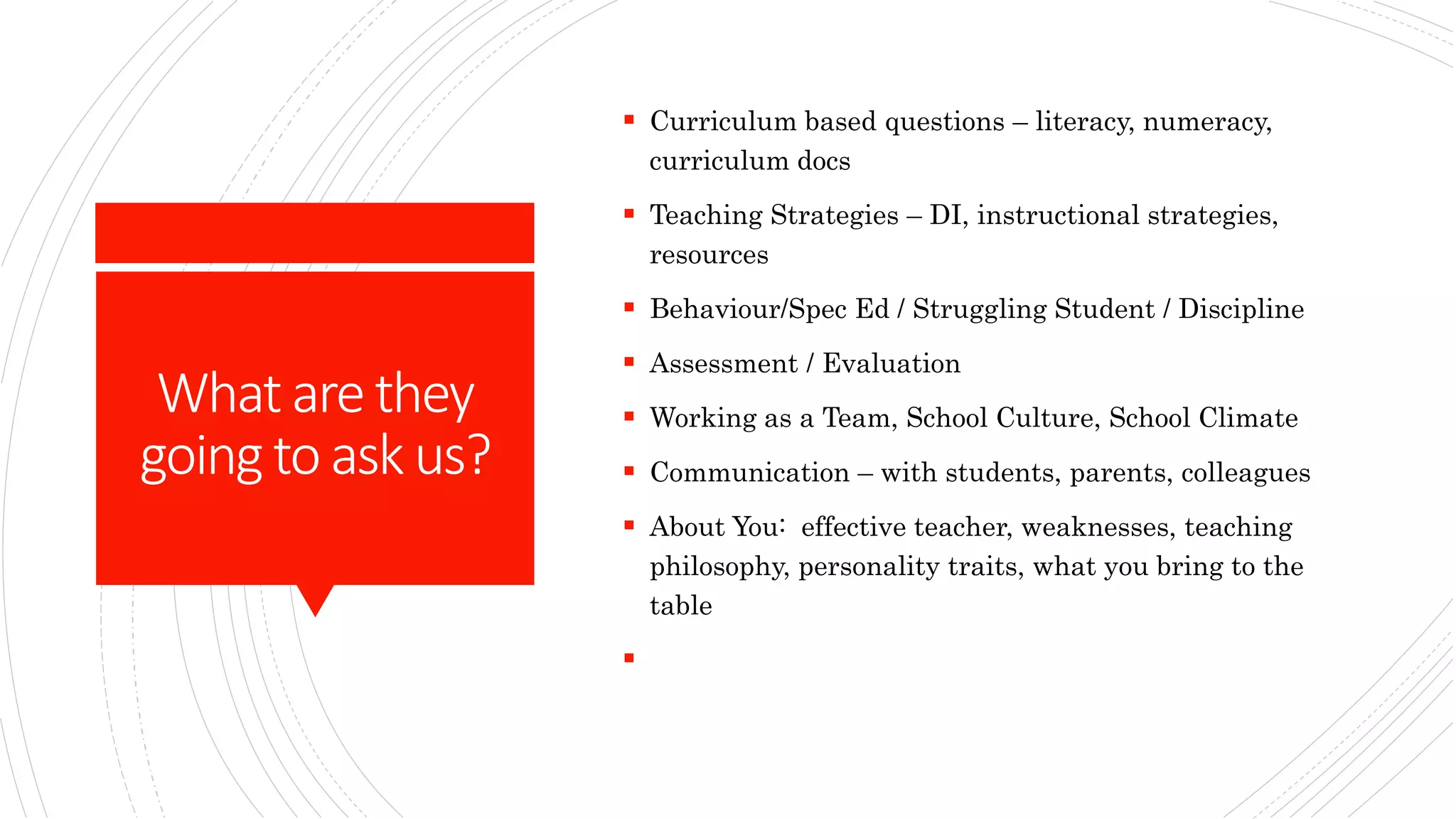
Whatarethey
goingtoaskus?
 Curriculum based questions – literacy, numeracy,
curriculum docs
 Teaching Strategies – DI, instructional strategies,
resources
 Behaviour/Spec Ed / Struggling Student / Discipline
 Assessment / Evaluation
 Working as a Team, School Culture, School Climate
 Communication – with students, parents, colleagues
 About You: effective teacher, weaknesses, teaching
philosophy, personality traits, what you bring to the
table

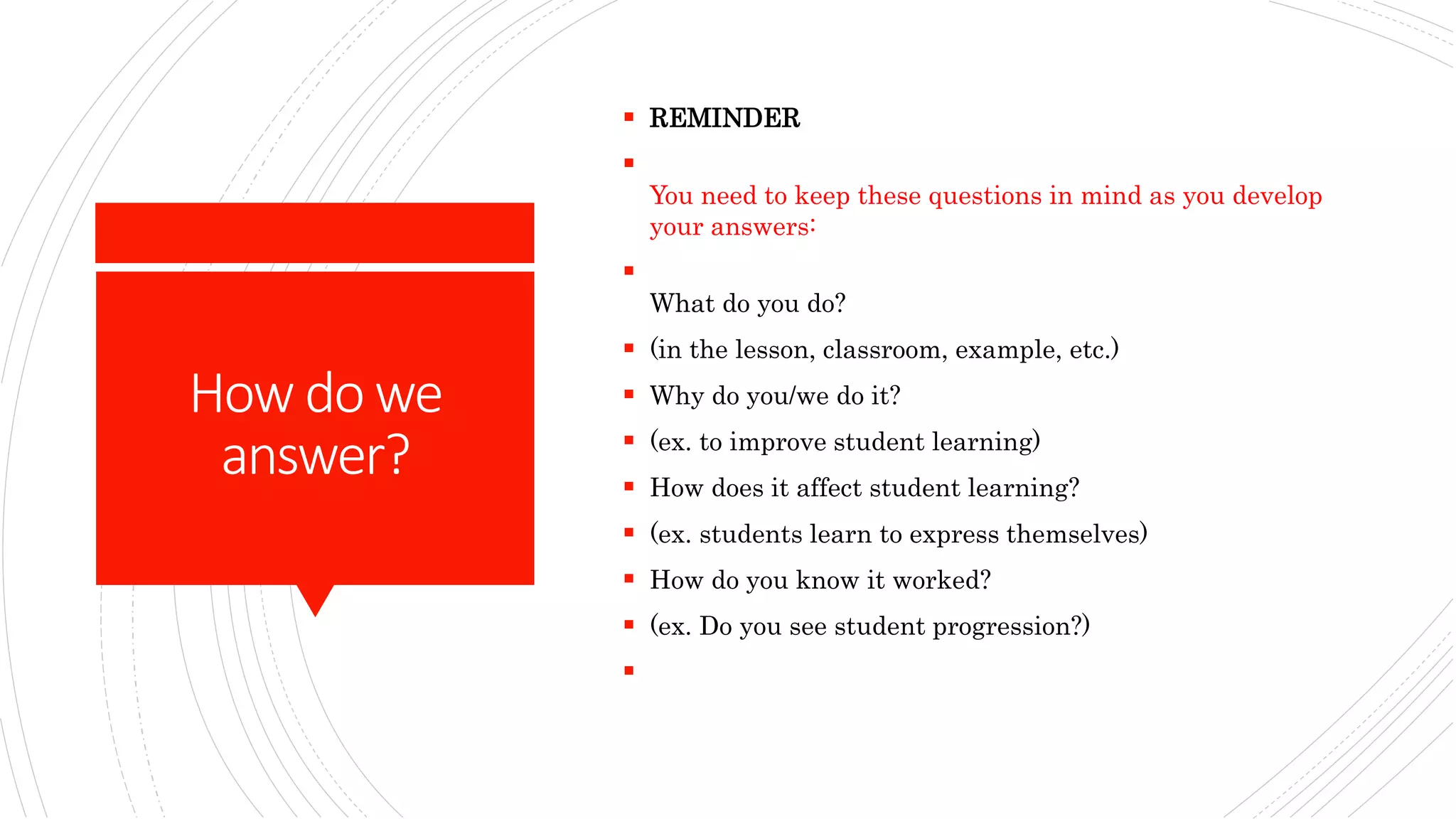
How dowe
answer?
 REMINDER

You need to keep these questions in mind as you develop
your answers:

What do you do?
 (in the lesson, classroom, example, etc.)
 Why do you/we do it?
 (ex. to improve student learning)
 How does it affect student learning?
 (ex. students learn to express themselves)
 How do you know it worked?
 (ex. Do you see student progression?)

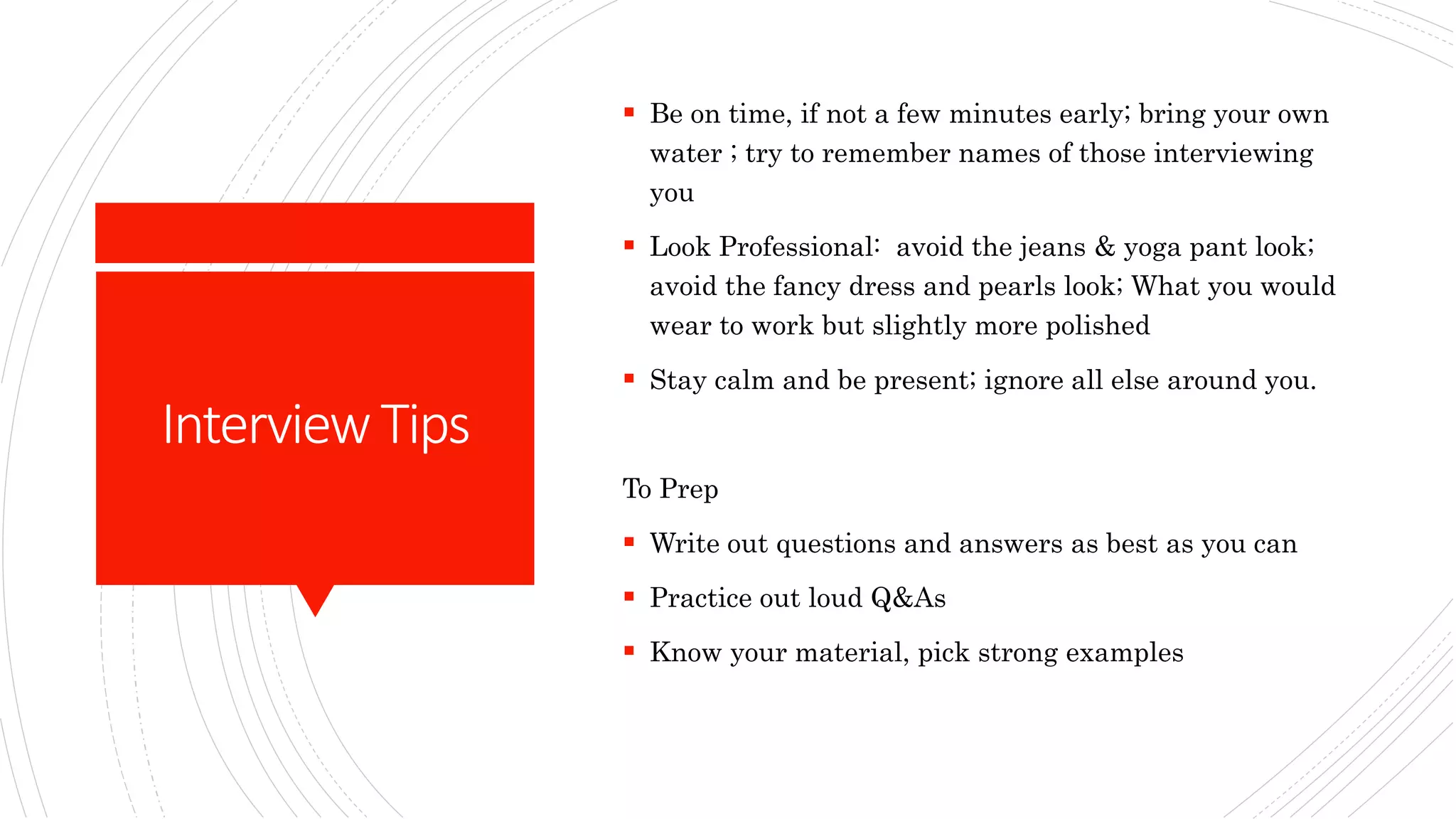
InterviewTips
 Be on time, if not a few minutes early; bring your own
water ; try to remember names of those interviewing
you
 Look Professional: avoid the jeans & yoga pant look;
avoid the fancy dress and pearls look; What you would
wear to work but slightly more polished
 Stay calm and be present; ignore all else around you.
To Prep
 Write out questions and answers as best as you can
 Practice out loud Q&As
 Know your material, pick strong examples
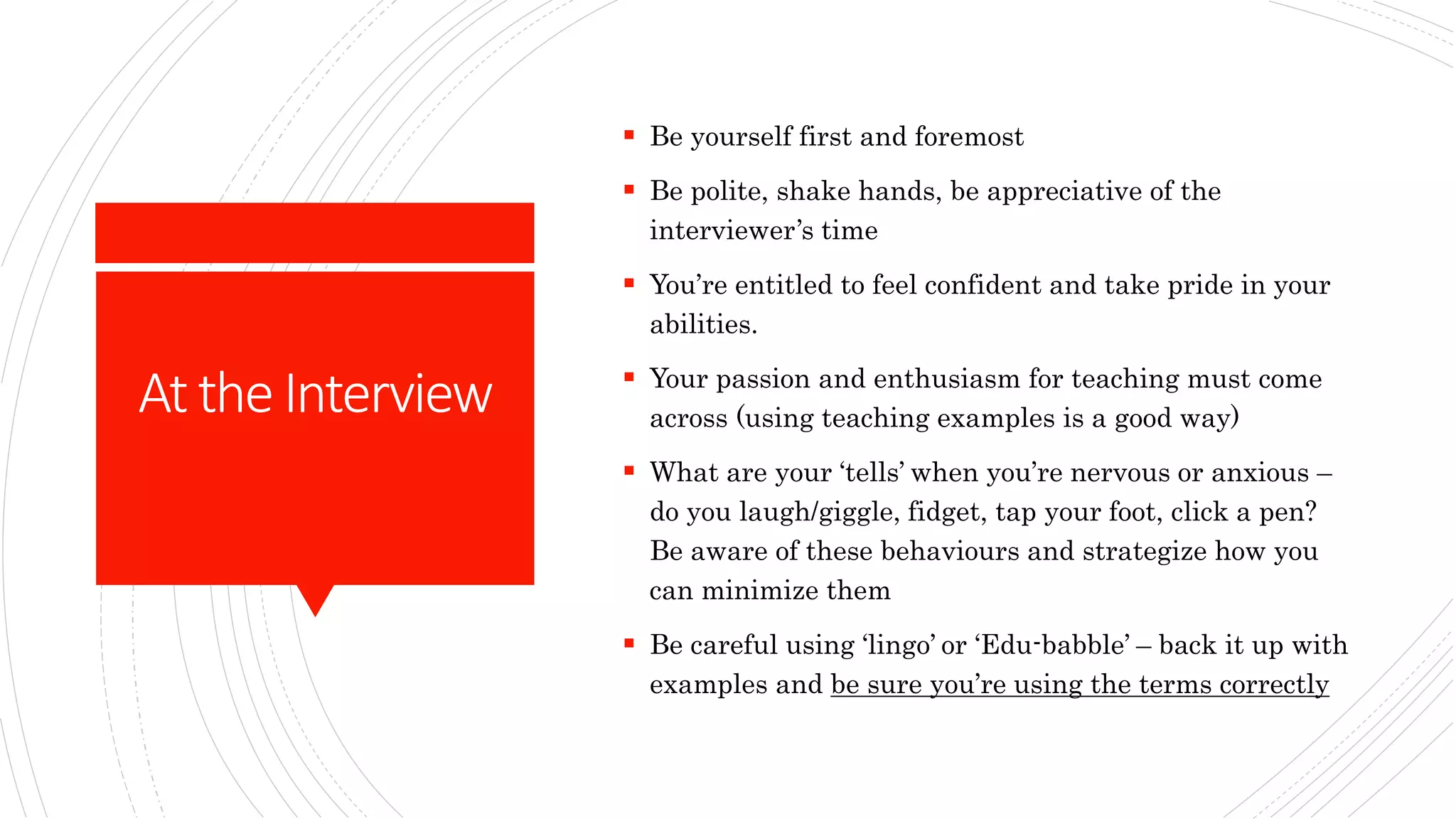
AttheInterview
 Be yourself first and foremost
 Be polite, shake hands, be appreciative of the
interviewer’s time
 You’re entitled to feel confident and take pride in your
abilities.
 Your passion and enthusiasm for teaching must come
across (using teaching examples is a good way)
 What are your ‘tells’ when you’re nervous or anxious –
do you laugh/giggle, fidget, tap your foot, click a pen?
Be aware of these behaviours and strategize how you
can minimize them
 Be careful using ‘lingo’ or ‘Edu-babble’ – back it up with
examples and be sure you’re using the terms correctly
MakeYour
Examples
Matter
TELL WHAT YOU DO, WHY YOU DO IT &
HOW IT AFFECTS STUDENT LEARNING
 Know your material so that you don’t sound too
rehearsed.
 Suggest you come up with 4 or 5 really good examples
of your teaching that can be used for different
questions/answers.
 Make sure you include why this is a good example &
how it affected student learning and success in your
answer.
 If you took a course and want to refer to it then make
sure you explain why you took it and how your new
knowledge/understanding benefits your students.
ALWAYS RELATE BACK TO YOUR STUDENTS
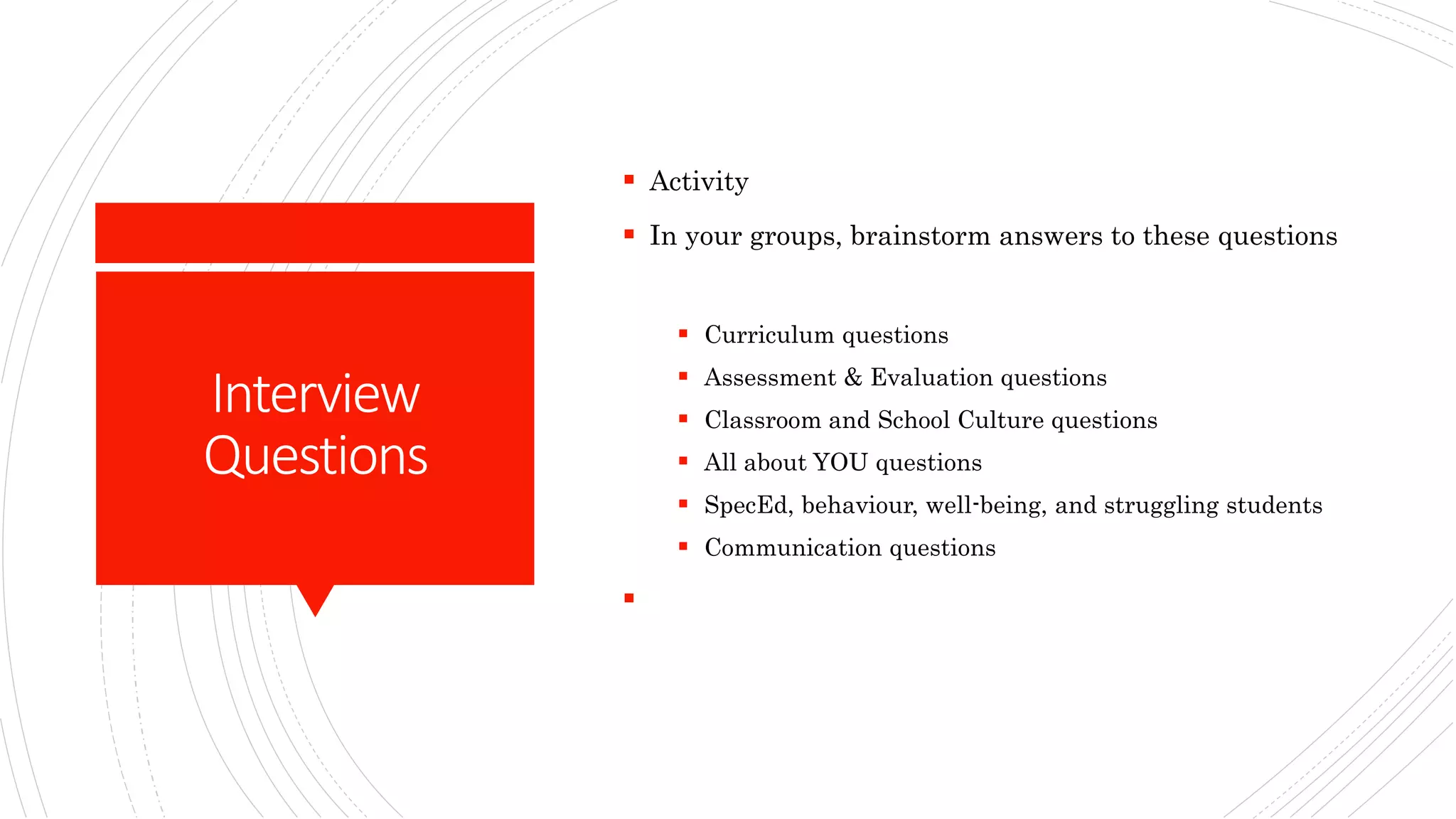
Interview
Questions
 Activity
 In your groups, brainstorm answers to these questions
 Curriculum questions
 Assessment & Evaluation questions
 Classroom and School Culture questions
 All about YOU questions
 SpecEd, behaviour, well-being, and struggling students
 Communication questions

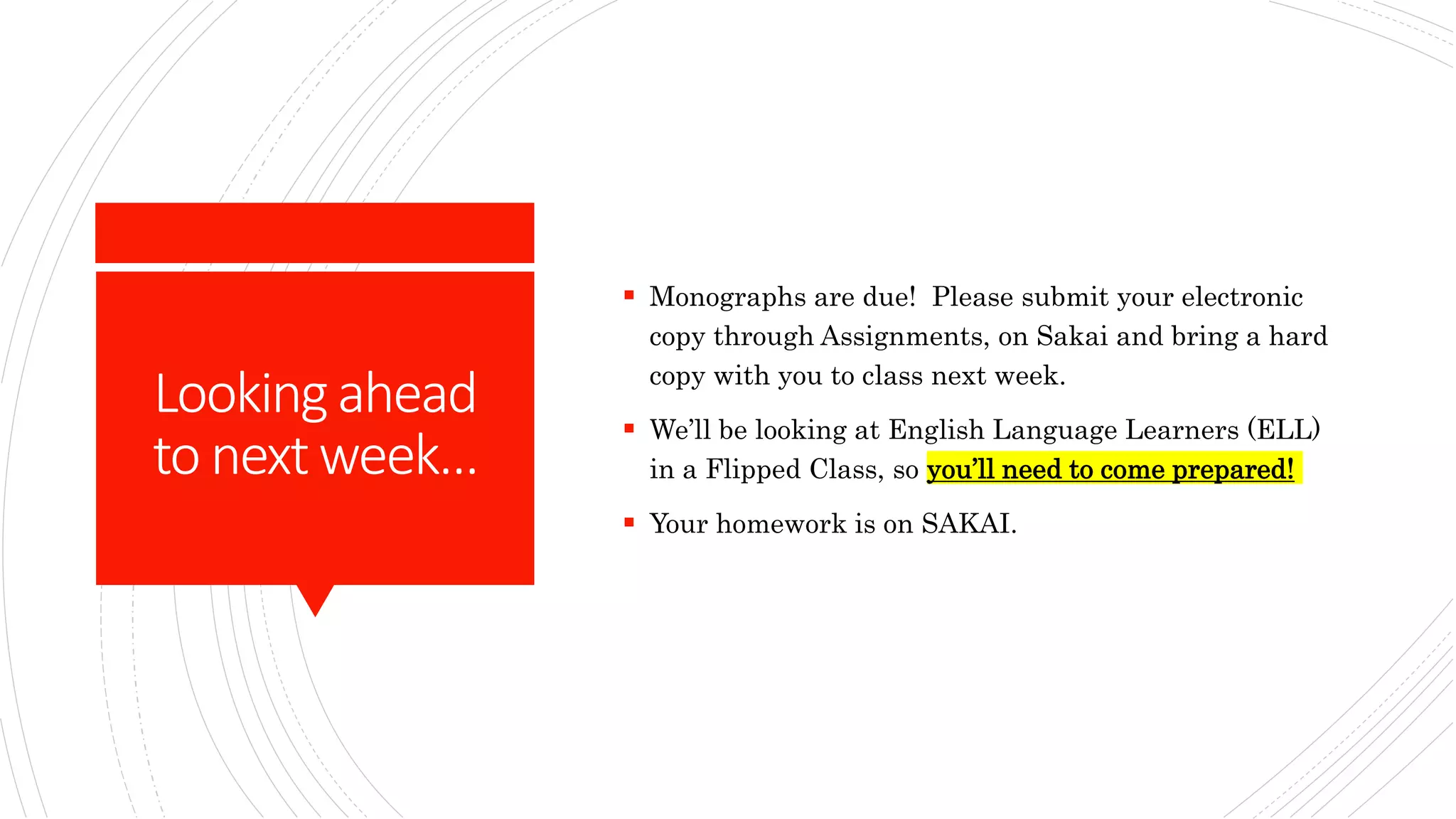
Lookingahead
to nextweek…
 Monographs are due! Please submit your electronic
copy through Assignments, on Sakai and bring a hard
copy with you to class next week.
 We’ll be looking at English Language Learners (ELL)
in a Flipped Class, so you’ll need to come prepared!
 Your homework is on SAKAI.
ExitCard  What is it that sets you apart from other educators?

Ec week 17 lesson notes

  • 1.
  • 2.
    Today’sAgenda  PBP byLauren and Tyler and Maira  What is differentiated Instruction?  Differentiation brainstorm  Monograph Work Time: quick look and Focus on Layout  Portfolio, Cover Letter, Resume, Interview
  • 3.
    SJBP Presenter:____ My Name:_____ During this presentation… I noticed… I felt… I learned… One thing I would like to incorporate into my teaching from this presentation would be…
  • 4.
  • 5.
  • 7.
    Ifthislookscrazy… WHY WOULD A“ONE-LESSON/ASSIGNMENT FITS-ALL” APPROACH IN THE CLASSROOM LOOK ANY LESS CRAZY?
  • 9.
     No twoliteracy learners… • have learned the same expressive and receptive skills • have the same interests (topics, genres, etc.) • acquire literacy skills at the same pace • overcome literacy challenges in exactly the same way
  • 12.
    ENVIRONMEN T Where students learn Noise level Deskarrangement Flexible groupings Minimize distractions Physical and emotional safety (culture of respect, collaboration, and community) CONTENT What student learn Varied materials (levels, topics, diversity in cultures) Student choice Real-Life contexts Multimodal Vocabulary and language support Background knowledge PROCESS How students learn Teaching strategies aligned to multiple learning styles Centered tasks Engaging technology Multimodal presentation Assistive technologies PRODUCT How students demonstrate their learning Varied Assessment strategies Varied Assessment tools Student choice based on interest and learning style Student goal setting and self-reflection
  • 13.
  • 14.
    How doI start? Youneed to… Be aware of each of your students strengths and weaknesses Be aware of the different ways in which your students learn (and take account of this in planning for teaching) Do so, by taking some kind of inventory at the beginning of the year, and make time to continue getting to know your students interests and readiness throughout the year by providing individual meetings for support and feedback
  • 15.
    How doI start? Youcould… Set slightly different tasks for each student / groups of students depending on their skill, interest, or ways of working Set the same task for every student, but give a variety of contexts or a variety of degrees of difficulty to extend the scope of the task or activity Develop related activities that could be handed to students upon completion of work to extend their learning
  • 16.
    WhatdoI do????????  Listen tothe story Lily and the Paper Man. Written by Rebecca Upjohn and Illustrated by Renné Benoit  Get into 4 groups (try and work with someone new)  You are going to create a Literacy Lesson.  Millieu – large Grade 6 class, 30 students, 3 gifted , 5 on IEP working well below grade level, 2 diagnosed with ADHD, 1 on the Autism spectrum  Include Differentiation  Include Multiple Intelligences  Decide on main expectations and if time permits see if you can find other expectations in other curriculum  You have 15 minutes  https://www.youtube.com/watch?v=t31wVSbeLiY
  • 17.
  • 18.
    Buildingyour Portfolio Gather any letters,photos, lesson plans, camp activities, volunteer hours, placements, previous work experience, awards, etc. Include: resume, certificates, references, related work experience, lesson plans and assignments, pictures of your classroom setup, parent communication etc. Decide how you want to display/share This is a continuous story of your journey as an educator It will be added to throughout your career
  • 19.
    Usingyour Portfolio It is unlikelythere will be time to go through every page in an interview. These pages can be useful to open to when answering a question to both job your memory, and provide evidence of your response!
  • 20.
    CoverLetter Generic to theBoard  To Whom It May Concern  Human Resources Staffing Manager  Superintendent of Human Resources  Dear Sir or Madame, Formatting/Conventions  Name, address, date, etc.  Spelling, Grammar, Consistent Verb Tense, Punctuation  Watch out for too many “I”s or other pronouns.
  • 21.
    Bodyof Letter  IntroParagraph  Explain your Education, Background and/or Qualifications:  Qualifications– new, ABQs, AQs  Experiences – give concrete examples  Extra-curriculars: coaching, club work, etc.  Concluding Paragraph  Statement of why you’re a good fit for the position and what you can bring to their Board  Include References & phone numbers  Philosophical Statement
  • 22.
    Philosophyof Education  In acover letter you can imbed your ideas with your experiences and your opening/concluding statements.  Your philosophy of education is personal and reflective  Use First Person  Contains brief statement about the most important idea in education/teaching: why you believe it and how you will make it happen for your students  May contain personal belief about your own learning/teaching styles  Might use a quote as your opening or closing statement
  • 23.
    Resume  2 pagestypically  To Bullet or Not To Bullet  Personal preference / Principal preference  If making statements use Action Verbs: implemented, assessed, developed, etc.  Include Workshops  Include Extra-curriculars  Include References (at least 1 principal or administrator within their board is ideal)
  • 24.
    InterviewPrep Session Believe in yourselfand your abilities. You’re more ready than you know.
  • 25.
    TheInterview  25 minutes,typically 5 questions, usually strict time limit  Environment – Board office vs hotel conference room  Any questions? When will a decision be made?
  • 26.
    Whatarethey goingtoaskus?  Curriculum basedquestions – literacy, numeracy, curriculum docs  Teaching Strategies – DI, instructional strategies, resources  Behaviour/Spec Ed / Struggling Student / Discipline  Assessment / Evaluation  Working as a Team, School Culture, School Climate  Communication – with students, parents, colleagues  About You: effective teacher, weaknesses, teaching philosophy, personality traits, what you bring to the table 
  • 27.
    How dowe answer?  REMINDER  Youneed to keep these questions in mind as you develop your answers:  What do you do?  (in the lesson, classroom, example, etc.)  Why do you/we do it?  (ex. to improve student learning)  How does it affect student learning?  (ex. students learn to express themselves)  How do you know it worked?  (ex. Do you see student progression?) 
  • 28.
    InterviewTips  Be ontime, if not a few minutes early; bring your own water ; try to remember names of those interviewing you  Look Professional: avoid the jeans & yoga pant look; avoid the fancy dress and pearls look; What you would wear to work but slightly more polished  Stay calm and be present; ignore all else around you. To Prep  Write out questions and answers as best as you can  Practice out loud Q&As  Know your material, pick strong examples
  • 29.
    AttheInterview  Be yourselffirst and foremost  Be polite, shake hands, be appreciative of the interviewer’s time  You’re entitled to feel confident and take pride in your abilities.  Your passion and enthusiasm for teaching must come across (using teaching examples is a good way)  What are your ‘tells’ when you’re nervous or anxious – do you laugh/giggle, fidget, tap your foot, click a pen? Be aware of these behaviours and strategize how you can minimize them  Be careful using ‘lingo’ or ‘Edu-babble’ – back it up with examples and be sure you’re using the terms correctly
  • 30.
    MakeYour Examples Matter TELL WHAT YOUDO, WHY YOU DO IT & HOW IT AFFECTS STUDENT LEARNING  Know your material so that you don’t sound too rehearsed.  Suggest you come up with 4 or 5 really good examples of your teaching that can be used for different questions/answers.  Make sure you include why this is a good example & how it affected student learning and success in your answer.  If you took a course and want to refer to it then make sure you explain why you took it and how your new knowledge/understanding benefits your students. ALWAYS RELATE BACK TO YOUR STUDENTS
  • 31.
    Interview Questions  Activity  Inyour groups, brainstorm answers to these questions  Curriculum questions  Assessment & Evaluation questions  Classroom and School Culture questions  All about YOU questions  SpecEd, behaviour, well-being, and struggling students  Communication questions 
  • 32.
    Lookingahead to nextweek…  Monographsare due! Please submit your electronic copy through Assignments, on Sakai and bring a hard copy with you to class next week.  We’ll be looking at English Language Learners (ELL) in a Flipped Class, so you’ll need to come prepared!  Your homework is on SAKAI.
  • 33.
    ExitCard  Whatis it that sets you apart from other educators?