THYROID GLAND
YATICH HILLARY KIPKORE
HSM201-0181/2017
MBChB IV
ANATOMY
 Thyroid is an endocrine gland overlying the upper part of the trachea and overlies
vertebra C5-T1.
 It is made up of two lobes each measuring 5cm X 2.5cm X 2.5cm, weighs 20-25g and
connected by isthmus. It is larger in females than males and tends to increase in size
during pregnancy
 Covered by 2 capsules. A true capsule derived from condensation of the connective tissue
of the gland and a false capsule derived from the pretracheal layer of the deep fascia of the
neck.
EMBRYOLOGY
 It develops from the endodermal cells of the floor of the pharynx( area of tongue
development)
 begins as a diverticulum at the dorsum of the tongue between the tuberculum
impar and hypo bronchial eminence.
 The thyroid diverticulum elongates to form thyro-glossal duct. The TG duct
elongates distally between hyoid and thyroid cartilage where it divides into two
parts
HISTOLOGY
The thyroid gland contains numerous follicles composed of epithelial and colloid.
The major constituent of the colloid is the large glycoprotein thyroglobulin,which
contain the thyroid hormones within its molecules.
Parafolicular or C cells are located between the follicles and produce calcitonin.
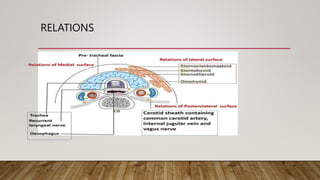
RELATIONS
BLOOD SUPPLY
PHYSIOLOGY
 Produces 3 hormones : thyroxine(90%) T4 ,triiodothyronineT3(9%) and calcitonin.
 SYNTHESIS;
 Iodine trapping
 Synthesis and secretion of thyroglobulin
 Oxidation of iodides
 Organification of thyroglobulin
 Coupling reaction
 Storage
REGULATION OF SECRETION
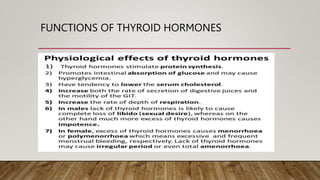
FUNCTIONS OF THYROID HORMONES
BENIGN THYROID
Benign non toxic conditions
• Diffuse hyperplastic and nodular goiter
Benign toxic conditions
• Toxic multinodular goiter
• Graves disease
• Toxic adenoma
Inflammatory conditions
• Chronic (Hashimoto’s ) thyroiditis
• Subacute ( De Quervain’s) thyroiditis
• Riedel’s thyroiditis
NON TOXIC GOITER
 Enlargement of the thyroid gland that does not result from inflammatory or
neoplastic process and not associated with abnormal thyroid function.
 Endemic goiter-occurs in more than 10% of the population and sporadic goiter do not
occur in general population and related to environmental and genetic factors.
ETIOLOGY
IODINE DEFICIENCY- causes goiter when there is less than 50mcg/d (normal children
(100-200) adults (150-250)). Very low intake is associated with hypothyroidism and
cretinism. However ,iodine excess can cause non toxic goiter in setting of autoimmune
thyroid disease.
ETIOLOGY CONT…
DYSHORMONOGENESIS- due to inherited defect in the thyroid hormone
biosynthesis pathway.
HEAD AND NECK RADIATION- results in benign or malignant thyroid nodules.
DRUGS- propylthiouracil, lithium ,phenylbutazone etc.
EVIRONMENTALAGENTS- phenolic and phthalate ester derivatives and resorcinol
found in downstream of coal and shale mines.
FOOD- vegetables of genus Brassica e.g. cabbage , turnips, brussels sprouts and
rutabagas. Seaweed, millet, cassava etc.
PATHOGENESIS
Persistent growth stimulation by TSH causing diffuse hyperplasia with all follicles
active and uniform uptake of iodine.
A mixed pattern occurs with areas of active colloid lobules and inactive colloid.
lobules Active colloid lobules becomes more hyperplastic and vascularized and
hemorrhage may occur causing central necrosis and leaving a ring of surrounding
ring of active follicles.
DIFFUSE HYPERPLASTIC GOITER
The goiter appears in childhood in endemic areas but, in sporadic cases, it usually occurs
at puberty when metabolic demands are high.
The goiter may regress if TSH stimulation ceases, but it tends to recur later at times of
stress such as pregnancy.
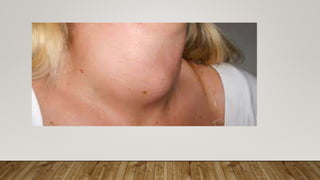
The goiter is soft, diffuse and may become large enough to cause discomfort.
A colloid goiter is a late stage of diffuse hyperplasia, when TSH stimulation has ceased
and when there are many inactive follicles full of colloid.
NODULAR GOITER
Nodules are usually multiple, forming a multinodular goiter.
Occasionally, only one macroscopic nodule(solitary nodule) is found, but
microscopic changes are present throughout the gland.
Nodules may be colloid or cellular, and cystic degeneration and hemorrhage are
common, as is subsequent calcification.
Nodules appear early in endemic goiter and later (20-30 years) in sporadic goiter,
although the patient may be unaware of the goiter until their late 40s or 50s.
All types of simple goiter are more common in the female than in the male.
CLINICAL PRESENTATION
Tracheal compression-dyspnea and stridor.
Solid food and pill dysphagia if the goiter extends posteriorly
Hoarseness due to vocal cord dysfunction-recurrent laryngeal nerve compression
Change in the pitch of the voice-superior laryngeal nerve compression
Compression of the venous outflow through the thoracic inlet by a mediastinal
goiter-facial plethora, dilated neck and upper thoracic veins.
HISTORY AND PHYSICAL EXAMINATION
Obtain a careful diet history for iodine deficiency/iodine excess from medications.
Record any history of head and neck radiation exposure, especially during
childhood.
Family history-inherited forms of dyshormonogenesis in the pediatric patient,
familial papillary carcinoma of the thyroid and familial forms of medullary thyroid
cancer.
Evaluate of the shape, asymmetry, size, and consistency of nontoxic goiters;
lymphadenopathy; and assess thyroid function
CONT..
 Assess the patient's voice for hoarseness.
 Pemberton maneuver?
 Facial plethora or engorgement of the neck veins
 Examine patients for signs of thyroid dysfunction
 Hypothyroidism-sallow complexion, dysarthric speech, mental slowing, weight gain
without change in appetite, cold intolerance, constipation, hypersomnia, and delayed
relaxation of deep tendon reflexes.
 Hyperthyroidism-tachycardia, atrial arrhythmias, diaphoresis, weight loss without
change in appetite, heat intolerance, hyperdefecation, palmar erythema, lid lag,
tremor, and brisk reflexes.
DIAGNOSIS
Usually through history and examination
The nodules are palpable and often visible; they are smooth, firm not hard, the
goitre is painless and moves freely on swallowing.
Hardness and irregularity, due to calcification, may simulate carcinoma.
A painful nodule, sudden appearance or rapid enlargement of a nodule raises
suspicion of carcinoma but is usually due to hemorrhage into a simple nodule.
Differentiating it from autoimmune thyroiditis may be difficult because the two
conditions frequently coexist.
INVESTIGATIONS
LABORATORY
Thyroid function tests-serum TSH
 TSH is low, measure serum free T4 and total T3-to confirm the diagnosis of
thyrotoxicosis.
IMAGING
Ultrasonography-gold standard for estimating the number and size of nodules
but is inaccurate in the clinical setting for measuring the volume of large goiters.
FNAC-only required for a nodule within the goiter that demonstrates
ultrasound features of concern. Biopsy should be performed under ultrasound
guidance to ensure the correct nodule is sampled.
CT and MRI-expensive but excellent for assessing tracheal compression and
intrathoracic extension of the goiter.
MANAGEMENT
NON OPERATIVE
Iodine supplementation
Levothyroxine (L-thyroxine, or T4) therapy 0.15–0.2 mg daily for a few months.
May regress.
Radioactive iodine therapy, levothyroxine (L-thyroxine, or T4) therapy
OPERATIVE
Thyroidectomy-total or subtotal- causes rapid relief for obstructive symptoms.
. In case of a multinodular change especially in older patients, total lobectomy on
the more affected side is the appropriate .
Radioactive iodine and thyroid hormone replacement therapy is given post
subtotal thyroidectomy . Prevent recurrence .
TOXIC GOITER
Thyrotoxicosis vs Hyperthyroidism? Hyperthyroidism is characterized by increased
thyroid hormone synthesis and secretion from the thyroid gland, whereas
thyrotoxicosis refers to the clinical syndrome of excess circulating thyroid
hormones, irrespective of the source.
Clinical types are:
• diffuse toxic goiter (Graves’ disease);
• toxic nodular goiter;
• toxic nodule;
• hyperthyroidism due to rarer causes.
GRAVES DISEASE
Graves disease is an organ-specific autoimmune disorder characterized by a variety
of circulating antibodies, including common autoimmune antibodies, as well as
anti-thyroid peroxidase (anti-TPO) and antithyroglobulin (anti-TG) antibodies.
The most important autoantibody is thyroid-stimulating immunoglobulin (TSI)
which is directed toward epitopes of the thyroid-stimulating hormone (TSH)
receptor and acts as a TSH-receptor agonist.
This results in the characteristic picture of Graves thyrotoxicosis, with a diffusely
enlarged thyroid, very high radioactive iodine uptake, and excessive thyroid
hormone levels compared with a healthy thyroid .
CLINICAL FEATURES
GRAVE CONT..
May be associated with other autoimmune diseases, such as pernicious anemia,
myasthenia gravis, vitiligo, adrenal insufficiency, and type 1 diabetes mellitus
TOXIC NODULAR GOITER
Complicating simple nodular goiter.
Diffuse and nodular enlargement of the thyroid. Some nodules will show
hyperfunctioning acini while other acini will be inactive.
Usually in the middle-aged or elderly, and very infrequently is associated with eye
signs.
OTHER CAUSES OF TOXIC THYROID
 Iodide-induced thyrotoxicosis (Jod-Basedow syndrome) esp in patients with areas of
thyroid autonomy, such as a multinodular goiter or autonomous nodule. The
thyrotoxicosis appears to be a result of loss of the normal adaptation of the thyroid to
iodide excess
 Struma ovarii-ectopic thyroid tissue associated with dermoid tumors or ovarian
teratomas that can secrete excessive amounts of thyroid hormone .Metastatic
follicular thyroid carcinoma maintains the ability to make thyroid hormone and can
cause thyrotoxicosis in patients with bulky tumors
 Patients with molar hydatidiform pregnancy or choriocarcinoma have extremely high
levels of beta human chorionic gonadotropin (βHCG) that can weakly activate the TSH
receptor.
MANAGEMENT
Involves use of antithyroid drugs, surgery and radioiodine.
Antithyroid drugs- mostly used are carbimazole and propylthiouracil. They are
used to restore the patient to a euthyroid state and to maintain this for a
prolonged period hoping that a permanent remission will occur.
Advantages-No surgery and no use of radioactive materials.
Disadvantages-Prolonged Tx with a failure rate of at least 50%. Recurrence of the
hyperthyroidism is certain when the drug is discontinued. Antithyroid drugs
cannot cure a toxic nodule.
MX CONT..
Radioiodine- destroys thyroid cells reduces the mass of functioning thyroid
tissue.
Disadvantages-Isotope facilities must be available. The patient must be
quarantined while radiation levels are high and avoid pregnancy and close
physical contact, particularly with children. Eye signs may be aggravated.
PRE OPERATION PREPARATION
Preoperative preparation includes antithyroid medication, stable (cold) iodine
treatment (to decrease gland vascularity), and beta-blocker therapy
Generally, antithyroid drug therapy should be administered until thyroid functions
normalize (4-8 wk.). Titrate propranolol until the resting pulse rate is less than 80
bpm.
Finally, administer iodide as SSKI (1-2 drops bid for 10-14 d) before surgery.
An additional benefit from stable iodide therapy, besides the reduction in thyroid
hormone excretion, is a demonstrated decrease in thyroid blood flow and
possible reduction in blood loss during surgery
SURGERY
AIM
 Reducing the mass of overactive tissue.
 Subtotal thyroidectomy- patient returns to euthyroid state after transient
hypothyroidism.
 Total thyroidectomy- patient requires thyroid hormone replacement.
Advantages-the cure is rapid and the cure rate is high if surgery has been adequate.
Disadvantages-Recurrence of thyrotoxicosis in at least 5% of cases of subtotal
thyroidectomy. Risk of permanent hypoparathyroidism and nerve injury. Poor cosmetic
result from the scar.
COMPLICATIONS
 Hemorrhage
 Recurrent laryngeal nerve paralysis and voice change
 Thyroid insufficiency
 Parathyroid insufficiency
 Thyrotoxic crisis (storm)
 Wound infection
 Hypertrophic or keloid scar
 Stitch granuloma
 Cardiac or respiratory events-deep vein thrombosis and pulmonary embolism are uncommon
HYPOTHYROIDISM
Hypothyroidism is a common endocrine disorder resulting from deficiency of
thyroid hormones.
It can be primary, in which the thyroid gland produces insufficient amounts of
thyroid hormones or secondary - that is, lack of thyroid hormone secretion due to
inadequate secretion of either thyrotropin from the pituitary gland or TRH from the
hypothalamus-tertiary hypothyroidism.
The patient's presentation may vary from asymptomatic to, rarely, coma with
multisystem organ failure (myxedema coma).
CLINICAL PRESENTATION
THYROIDITIS
Inflammation of the thyroid.
TYPES
• Hashimoto thyroiditis
• Subacute granulomatous thyroiditis/DeQuervain thyroiditis
• Riedel's /fibrous thyroiditis
HASHIMOTO THYROIDITIS
Occur in middle aged and elderly patients
Common in female than male 20:1
Causes painless thyroid enlargement
Associated with hypothyroidism.
Pathogenesis
Autoimmune disease
GROSS PICTURE
Symmetrically enlarged thyroid gland
Firm consistency
Intact non adherent capsule
Cut surface pale, homogenous and sometimes nodular
MICROSCOPY
Dense inflammatory infiltrate consisting of ; lymphocytes, macrophages and
plasma cells
Some acini are atrophied while others show regenerative changes( lined with
deeply eosinophilic granular cytoplasm termed as HURTHLE CELLS( Hurtle cell
metaplasia)
Fibrosis
Hurtle cell metaplasia
Malignant transformation.
SUBACUTE GRANULOMATOUS
THYROIDITIS/DEQUERVAIN THYROIDITIS
Occurs between 30-50yrs
More common in females than male 5:1
Cause painful thyroid enlargement
Associated with transient hyperthyroidism
Pathogenesis
Associated with viral infection e.g cocksackie, mumps and adenoviruses.
GROSS PICTURE
Unilateral or bilateral enlargement
Intact/slightly adherent capsule
Cut areas show scattered firm yellowish areas
MICROSCOPIC
Aggregation of neutrophils
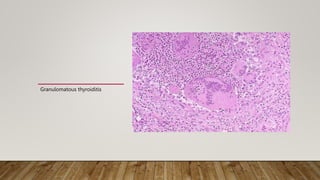
Pool of colloid surrounded by multinucleated giant cells, histiocytes and
lymphocytes
Fibrosis
Granulomatous thyroiditis
RIEDEL’S THYROIDITIS
Rare, unknown cause, affect both sexes equally.
GROSS PICTURE
Hard in consistency and adherent to surrounding structures
MICROSCOPIC PICTURE
Dense fibrous tissue replacing normal thyroid gland and penetrating the capsule
to surround neck structures.
CENTRAL HYPOTHYROIDISM
Results when the hypothalamic-pituitary axis is damaged by:
Pituitary adenoma
Tumors impinging on the hypothalamus
History of brain irradiation
Drugs (e.g. dopamine, lithium)
Sheehan syndrome
MYXEDEMA
Myxedema is the hypothyroidism in adults, characterized by generalized
edematous appearance-Swelling of the face, bagginess under the eyes, non-
pitting edema and atherosclerosis.
Other features include: Anemia, fatigue and muscular sluggishness, extreme
somnolence, menorrhagia and decreased cardiovascular functions such as
reduced rate and force of contraction of the heart, cardiac output and blood
volume; increase in body weight, constipation, mental sluggishness, depressed
hair growth, scaliness of the skin, frog-like husky voice and cold intolerance.
CRETINISM
 Cretinism is the hypothyroidism in children, characterized by stunted growth.
 Cretinism occurs due to congenital absence of thyroid gland, genetic disorder or lack
of iodine in the diet.
 A newborn baby with thyroid deficiency may appear normal at the time of birth but a
few weeks after birth, the baby starts developing signs like sluggish movements and
croaking sound while crying.
 There is stunted growth with bloated body. The tongue becomes so big that it hangs
down with drooling. The big tongue obstructs swallowing and breathing. The tongue
may sometimes choke the baby.
MANAGEMENT
The treatment goals for hypothyroidism are the reversal of clinical progression
and the corrections of metabolic derangements
Levothyroxine is considered the treatment of choice.
Surgery is indicated for large goiters that compromise tracheoesophageal
function; surgery is rarely needed in patients with hypothyroidism and is more
common in the treatment of hyperthyroidism.
THYROID NEOPLASM
CLASSIFICATION
A. Benign
 Follicular adenoma – colloid (commonest), embryonal, fetal.
 Hurthle cell adenoma.
Papillary adenoma – low-grade papillary carcinoma.
B. Malignant (Dunhill classification).
a. Differentiated.
Papillary carcinoma (60%).
Follicular carcinoma (17%).
CONT…
Papillofollicular carcinoma behaves like papillary carcinoma of thyroid.
Hurthle cell carcinoma behaves like follicular carcinoma.
b. Undifferentiated-Anaplastic carcinoma (13%).
c. Medullary carcinoma (6%).
d. Malignant lymphoma (4%)
e. Secondary(rare) – From colon, kidney, melanoma.
ETHIOPATHOGENESIS
• Radiation either external or radioiodine can cause papillary carcinoma thyroid-
Chernobyl nuclear disaster in Ukraine in 1986.
• Pre-existing multinodular goiter-can turn into follicular carcinoma.
• Family history-Medullary carcinoma thyroid is often familial.
• Hashimoto’s thyroiditis may predispose to papillary carcinoma of thyroid.
PAPILLARY CARCINOMA
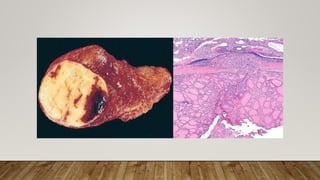
• Most common(60%)- slowly progressive and less aggressive tumour.
• Common in females and younger age group.
• Etiology-Radiation either external or radioactive iodine therapy.
• TSH levels in the blood of these patients are high and so it is called as hormone
dependent tumor.
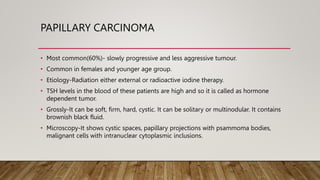
• Grossly-It can be soft, firm, hard, cystic. It can be solitary or multinodular. It contains
brownish black fluid.
• Microscopy-It shows cystic spaces, papillary projections with psammoma bodies,
malignant cells with intranuclear cytoplasmic inclusions.
FOLLICULAR CARCINOMA
It accounts for about 15% of thyroid cancers and is more common in the elderly
and in females.
It is a well-differentiated tumor of thyroid epithelium, second in incidence to
papillary thyroid cancer.
It can occur either de novo or in a pre-existing multinodular goitre.
It can be invasive-blood spread common or non-invasive—blood spread not
common.
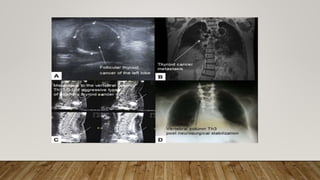
Typical features: Capsular invasion and angioinvasion- spreading into the bones,
lungs, liver and occasionally lymph nodes.
CONT..
• Occasionally associated with a history of radiation exposure.
• It is more malignant than papillary carcinoma, spreading hematogenous with
distant metastases.
• These tumors are more typically uninodular when compared to papillary thyroid
carcinoma.
• While vascular invasion is frequent with follicular carcinoma, spread to lymph
nodes is uncommon, occurring in only 8 to 13 percent of cases
CLINICAL FEATURES
PAPILLARY CARCINOMA
 Soft or hard or firm, solid or cystic, solitary or
multinodular thyroid swelling.
 Compression features are uncommon.
 Palpable discrete lymph nodes in the neck (40%) .
 May present with metastasis to neck lymph nodes only
FOLLICULAR CARCINOMA
 Swelling in the neck-firm or hard and nodular.
 Tracheal compression and stridor.
 Dyspnoea, haemoptysis, chest pain when there are
metastases to the lungs.
 Recurrent laryngeal nerve involvement causes hoarseness
of voice, +ve ‘Berry’s sign’ signifies advanced malignancy
(infiltration into the carotid sheath and so absence of
carotid pulsation).
 Pulsatile secondary malignancies in the skull and long
bones.
INVESTIGATIONS
PAPILLARY CARCINOMA
 FNAC of thyroid nodule and lymph node.
 Radioisotope scan-cold nodule.
 High TSH levels
 Plain X-ray neck shows fine calcification.
Nodular goitre shows coarse – ring/rim
calcification.
 U/S neck or CT scan neck to identify
nonpalpable nodes in neck.
FOLLICULAR CARCINOMA
 FNAC inconclusive-because capsular- and
angioinvasion, which are the main features in
follicular carcinoma, cannot be detected by
FNAC.
 Frozen section biopsy -If unavailable, then
hemithyroidectomy is done.
 U/S abdomen, chest X-ray, X-ray bones to r/o
metastases
 Tru cut biopsy gives tissue diagnosis, but
danger of hemorrhage and injury to vital
structures like trachea, recurrent laryngeal
nerve.
MANAGEMENT
PAPILLARY CARCINOMA
Total or near total thyroidectomy.
Suppressive dose of L-Thyroxine 0.3 mg OD life long. TSH level should be < 0.1 m
U/L.
MRND (modified radical neck dissection) type III-if lymph nodes are involved.
Prognosis-Excellent with 90% survival at 10yrs
FOLLICULAR CARCINOMA
Total thyroidectomy is done, along with block dissection whenever lymph nodes
are enlarged.
Maintenance dose of L-Thyroxine 0.1 mg O.D or T3 80 μg/day is given lifelong.
On table frozen section biopsy is useful in negative FNAC but doubtful cases.
If secondaries are detected therapeutic dose radioactive iodine is given orally.
Secondaries in bone are treated by external radiotherapy.
Internal fixation should be done whenever there is pathological fracture.
HURTHLE CELL CARCINOMA
Is a variant of follicular carcinoma of thyroid which contains abundant oxyphill cells. It spreads
more commonly to regional lymph nodes than follicular carcinoma of thyroid.
Note:
 Hurthle cell carcinoma does not take up radioactive iodine
 It secretes thyroglobulin
 Poorer prognosis than follicular cell carcinoma
 Regional nodes are commonly involved than follicular carcinoma
 Abundant oxyphill cells are specific
 Total thyroidectomy, MRND and TSH suppression is the treatment
ANAPLASTIC CARCINOMA
One of the least common thyroid carcinomas-1.6% of all thyroid cancers.
It occurs in elderly and is a very aggressive tumour of short duration, presents with
a swelling in thyroid region which is rapidly progressive causing—
i. Stridor and hoarseness of voice due to tracheal obstruction.
ii. Dysphagia.
iii. Fixity to the skin.
iv. Positive Berry’s sign—involvement of carotid sheath leads to absence of carotid
pulsation.
CONT..
Swelling is hard, with involvement of isthmus and lateral lobes.
FNAC is diagnostic.
Tracheostomy and isthmectomy has got a role to relieve respiratory obstruction
temporarily.
Treatment is external radiotherapy, as usually thyroidectomy is not possible.
Adriamycin as chemotherapy.
Poorest prognosis of all thyroid malignancies and one of the worst survival rates
of all malignancies in general.
MEDULLARY CARCINOMA OF THYROID (MCT)
 Uncommon (5%) type of thyroid malignancy.
 Arises from the parafollicular ‘C’ cells derived from the neural crest and located mostly at the
upper pole of the thyroid gland.
 It contains characteristic ‘amyloid stroma’ wherein malignant cells are dispersed.
Immunohistochemistry reveals calcitonin in amyloid.
 In these patients blood levels of calcitonin both basal as well as that following calcium or
pentagastrin stimulation is high, a very useful tumour marker.
 Tumour also secretes serotonin, prostaglandins, ACTH and VIP(PARANEOPLASTIC SYNDROME)
 It spreads mainly to lymph nodes (60%).
CONT..
• It can be:
• Sporadic-usually solitary(70%)
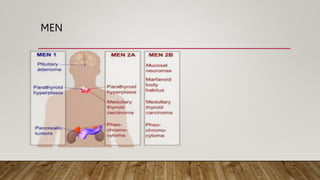
• Associated with MEN II syndrome and pheochromocytoma with hypertension.
When associated with MEN type II B plus pheochromocytoma (Sipple’s
disease) it is most aggressive.
• Familial MCT (20%)-commonly multicentric, AD mutations on chromosome
10.
• There may be mucosal neuromas in lips, oral cavity, tongue, eyelids with marfanoid
features.
• MCT is not TSH dependent and does not take up radioactive iodine.
MEN
CLINICAL FEATURES
A slight female preponderance is observed.
Thyroid swelling often with enlargement of neck lymph nodes.
Diarrhoea, flushing (30%).
Hypertension, pheochromocytomas and mucosal neuromas when associated with
MEN II syndrome.
Sporadic and familial types occur in adulthood whereas cases associated with
MEN syndrome II occur in younger age groups
INVESTIGATIONS
FNAC: shows amyloid deposition with dispersed malignant cells and “C” cell
hyperplasia.
Tumour marker: Calcitonin level will be higher.
U/S abdomen.
U/S neck to see neck nodes. CT neck and chest to identify neck and mediastinal
nodes.
Urinary VMA, urinary catecholamines, urinary metanephrine, serum calcium,
serum parathormone estimation.
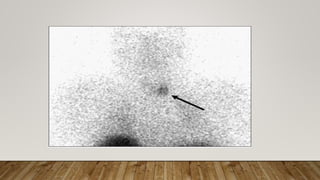
111 Indium octreotide scanning-useful in detecting MCT(70% sensitivity). Also
used for postop follow up to find out residual/metastatic disease.
TREATMENT
 Surgery is the main therapeutic modality. Total thyroidectomy with central node
dissection (level 6) in all patients even if there are no nodes in the neck plus
maintenance dose of L-thyroxine.
 Neck lymph nodes block dissection if lymph nodes are involved. Later regular U/S
neck is done to detect early neck nodes.
 No role of suppressive hormone therapy or radioactive iodine therapy.
 External beam radiotherapy for residual tumour disease.
 If there is associated pheochromocytoma it should be treated surgically by
adrenalectomy, followed later by thyroidectomy.
MALIGNANT LYMPHOMA
 It is Non-HL type.
 Associated with pre-existing Hashimoto’s thyroiditis
 CLINICAL FEATURES
 The most common clinical presentation is an enlarging thyroid mass.
 Patients may have evidence of hypothyroidism.
 Local extension into the aerodigestive tract or surrounding tissues may cause
dysphagia, dyspnea, or symptoms of pressure in the neck.
 Vocal fold paralysis and hoarseness suggest involvement of the recurrent laryngeal
nerve.
CONT..
Regional and distant lymphadenopathy is common
FNAC is useful to diagnose the condition (Often trucut biopsy).
Chemotherapy is the mainstay of treatment. Doxorubicin or CHOP (i.e.
cyclophosphamide, hydroxydaunomycin, Oncovin [vincristine], prednisone) is the
commonly used chemotherapeutic regimen.
Rarely, total thyroidectomy is done to enhance the results.
End
Thank you

THYROID_GLAND[1].pptx

  • 1.
    THYROID GLAND YATICH HILLARYKIPKORE HSM201-0181/2017 MBChB IV
  • 2.
    ANATOMY  Thyroid isan endocrine gland overlying the upper part of the trachea and overlies vertebra C5-T1.  It is made up of two lobes each measuring 5cm X 2.5cm X 2.5cm, weighs 20-25g and connected by isthmus. It is larger in females than males and tends to increase in size during pregnancy  Covered by 2 capsules. A true capsule derived from condensation of the connective tissue of the gland and a false capsule derived from the pretracheal layer of the deep fascia of the neck.
  • 4.
    EMBRYOLOGY  It developsfrom the endodermal cells of the floor of the pharynx( area of tongue development)  begins as a diverticulum at the dorsum of the tongue between the tuberculum impar and hypo bronchial eminence.  The thyroid diverticulum elongates to form thyro-glossal duct. The TG duct elongates distally between hyoid and thyroid cartilage where it divides into two parts
  • 5.
    HISTOLOGY The thyroid glandcontains numerous follicles composed of epithelial and colloid. The major constituent of the colloid is the large glycoprotein thyroglobulin,which contain the thyroid hormones within its molecules. Parafolicular or C cells are located between the follicles and produce calcitonin.
  • 7.
  • 8.
  • 9.
    PHYSIOLOGY  Produces 3hormones : thyroxine(90%) T4 ,triiodothyronineT3(9%) and calcitonin.  SYNTHESIS;  Iodine trapping  Synthesis and secretion of thyroglobulin  Oxidation of iodides  Organification of thyroglobulin  Coupling reaction  Storage
  • 11.
  • 12.
  • 13.
    BENIGN THYROID Benign nontoxic conditions • Diffuse hyperplastic and nodular goiter Benign toxic conditions • Toxic multinodular goiter • Graves disease • Toxic adenoma Inflammatory conditions • Chronic (Hashimoto’s ) thyroiditis • Subacute ( De Quervain’s) thyroiditis • Riedel’s thyroiditis
  • 14.
    NON TOXIC GOITER Enlargement of the thyroid gland that does not result from inflammatory or neoplastic process and not associated with abnormal thyroid function.  Endemic goiter-occurs in more than 10% of the population and sporadic goiter do not occur in general population and related to environmental and genetic factors. ETIOLOGY IODINE DEFICIENCY- causes goiter when there is less than 50mcg/d (normal children (100-200) adults (150-250)). Very low intake is associated with hypothyroidism and cretinism. However ,iodine excess can cause non toxic goiter in setting of autoimmune thyroid disease.
  • 15.
    ETIOLOGY CONT… DYSHORMONOGENESIS- dueto inherited defect in the thyroid hormone biosynthesis pathway. HEAD AND NECK RADIATION- results in benign or malignant thyroid nodules. DRUGS- propylthiouracil, lithium ,phenylbutazone etc. EVIRONMENTALAGENTS- phenolic and phthalate ester derivatives and resorcinol found in downstream of coal and shale mines. FOOD- vegetables of genus Brassica e.g. cabbage , turnips, brussels sprouts and rutabagas. Seaweed, millet, cassava etc.
  • 16.
    PATHOGENESIS Persistent growth stimulationby TSH causing diffuse hyperplasia with all follicles active and uniform uptake of iodine. A mixed pattern occurs with areas of active colloid lobules and inactive colloid. lobules Active colloid lobules becomes more hyperplastic and vascularized and hemorrhage may occur causing central necrosis and leaving a ring of surrounding ring of active follicles.
  • 18.
    DIFFUSE HYPERPLASTIC GOITER Thegoiter appears in childhood in endemic areas but, in sporadic cases, it usually occurs at puberty when metabolic demands are high. The goiter may regress if TSH stimulation ceases, but it tends to recur later at times of stress such as pregnancy. The goiter is soft, diffuse and may become large enough to cause discomfort. A colloid goiter is a late stage of diffuse hyperplasia, when TSH stimulation has ceased and when there are many inactive follicles full of colloid.
  • 19.
    NODULAR GOITER Nodules areusually multiple, forming a multinodular goiter. Occasionally, only one macroscopic nodule(solitary nodule) is found, but microscopic changes are present throughout the gland. Nodules may be colloid or cellular, and cystic degeneration and hemorrhage are common, as is subsequent calcification. Nodules appear early in endemic goiter and later (20-30 years) in sporadic goiter, although the patient may be unaware of the goiter until their late 40s or 50s. All types of simple goiter are more common in the female than in the male.
  • 22.
    CLINICAL PRESENTATION Tracheal compression-dyspneaand stridor. Solid food and pill dysphagia if the goiter extends posteriorly Hoarseness due to vocal cord dysfunction-recurrent laryngeal nerve compression Change in the pitch of the voice-superior laryngeal nerve compression Compression of the venous outflow through the thoracic inlet by a mediastinal goiter-facial plethora, dilated neck and upper thoracic veins.
  • 23.
    HISTORY AND PHYSICALEXAMINATION Obtain a careful diet history for iodine deficiency/iodine excess from medications. Record any history of head and neck radiation exposure, especially during childhood. Family history-inherited forms of dyshormonogenesis in the pediatric patient, familial papillary carcinoma of the thyroid and familial forms of medullary thyroid cancer. Evaluate of the shape, asymmetry, size, and consistency of nontoxic goiters; lymphadenopathy; and assess thyroid function
  • 24.
    CONT..  Assess thepatient's voice for hoarseness.  Pemberton maneuver?  Facial plethora or engorgement of the neck veins  Examine patients for signs of thyroid dysfunction  Hypothyroidism-sallow complexion, dysarthric speech, mental slowing, weight gain without change in appetite, cold intolerance, constipation, hypersomnia, and delayed relaxation of deep tendon reflexes.  Hyperthyroidism-tachycardia, atrial arrhythmias, diaphoresis, weight loss without change in appetite, heat intolerance, hyperdefecation, palmar erythema, lid lag, tremor, and brisk reflexes.
  • 25.
    DIAGNOSIS Usually through historyand examination The nodules are palpable and often visible; they are smooth, firm not hard, the goitre is painless and moves freely on swallowing. Hardness and irregularity, due to calcification, may simulate carcinoma. A painful nodule, sudden appearance or rapid enlargement of a nodule raises suspicion of carcinoma but is usually due to hemorrhage into a simple nodule. Differentiating it from autoimmune thyroiditis may be difficult because the two conditions frequently coexist.
  • 26.
    INVESTIGATIONS LABORATORY Thyroid function tests-serumTSH  TSH is low, measure serum free T4 and total T3-to confirm the diagnosis of thyrotoxicosis.
  • 27.
    IMAGING Ultrasonography-gold standard forestimating the number and size of nodules but is inaccurate in the clinical setting for measuring the volume of large goiters. FNAC-only required for a nodule within the goiter that demonstrates ultrasound features of concern. Biopsy should be performed under ultrasound guidance to ensure the correct nodule is sampled. CT and MRI-expensive but excellent for assessing tracheal compression and intrathoracic extension of the goiter.
  • 28.
    MANAGEMENT NON OPERATIVE Iodine supplementation Levothyroxine(L-thyroxine, or T4) therapy 0.15–0.2 mg daily for a few months. May regress. Radioactive iodine therapy, levothyroxine (L-thyroxine, or T4) therapy
  • 29.
    OPERATIVE Thyroidectomy-total or subtotal-causes rapid relief for obstructive symptoms. . In case of a multinodular change especially in older patients, total lobectomy on the more affected side is the appropriate . Radioactive iodine and thyroid hormone replacement therapy is given post subtotal thyroidectomy . Prevent recurrence .
  • 30.
    TOXIC GOITER Thyrotoxicosis vsHyperthyroidism? Hyperthyroidism is characterized by increased thyroid hormone synthesis and secretion from the thyroid gland, whereas thyrotoxicosis refers to the clinical syndrome of excess circulating thyroid hormones, irrespective of the source. Clinical types are: • diffuse toxic goiter (Graves’ disease); • toxic nodular goiter; • toxic nodule; • hyperthyroidism due to rarer causes.
  • 31.
    GRAVES DISEASE Graves diseaseis an organ-specific autoimmune disorder characterized by a variety of circulating antibodies, including common autoimmune antibodies, as well as anti-thyroid peroxidase (anti-TPO) and antithyroglobulin (anti-TG) antibodies. The most important autoantibody is thyroid-stimulating immunoglobulin (TSI) which is directed toward epitopes of the thyroid-stimulating hormone (TSH) receptor and acts as a TSH-receptor agonist. This results in the characteristic picture of Graves thyrotoxicosis, with a diffusely enlarged thyroid, very high radioactive iodine uptake, and excessive thyroid hormone levels compared with a healthy thyroid .
  • 32.
  • 34.
    GRAVE CONT.. May beassociated with other autoimmune diseases, such as pernicious anemia, myasthenia gravis, vitiligo, adrenal insufficiency, and type 1 diabetes mellitus
  • 35.
    TOXIC NODULAR GOITER Complicatingsimple nodular goiter. Diffuse and nodular enlargement of the thyroid. Some nodules will show hyperfunctioning acini while other acini will be inactive. Usually in the middle-aged or elderly, and very infrequently is associated with eye signs.
  • 36.
    OTHER CAUSES OFTOXIC THYROID  Iodide-induced thyrotoxicosis (Jod-Basedow syndrome) esp in patients with areas of thyroid autonomy, such as a multinodular goiter or autonomous nodule. The thyrotoxicosis appears to be a result of loss of the normal adaptation of the thyroid to iodide excess  Struma ovarii-ectopic thyroid tissue associated with dermoid tumors or ovarian teratomas that can secrete excessive amounts of thyroid hormone .Metastatic follicular thyroid carcinoma maintains the ability to make thyroid hormone and can cause thyrotoxicosis in patients with bulky tumors  Patients with molar hydatidiform pregnancy or choriocarcinoma have extremely high levels of beta human chorionic gonadotropin (βHCG) that can weakly activate the TSH receptor.
  • 38.
    MANAGEMENT Involves use ofantithyroid drugs, surgery and radioiodine. Antithyroid drugs- mostly used are carbimazole and propylthiouracil. They are used to restore the patient to a euthyroid state and to maintain this for a prolonged period hoping that a permanent remission will occur. Advantages-No surgery and no use of radioactive materials. Disadvantages-Prolonged Tx with a failure rate of at least 50%. Recurrence of the hyperthyroidism is certain when the drug is discontinued. Antithyroid drugs cannot cure a toxic nodule.
  • 39.
    MX CONT.. Radioiodine- destroysthyroid cells reduces the mass of functioning thyroid tissue. Disadvantages-Isotope facilities must be available. The patient must be quarantined while radiation levels are high and avoid pregnancy and close physical contact, particularly with children. Eye signs may be aggravated.
  • 40.
    PRE OPERATION PREPARATION Preoperativepreparation includes antithyroid medication, stable (cold) iodine treatment (to decrease gland vascularity), and beta-blocker therapy Generally, antithyroid drug therapy should be administered until thyroid functions normalize (4-8 wk.). Titrate propranolol until the resting pulse rate is less than 80 bpm. Finally, administer iodide as SSKI (1-2 drops bid for 10-14 d) before surgery. An additional benefit from stable iodide therapy, besides the reduction in thyroid hormone excretion, is a demonstrated decrease in thyroid blood flow and possible reduction in blood loss during surgery
  • 41.
    SURGERY AIM  Reducing themass of overactive tissue.  Subtotal thyroidectomy- patient returns to euthyroid state after transient hypothyroidism.  Total thyroidectomy- patient requires thyroid hormone replacement. Advantages-the cure is rapid and the cure rate is high if surgery has been adequate. Disadvantages-Recurrence of thyrotoxicosis in at least 5% of cases of subtotal thyroidectomy. Risk of permanent hypoparathyroidism and nerve injury. Poor cosmetic result from the scar.
  • 42.
    COMPLICATIONS  Hemorrhage  Recurrentlaryngeal nerve paralysis and voice change  Thyroid insufficiency  Parathyroid insufficiency  Thyrotoxic crisis (storm)  Wound infection  Hypertrophic or keloid scar  Stitch granuloma  Cardiac or respiratory events-deep vein thrombosis and pulmonary embolism are uncommon
  • 43.
    HYPOTHYROIDISM Hypothyroidism is acommon endocrine disorder resulting from deficiency of thyroid hormones. It can be primary, in which the thyroid gland produces insufficient amounts of thyroid hormones or secondary - that is, lack of thyroid hormone secretion due to inadequate secretion of either thyrotropin from the pituitary gland or TRH from the hypothalamus-tertiary hypothyroidism. The patient's presentation may vary from asymptomatic to, rarely, coma with multisystem organ failure (myxedema coma).
  • 44.
  • 45.
    THYROIDITIS Inflammation of thethyroid. TYPES • Hashimoto thyroiditis • Subacute granulomatous thyroiditis/DeQuervain thyroiditis • Riedel's /fibrous thyroiditis
  • 46.
    HASHIMOTO THYROIDITIS Occur inmiddle aged and elderly patients Common in female than male 20:1 Causes painless thyroid enlargement Associated with hypothyroidism. Pathogenesis Autoimmune disease
  • 47.
    GROSS PICTURE Symmetrically enlargedthyroid gland Firm consistency Intact non adherent capsule Cut surface pale, homogenous and sometimes nodular
  • 48.
    MICROSCOPY Dense inflammatory infiltrateconsisting of ; lymphocytes, macrophages and plasma cells Some acini are atrophied while others show regenerative changes( lined with deeply eosinophilic granular cytoplasm termed as HURTHLE CELLS( Hurtle cell metaplasia) Fibrosis
  • 49.
  • 50.
    SUBACUTE GRANULOMATOUS THYROIDITIS/DEQUERVAIN THYROIDITIS Occursbetween 30-50yrs More common in females than male 5:1 Cause painful thyroid enlargement Associated with transient hyperthyroidism Pathogenesis Associated with viral infection e.g cocksackie, mumps and adenoviruses.
  • 51.
    GROSS PICTURE Unilateral orbilateral enlargement Intact/slightly adherent capsule Cut areas show scattered firm yellowish areas MICROSCOPIC Aggregation of neutrophils Pool of colloid surrounded by multinucleated giant cells, histiocytes and lymphocytes Fibrosis
  • 52.
  • 53.
    RIEDEL’S THYROIDITIS Rare, unknowncause, affect both sexes equally. GROSS PICTURE Hard in consistency and adherent to surrounding structures MICROSCOPIC PICTURE Dense fibrous tissue replacing normal thyroid gland and penetrating the capsule to surround neck structures.
  • 54.
    CENTRAL HYPOTHYROIDISM Results whenthe hypothalamic-pituitary axis is damaged by: Pituitary adenoma Tumors impinging on the hypothalamus History of brain irradiation Drugs (e.g. dopamine, lithium) Sheehan syndrome
  • 55.
    MYXEDEMA Myxedema is thehypothyroidism in adults, characterized by generalized edematous appearance-Swelling of the face, bagginess under the eyes, non- pitting edema and atherosclerosis. Other features include: Anemia, fatigue and muscular sluggishness, extreme somnolence, menorrhagia and decreased cardiovascular functions such as reduced rate and force of contraction of the heart, cardiac output and blood volume; increase in body weight, constipation, mental sluggishness, depressed hair growth, scaliness of the skin, frog-like husky voice and cold intolerance.
  • 56.
    CRETINISM  Cretinism isthe hypothyroidism in children, characterized by stunted growth.  Cretinism occurs due to congenital absence of thyroid gland, genetic disorder or lack of iodine in the diet.  A newborn baby with thyroid deficiency may appear normal at the time of birth but a few weeks after birth, the baby starts developing signs like sluggish movements and croaking sound while crying.  There is stunted growth with bloated body. The tongue becomes so big that it hangs down with drooling. The big tongue obstructs swallowing and breathing. The tongue may sometimes choke the baby.
  • 57.
    MANAGEMENT The treatment goalsfor hypothyroidism are the reversal of clinical progression and the corrections of metabolic derangements Levothyroxine is considered the treatment of choice. Surgery is indicated for large goiters that compromise tracheoesophageal function; surgery is rarely needed in patients with hypothyroidism and is more common in the treatment of hyperthyroidism.
  • 58.
  • 59.
    CLASSIFICATION A. Benign  Follicularadenoma – colloid (commonest), embryonal, fetal.  Hurthle cell adenoma. Papillary adenoma – low-grade papillary carcinoma. B. Malignant (Dunhill classification). a. Differentiated. Papillary carcinoma (60%). Follicular carcinoma (17%).
  • 60.
    CONT… Papillofollicular carcinoma behaveslike papillary carcinoma of thyroid. Hurthle cell carcinoma behaves like follicular carcinoma. b. Undifferentiated-Anaplastic carcinoma (13%). c. Medullary carcinoma (6%). d. Malignant lymphoma (4%) e. Secondary(rare) – From colon, kidney, melanoma.
  • 61.
    ETHIOPATHOGENESIS • Radiation eitherexternal or radioiodine can cause papillary carcinoma thyroid- Chernobyl nuclear disaster in Ukraine in 1986. • Pre-existing multinodular goiter-can turn into follicular carcinoma. • Family history-Medullary carcinoma thyroid is often familial. • Hashimoto’s thyroiditis may predispose to papillary carcinoma of thyroid.
  • 63.
    PAPILLARY CARCINOMA • Mostcommon(60%)- slowly progressive and less aggressive tumour. • Common in females and younger age group. • Etiology-Radiation either external or radioactive iodine therapy. • TSH levels in the blood of these patients are high and so it is called as hormone dependent tumor. • Grossly-It can be soft, firm, hard, cystic. It can be solitary or multinodular. It contains brownish black fluid. • Microscopy-It shows cystic spaces, papillary projections with psammoma bodies, malignant cells with intranuclear cytoplasmic inclusions.
  • 65.
    FOLLICULAR CARCINOMA It accountsfor about 15% of thyroid cancers and is more common in the elderly and in females. It is a well-differentiated tumor of thyroid epithelium, second in incidence to papillary thyroid cancer. It can occur either de novo or in a pre-existing multinodular goitre. It can be invasive-blood spread common or non-invasive—blood spread not common. Typical features: Capsular invasion and angioinvasion- spreading into the bones, lungs, liver and occasionally lymph nodes.
  • 67.
    CONT.. • Occasionally associatedwith a history of radiation exposure. • It is more malignant than papillary carcinoma, spreading hematogenous with distant metastases. • These tumors are more typically uninodular when compared to papillary thyroid carcinoma. • While vascular invasion is frequent with follicular carcinoma, spread to lymph nodes is uncommon, occurring in only 8 to 13 percent of cases
  • 69.
    CLINICAL FEATURES PAPILLARY CARCINOMA Soft or hard or firm, solid or cystic, solitary or multinodular thyroid swelling.  Compression features are uncommon.  Palpable discrete lymph nodes in the neck (40%) .  May present with metastasis to neck lymph nodes only FOLLICULAR CARCINOMA  Swelling in the neck-firm or hard and nodular.  Tracheal compression and stridor.  Dyspnoea, haemoptysis, chest pain when there are metastases to the lungs.  Recurrent laryngeal nerve involvement causes hoarseness of voice, +ve ‘Berry’s sign’ signifies advanced malignancy (infiltration into the carotid sheath and so absence of carotid pulsation).  Pulsatile secondary malignancies in the skull and long bones.
  • 70.
    INVESTIGATIONS PAPILLARY CARCINOMA  FNACof thyroid nodule and lymph node.  Radioisotope scan-cold nodule.  High TSH levels  Plain X-ray neck shows fine calcification. Nodular goitre shows coarse – ring/rim calcification.  U/S neck or CT scan neck to identify nonpalpable nodes in neck. FOLLICULAR CARCINOMA  FNAC inconclusive-because capsular- and angioinvasion, which are the main features in follicular carcinoma, cannot be detected by FNAC.  Frozen section biopsy -If unavailable, then hemithyroidectomy is done.  U/S abdomen, chest X-ray, X-ray bones to r/o metastases  Tru cut biopsy gives tissue diagnosis, but danger of hemorrhage and injury to vital structures like trachea, recurrent laryngeal nerve.
  • 71.
    MANAGEMENT PAPILLARY CARCINOMA Total ornear total thyroidectomy. Suppressive dose of L-Thyroxine 0.3 mg OD life long. TSH level should be < 0.1 m U/L. MRND (modified radical neck dissection) type III-if lymph nodes are involved. Prognosis-Excellent with 90% survival at 10yrs
  • 73.
    FOLLICULAR CARCINOMA Total thyroidectomyis done, along with block dissection whenever lymph nodes are enlarged. Maintenance dose of L-Thyroxine 0.1 mg O.D or T3 80 μg/day is given lifelong. On table frozen section biopsy is useful in negative FNAC but doubtful cases. If secondaries are detected therapeutic dose radioactive iodine is given orally. Secondaries in bone are treated by external radiotherapy. Internal fixation should be done whenever there is pathological fracture.
  • 74.
    HURTHLE CELL CARCINOMA Isa variant of follicular carcinoma of thyroid which contains abundant oxyphill cells. It spreads more commonly to regional lymph nodes than follicular carcinoma of thyroid. Note:  Hurthle cell carcinoma does not take up radioactive iodine  It secretes thyroglobulin  Poorer prognosis than follicular cell carcinoma  Regional nodes are commonly involved than follicular carcinoma  Abundant oxyphill cells are specific  Total thyroidectomy, MRND and TSH suppression is the treatment
  • 76.
    ANAPLASTIC CARCINOMA One ofthe least common thyroid carcinomas-1.6% of all thyroid cancers. It occurs in elderly and is a very aggressive tumour of short duration, presents with a swelling in thyroid region which is rapidly progressive causing— i. Stridor and hoarseness of voice due to tracheal obstruction. ii. Dysphagia. iii. Fixity to the skin. iv. Positive Berry’s sign—involvement of carotid sheath leads to absence of carotid pulsation.
  • 78.
    CONT.. Swelling is hard,with involvement of isthmus and lateral lobes. FNAC is diagnostic. Tracheostomy and isthmectomy has got a role to relieve respiratory obstruction temporarily. Treatment is external radiotherapy, as usually thyroidectomy is not possible. Adriamycin as chemotherapy. Poorest prognosis of all thyroid malignancies and one of the worst survival rates of all malignancies in general.
  • 79.
    MEDULLARY CARCINOMA OFTHYROID (MCT)  Uncommon (5%) type of thyroid malignancy.  Arises from the parafollicular ‘C’ cells derived from the neural crest and located mostly at the upper pole of the thyroid gland.  It contains characteristic ‘amyloid stroma’ wherein malignant cells are dispersed. Immunohistochemistry reveals calcitonin in amyloid.  In these patients blood levels of calcitonin both basal as well as that following calcium or pentagastrin stimulation is high, a very useful tumour marker.  Tumour also secretes serotonin, prostaglandins, ACTH and VIP(PARANEOPLASTIC SYNDROME)  It spreads mainly to lymph nodes (60%).
  • 81.
    CONT.. • It canbe: • Sporadic-usually solitary(70%) • Associated with MEN II syndrome and pheochromocytoma with hypertension. When associated with MEN type II B plus pheochromocytoma (Sipple’s disease) it is most aggressive. • Familial MCT (20%)-commonly multicentric, AD mutations on chromosome 10. • There may be mucosal neuromas in lips, oral cavity, tongue, eyelids with marfanoid features. • MCT is not TSH dependent and does not take up radioactive iodine.
  • 82.
  • 83.
    CLINICAL FEATURES A slightfemale preponderance is observed. Thyroid swelling often with enlargement of neck lymph nodes. Diarrhoea, flushing (30%). Hypertension, pheochromocytomas and mucosal neuromas when associated with MEN II syndrome. Sporadic and familial types occur in adulthood whereas cases associated with MEN syndrome II occur in younger age groups
  • 84.
    INVESTIGATIONS FNAC: shows amyloiddeposition with dispersed malignant cells and “C” cell hyperplasia. Tumour marker: Calcitonin level will be higher. U/S abdomen. U/S neck to see neck nodes. CT neck and chest to identify neck and mediastinal nodes. Urinary VMA, urinary catecholamines, urinary metanephrine, serum calcium, serum parathormone estimation. 111 Indium octreotide scanning-useful in detecting MCT(70% sensitivity). Also used for postop follow up to find out residual/metastatic disease.
  • 86.
    TREATMENT  Surgery isthe main therapeutic modality. Total thyroidectomy with central node dissection (level 6) in all patients even if there are no nodes in the neck plus maintenance dose of L-thyroxine.  Neck lymph nodes block dissection if lymph nodes are involved. Later regular U/S neck is done to detect early neck nodes.  No role of suppressive hormone therapy or radioactive iodine therapy.  External beam radiotherapy for residual tumour disease.  If there is associated pheochromocytoma it should be treated surgically by adrenalectomy, followed later by thyroidectomy.
  • 87.
    MALIGNANT LYMPHOMA  Itis Non-HL type.  Associated with pre-existing Hashimoto’s thyroiditis  CLINICAL FEATURES  The most common clinical presentation is an enlarging thyroid mass.  Patients may have evidence of hypothyroidism.  Local extension into the aerodigestive tract or surrounding tissues may cause dysphagia, dyspnea, or symptoms of pressure in the neck.  Vocal fold paralysis and hoarseness suggest involvement of the recurrent laryngeal nerve.
  • 88.
    CONT.. Regional and distantlymphadenopathy is common FNAC is useful to diagnose the condition (Often trucut biopsy). Chemotherapy is the mainstay of treatment. Doxorubicin or CHOP (i.e. cyclophosphamide, hydroxydaunomycin, Oncovin [vincristine], prednisone) is the commonly used chemotherapeutic regimen. Rarely, total thyroidectomy is done to enhance the results.
  • 89.