Soumya.
CONTENTS
 Introduction
 Quality management system
 Quality assurance
 Personnel
 Training
 Premises
 Equipment
 Design and Construction
 Sanitation and hygiene
 Documentation
 Complaints
 Product recalls
Cosmetics - Products that are created
for application on the body for the
purpose of cleansing, beautifying or
altering appearance and enhancing
attractive features.
An essential element in cosmetics
manufacturing is the establishment,
implementation, and enforcement of
Good Manufacturing Practices (GMPs)
that define control systems designed to
assure product quality and consumer
safety.
Benefits of GMP’s
•Facilitate the organization and implementation of activities by a
cosmetics establishment so as to control the factors which may have an
effect on the quality of cosmetic products.
• Take account of the specific needs of the cosmetics sector.
• Reduce the risk of confusion, omissions, deteriorations, contaminations
and errors - involve the staff by better knowledge of activities.
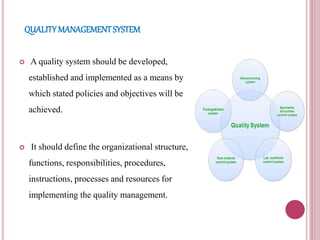
QUALITYMANAGEMENTSYSTEM
 A quality system should be developed,
established and implemented as a means by
which stated policies and objectives will be
achieved.
 It should define the organizational structure,
functions, responsibilities, procedures,
instructions, processes and resources for
implementing the quality management.
 Qualityassurance, or QA for short, is the systematic monitoring and
evaluation of the various aspects of a project, service or facility to
maximize the probability that minimum standards of quality are being
attained by the production process. QA cannot absolutely guarantee the
production of quality products [15].
PERSONNEL:
 There should be an adequate number of personnel having knowledge,
education, experience, skill and capabilities relevant to their assigned
function and ensure manufacture of acceptable and safe cosmetic
products.
 All personnel should be in good health and capable of handling the
duties assigned to them.
 Responsibility for GMP compliance within each involved function
should be assigned to appropriate management or supervisory
personnel.
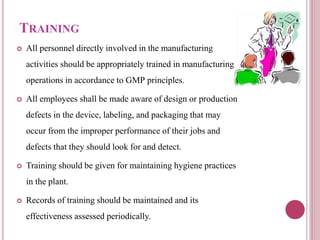
TRAINING
 All personnel directly involved in the manufacturing
activities should be appropriately trained in manufacturing
operations in accordance to GMP principles.
 All employees shall be made aware of design or production
defects in the device, labeling, and packaging that may
occur from the improper performance of their jobs and
defects that they should look for and detect.
 Training should be given for maintaining hygiene practices
in the plant.
 Records of training should be maintained and its
effectiveness assessed periodically.
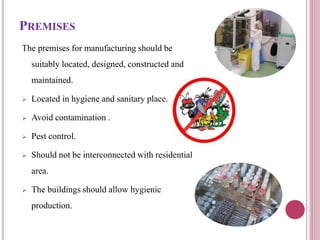
PREMISES
The premises for manufacturing should be
suitably located, designed, constructed and
maintained.
 Located in hygiene and sanitary place.
 Avoid contamination .
 Pest control.
 Should not be interconnected with residential
area.
 The buildings should allow hygienic
production.
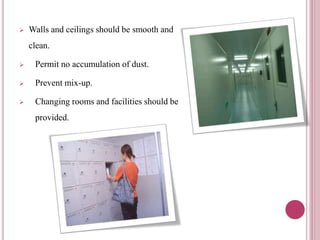
 Walls and ceilings should be smooth and
clean.
 Permit no accumulation of dust.
 Prevent mix-up.
 Changing rooms and facilities should be
provided.
 Properly ventilation should be provided.
 Open channels should be avoided.
 Electrical connections shall be concealed.
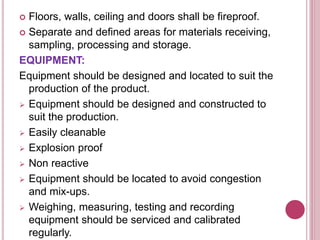
 Storage areas should be of adequate space, with suitable lighting e.tc
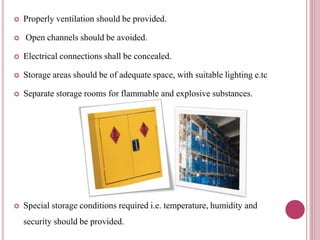
 Separate storage rooms for flammable and explosive substances.
 Special storage conditions required i.e. temperature, humidity and
security should be provided.
 Floors, walls, ceiling and doors shall be fireproof.
 Separate and defined areas for materials receiving,
sampling, processing and storage.
EQUIPMENT:
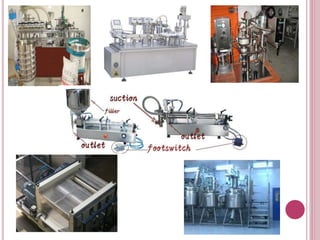
Equipment should be designed and located to suit the
production of the product.
 Equipment should be designed and constructed to
suit the production.
 Easily cleanable
 Explosion proof
 Non reactive
 Equipment should be located to avoid congestion
and mix-ups.
 Weighing, measuring, testing and recording
equipment should be serviced and calibrated
regularly.
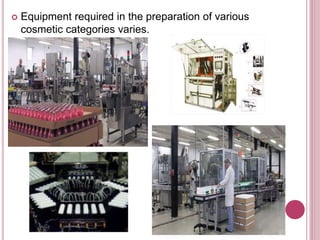
 Equipment required in the preparation of various
cosmetic categories varies.
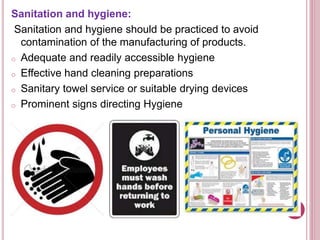
Sanitation and hygiene:
Sanitation and hygiene should be practiced to avoid
contamination of the manufacturing of products.
o Adequate and readily accessible hygiene
o Effective hand cleaning preparations
o Sanitary towel service or suitable drying devices
o Prominent signs directing Hygiene
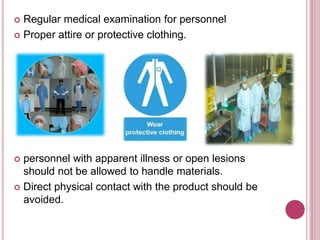
 Regular medical examination for personnel
 Proper attire or protective clothing.
 personnel with apparent illness or open lesions
should not be allowed to handle materials.
 Direct physical contact with the product should be
avoided.
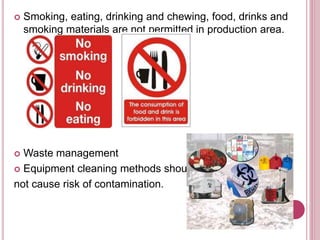
 Smoking, eating, drinking and chewing, food, drinks and
smoking materials are not permitted in production area.
 Waste management
 Equipment cleaning methods should
not cause risk of contamination.
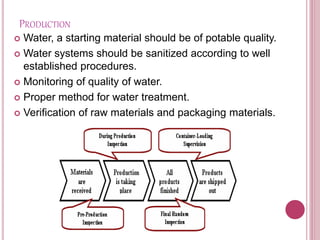
PRODUCTION
 Water, a starting material should be of potable quality.
 Water systems should be sanitized according to well
established procedures.
 Monitoring of quality of water.
 Proper method for water treatment.
 Verification of raw materials and packaging materials.
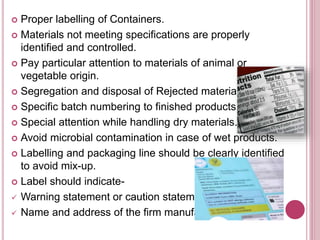
 Proper labelling of Containers.
 Materials not meeting specifications are properly
identified and controlled.
 Pay particular attention to materials of animal or
vegetable origin.
 Segregation and disposal of Rejected materials
 Specific batch numbering to finished products.
 Special attention while handling dry materials.
 Avoid microbial contamination in case of wet products.
 Labelling and packaging line should be clearly identified
to avoid mix-up.
 Label should indicate-
 Warning statement or caution statement
 Name and address of the firm manufacturing
 Direction for safe use of product.
 Composition of Ingredients.
QUALITYCONTROL
Quality control is an essential part of GMP.
 It provides: sampling, inspecting and testing materials,
processing.
 Ensures product quality and quantity.
 Evaluation of Reprocessing methods.
 Testing of returned products shall be tested
 Identification and disposal of rejected products.
 Maintaining correct specifications of materials and
products
DOCUMENTATION
Documentation should:
 Provide complete history of each batch, from starting
materials to finished products.
 Easy to read and understand.
 Dated and authorized.
 Reviewed by quality control.
 Approved by designated personnel.
 Authenticated electronic signatures.
 Specifications should be approved.
 Materials include detailed description.
 Document contains master formula with detailed
information.
 Batch Manufacturing Records should be prepared for
each batch with
 Name of product
 Batch formula and code number
 Records for each process should be maintained for:
 Starting materials
 Intermediates
 Bulk and finished product
 Conducting Internal audits
 Examination and assessment
 Report should be made at the completion of each
quality audit.
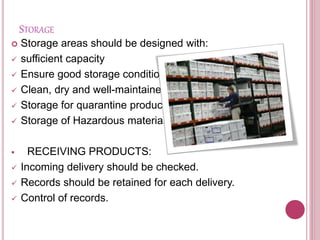
STORAGE
 Storage areas should be designed with:
 sufficient capacity
 Ensure good storage conditions.
 Clean, dry and well-maintained.
 Storage for quarantine products.
 Storage of Hazardous materials.
 RECEIVING PRODUCTS:
 Incoming delivery should be checked.
 Records should be retained for each delivery.
 Control of records.
CONTRACT MANUFACTURING AND ANALYSIS
 contract manufacturing and analysis is:
 clearly defined, agreed, and controlled.
 To avoid misunderstandings.
 To obtain a quality product.
 There should be a written contract.
complaints
 Designated person for handling complaints.
 Complaints for product defects.
 Investigation of defective batch.
 Follow-up action.
 Complaint records.
PRODUCTRECALLS
 A system for recall.
 Recall operations.
 Written procedures for
recall.
Gmp cosmetics

Gmp cosmetics

  • 1.
  • 2.
    CONTENTS  Introduction  Qualitymanagement system  Quality assurance  Personnel  Training  Premises  Equipment  Design and Construction  Sanitation and hygiene  Documentation  Complaints  Product recalls
  • 3.
    Cosmetics - Productsthat are created for application on the body for the purpose of cleansing, beautifying or altering appearance and enhancing attractive features. An essential element in cosmetics manufacturing is the establishment, implementation, and enforcement of Good Manufacturing Practices (GMPs) that define control systems designed to assure product quality and consumer safety.
  • 4.
    Benefits of GMP’s •Facilitatethe organization and implementation of activities by a cosmetics establishment so as to control the factors which may have an effect on the quality of cosmetic products. • Take account of the specific needs of the cosmetics sector. • Reduce the risk of confusion, omissions, deteriorations, contaminations and errors - involve the staff by better knowledge of activities.
  • 5.
    QUALITYMANAGEMENTSYSTEM  A qualitysystem should be developed, established and implemented as a means by which stated policies and objectives will be achieved.  It should define the organizational structure, functions, responsibilities, procedures, instructions, processes and resources for implementing the quality management.
  • 6.
     Qualityassurance, orQA for short, is the systematic monitoring and evaluation of the various aspects of a project, service or facility to maximize the probability that minimum standards of quality are being attained by the production process. QA cannot absolutely guarantee the production of quality products [15].
  • 7.
    PERSONNEL:  There shouldbe an adequate number of personnel having knowledge, education, experience, skill and capabilities relevant to their assigned function and ensure manufacture of acceptable and safe cosmetic products.  All personnel should be in good health and capable of handling the duties assigned to them.  Responsibility for GMP compliance within each involved function should be assigned to appropriate management or supervisory personnel.
  • 8.
    TRAINING  All personneldirectly involved in the manufacturing activities should be appropriately trained in manufacturing operations in accordance to GMP principles.  All employees shall be made aware of design or production defects in the device, labeling, and packaging that may occur from the improper performance of their jobs and defects that they should look for and detect.  Training should be given for maintaining hygiene practices in the plant.  Records of training should be maintained and its effectiveness assessed periodically.
  • 9.
    PREMISES The premises formanufacturing should be suitably located, designed, constructed and maintained.  Located in hygiene and sanitary place.  Avoid contamination .  Pest control.  Should not be interconnected with residential area.  The buildings should allow hygienic production.
  • 10.
     Walls andceilings should be smooth and clean.  Permit no accumulation of dust.  Prevent mix-up.  Changing rooms and facilities should be provided.
  • 11.
     Properly ventilationshould be provided.  Open channels should be avoided.  Electrical connections shall be concealed.  Storage areas should be of adequate space, with suitable lighting e.tc  Separate storage rooms for flammable and explosive substances.  Special storage conditions required i.e. temperature, humidity and security should be provided.
  • 12.
     Floors, walls,ceiling and doors shall be fireproof.  Separate and defined areas for materials receiving, sampling, processing and storage. EQUIPMENT: Equipment should be designed and located to suit the production of the product.  Equipment should be designed and constructed to suit the production.  Easily cleanable  Explosion proof  Non reactive  Equipment should be located to avoid congestion and mix-ups.  Weighing, measuring, testing and recording equipment should be serviced and calibrated regularly.
  • 14.
     Equipment requiredin the preparation of various cosmetic categories varies.
  • 15.
    Sanitation and hygiene: Sanitationand hygiene should be practiced to avoid contamination of the manufacturing of products. o Adequate and readily accessible hygiene o Effective hand cleaning preparations o Sanitary towel service or suitable drying devices o Prominent signs directing Hygiene
  • 16.
     Regular medicalexamination for personnel  Proper attire or protective clothing.  personnel with apparent illness or open lesions should not be allowed to handle materials.  Direct physical contact with the product should be avoided.
  • 17.
     Smoking, eating,drinking and chewing, food, drinks and smoking materials are not permitted in production area.  Waste management  Equipment cleaning methods should not cause risk of contamination.
  • 18.
    PRODUCTION  Water, astarting material should be of potable quality.  Water systems should be sanitized according to well established procedures.  Monitoring of quality of water.  Proper method for water treatment.  Verification of raw materials and packaging materials.
  • 19.
     Proper labellingof Containers.  Materials not meeting specifications are properly identified and controlled.  Pay particular attention to materials of animal or vegetable origin.  Segregation and disposal of Rejected materials  Specific batch numbering to finished products.  Special attention while handling dry materials.  Avoid microbial contamination in case of wet products.  Labelling and packaging line should be clearly identified to avoid mix-up.  Label should indicate-  Warning statement or caution statement  Name and address of the firm manufacturing
  • 20.
     Direction forsafe use of product.  Composition of Ingredients. QUALITYCONTROL Quality control is an essential part of GMP.  It provides: sampling, inspecting and testing materials, processing.  Ensures product quality and quantity.  Evaluation of Reprocessing methods.  Testing of returned products shall be tested  Identification and disposal of rejected products.  Maintaining correct specifications of materials and products
  • 21.
    DOCUMENTATION Documentation should:  Providecomplete history of each batch, from starting materials to finished products.  Easy to read and understand.  Dated and authorized.  Reviewed by quality control.  Approved by designated personnel.  Authenticated electronic signatures.  Specifications should be approved.  Materials include detailed description.
  • 22.
     Document containsmaster formula with detailed information.  Batch Manufacturing Records should be prepared for each batch with  Name of product  Batch formula and code number  Records for each process should be maintained for:  Starting materials  Intermediates  Bulk and finished product  Conducting Internal audits  Examination and assessment  Report should be made at the completion of each quality audit.
  • 23.
    STORAGE  Storage areasshould be designed with:  sufficient capacity  Ensure good storage conditions.  Clean, dry and well-maintained.  Storage for quarantine products.  Storage of Hazardous materials.  RECEIVING PRODUCTS:  Incoming delivery should be checked.  Records should be retained for each delivery.  Control of records.
  • 24.
    CONTRACT MANUFACTURING ANDANALYSIS  contract manufacturing and analysis is:  clearly defined, agreed, and controlled.  To avoid misunderstandings.  To obtain a quality product.  There should be a written contract. complaints  Designated person for handling complaints.  Complaints for product defects.  Investigation of defective batch.  Follow-up action.  Complaint records.
  • 25.
    PRODUCTRECALLS  A systemfor recall.  Recall operations.  Written procedures for recall.