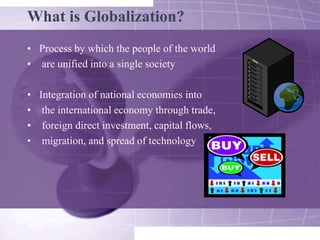
GLOBALIZATIONA Presentation byYolanda TevesSobrepeñaWhat is Globalization?Process by which the people of the worldare unified into a single societyIntegration of national economies intothe international economy through trade,foreign direct investment, capital flows,migration, and spread of technology
QUESTIONS:1.Is globalization merely harmful, or are there positive features associated with its practices and dynamics? 2.Is it possible, then, to give general answers to the question of how globalization is affecting educational policy and practice worldwide?
Hence, the answers developed will require a careful analysis of trends in education, including:• the currently popular policy "buzz words" (privatization, choice, and decentralization of educational systems) that drive policy formation in education and prevailing research agendas based in rational organization and management theories
• the role of national and international organizations in education, including teacher unions, parent organizations, and social movements; and• the new scholarship on race, class, gender, and the state in education
PurposesFirst, to identify, characterize, and clarify some of the debates surrounding the phenomenon of globalization; and Second, to try to understand some of the multiple and complex effects of globalization on educational policy and policy formation.             In summarizing some of the consequences of globalization for educational policy, we will follow the previous organization divided into three parts: tracing some of the economic impacts, the politicalimpacts, and the cultural impacts.
Economic Level Schools will need to reconsider this mission in light of changing job markets in a work environment; new skills and the flexibility to adapt to changing job demands and, for that matter, changing jobs over a lifetime; and dealing with an increasingly competitive international labor pool.
The broader economic effects of globalization tend to force national educational policies into a neoliberal framework that emphasizes lower taxes; shrinking the state sector and "doing more with less"; promoting market approaches to school choice (particularly vouchers); rational management of school organizations; performance assessment (testing); and deregulation in order to encourage new providers (including online providers) of educational services.
Political Levelthe constraint on national/state policy making posed by external demands from transnational institutions. a growing internationalization of global conflict, crime, terrorism, and environmental issues, but with an inadequate development of political institutions to address them.
Educational institutions may have a crucial role to play in addressing these problems, and the complex network of intended and unintended human consequences that have followed from the growth of global corporations, global mobility, global communication, and global expansion. In part, this awareness may help to foster a more critical conception of what education for "world citizenship" requires.
Cultural LevelGlobal changes in culture deeply affect educational policies, practices, and institutions. Particularly in advanced industrial societies, for instance, the question of "multiculturalism" takes on a special meaning in a global context.
Aframework for multicultural education in developed societies -- to learn about different others as a way of living with them and coordinating social activity with them within a compact of mutual tolerance and respect -- extend to a global order in which the gulf of differences becomes wider, the sense of interdependence and common interest more attenuated, and the grounding of affiliation more abstract and indirect.
Criteria For Measuring GlobalizationPolitical EngagementPersonal ContactTechnological ConnectivityEconomic Integration
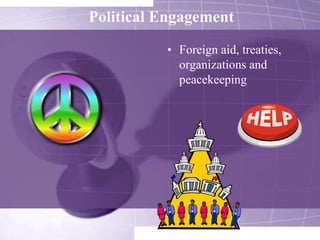
Political EngagementForeign aid, treaties, organizations and peacekeeping
Personal ContactIncluding telephone calls, travel, and remittances.
Technological ConnectivityNumber of internet users, hosts, and secure servers
Technological EnvironmentChanging at “lightning speed”
Internet and telecommunications
Increasing bandwidth/high-speed access
Reduced costs of entry/leapfrogging
E-business
Customization (“the long end of the tail”)
E-retailing and financial services
Movement of money across borders
“E-cash” – a currency without a country
Outsourcing and offshoring
Information as a commodity
The 24-hour office – increased productivity/lower costEconomic IntegrationInternational trade and foreign direct investment
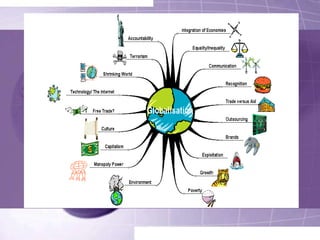
Some AdvantagesIncreased free trade between nationsIncreased liquidity of capital allowing investors in developed nations to invest in developing nationsCorporations have greater flexibility to operate across bordersGlobal mass media ties the world togetherIncreased flow of communications allows vital information to be shared between individuals and corporations around the world
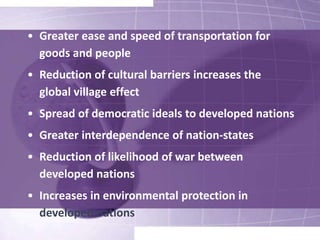
Greater ease and speed of transportation for goods and peopleReduction of cultural barriers increases the global village effectSpread of democratic ideals to developed nationsGreater interdependence of nation-statesReduction of likelihood of war between developed nationsIncreases in environmental protection in developed nations

Globalization report

  • 1.
    GLOBALIZATIONA Presentation byYolandaTevesSobrepeñaWhat is Globalization?Process by which the people of the worldare unified into a single societyIntegration of national economies intothe international economy through trade,foreign direct investment, capital flows,migration, and spread of technology
  • 3.
    QUESTIONS:1.Is globalization merelyharmful, or are there positive features associated with its practices and dynamics? 2.Is it possible, then, to give general answers to the question of how globalization is affecting educational policy and practice worldwide?
  • 4.
    Hence, the answersdeveloped will require a careful analysis of trends in education, including:• the currently popular policy "buzz words" (privatization, choice, and decentralization of educational systems) that drive policy formation in education and prevailing research agendas based in rational organization and management theories
  • 5.
    • the roleof national and international organizations in education, including teacher unions, parent organizations, and social movements; and• the new scholarship on race, class, gender, and the state in education
  • 6.
    PurposesFirst, to identify,characterize, and clarify some of the debates surrounding the phenomenon of globalization; and Second, to try to understand some of the multiple and complex effects of globalization on educational policy and policy formation. In summarizing some of the consequences of globalization for educational policy, we will follow the previous organization divided into three parts: tracing some of the economic impacts, the politicalimpacts, and the cultural impacts.
  • 7.
    Economic Level Schoolswill need to reconsider this mission in light of changing job markets in a work environment; new skills and the flexibility to adapt to changing job demands and, for that matter, changing jobs over a lifetime; and dealing with an increasingly competitive international labor pool.
  • 8.
    The broader economiceffects of globalization tend to force national educational policies into a neoliberal framework that emphasizes lower taxes; shrinking the state sector and "doing more with less"; promoting market approaches to school choice (particularly vouchers); rational management of school organizations; performance assessment (testing); and deregulation in order to encourage new providers (including online providers) of educational services.
  • 9.
    Political Levelthe constrainton national/state policy making posed by external demands from transnational institutions. a growing internationalization of global conflict, crime, terrorism, and environmental issues, but with an inadequate development of political institutions to address them.
  • 10.
    Educational institutions mayhave a crucial role to play in addressing these problems, and the complex network of intended and unintended human consequences that have followed from the growth of global corporations, global mobility, global communication, and global expansion. In part, this awareness may help to foster a more critical conception of what education for "world citizenship" requires.
  • 11.
    Cultural LevelGlobal changesin culture deeply affect educational policies, practices, and institutions. Particularly in advanced industrial societies, for instance, the question of "multiculturalism" takes on a special meaning in a global context.
  • 12.
    Aframework for multiculturaleducation in developed societies -- to learn about different others as a way of living with them and coordinating social activity with them within a compact of mutual tolerance and respect -- extend to a global order in which the gulf of differences becomes wider, the sense of interdependence and common interest more attenuated, and the grounding of affiliation more abstract and indirect.
  • 13.
    Criteria For MeasuringGlobalizationPolitical EngagementPersonal ContactTechnological ConnectivityEconomic Integration
  • 14.
    Political EngagementForeign aid,treaties, organizations and peacekeeping
  • 15.
    Personal ContactIncluding telephonecalls, travel, and remittances.
  • 16.
    Technological ConnectivityNumber ofinternet users, hosts, and secure servers
  • 17.
  • 18.
  • 19.
  • 20.
    Reduced costs ofentry/leapfrogging
  • 21.
  • 22.
    Customization (“the longend of the tail”)
  • 23.
  • 24.
    Movement of moneyacross borders
  • 25.
    “E-cash” – acurrency without a country
  • 26.
  • 27.
  • 28.
    The 24-hour office– increased productivity/lower costEconomic IntegrationInternational trade and foreign direct investment
  • 29.
    Some AdvantagesIncreased freetrade between nationsIncreased liquidity of capital allowing investors in developed nations to invest in developing nationsCorporations have greater flexibility to operate across bordersGlobal mass media ties the world togetherIncreased flow of communications allows vital information to be shared between individuals and corporations around the world
  • 30.
    Greater ease andspeed of transportation for goods and peopleReduction of cultural barriers increases the global village effectSpread of democratic ideals to developed nationsGreater interdependence of nation-statesReduction of likelihood of war between developed nationsIncreases in environmental protection in developed nations