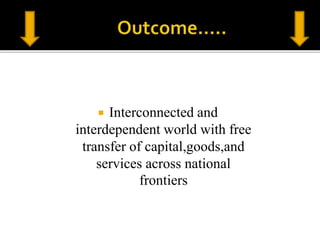

 Interconnected and
interdependent world with free
transfer of capital,goods,and
services across national
frontiers
 A British professor’s lecture in an American
University is made available to scholars in
US via web-conference
 An Indian, receives a Master's degree in
Europe, will work for an American registered
company, which is based in China and started
by an Italian……
People in different parts of the world:
▪ Wear clothes made in China
▪ Drive cars made in Japan
▪ Sip Australian Wine while watching the LIVE
telecast of a soccer match in Germany
 Share views and news Globally
 Sell local products (e.g. OCK Curry
Puff) in the global market (e.g. Malaysia,
China, Indonesia, etc.)
Political globalisation
Governmental action takes place on a global level
Economic Globalisation
Increasing occurrence, speed and intensity of production
trading and financial exchange
Cultural globalisation
Growth in the exchange of cultural practices between nations
and peoples
 Transportation
 Increasing mobility of goods and people
 Countries have built efficient and integrated
transportation infrastructure (e.g. airports,
seaports, railways, highways to facilitate
movement)
 Transportation
 Improvements in transport technology has “shrunk” the
world
 19th century steam engine  20th century jet engine,
large ocean-going vessels move people
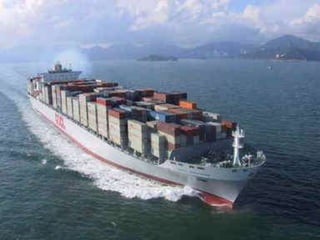
 Containerisation moves goods fast and cheap over long
distances (ships  trucks)
 Communications
 Faster and more convenient communication
 People all over the globe can communicate via
telephone, e-mail, fax, video conferencing, etc
 Satellite technology allows for simultaneous
communication
 Optical fibre systems can transmit large amounts of
information and very high speeds
 Communications
 Internet has enabled consumers to access information
instantly, conveniently and efficiently
 Internet has transferred the way people communicate,
do business, obtain information and purchase goods and
services
Multinational Companies
 Large global firms that operate in a number of
countries and have production and service facilities
outside the country of their origin
 Example: Microsoft,Toyota
Multinational Companies
MNCs set up operations in different parts of
the world because:
 Sourcing for new markets
 Lowering cost of production
 Production of different parts for products and
assembly done in a variety of countries
Impact Of Globalization
Improvements in Standards of Living
 As countries trade and open their doors to foreign
investment, they earn more revenue
▪ As a result, their citizens benefit from a higher
standard of living
▪ Free trade allows for a larger variety of foreign
goods for the consumer to choose from
▪ Better quality of life
 Increased Awareness of Foreign Culture
 Travel, the Internet, mass media (products of globalization allow
you to learn more about foreign culture
 Loss of Local Culture
 Global (Western) brands dominate consumer markets in
developing countries
 Creation of homogenous culture across the world
 Spread of pop culture and erosion or loss of local culture
 Negative influence of youth
 Enforced beliefs
 Depletion of natural resources by MNCs
 Concern over profits vs. protection of the environment
 Lack of funds to implement environmental protection
 Environmental Degradation
 Deforestation and Related Problems
 GlobalWarming
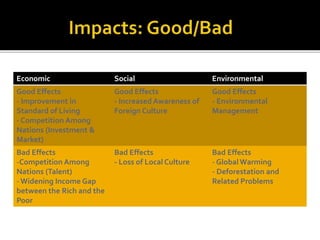
Economic Social Environmental
Good Effects
- Improvement in
Standard of Living
- Competition Among
Nations (Investment &
Market)
Good Effects
- Increased Awareness of
Foreign Culture
Good Effects
- Environmental
Management
Bad Effects
-Competition Among
Nations (Talent)
- Widening Income Gap
between the Rich and the
Poor
Bad Effects
- Loss of Local Culture
Bad Effects
- GlobalWarming
- Deforestation and
Related Problems
Globalisation its causes and impact

Globalisation its causes and impact

  • 3.
     Interconnected and interdependentworld with free transfer of capital,goods,and services across national frontiers
  • 4.
     A Britishprofessor’s lecture in an American University is made available to scholars in US via web-conference  An Indian, receives a Master's degree in Europe, will work for an American registered company, which is based in China and started by an Italian……
  • 5.
    People in differentparts of the world: ▪ Wear clothes made in China ▪ Drive cars made in Japan ▪ Sip Australian Wine while watching the LIVE telecast of a soccer match in Germany
  • 6.
     Share viewsand news Globally  Sell local products (e.g. OCK Curry Puff) in the global market (e.g. Malaysia, China, Indonesia, etc.)
  • 7.
    Political globalisation Governmental actiontakes place on a global level Economic Globalisation Increasing occurrence, speed and intensity of production trading and financial exchange Cultural globalisation Growth in the exchange of cultural practices between nations and peoples
  • 8.
     Transportation  Increasingmobility of goods and people  Countries have built efficient and integrated transportation infrastructure (e.g. airports, seaports, railways, highways to facilitate movement)
  • 9.
     Transportation  Improvementsin transport technology has “shrunk” the world  19th century steam engine  20th century jet engine, large ocean-going vessels move people  Containerisation moves goods fast and cheap over long distances (ships  trucks)
  • 11.
     Communications  Fasterand more convenient communication  People all over the globe can communicate via telephone, e-mail, fax, video conferencing, etc  Satellite technology allows for simultaneous communication  Optical fibre systems can transmit large amounts of information and very high speeds
  • 12.
     Communications  Internethas enabled consumers to access information instantly, conveniently and efficiently  Internet has transferred the way people communicate, do business, obtain information and purchase goods and services
  • 13.
    Multinational Companies  Largeglobal firms that operate in a number of countries and have production and service facilities outside the country of their origin  Example: Microsoft,Toyota
  • 14.
    Multinational Companies MNCs setup operations in different parts of the world because:  Sourcing for new markets  Lowering cost of production  Production of different parts for products and assembly done in a variety of countries
  • 15.
  • 16.
    Improvements in Standardsof Living  As countries trade and open their doors to foreign investment, they earn more revenue ▪ As a result, their citizens benefit from a higher standard of living ▪ Free trade allows for a larger variety of foreign goods for the consumer to choose from ▪ Better quality of life
  • 17.
     Increased Awarenessof Foreign Culture  Travel, the Internet, mass media (products of globalization allow you to learn more about foreign culture  Loss of Local Culture  Global (Western) brands dominate consumer markets in developing countries  Creation of homogenous culture across the world  Spread of pop culture and erosion or loss of local culture  Negative influence of youth  Enforced beliefs
  • 18.
     Depletion ofnatural resources by MNCs  Concern over profits vs. protection of the environment  Lack of funds to implement environmental protection  Environmental Degradation  Deforestation and Related Problems  GlobalWarming
  • 19.
    Economic Social Environmental GoodEffects - Improvement in Standard of Living - Competition Among Nations (Investment & Market) Good Effects - Increased Awareness of Foreign Culture Good Effects - Environmental Management Bad Effects -Competition Among Nations (Talent) - Widening Income Gap between the Rich and the Poor Bad Effects - Loss of Local Culture Bad Effects - GlobalWarming - Deforestation and Related Problems

Editor's Notes

  • #5 Attending lectures by a British professor teaching in an American University via a web-conference in US
  • #8 Responsibilities such asthe welfareofcitizens and economic growth areactedupon by7 an international political body.an emergence of national and international nongovermental organizations like UNOTHAT ACTLIKE WATCH DOGSOVER GOVERNMENTS
  • #12 Communication systems are the means by which information is transmitted from place to place in the form of ideas, instructions and images
  • #14 Transnational Companies can operate as information from the head office can be easily and effectively transmitted to every branch office anywhere in the world