Globalization and Implications for Education Based on Kubow & Fossum Chapter 8 Prepared by Carla Piper, Ed. D.
Globalization Definitions Wikipedia Process by which the people of the world are unified into a single society and functioning together  Combination of economic, technological, sociocultural and political forces.  http ://en.wikipedia.org/wiki/Globalization Global Policy Making – UN   http://www.globalpolicy.org/   Globalization 101  -   http://www.globalization101.org/ The World Bank on Globalization  -  http://www1.worldbank.org/economicpolicy/globalization/
Thomas Friedman:  The World is Flat Metaphor for viewing the world as flat or level in terms of commerce and competition A  level playing field  where all competitors have an equal opportunity.  Countries, companies and individuals want to remain competitive in a global market Historical, regional and geographical divisions are becoming increasingly irrelevant. From:  http ://en.wikipedia.org/wiki/The_World_is_Flat
Ten Flatteners #1: Collapse of Berlin Wall- -11/'89 Symbolized the end of the Cold war Allowed people from other side of the wall to join the economic mainstream #2: Netscape (and the Web) Broadened the audience for the Internet from its roots as a communications medium that  Made the Internet accessible to everyone from ages 5-85 #3: Workflow software: Ability of machines to talk to other machines with no humans involved. “ Crude foundation of a whole new global platform for collaboration.”  #4: Open sourcing:   Communities uploading and collaborating on online projects  Open source software, blogs, and Wikipedia “ The most disruptive force of all."  #5: Outsourcing:   Allowed companies to split service and manufacturing activities into components Each component performed in most efficient, cost-effective way Wikipedia -  http://en.wikipedia.org/wiki/The_World_is_Flat   Thomas L. Friedman
Ten Flatteners (continued) #6: Offshoring:  Manufacturing's version of outsourcing.  #7: Supply chaining:   Retail supply chain like a river Wal-Mart as the best example of a company using technology to streamline item sales, distribution, and shipping.  #8: Insourcing:   UPS as a prime example for insourcing (UPS itself repairs Toshiba computers) Company's employees perform services--beyond shipping--for another company.  #9: In-forming:   Google and other search engines  "Never before in the history of the planet have so many people-on their own-had the ability to find so much information about so many things and about so many other people“ #10: "The Steroids":   Personal digital devices like mobile phones  IPods, personal digital assistants, instant messaging Voice over Internet Protocol (VoIP) Wikipedia -  http://en.wikipedia.org/wiki/The_World_is_Flat   Thomas L. Friedman
Globalization Central issue of our time Will define the world our children live in Increasing interdependence and integration of countries Result of worldwide movement Ideas Capital Labor Goods De-territorialization of economic, social, and cultural practices Kubow & Fossum, p. 283
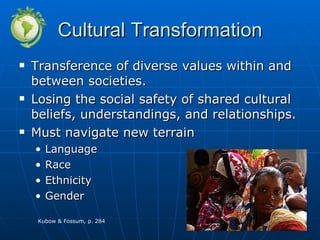
Cultural Transformation Transference of diverse values within and between societies. Losing the social safety of shared cultural beliefs, understandings, and relationships. Must navigate new terrain Language Race Ethnicity Gender Kubow & Fossum, p. 284
Globalization as a Paradigm Definition from Globalization 101 -  http://www.globalization101.org/ “ Globalization is a process of interaction and integration among the people, companies, and governments of different nations, a process driven by international trade and investment and aided by information technology. This process has effects on the environment, on culture, on political systems, on economic development and prosperity, and on human physical well-being in societies around the world.”
Globalization as a Paradox Paradoxical contradictions of globalization Forces people into closer relations Splinters people into units of distinctiveness and difference Tensions exist between global and local needs and interests How will nations form unity amidst diversity? Kubow & Fossum, p. 284
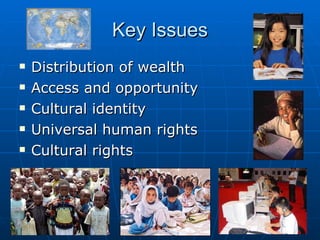
Key Issues Distribution of wealth Access and opportunity Cultural identity Universal human rights Cultural rights
Local-Global Dichotomy Need to strike balance between the local and the global. Great tensions exist for developing countries who seldom reap the benefits. Globalization interrupts the ways individuals experience cultural belonging and a feeling of national identity. Schools are expected to prepare students to adapt to a global-oriented economy while simultaneously negotiating lcoal community values.  Kubow & Fossum, p. 285-287
Globalization as Economics Worldwide marketization and economic growth Optimistic Perspective - a natural and inevitable expansion of the marketplace beyond national borders Critical Perspective – stratification has occurred resulting in economic inequality within and across nations. Affects US Schools through emphasis on world competition Kubow & Fossum, p. 288
Globalization as Information and Communications Technologies The rate and reach of knowledge across space, time, and people. Global economy through of as a “knowledge economy.” Transformed the rate of globalization through new modes of media and communication Homogenizing effect on societies Broader reception of information, but not necessarily transmission of information Kubow & Fossum, p. 290
Globalization as Sociocultural Phenomena The movement of populations and the mingling of cultures and identities. Worldwide homogenization Increased immigration Not necessarily identify with host culture Sense of physical displacement Classrooms are increasingly multicultural. Kubow & Fossum, p. 293
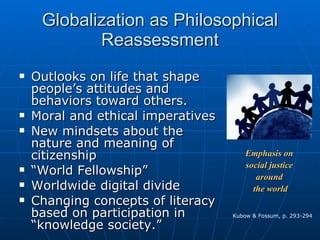
Globalization as Philosophical Reassessment Outlooks on life that shape people’s attitudes and behaviors toward others. Moral and ethical imperatives New mindsets about the nature and meaning of citizenship “ World Fellowship” Worldwide digital divide Changing concepts of literacy based on participation in “knowledge society.” Kubow & Fossum, p. 293-294 Emphasis on  social justice  around  the world
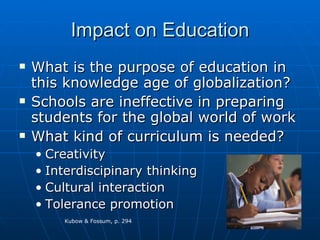
Impact on Education What is the purpose of education in this knowledge age of globalization? Schools are ineffective in preparing students for the global world of work What kind of curriculum is needed? Creativity Interdiscipinary thinking Cultural interaction Tolerance promotion Kubow & Fossum, p. 294
Comparative Perspective Taking Skills for 21 st  Century Teacher  Teacher’s task Prepare students for contemporary society Help students envision and construct a better world   Teachers must work toward social justice worldwide by: Encouraging critical thinking Aiding educational decision making Facilitating educational improvment (Kubow & Fossum, p. 302)
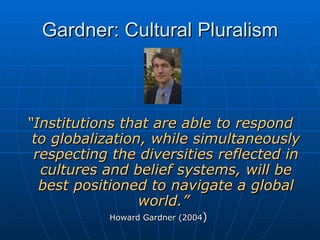
Gardner: Cultural Pluralism “ Institutions that are able to respond to globalization, while simultaneously respecting the diversities reflected in cultures and belief systems, will be best positioned to navigate a global world.”  Howard Gardner (2004 )
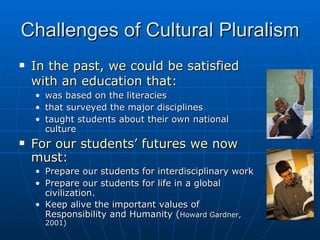
Challenges of Cultural Pluralism In the past, we could be satisfied with an education that:   was based on the literacies  that surveyed the major disciplines taught students about their own national culture For our students’ futures we now must: Prepare our students for interdisciplinary work  Prepare our students for life in a global civilization.  Keep alive the important values of Responsibility and Humanity ( Howard Gardner, 2001)
What Students Need to Learn in Global Society Understanding of the global system.   “ The trends of globalization --the unprecedented and unpredictable movement of human beings, capital, information, and cultural life forms—need to be understood by the young persons who are and will always inhabit a global community.” Howard Gardner’s Recommendations (2004)-  http://www.pz.harvard.edu/PIs/HG_HowEducationChanges.pdf
What Students Need to Learn Through Multiple Disciplines Capacity to think analytically and creatively within disciplines.  “ Simple mastery of information, concepts, and definitions will no longer suffice. Students will have to master disciplinary moves sufficiently so that they can apply them flexibly and generatively to deal with issues that could not be anticipated by the authors of textbooks.” Howard Gardner’s Recommendations (2004)-  http://www.pz.harvard.edu/PIs/HG_HowEducationChanges.pdf
What Students Need to Learn   Global Understanding Ability to tackle problems and issues that do not respect disciplinary boundaries.   “ The most vexing issues facing the world today (including the issue of globalization!) do not respect disciplinary boundaries. AIDS, large-scale immigration, and global warming are examples of problems in need of interdisciplinary thinking.” Howard Gardner’s Recommendations (2004)-  http://www.pz.harvard.edu/PIs/HG_HowEducationChanges.pdf
Students Need to Learn  to Work with Others Knowledge of and ability to interact civilly and productively with individuals from quite different cultural backgrounds--both within one’s own society and across the planet. “ Globalization is selecting for interpersonal competencies, including the ability to think and work with others coming from very different racial, linguistic, religious, and cultural backgrounds.” Howard Gardner’s Recommendations (2004)-  http://www.pz.harvard.edu/PIs/HG_HowEducationChanges.pdf
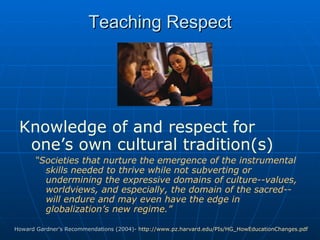
Teaching Respect Knowledge of and respect for one’s own cultural tradition(s)   “ Societies that nurture the emergence of the instrumental skills needed to thrive while not subverting or undermining the expressive domains of culture--values, worldviews, and especially, the domain of the sacred--will endure and may even have the edge in globalization’s new regime.” Howard Gardner’s Recommendations (2004)-  http://www.pz.harvard.edu/PIs/HG_HowEducationChanges.pdf
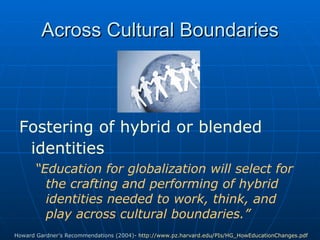
Fostering of hybrid or blended identities   “ Education for globalization will select for the crafting and performing of hybrid identities needed to work, think, and play across cultural boundaries.”  Across Cultural Boundaries Howard Gardner’s Recommendations (2004)-  http://www.pz.harvard.edu/PIs/HG_HowEducationChanges.pdf
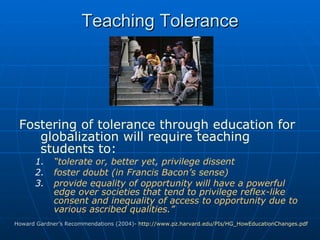
Teaching Tolerance Fostering of tolerance through education for globalization will require teaching students to: “ tolerate or, better yet, privilege dissent  foster doubt (in Francis Bacon’s sense)  provide equality of opportunity will have a powerful edge over societies that tend to privilege reflex-like consent and inequality of access to opportunity due to various ascribed qualities.” Howard Gardner’s Recommendations (2004)-  http://www.pz.harvard.edu/PIs/HG_HowEducationChanges.pdf
 

Globalization and implications for education

  • 1.
    Globalization and Implicationsfor Education Based on Kubow & Fossum Chapter 8 Prepared by Carla Piper, Ed. D.
  • 2.
    Globalization Definitions WikipediaProcess by which the people of the world are unified into a single society and functioning together Combination of economic, technological, sociocultural and political forces. http ://en.wikipedia.org/wiki/Globalization Global Policy Making – UN http://www.globalpolicy.org/ Globalization 101 - http://www.globalization101.org/ The World Bank on Globalization - http://www1.worldbank.org/economicpolicy/globalization/
  • 3.
    Thomas Friedman: The World is Flat Metaphor for viewing the world as flat or level in terms of commerce and competition A level playing field where all competitors have an equal opportunity. Countries, companies and individuals want to remain competitive in a global market Historical, regional and geographical divisions are becoming increasingly irrelevant. From: http ://en.wikipedia.org/wiki/The_World_is_Flat
  • 4.
    Ten Flatteners #1:Collapse of Berlin Wall- -11/'89 Symbolized the end of the Cold war Allowed people from other side of the wall to join the economic mainstream #2: Netscape (and the Web) Broadened the audience for the Internet from its roots as a communications medium that Made the Internet accessible to everyone from ages 5-85 #3: Workflow software: Ability of machines to talk to other machines with no humans involved. “ Crude foundation of a whole new global platform for collaboration.” #4: Open sourcing: Communities uploading and collaborating on online projects Open source software, blogs, and Wikipedia “ The most disruptive force of all." #5: Outsourcing: Allowed companies to split service and manufacturing activities into components Each component performed in most efficient, cost-effective way Wikipedia - http://en.wikipedia.org/wiki/The_World_is_Flat Thomas L. Friedman
  • 5.
    Ten Flatteners (continued)#6: Offshoring: Manufacturing's version of outsourcing. #7: Supply chaining: Retail supply chain like a river Wal-Mart as the best example of a company using technology to streamline item sales, distribution, and shipping. #8: Insourcing: UPS as a prime example for insourcing (UPS itself repairs Toshiba computers) Company's employees perform services--beyond shipping--for another company. #9: In-forming: Google and other search engines "Never before in the history of the planet have so many people-on their own-had the ability to find so much information about so many things and about so many other people“ #10: "The Steroids": Personal digital devices like mobile phones IPods, personal digital assistants, instant messaging Voice over Internet Protocol (VoIP) Wikipedia - http://en.wikipedia.org/wiki/The_World_is_Flat Thomas L. Friedman
  • 6.
    Globalization Central issueof our time Will define the world our children live in Increasing interdependence and integration of countries Result of worldwide movement Ideas Capital Labor Goods De-territorialization of economic, social, and cultural practices Kubow & Fossum, p. 283
  • 7.
    Cultural Transformation Transferenceof diverse values within and between societies. Losing the social safety of shared cultural beliefs, understandings, and relationships. Must navigate new terrain Language Race Ethnicity Gender Kubow & Fossum, p. 284
  • 8.
    Globalization as aParadigm Definition from Globalization 101 - http://www.globalization101.org/ “ Globalization is a process of interaction and integration among the people, companies, and governments of different nations, a process driven by international trade and investment and aided by information technology. This process has effects on the environment, on culture, on political systems, on economic development and prosperity, and on human physical well-being in societies around the world.”
  • 9.
    Globalization as aParadox Paradoxical contradictions of globalization Forces people into closer relations Splinters people into units of distinctiveness and difference Tensions exist between global and local needs and interests How will nations form unity amidst diversity? Kubow & Fossum, p. 284
  • 10.
    Key Issues Distributionof wealth Access and opportunity Cultural identity Universal human rights Cultural rights
  • 11.
    Local-Global Dichotomy Needto strike balance between the local and the global. Great tensions exist for developing countries who seldom reap the benefits. Globalization interrupts the ways individuals experience cultural belonging and a feeling of national identity. Schools are expected to prepare students to adapt to a global-oriented economy while simultaneously negotiating lcoal community values. Kubow & Fossum, p. 285-287
  • 12.
    Globalization as EconomicsWorldwide marketization and economic growth Optimistic Perspective - a natural and inevitable expansion of the marketplace beyond national borders Critical Perspective – stratification has occurred resulting in economic inequality within and across nations. Affects US Schools through emphasis on world competition Kubow & Fossum, p. 288
  • 13.
    Globalization as Informationand Communications Technologies The rate and reach of knowledge across space, time, and people. Global economy through of as a “knowledge economy.” Transformed the rate of globalization through new modes of media and communication Homogenizing effect on societies Broader reception of information, but not necessarily transmission of information Kubow & Fossum, p. 290
  • 14.
    Globalization as SocioculturalPhenomena The movement of populations and the mingling of cultures and identities. Worldwide homogenization Increased immigration Not necessarily identify with host culture Sense of physical displacement Classrooms are increasingly multicultural. Kubow & Fossum, p. 293
  • 15.
    Globalization as PhilosophicalReassessment Outlooks on life that shape people’s attitudes and behaviors toward others. Moral and ethical imperatives New mindsets about the nature and meaning of citizenship “ World Fellowship” Worldwide digital divide Changing concepts of literacy based on participation in “knowledge society.” Kubow & Fossum, p. 293-294 Emphasis on social justice around the world
  • 16.
    Impact on EducationWhat is the purpose of education in this knowledge age of globalization? Schools are ineffective in preparing students for the global world of work What kind of curriculum is needed? Creativity Interdiscipinary thinking Cultural interaction Tolerance promotion Kubow & Fossum, p. 294
  • 17.
    Comparative Perspective TakingSkills for 21 st Century Teacher Teacher’s task Prepare students for contemporary society Help students envision and construct a better world Teachers must work toward social justice worldwide by: Encouraging critical thinking Aiding educational decision making Facilitating educational improvment (Kubow & Fossum, p. 302)
  • 18.
    Gardner: Cultural Pluralism“ Institutions that are able to respond to globalization, while simultaneously respecting the diversities reflected in cultures and belief systems, will be best positioned to navigate a global world.” Howard Gardner (2004 )
  • 19.
    Challenges of CulturalPluralism In the past, we could be satisfied with an education that: was based on the literacies that surveyed the major disciplines taught students about their own national culture For our students’ futures we now must: Prepare our students for interdisciplinary work Prepare our students for life in a global civilization. Keep alive the important values of Responsibility and Humanity ( Howard Gardner, 2001)
  • 20.
    What Students Needto Learn in Global Society Understanding of the global system. “ The trends of globalization --the unprecedented and unpredictable movement of human beings, capital, information, and cultural life forms—need to be understood by the young persons who are and will always inhabit a global community.” Howard Gardner’s Recommendations (2004)- http://www.pz.harvard.edu/PIs/HG_HowEducationChanges.pdf
  • 21.
    What Students Needto Learn Through Multiple Disciplines Capacity to think analytically and creatively within disciplines. “ Simple mastery of information, concepts, and definitions will no longer suffice. Students will have to master disciplinary moves sufficiently so that they can apply them flexibly and generatively to deal with issues that could not be anticipated by the authors of textbooks.” Howard Gardner’s Recommendations (2004)- http://www.pz.harvard.edu/PIs/HG_HowEducationChanges.pdf
  • 22.
    What Students Needto Learn Global Understanding Ability to tackle problems and issues that do not respect disciplinary boundaries. “ The most vexing issues facing the world today (including the issue of globalization!) do not respect disciplinary boundaries. AIDS, large-scale immigration, and global warming are examples of problems in need of interdisciplinary thinking.” Howard Gardner’s Recommendations (2004)- http://www.pz.harvard.edu/PIs/HG_HowEducationChanges.pdf
  • 23.
    Students Need toLearn to Work with Others Knowledge of and ability to interact civilly and productively with individuals from quite different cultural backgrounds--both within one’s own society and across the planet. “ Globalization is selecting for interpersonal competencies, including the ability to think and work with others coming from very different racial, linguistic, religious, and cultural backgrounds.” Howard Gardner’s Recommendations (2004)- http://www.pz.harvard.edu/PIs/HG_HowEducationChanges.pdf
  • 24.
    Teaching Respect Knowledgeof and respect for one’s own cultural tradition(s) “ Societies that nurture the emergence of the instrumental skills needed to thrive while not subverting or undermining the expressive domains of culture--values, worldviews, and especially, the domain of the sacred--will endure and may even have the edge in globalization’s new regime.” Howard Gardner’s Recommendations (2004)- http://www.pz.harvard.edu/PIs/HG_HowEducationChanges.pdf
  • 25.
    Fostering of hybridor blended identities “ Education for globalization will select for the crafting and performing of hybrid identities needed to work, think, and play across cultural boundaries.” Across Cultural Boundaries Howard Gardner’s Recommendations (2004)- http://www.pz.harvard.edu/PIs/HG_HowEducationChanges.pdf
  • 26.
    Teaching Tolerance Fosteringof tolerance through education for globalization will require teaching students to: “ tolerate or, better yet, privilege dissent foster doubt (in Francis Bacon’s sense) provide equality of opportunity will have a powerful edge over societies that tend to privilege reflex-like consent and inequality of access to opportunity due to various ascribed qualities.” Howard Gardner’s Recommendations (2004)- http://www.pz.harvard.edu/PIs/HG_HowEducationChanges.pdf
  • 27.