Dr. Gunwant Joshi
     Scientist
• As Ecological Processes do not
  respect National Boundaries, and
  the Environmental problems often
  have impacts beyond Borders.
The Story of a Goose that
    laid Golden Eggs
•   Deforestation
•   Soil degradation
•   Desertification
•   Loss of biodiversity
•   Air Pollution
•   Acid rain
•   Greenhouse effect
•   Ozone depletion
•   Water contamination
•   Importation & Disposal of Toxic Wastes
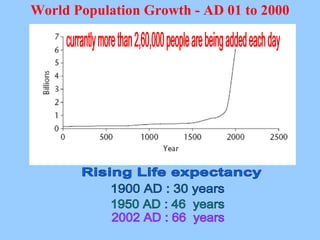
World Population Growth - AD 01 to 2000
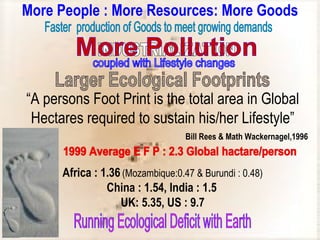
More People : More Resources: More Goods


“A persons Foot Print is the total area in Global
 Hectares required to sustain his/her Lifestyle”
                                   Bill Rees & Math Wackernagel,1996


      Africa : 1.36 (Mozambique:0.47 & Burundi : 0.48)
                China : 1.54, India : 1.5
                   UK: 5.35, US : 9.7
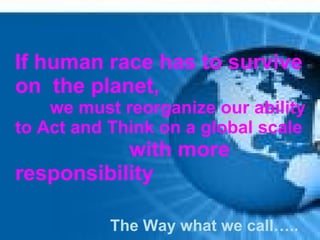
If human race has to survive
on the planet,
    we must reorganize our ability
to Act and Think on a global scale
           with more
responsibility

           The Way what we call…..
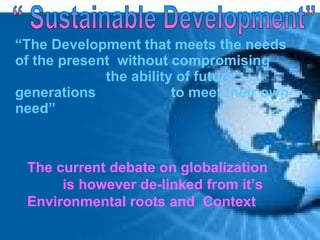
“The Development that meets the needs
of the present without compromising
             the ability of future
generations             to meet their own
need”


 The current debate on globalization
      is however de-linked from it’s
 Environmental roots and Context
“ Globalization describe the cross-border
relations between countries.” , i.e., the growth in
  international exchange and interdependence.
It is an on going process of global integration of :
    Economies & Production processes that includes trade,
     capital- flows and investment .
    System of Polity, Governance, and bureaucratic set-up.
    Information & Information Technology.
   Culture.
GLOBALIZATION
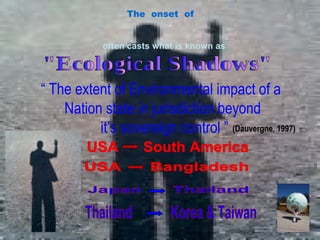
The onset of


            often casts what is known as


“ The extent of Environmental impact of a
    Nation state in jurisdiction beyond
          it’s sovereign control ” (Dauvergne, 1997)
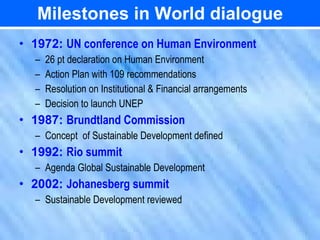
Milestones in World dialogue
• 1972: UN conference on Human Environment
  –   26 pt declaration on Human Environment
  –   Action Plan with 109 recommendations
  –   Resolution on Institutional & Financial arrangements
  –   Decision to launch UNEP
• 1987: Brundtland Commission
  – Concept of Sustainable Development defined
• 1992: Rio summit
  – Agenda Global Sustainable Development
• 2002: Johanesberg summit
  – Sustainable Development reviewed
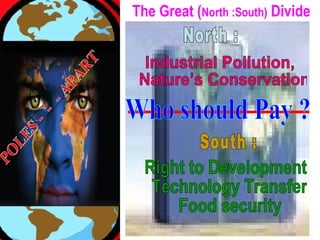
The Great (North :South) Divide
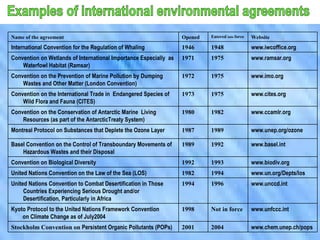
Name of the agreement                                              Opened   Entered into force   Website
International Convention for the Regulation of Whaling             1946     1948                 www.iwcoffice.org
Convention on Wetlands of International Importance Especially as   1971     1975                 www.ramsar.org
    Waterfowl Habitat (Ramsar)
Convention on the Prevention of Marine Pollution by Dumping        1972     1975                 www.imo.org
    Wastes and Other Matter (London Convention)
Convention on the International Trade in Endangered Species of     1973     1975                 www.cites.org
    Wild Flora and Fauna (CITES)
Convention on the Conservation of Antarctic Marine Living          1980     1982                 www.ccamlr.org
    Resources (as part of the AntarcticTreaty System)
Montreal Protocol on Substances that Deplete the Ozone Layer       1987     1989                 www.unep.org/ozone

Basel Convention on the Control of Transboundary Movements of      1989     1992                 www.basel.int
    Hazardous Wastes and their Disposal
Convention on Biological Diversity                                 1992     1993                 www.biodiv.org
United Nations Convention on the Law of the Sea (LOS)              1982     1994                 www.un.org/Depts/los
United Nations Convention to Combat Desertification in Those       1994     1996                 www.unccd.int
     Countries Experiencing Serious Drought and/or
     Desertification, Particularly in Africa
Kyoto Protocol to the United Nations Framework Convention          1998     Not in force         www.unfccc.int
    on Climate Change as of July2004
Stockholm Convention on Persistent Organic Pollutants (POPs)       2001     2004                 www.chem.unep.ch/pops
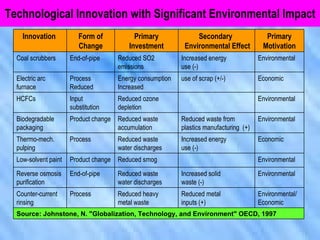
Technological Innovation with Significant Environmental Impact
    Innovation           Form of             Primary             Secondary                 Primary
                         Change            Investment        Environmental Effect         Motivation
  Coal scrubbers      End-of-pipe      Reduced SO2          Increased energy             Environmental
                                       emissions            use (-)
  Electric arc        Process          Energy consumption   use of scrap (+/-)           Economic
  furnace             Reduced          Increased
  HCFCs               Input            Reduced ozone                                     Environmental
                      substitution     depletion
  Biodegradable       Product change   Reduced waste        Reduced waste from           Environmental
  packaging                            accumulation         plastics manufacturing (+)
  Thermo-mech.        Process          Reduced waste        Increased energy             Economic
  pulping                              water discharges     use (-)
  Low-solvent paint   Product change   Reduced smog                                      Environmental
  Reverse osmosis     End-of-pipe      Reduced waste        Increased solid              Environmental
  purification                         water discharges     waste (-)
  Counter-current     Process          Reduced heavy        Reduced metal                Environmental/
  rinsing                              metal waste          inputs (+)                   Economic
  Source: Johnstone, N. "Globalization, Technology, and Environment" OECD, 1997
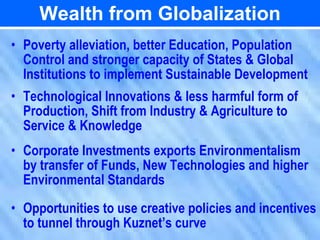
Wealth from Globalization
• Poverty alleviation, better Education, Population
  Control and stronger capacity of States & Global
  Institutions to implement Sustainable Development
• Technological Innovations & less harmful form of
  Production, Shift from Industry & Agriculture to
  Service & Knowledge
• Corporate Investments exports Environmentalism
  by transfer of Funds, New Technologies and higher
  Environmental Standards
• Opportunities to use creative policies and incentives
  to tunnel through Kuznet’s curve
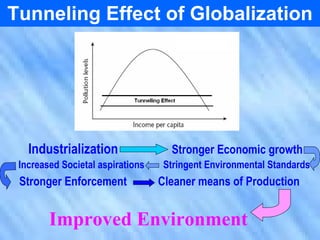
Tunneling Effect of Globalization


   Industrialization                Stronger Economic growth
 Increased Societal aspirations   Stringent Environmental Standards
 Stronger Enforcement             Cleaner means of Production


        Improved Environment
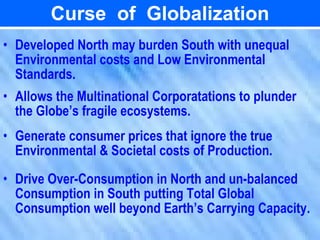
Curse of Globalization
• Developed North may burden South with unequal
  Environmental costs and Low Environmental
  Standards.
• Allows the Multinational Corporatations to plunder
  the Globe’s fragile ecosystems.
• Generate consumer prices that ignore the true
  Environmental & Societal costs of Production.
• Drive Over-Consumption in North and un-balanced
  Consumption in South putting Total Global
  Consumption well beyond Earth’s Carrying Capacity.
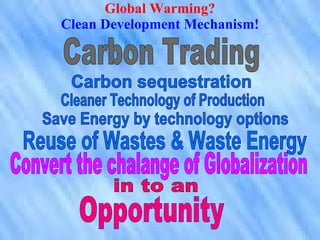
Global Warming?
Clean Development Mechanism!
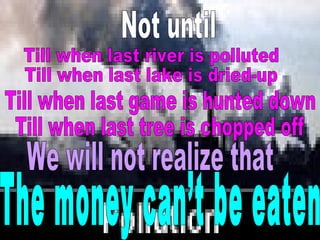
What do we leave for
   our children?
Globalization and Environment

Globalization and Environment

  • 1.
  • 2.
    • As EcologicalProcesses do not respect National Boundaries, and the Environmental problems often have impacts beyond Borders.
  • 3.
    The Story ofa Goose that laid Golden Eggs
  • 4.
    Deforestation • Soil degradation • Desertification • Loss of biodiversity • Air Pollution • Acid rain • Greenhouse effect • Ozone depletion • Water contamination • Importation & Disposal of Toxic Wastes
  • 5.
    World Population Growth- AD 01 to 2000
  • 6.
    More People :More Resources: More Goods “A persons Foot Print is the total area in Global Hectares required to sustain his/her Lifestyle” Bill Rees & Math Wackernagel,1996 Africa : 1.36 (Mozambique:0.47 & Burundi : 0.48) China : 1.54, India : 1.5 UK: 5.35, US : 9.7
  • 7.
    If human racehas to survive on the planet, we must reorganize our ability to Act and Think on a global scale with more responsibility The Way what we call…..
  • 8.
    “The Development thatmeets the needs of the present without compromising the ability of future generations to meet their own need” The current debate on globalization is however de-linked from it’s Environmental roots and Context
  • 9.
    “ Globalization describethe cross-border relations between countries.” , i.e., the growth in international exchange and interdependence. It is an on going process of global integration of :  Economies & Production processes that includes trade, capital- flows and investment .  System of Polity, Governance, and bureaucratic set-up.  Information & Information Technology.  Culture.
  • 13.
  • 14.
    The onset of often casts what is known as “ The extent of Environmental impact of a Nation state in jurisdiction beyond it’s sovereign control ” (Dauvergne, 1997)
  • 15.
    Milestones in Worlddialogue • 1972: UN conference on Human Environment – 26 pt declaration on Human Environment – Action Plan with 109 recommendations – Resolution on Institutional & Financial arrangements – Decision to launch UNEP • 1987: Brundtland Commission – Concept of Sustainable Development defined • 1992: Rio summit – Agenda Global Sustainable Development • 2002: Johanesberg summit – Sustainable Development reviewed
  • 16.
    The Great (North:South) Divide
  • 17.
    Name of theagreement Opened Entered into force Website International Convention for the Regulation of Whaling 1946 1948 www.iwcoffice.org Convention on Wetlands of International Importance Especially as 1971 1975 www.ramsar.org Waterfowl Habitat (Ramsar) Convention on the Prevention of Marine Pollution by Dumping 1972 1975 www.imo.org Wastes and Other Matter (London Convention) Convention on the International Trade in Endangered Species of 1973 1975 www.cites.org Wild Flora and Fauna (CITES) Convention on the Conservation of Antarctic Marine Living 1980 1982 www.ccamlr.org Resources (as part of the AntarcticTreaty System) Montreal Protocol on Substances that Deplete the Ozone Layer 1987 1989 www.unep.org/ozone Basel Convention on the Control of Transboundary Movements of 1989 1992 www.basel.int Hazardous Wastes and their Disposal Convention on Biological Diversity 1992 1993 www.biodiv.org United Nations Convention on the Law of the Sea (LOS) 1982 1994 www.un.org/Depts/los United Nations Convention to Combat Desertification in Those 1994 1996 www.unccd.int Countries Experiencing Serious Drought and/or Desertification, Particularly in Africa Kyoto Protocol to the United Nations Framework Convention 1998 Not in force www.unfccc.int on Climate Change as of July2004 Stockholm Convention on Persistent Organic Pollutants (POPs) 2001 2004 www.chem.unep.ch/pops
  • 18.
    Technological Innovation withSignificant Environmental Impact Innovation Form of Primary Secondary Primary Change Investment Environmental Effect Motivation Coal scrubbers End-of-pipe Reduced SO2 Increased energy Environmental emissions use (-) Electric arc Process Energy consumption use of scrap (+/-) Economic furnace Reduced Increased HCFCs Input Reduced ozone Environmental substitution depletion Biodegradable Product change Reduced waste Reduced waste from Environmental packaging accumulation plastics manufacturing (+) Thermo-mech. Process Reduced waste Increased energy Economic pulping water discharges use (-) Low-solvent paint Product change Reduced smog Environmental Reverse osmosis End-of-pipe Reduced waste Increased solid Environmental purification water discharges waste (-) Counter-current Process Reduced heavy Reduced metal Environmental/ rinsing metal waste inputs (+) Economic Source: Johnstone, N. "Globalization, Technology, and Environment" OECD, 1997
  • 19.
    Wealth from Globalization •Poverty alleviation, better Education, Population Control and stronger capacity of States & Global Institutions to implement Sustainable Development • Technological Innovations & less harmful form of Production, Shift from Industry & Agriculture to Service & Knowledge • Corporate Investments exports Environmentalism by transfer of Funds, New Technologies and higher Environmental Standards • Opportunities to use creative policies and incentives to tunnel through Kuznet’s curve
  • 20.
    Tunneling Effect ofGlobalization Industrialization Stronger Economic growth Increased Societal aspirations Stringent Environmental Standards Stronger Enforcement Cleaner means of Production Improved Environment
  • 21.
    Curse of Globalization •Developed North may burden South with unequal Environmental costs and Low Environmental Standards. • Allows the Multinational Corporatations to plunder the Globe’s fragile ecosystems. • Generate consumer prices that ignore the true Environmental & Societal costs of Production. • Drive Over-Consumption in North and un-balanced Consumption in South putting Total Global Consumption well beyond Earth’s Carrying Capacity.
  • 23.
  • 26.
    What do weleave for our children?