


 Definition of terms
 Mode of entry in international market
 Factors driving internationalisation
 Internationalisation process
 References
Globalisation , international businesses and internationalisation
According to the American Defense Institute, globalisation is a “fast and
continuous inter-border flow of goods, services, capital (or money),
technology, ideas, information, cultures and nations”.
With the help of globalisation, that is, the improved communication
network and technology and the “disappearance” of frontiers, enterprises
started to move internationally and thus giving rise to international
businesses.
International businesses are any commercial transactions which are
carried out between firms in countries across national borders. This
process of being involved in international operations is known as
internationalisation (Welch and Luostarin, 1988, p.35)
Mode of entry into an international country
A mode of entry into an international market is the way an
organisation enters a foreign country.
Most literature suggests that there are some key decisions to be
taken while entering a new market:
-Barriers to entry, e.g government policy
-Market selection
-Entry timing (early or late entrant)
-Mode of entry selection
1. Export
Oldest form of economic transfer and easiest way to enter a market.
Example : Mauritius exports non-industrial diamond to the United
States.
Export can be either direct (company exporting directly to the country)
or indirect (using a third party)
Less risky mode of entry since the company has control over
production of goods and can obtain knowledge of market before
exporting
However, for indirect export, the company has less control over
distribution
2. licensing
contractual agreement between a licensor and a licensee to use the
brand name or patent in exchange of a fees
One example of licensing in Mauritius is Phoenix Beverages which
have the licence to make Coca Cola Company products.
less risk and costs associated with licensing since the licensor
undertake all research and development of the products.
However the licensee may perform better and become a competitor
3. joint ventures
A Joint Venture occurs when two or more people agree to pool
their resources in order to share ownership over a company,
usually with the aim of making a profit.
In Zimbabwe, Olivine industries have a joint venture agreement
with HJ Heinz in food processing.
company has a separate legal identity and the owners share the
risks as well as ideas
However, the partners may have conflict of interests and it is
impossible to recover the capital invested in the joint venture.
4. Strategic Alliances
 agreement between two parties who have decided to share their
resources for a specific project
 According to a New York Press release of 10th
February 2014, Avon
and KORRES formed a long-term strategic alliance in Latin
America
 When a company forms an alliance with a firm in another country,
the local firm better understand the market and culture
 For example, non-Saudi Arabian companies who want to do
business in Saudi Arabia are required by law to have a Saudi
Arabian partner which will be beneficial to the foreign one in terms
of knowledge.
 However, there is a lack of direct control over the project
5. Franchises
 A franchise involves a licence which the franchisee acquires
from the franchisor in order to sell the latter’s product under
its business name
 On example of a franchise is Motovac, one of the largest
importer and distributor of automotive spare parts, has opened
its first franchise shop in Jwaneng in August 2014.
 Like exporting, franchising is among the cheapest mode of
entry even if there is a cost incurred for creating a unique
package for international purposes.
6. Wholly Owned Subsidiary
 known as a “daughter company” which is completely owned by a parent
or holding company.
 large amount of capital and resources required
 Example : Volkswagen Group of America, Inc. is a wholly owned
subsidiary of Volkswagen AG, one of the world’s leading automobile
manufacturers and the largest car producer in Europe
 Unlike the other mode of entry, this one is different since the parent
company exercise full control and ownership over the subsidiary.
 This one is more applicable for the international production theories
since the production facility will be set up in the foreign country
Different theories were created to analyse why countries move
internationally. Some of them are:
Hymer’s (1960) theory
Vernon (1966) Product life cycle
Buckley and Casson (1976, 1988) internationalisation theory
Dunning (1980, 1988, 1993) Eclectic Paradigm
Transaction cost theory
Hymer’s theory (1960)
Hymer’s (1960) theory: origin
In 1960, Stephen Hymer worked on a doctoral dissertation
namely, “The International Operations of National Firms: A study
of Foreign Direct Investment”
He was the first one to differentiate between portfolio and direct
investment which was defined as same in the classical theories.
However, his work was published in 1976 with the help of his
supervisor, Charles Kindleberger
Hymer’s (1960) theory: methodology
Analyse the statistics concerning the movement of capital for the
two investments in Canada, Europe, Latin America and other
countries
developed his model based on oligopoly firms operating in the
planned economy in which he was living
These companies’ objectives were to preserve the monopolistic
advantages that they had in their home country.
Hymer’s (1960) theory: Reasons for foreign direct
investment
Hymer (1976) argues that foreign direct investment is an
efficient strategy which is used by firms in order to maximise
profits especially when the firm has some technological
advantages or intangible assets.
However, two conditions are required for foreign direct
investment to take place:
-presence of market imperfection
-ownership advantages.
Hymer’s (1960) theory: Reasons for foreign direct investment
Two major reasons and one minor
1.‘removal of conflicts or competition’ in foreign markets
2.manipulation of ownership advantages of firms
3.risk diversification
Hymer’s (1960) theory: the 21st
century
After publishing his dissertation, Hymer decided to write more
papers.
This proves that his thought was evolving and he adapted his
theories based on different circumstances.
 This also means that some of his ideas need to be revisited for
others to use it in this 21st
century
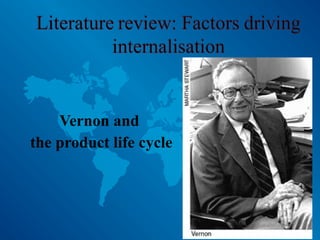
Vernon and
the product life cycle
Vernon and the product life cycle: origin
According to Posner (1961) Raymond Vernon’s theory
(1966) is based on the product life cycle which originates
from Kuznets (1953) and the technological gap theory of
trade.
His theory was constructed from the fact that most new
products which were sold in the United States were produced
in the United States itself and it was not worth to settle in
other countries due to low demand until it started to rise.
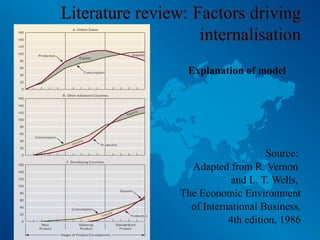
Explanation of model
Source:
Adapted from R. Vernon
and L. T. Wells,
The Economic Environment
of International Business,
4th edition, 1986
Vernon and the product life cycle: explanation of model
Stage 1: The product is first produced and consumed at home
and then exported to other high income countries.
Stage 2: When the product reaches a maturity stage, the mode of
production is changed into a foreign direct investment.
Stage 3: There is an imitation process of the product which is
developed by the competitors. The firm needs to cut cost and
finally has to shift to other developed countries and developing
countries.
Vernon and the product life cycle: criticisms and revision of
model
His model was based on the United States but new products
were not created in that part of the world only
Cantwell (1995) added that the theory cannot be used to explain
the innovation activities taken by a firm and considers the model
to be product-focus.
In 1973, Frederick Knickerbocker, one of the students of Vernon
revisited the model, including an explanation for alarge amount
of firm opting for foreign direct investment.
Buckley and Casson (1976, 1988)
internationalisation theory
Buckley and Casson (1976, 1988) internationalisation
theory: foundation of the model
used Ronald Coase’s (1937) theory of transaction cost
analysis was based on Multinational Enterprises.
believed that producing in foreign countries is more efficient
since transaction costs are saved and the knowledge obtained
from research and development activities is preserved in the
firm.
Buckley and Casson (1976, 1988) internationalisation theory:
Reasons for internalisation decision
industry-specific factors
location-specific factors
firm-specific factors
high transportation cost or trade barriers in foreign countries
inadequate information on the foreign market
to maximise profits
easiness to reach buyers and form a relationship with them
Dunning (1980, 1988, 1993)
Eclectic Paradigm
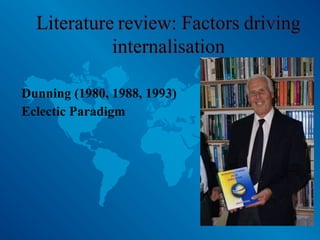
Dunning (1980, 1988, 1993) Eclectic Paradigm: root of model
Dunning was working on international business research since the
1950’s before he developed his Eclectic model in 1977
model was renamed from ‘Eclectic theory’ to ‘Eclectic paradigm’ due
to its limitations and it is also known as the OLI Paradigm
Dunning (1979) believes that the theory of Hymer, Vernon and the
internationalisation theory was insufficient to explain the international
production theory,
This is the reason why he combined the knowledge of the three models
as well as other models to create his own theory
Dunning (1980, 1988, 1993) Eclectic Paradigm: The
components of the model
This theory answers the questions below:
why certain firms are in a favourite position for investing
abroad;
 where would production be located; and
when direct production is preferred over other mode of entry
such as exports or licensing.
Dunning (1980, 1988, 1993) Eclectic Paradigm: The
components of the model
According to Dunning (1980) production of a firm in a foreign
country depends on three conditions
Ownership advantage (O)
Location advantage (L)
Internationalisation advantage (I)
Dunning (1980, 1988, 1993) Eclectic Paradigm: The
components of the model
Ownership advantages
can be divided into asset advantages (assets of the company) and
transactional advantages (ability to lower transactional cost
compare to other firms while using the same resources).
The firm should own tangible and intangible assets as well as
skills so that it can compete with the domestic firms of the host
country
Example: property rights and intangible assets (like product
innovations); advantages of common governance (specialisation)
Dunning (1980, 1988, 1993) Eclectic Paradigm: The
components of the model
Locational advantages
Company can earn more profits if it uses advantages available in
the foreign country, like cheap labour, proximity to customers
The country specific advantages that influence the location in
which the company will invest can be grouped into the economic
(quantity and quality of the factors of production),
social (psychic distance between the home country
and the host country; culture and language) and
political advantages (government policies and tax exemptions)
Dunning (1980, 1988, 1993) Eclectic Paradigm: The
components of the model
Internalisation advantages
help a firm to exploit the gains that it obtain from its ownership
advantage and therefore overcome market imperfections
(Dunning, 1996)
They also help the company to transfer its ownership advantages
across borders (Dunning, 1988).
Examples: exploitation of government intervention like quotas,
tariffs, price controls and tax differences; to control supplies and
conditions of sale of inputs
Transaction cost theory
Transaction cost theory: origin
The idea of ‘transactions form the basis of an economic thinking’
was first thought by an institutional economist, John R.
Commons (1931).
Transaction cost theory was later developed by Ronald Coase in
1937.
model answers the question “what ownership structure does the
firm want?”
Transaction cost theory: description of Transaction cost and
development of model
Coase describes in his article “The Problem of Social Cost” transaction
costs as:
Search and information costs
Bargaining and decision costs
Policing and enforcement costs
The model was further popularised by Oliver E. Williamson
According to Williamson, the determinants of transaction costs are
frequency, specificity, uncertainty, limited rationality, and opportunistic
behaviour.
 This process includes a series of stages undertaken by firms
to move internationally. The models developed are:
 Johanson and Valhne (1977, 1980) Uppsala
internationalisation process model
 Johanson and Mattson (1988) Network theory
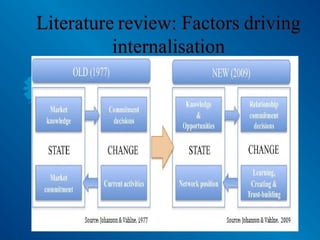
 Johanson and Valhne Uppsala model (2009)
Johanson and Vahlne (1977,
1980) Uppsala
internationalisation process
model
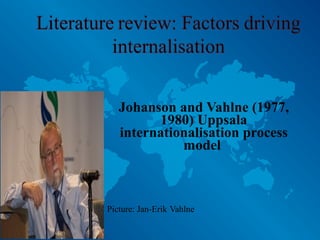
Picture: Jan-Erik Vahlne
Johanson and Vahlne (1977, 1980) Uppsala internationalisation
process model
The Uppsala school was developed by the Scandinavian researchers
Johanson, Wiedersheim-Paul and Vahlne in 1975
Johanson and Wiedersheim-Paul studied four Swedish multinationals
and the changes in their growth pattern were described as the
internationalisation process.
Later on, Johanson and Vahlne (1977) revised this model and
recognised that companies use an incremental step to access the
international market by using the knowledge from international
markets.
Their theory also put emphasis on four aspects that firms should face
while going abroad.
Johanson and Vahlne (1977, 1980) Uppsala internationalisation
process model
These four aspects can be classified as:
state (market knowledge and market commitment) and
- state aspects have an impact on the firm’s opportunities and risks.
- Market commitment consists of the resources to be used and the
degree of participation of the firm whereas Market knowledge, which is
gained by the firm, will be used for the decision making purposes.
change aspects (commitment decisions and current activities).
- change aspects are the outcomes of the state aspect. This means that
once the knowledge has been gained and the resources to be used are
known, the firm can plan and execute the current activities.
Johanson and Vahlne (1977, 1980) Uppsala
internationalisation process model: Pros and cons
Forsgren (2002) believes that the concept of learning is well
described in this model.
In fact, the model states that if there is a lack of knowledge
of foreign markets, it is difficult for the process of
internalisation to occur.
However, according to Andersen (1993), there is no
clarification about how or why the internalisation process is
conducted in this model.
Network Theory
Network Theory
According to Mitgwe (2006), Network theorists disapprove the
Uppsala-model and believe that firms using modern technology
do not go through the incremental stages since they can achieve a
faster internalisation.
In this model, Johanson and Mattsson (1988) defined
internalisation as an evolutionary process in which network of
business relationships are developed in other countries through
three stages:
oexpansion (finding a new position in a new market as a
network),
openetration (improve existing position) and
ointegration (coordinate the different position in the market).
Network Theory
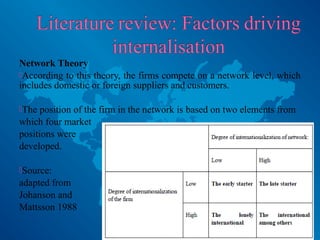
According to this theory, the firms compete on a network level, which
includes domestic or foreign suppliers and customers.
The position of the firm in the network is based on two elements from
which four market
positions were
developed.
Source:
adapted from
Johanson and
Mattsson 1988
Network Theory
early starter
has only a few relationships in the foreign market, little
knowledge on the foreign market and they have to appoint an
agent in the foreign market and use his experience.
lonely category
the firm’s suppliers, competitors and other cooperative
companies do not have access to the international market. Thus,
they cannot help the firm to enter the international market.
Network Theory
Late starters
firms which enter markets which are already
internationalised. However the late starters are disadvantaged
since competitors have more knowledge and experience about
the market than them.
International among others
both the market and the firm are highly internationalised.
Firms possess knowledge and experience and are connected
to international networks.
Network Theory : Advantages and disadvantages of the
model
Model explains the process rather than mentioning the presence
of international firms
However, for early starters these strategies cannot be achieved
and there may be a high cost while entering the foreign market.
They may have to use the Uppsala model (Hertz & Mattsson
1994)
 Johanson and Vahlne Uppsala model (2009)
 revisited their model and integrated the network approach to it
because of new technologies.
 In this updated model, the business environment is defined as an
international network of relations due to the falling of borders
between firms and markets.
 It also assumes that for a firm to become successful, it has to be
part of strong network.
 Alex Burke, Demand Media “What Is the Difference Between a Subsidiary & a Sister
Company?”, accessed on 19 August 2014
Available on http://smallbusiness.chron.com/difference-between-subsidiary-sister-company-
35043.html
 Avon and KORRES Enter into Strategic Alliance in Latin America, PR Newswire, NEW
YORK, Feb. 10, 2014, accessed on 18 August 2014
Available on
http://in.reuters.com/article/2014/02/10/avon-korres-agreemnt-
idUSnPnNYr5QFC+167+PRN20140210
 Bardhyl Dauti, December 2008, “Determinants of FDI inflow in South East European
Countries”, Tirana International Conference, accessed on 16 September 2014
Available on http://mpra.ub.uni-muenchen.de/18273/1/MPRA_paper_18273.pdfRobert E.
 Carolyn Erdener and Daniel M. Shapiro, 2005, ‘The internationalisation of Chinese
family enterprise and Dunning eclectic MNE's paradigm’, Management and Organization
Review 1:3, p411–436, 1740-8776, accessed on 18 December 2014
 Daniel Tykesson and Mikael Alserud, May 2011, “The Uppsala
Model’s Applicability on Internationalization Processes of
European SMEs, Today: A Case Study of Three Small and
Medium Sized Enterprises”, accessed on 11 September 2014
Available on
https://lup.lub.lu.se/luur/download?
func=downloadFile&recordOId=2058238&fileOId=2436198
 Definition of export, accessed on 17 August 2014
Available on http://www.investopedia.com/terms/e/export.asp
 Gao Dawei, 2008, “Internalisation and Entry Strategy of
Enterprises: A Case study of Chinese firm: Huawei”, accessed
on 11 September 2014
Available on: http://hh.diva-
portal.org/smash/get/diva2:238972/FULLTEXT01.pdf
 John H. Dunning, 1970, “Toward an eclectic theory of international production: some
empirical tests”, journal of International Business Studies, Vol. 19, No. 1 (spring,
1988), pp. 1-31, accessed on 11 September 2014
Available on http://www.palgrave-journals.com/jibs/journal/v11/n1/pdf/8490593a.pdf
 Leo Sun, “Five Ways to Become a Multinational Company”, accessed on 19 August
2014
Available on http://www.businessdictionary.com/article/602/five-ways-to-become-a-
multinational-company/
 Mason A. Carpenter and Sanjyot P. Dunung, “International Business: Opportunities and
Challenges in a Flattening World, v. 1.0”, accessed on 19 August 2014
Available on http://catalog.flatworldknowledge.com/bookhub/reader/3158?e=fwk-168388-
ch10_s03
 The Product Life-Cycle Theory, voyevodins library, accessed on 09 September 2014
Available on http://enbv.narod.ru/text/Econom/ib/str/049.html
International Business Management  Summary  by k.jeetun BSc(Hons) Management

International Business Management Summary by k.jeetun BSc(Hons) Management

  • 2.
     Definition ofterms  Mode of entry in international market  Factors driving internationalisation  Internationalisation process  References
  • 3.
    Globalisation , internationalbusinesses and internationalisation According to the American Defense Institute, globalisation is a “fast and continuous inter-border flow of goods, services, capital (or money), technology, ideas, information, cultures and nations”. With the help of globalisation, that is, the improved communication network and technology and the “disappearance” of frontiers, enterprises started to move internationally and thus giving rise to international businesses. International businesses are any commercial transactions which are carried out between firms in countries across national borders. This process of being involved in international operations is known as internationalisation (Welch and Luostarin, 1988, p.35)
  • 4.
    Mode of entryinto an international country A mode of entry into an international market is the way an organisation enters a foreign country. Most literature suggests that there are some key decisions to be taken while entering a new market: -Barriers to entry, e.g government policy -Market selection -Entry timing (early or late entrant) -Mode of entry selection
  • 5.
    1. Export Oldest formof economic transfer and easiest way to enter a market. Example : Mauritius exports non-industrial diamond to the United States. Export can be either direct (company exporting directly to the country) or indirect (using a third party) Less risky mode of entry since the company has control over production of goods and can obtain knowledge of market before exporting However, for indirect export, the company has less control over distribution
  • 6.
    2. licensing contractual agreementbetween a licensor and a licensee to use the brand name or patent in exchange of a fees One example of licensing in Mauritius is Phoenix Beverages which have the licence to make Coca Cola Company products. less risk and costs associated with licensing since the licensor undertake all research and development of the products. However the licensee may perform better and become a competitor
  • 7.
    3. joint ventures AJoint Venture occurs when two or more people agree to pool their resources in order to share ownership over a company, usually with the aim of making a profit. In Zimbabwe, Olivine industries have a joint venture agreement with HJ Heinz in food processing. company has a separate legal identity and the owners share the risks as well as ideas However, the partners may have conflict of interests and it is impossible to recover the capital invested in the joint venture.
  • 8.
    4. Strategic Alliances agreement between two parties who have decided to share their resources for a specific project  According to a New York Press release of 10th February 2014, Avon and KORRES formed a long-term strategic alliance in Latin America  When a company forms an alliance with a firm in another country, the local firm better understand the market and culture  For example, non-Saudi Arabian companies who want to do business in Saudi Arabia are required by law to have a Saudi Arabian partner which will be beneficial to the foreign one in terms of knowledge.  However, there is a lack of direct control over the project
  • 9.
    5. Franchises  Afranchise involves a licence which the franchisee acquires from the franchisor in order to sell the latter’s product under its business name  On example of a franchise is Motovac, one of the largest importer and distributor of automotive spare parts, has opened its first franchise shop in Jwaneng in August 2014.  Like exporting, franchising is among the cheapest mode of entry even if there is a cost incurred for creating a unique package for international purposes.
  • 10.
    6. Wholly OwnedSubsidiary  known as a “daughter company” which is completely owned by a parent or holding company.  large amount of capital and resources required  Example : Volkswagen Group of America, Inc. is a wholly owned subsidiary of Volkswagen AG, one of the world’s leading automobile manufacturers and the largest car producer in Europe  Unlike the other mode of entry, this one is different since the parent company exercise full control and ownership over the subsidiary.  This one is more applicable for the international production theories since the production facility will be set up in the foreign country
  • 11.
    Different theories werecreated to analyse why countries move internationally. Some of them are: Hymer’s (1960) theory Vernon (1966) Product life cycle Buckley and Casson (1976, 1988) internationalisation theory Dunning (1980, 1988, 1993) Eclectic Paradigm Transaction cost theory
  • 12.
  • 13.
    Hymer’s (1960) theory:origin In 1960, Stephen Hymer worked on a doctoral dissertation namely, “The International Operations of National Firms: A study of Foreign Direct Investment” He was the first one to differentiate between portfolio and direct investment which was defined as same in the classical theories. However, his work was published in 1976 with the help of his supervisor, Charles Kindleberger
  • 14.
    Hymer’s (1960) theory:methodology Analyse the statistics concerning the movement of capital for the two investments in Canada, Europe, Latin America and other countries developed his model based on oligopoly firms operating in the planned economy in which he was living These companies’ objectives were to preserve the monopolistic advantages that they had in their home country.
  • 15.
    Hymer’s (1960) theory:Reasons for foreign direct investment Hymer (1976) argues that foreign direct investment is an efficient strategy which is used by firms in order to maximise profits especially when the firm has some technological advantages or intangible assets. However, two conditions are required for foreign direct investment to take place: -presence of market imperfection -ownership advantages.
  • 16.
    Hymer’s (1960) theory:Reasons for foreign direct investment Two major reasons and one minor 1.‘removal of conflicts or competition’ in foreign markets 2.manipulation of ownership advantages of firms 3.risk diversification
  • 17.
    Hymer’s (1960) theory:the 21st century After publishing his dissertation, Hymer decided to write more papers. This proves that his thought was evolving and he adapted his theories based on different circumstances.  This also means that some of his ideas need to be revisited for others to use it in this 21st century
  • 18.
  • 19.
    Vernon and theproduct life cycle: origin According to Posner (1961) Raymond Vernon’s theory (1966) is based on the product life cycle which originates from Kuznets (1953) and the technological gap theory of trade. His theory was constructed from the fact that most new products which were sold in the United States were produced in the United States itself and it was not worth to settle in other countries due to low demand until it started to rise.
  • 20.
    Explanation of model Source: Adaptedfrom R. Vernon and L. T. Wells, The Economic Environment of International Business, 4th edition, 1986
  • 21.
    Vernon and theproduct life cycle: explanation of model Stage 1: The product is first produced and consumed at home and then exported to other high income countries. Stage 2: When the product reaches a maturity stage, the mode of production is changed into a foreign direct investment. Stage 3: There is an imitation process of the product which is developed by the competitors. The firm needs to cut cost and finally has to shift to other developed countries and developing countries.
  • 22.
    Vernon and theproduct life cycle: criticisms and revision of model His model was based on the United States but new products were not created in that part of the world only Cantwell (1995) added that the theory cannot be used to explain the innovation activities taken by a firm and considers the model to be product-focus. In 1973, Frederick Knickerbocker, one of the students of Vernon revisited the model, including an explanation for alarge amount of firm opting for foreign direct investment.
  • 23.
    Buckley and Casson(1976, 1988) internationalisation theory
  • 24.
    Buckley and Casson(1976, 1988) internationalisation theory: foundation of the model used Ronald Coase’s (1937) theory of transaction cost analysis was based on Multinational Enterprises. believed that producing in foreign countries is more efficient since transaction costs are saved and the knowledge obtained from research and development activities is preserved in the firm.
  • 25.
    Buckley and Casson(1976, 1988) internationalisation theory: Reasons for internalisation decision industry-specific factors location-specific factors firm-specific factors high transportation cost or trade barriers in foreign countries inadequate information on the foreign market to maximise profits easiness to reach buyers and form a relationship with them
  • 26.
    Dunning (1980, 1988,1993) Eclectic Paradigm
  • 27.
    Dunning (1980, 1988,1993) Eclectic Paradigm: root of model Dunning was working on international business research since the 1950’s before he developed his Eclectic model in 1977 model was renamed from ‘Eclectic theory’ to ‘Eclectic paradigm’ due to its limitations and it is also known as the OLI Paradigm Dunning (1979) believes that the theory of Hymer, Vernon and the internationalisation theory was insufficient to explain the international production theory, This is the reason why he combined the knowledge of the three models as well as other models to create his own theory
  • 28.
    Dunning (1980, 1988,1993) Eclectic Paradigm: The components of the model This theory answers the questions below: why certain firms are in a favourite position for investing abroad;  where would production be located; and when direct production is preferred over other mode of entry such as exports or licensing.
  • 29.
    Dunning (1980, 1988,1993) Eclectic Paradigm: The components of the model According to Dunning (1980) production of a firm in a foreign country depends on three conditions Ownership advantage (O) Location advantage (L) Internationalisation advantage (I)
  • 30.
    Dunning (1980, 1988,1993) Eclectic Paradigm: The components of the model Ownership advantages can be divided into asset advantages (assets of the company) and transactional advantages (ability to lower transactional cost compare to other firms while using the same resources). The firm should own tangible and intangible assets as well as skills so that it can compete with the domestic firms of the host country Example: property rights and intangible assets (like product innovations); advantages of common governance (specialisation)
  • 31.
    Dunning (1980, 1988,1993) Eclectic Paradigm: The components of the model Locational advantages Company can earn more profits if it uses advantages available in the foreign country, like cheap labour, proximity to customers The country specific advantages that influence the location in which the company will invest can be grouped into the economic (quantity and quality of the factors of production), social (psychic distance between the home country and the host country; culture and language) and political advantages (government policies and tax exemptions)
  • 32.
    Dunning (1980, 1988,1993) Eclectic Paradigm: The components of the model Internalisation advantages help a firm to exploit the gains that it obtain from its ownership advantage and therefore overcome market imperfections (Dunning, 1996) They also help the company to transfer its ownership advantages across borders (Dunning, 1988). Examples: exploitation of government intervention like quotas, tariffs, price controls and tax differences; to control supplies and conditions of sale of inputs
  • 33.
  • 34.
    Transaction cost theory:origin The idea of ‘transactions form the basis of an economic thinking’ was first thought by an institutional economist, John R. Commons (1931). Transaction cost theory was later developed by Ronald Coase in 1937. model answers the question “what ownership structure does the firm want?”
  • 35.
    Transaction cost theory:description of Transaction cost and development of model Coase describes in his article “The Problem of Social Cost” transaction costs as: Search and information costs Bargaining and decision costs Policing and enforcement costs The model was further popularised by Oliver E. Williamson According to Williamson, the determinants of transaction costs are frequency, specificity, uncertainty, limited rationality, and opportunistic behaviour.
  • 36.
     This processincludes a series of stages undertaken by firms to move internationally. The models developed are:  Johanson and Valhne (1977, 1980) Uppsala internationalisation process model  Johanson and Mattson (1988) Network theory  Johanson and Valhne Uppsala model (2009)
  • 37.
    Johanson and Vahlne(1977, 1980) Uppsala internationalisation process model Picture: Jan-Erik Vahlne
  • 38.
    Johanson and Vahlne(1977, 1980) Uppsala internationalisation process model The Uppsala school was developed by the Scandinavian researchers Johanson, Wiedersheim-Paul and Vahlne in 1975 Johanson and Wiedersheim-Paul studied four Swedish multinationals and the changes in their growth pattern were described as the internationalisation process. Later on, Johanson and Vahlne (1977) revised this model and recognised that companies use an incremental step to access the international market by using the knowledge from international markets. Their theory also put emphasis on four aspects that firms should face while going abroad.
  • 39.
    Johanson and Vahlne(1977, 1980) Uppsala internationalisation process model These four aspects can be classified as: state (market knowledge and market commitment) and - state aspects have an impact on the firm’s opportunities and risks. - Market commitment consists of the resources to be used and the degree of participation of the firm whereas Market knowledge, which is gained by the firm, will be used for the decision making purposes. change aspects (commitment decisions and current activities). - change aspects are the outcomes of the state aspect. This means that once the knowledge has been gained and the resources to be used are known, the firm can plan and execute the current activities.
  • 40.
    Johanson and Vahlne(1977, 1980) Uppsala internationalisation process model: Pros and cons Forsgren (2002) believes that the concept of learning is well described in this model. In fact, the model states that if there is a lack of knowledge of foreign markets, it is difficult for the process of internalisation to occur. However, according to Andersen (1993), there is no clarification about how or why the internalisation process is conducted in this model.
  • 41.
  • 42.
    Network Theory According toMitgwe (2006), Network theorists disapprove the Uppsala-model and believe that firms using modern technology do not go through the incremental stages since they can achieve a faster internalisation. In this model, Johanson and Mattsson (1988) defined internalisation as an evolutionary process in which network of business relationships are developed in other countries through three stages: oexpansion (finding a new position in a new market as a network), openetration (improve existing position) and ointegration (coordinate the different position in the market).
  • 43.
    Network Theory According tothis theory, the firms compete on a network level, which includes domestic or foreign suppliers and customers. The position of the firm in the network is based on two elements from which four market positions were developed. Source: adapted from Johanson and Mattsson 1988
  • 44.
    Network Theory early starter hasonly a few relationships in the foreign market, little knowledge on the foreign market and they have to appoint an agent in the foreign market and use his experience. lonely category the firm’s suppliers, competitors and other cooperative companies do not have access to the international market. Thus, they cannot help the firm to enter the international market.
  • 45.
    Network Theory Late starters firmswhich enter markets which are already internationalised. However the late starters are disadvantaged since competitors have more knowledge and experience about the market than them. International among others both the market and the firm are highly internationalised. Firms possess knowledge and experience and are connected to international networks.
  • 46.
    Network Theory :Advantages and disadvantages of the model Model explains the process rather than mentioning the presence of international firms However, for early starters these strategies cannot be achieved and there may be a high cost while entering the foreign market. They may have to use the Uppsala model (Hertz & Mattsson 1994)
  • 47.
     Johanson andVahlne Uppsala model (2009)  revisited their model and integrated the network approach to it because of new technologies.  In this updated model, the business environment is defined as an international network of relations due to the falling of borders between firms and markets.  It also assumes that for a firm to become successful, it has to be part of strong network.
  • 49.
     Alex Burke,Demand Media “What Is the Difference Between a Subsidiary & a Sister Company?”, accessed on 19 August 2014 Available on http://smallbusiness.chron.com/difference-between-subsidiary-sister-company- 35043.html  Avon and KORRES Enter into Strategic Alliance in Latin America, PR Newswire, NEW YORK, Feb. 10, 2014, accessed on 18 August 2014 Available on http://in.reuters.com/article/2014/02/10/avon-korres-agreemnt- idUSnPnNYr5QFC+167+PRN20140210  Bardhyl Dauti, December 2008, “Determinants of FDI inflow in South East European Countries”, Tirana International Conference, accessed on 16 September 2014 Available on http://mpra.ub.uni-muenchen.de/18273/1/MPRA_paper_18273.pdfRobert E.  Carolyn Erdener and Daniel M. Shapiro, 2005, ‘The internationalisation of Chinese family enterprise and Dunning eclectic MNE's paradigm’, Management and Organization Review 1:3, p411–436, 1740-8776, accessed on 18 December 2014
  • 50.
     Daniel Tykessonand Mikael Alserud, May 2011, “The Uppsala Model’s Applicability on Internationalization Processes of European SMEs, Today: A Case Study of Three Small and Medium Sized Enterprises”, accessed on 11 September 2014 Available on https://lup.lub.lu.se/luur/download? func=downloadFile&recordOId=2058238&fileOId=2436198  Definition of export, accessed on 17 August 2014 Available on http://www.investopedia.com/terms/e/export.asp  Gao Dawei, 2008, “Internalisation and Entry Strategy of Enterprises: A Case study of Chinese firm: Huawei”, accessed on 11 September 2014 Available on: http://hh.diva- portal.org/smash/get/diva2:238972/FULLTEXT01.pdf
  • 51.
     John H.Dunning, 1970, “Toward an eclectic theory of international production: some empirical tests”, journal of International Business Studies, Vol. 19, No. 1 (spring, 1988), pp. 1-31, accessed on 11 September 2014 Available on http://www.palgrave-journals.com/jibs/journal/v11/n1/pdf/8490593a.pdf  Leo Sun, “Five Ways to Become a Multinational Company”, accessed on 19 August 2014 Available on http://www.businessdictionary.com/article/602/five-ways-to-become-a- multinational-company/  Mason A. Carpenter and Sanjyot P. Dunung, “International Business: Opportunities and Challenges in a Flattening World, v. 1.0”, accessed on 19 August 2014 Available on http://catalog.flatworldknowledge.com/bookhub/reader/3158?e=fwk-168388- ch10_s03  The Product Life-Cycle Theory, voyevodins library, accessed on 09 September 2014 Available on http://enbv.narod.ru/text/Econom/ib/str/049.html