Globalization 
International Business
Prepared By 
Manu Melwin Joy 
Assistant Professor 
Ilahia School of Management Studies 
Kerala, India. 
Phone – 9744551114 
Mail – manu_melwinjoy@yahoo.com 
Kindly restrict the use of slides for personal purpose. 
Please seek permission to reproduce the same in public forms and presentations.
Global World 
• Each day, an average person 
makes use of goods and 
services of multiple origins— 
for instance, the Finnish 
mobile Nokia and the US toy-maker’s 
Barbie doll made in 
China but used across the 
world; a software from the 
US-based Microsoft, 
developed by an Indian 
software engineer based in 
Singapore, used in Japan; the 
Thailand-manufactured US 
sports shoe Nike used by a 
Saudi consumer.
Definition 
The IMF defines globalization 
as “ the growing economic 
and interdependence of 
countries worldwide through 
increasing volume and 
variety of cross border 
transactions in goods and 
services and of international 
capital flow and also through 
the more rapid and 
widespread diffusion of 
technology”.
Factors affecting Globalization
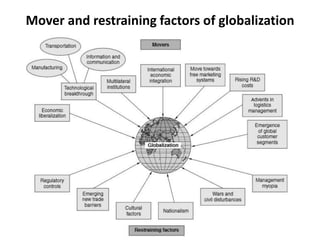
Mover and restraining factors of globalization
Movers of Globalization
Movers of Globalization 
1. Economic liberalization. 
2. Technological breakthroughs . 
3. Multilateral institutions. 
4. International Economic Integrations. 
5. Move towards free marketing system . 
6. Rising R&D cost. 
7. Advents in Logistics Management. 
8. Emergence of global customer segment.
Economic Liberalization 
• Economic liberalization, both 
in terms of regulations and 
tariff structure, has greatly 
contributed to the 
globalization of trade and 
investment. The emergence of 
the multilateral trade regime 
under the WTO has facilitated 
the reduction of tariffs and 
non-tariff trade barriers. In the 
coming years, the tariffs are 
expected to decline 
considerably further.
Technological breakthroughs 
• The breakthroughs in science 
and technology have 
transformed the world virtually 
into a global village, especially 
manufacturing, transportation, 
and information and 
communication technologies.
Multilateral institutions 
• A number of multilateral 
institutions under the UN 
framework, set up during the 
post-World War II era, have 
facilitated exchanges among 
countries and became prominent 
forces in present-day 
globalization. Multilateral 
organizations such as the GATT 
and WTO contributed to the 
process of globalization and the 
opening up of markets by 
consistently reducing tariffs and 
increasing market access through 
various rounds of multilateral 
trade negotiations.
International Economic Integrations 
• Consequent to World War II, a 
number of countries across the 
world collaborated to form 
economic groupings so as to 
promote trade and investment 
among the members. The Treaty 
of Rome in 1957 led to the 
creation of the European 
Economic Community (EEC) that 
graduated to the European Union 
(EU) so as to form a stronger 
Economic Union. The US, Canada, 
and Mexico collaborated to form 
the North American Free Trade 
Agreement (NAFTA) in 1994.
Move towards free marketing system 
• The demise of centrally 
planned economies in Eastern 
Europe, the former USSR, and 
China has also contributed to 
the process of globalization as 
these countries gradually 
integrated themselves with the 
world economy. The 
Commonwealth of 
Independent States (CIS) 
countries—all former Soviet 
Republics—and China have 
opened up and are moving 
towards market-driven 
economic systems at fast 
pace.
Rising R&D cost 
• The rapid growth in market 
competition and the ever-increasing 
insatiable consumer 
demand for newer and 
increasingly sophisticated 
goods and services compel 
businesses to invest huge 
amounts on research and 
development (R&D). In order 
to recover the costs of massive 
investments in R&D and 
achieve economic viability, it 
becomes necessary to 
globalize the business 
operations.
Example 
• For instance, software 
companies such as 
Microsoft, Novel, and 
Oracle, commercial aircraft 
manufacturers like Boeing 
and Airbus, pharmaceutical 
giants such as Pfizer, Glaxo 
SmithKline, Johnson & 
Johnson, Merck, and 
Novartis, etc., can hardly be 
commercially viable unless 
global scale of operations 
are adopted.
Advents in Logistics Management 
• Besides these, the greater 
availability of speedier and 
increasingly cost-effective 
means of transport, 
breakthroughs in logistics 
management such as 
multimodal transport 
technology, and third-party 
logistics management 
contributed to the faster 
and efficient movement of 
goods internationally.
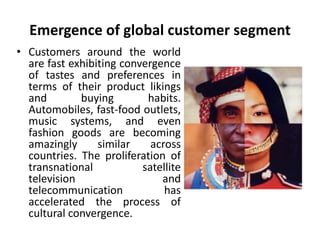
Emergence of global customer segment 
• Customers around the world 
are fast exhibiting convergence 
of tastes and preferences in 
terms of their product likings 
and buying habits. 
Automobiles, fast-food outlets, 
music systems, and even 
fashion goods are becoming 
amazingly similar across 
countries. The proliferation of 
transnational satellite 
television and 
telecommunication has 
accelerated the process of 
cultural convergence.
Factors restraining of 
globalization
Factors restraining of globalization 
1. Regulatory controls . 
2. Emerging trade barriers. 
3. Cultural Factors. 
4. Nationalism. 
5. War and civil disturbances. 
6. Management Myopia .
Regulatory controls 
• The restrictions imposed by 
national governments by way 
of regulatory measures in their 
trade, industrial, monetary, 
and fiscal policies restrain 
companies from global 
expansion. Restrictions on 
portfolio and foreign direct 
investment considerably 
influence monetary and capital 
flows across borders. The high 
incidence of import duties 
makes imported goods 
uncompetitive and deters 
them from entering domestic 
markets.
Emerging trade barriers 
• The integration of national economies 
under the WTO framework has 
restrained countries from increasing 
tariffs and imposing explicit non-tariff 
trade barriers. However, countries are 
consistently evolving innovative 
marketing barriers that are WTO 
compatible. Such barriers include 
quality and technical specifications, 
environmental issues, regulations 
related to human exploitation, such as 
child labour, etc. Innovative technical 
jargons and justifications are often 
evolved by developed countries to 
impose such restrictions over goods 
from developing countries, who find it 
very hard to defend against such 
measures.
Cultural Factors 
• Cultural factors can restrain 
the benefits of globalization. 
For instance, France’s 
collective nationalism favours 
home-grown agriculture and 
the US fear of terrorism has 
made foreign management of 
its ports difficult and 
restrained the entry of the 
Dubai PortWorld.
Nationalism 
• The feeling of nationalism often 
aroused by local trade and 
industry, trade unions, political 
parties, and other nationalistic 
interest groups exerts 
considerable pressure against 
globalization. The increased 

availability of quality goods at 
comparatively lower prices 
generally benefits the mass 
consumers in the importing 
country but hurts the interests 
of the domestic industry.
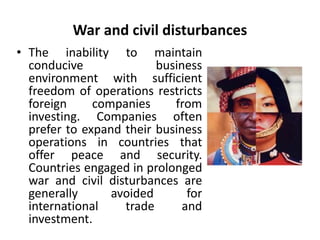
War and civil disturbances 
• The inability to maintain 
conducive business 
environment with sufficient 
freedom of operations restricts 
foreign companies from 
investing. Companies often 
prefer to expand their business 
operations in countries that 
offer peace and security. 
Countries engaged in prolonged 
war and civil disturbances are 
generally avoided for 
international trade and 
investment.
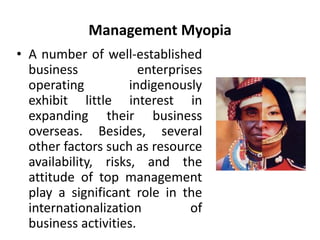
Management Myopia 
• A number of well-established 
business enterprises 
operating indigenously 
exhibit little interest in 
expanding their business 
overseas. Besides, several 
other factors such as resource 
availability, risks, and the 
attitude of top management 
play a significant role in the 
internationalization of 
business activities.
World Is flat
World is Flat 
• The flat-world view is largely credited to 
Thomas Friedman and his 2005 best seller, 
The World Is Flat. Many people consider 
globalization a modern phenomenon, but 
according to Friedman, this is its third stage.
Globalization 1.0 
• The first stage of global development, what 
Friedman calls “Globalization 1.0,” started 
with Columbus’s discovery of the New World 
and ran from 1492 to about 1800. Driven by 
nationalism and religion, this lengthy stage 
was characterized by how much industrial 
power countries could produce and apply.
Globalization 2.0 
• “Globalization 2.0,” from about 1800 to 2000, 
was disrupted by the Great Depression and both 
World Wars and was largely shaped by the 
emerging power of huge, multinational 
corporations. Globalization 2.0 grew with the 
European mercantile stock companies as they 
expanded in search of new markets, cheap labor, 
and raw materials. It continued with subsequent 
advances in sea and rail transportation. This 
period saw the introduction of modern 
communications and cheaper shipping costs.
Globalization 3.0 
• “Globalization 3.0” began around 2000, with 
advances in global electronic interconnectivity 
that allowed individuals to communicate as never 
before. In Globalization 1.0, nations dominated 
global expansion. Globalization 2.0 was driven by 
the ascension of multinational companies, which 
pushed global development. In Globalization 3.0, 
major software advances have allowed an 
unprecedented number of people worldwide to 
work together with unlimited potential.
How the World Got Flat 
• Friedman identifies ten major events that 
helped reshape the modern world and make it 
flat:
How the World Got Flat 
• 11/9/89: When the walls came down and the 
windows went up.The fall of the Berlin Wall 
ended old-style communism and planned 
economies. Capitalism ascended. 
• 8/9/95: When Netscape went public. Internet 
browsing and e-mail helped propel the 
Internet by making it commercially viable and 
user friendly.
How the World Got Flat 
• Work-flow software: Let’s do lunch. Have your 
application talk to my application. With more 
powerful, easier-to-use software and improved 
connectivity, more people can share work. Thus, 
complex projects with more interdependent parts 
can be worked on collaboratively from anywhere. 
• Open-sourcing: Self-organizing, collaborative 
communities. Providing basic software online for 
free gives everyone source code, thus 
accelerating collaboration and software 
development.
How the World Got Flat 
• Outsourcing: Y2K. The Internet lets firms use 
employees worldwide and send specific work to 
the most qualified, cheapest labor, wherever it is. 
Enter India, with educated and talented people 
who work at a fraction of US or European wages. 
Indian technicians and software experts built an 
international reputation during the Y2K 
millennium event. The feared computer -system 
breakdown never happened, but the Indian IT 
industry began handling e-commerce and related 
businesses worldwide.
How the World Got Flat 
• Offshoring: When it comes to jobs leaving and factories 
being built in cheaper places, people think of China, 
Malaysia, Thailand, Mexico, Ireland, Brazil, and 
Vietnam. But going offshore isn’t just moving part of a 
manufacturing or service process. It means creating a 
new business model to make more goods for non-US 
sale, thus increasing US exports. 
• Supply-chaining: Eating sushi in Arkansas. Walmart 
demonstrates that improved acquisition and 
distribution can lower costs and make suppliers boost 
quality.
How the World Got Flat 
• Insourcing: What the guys in funny brown shorts 
are really doing. This kind of service collaboration 
happens when firms devise new service 
combinations to improve service. Take United 
Parcel Service (UPS). The “brown” company 
delivers packages globally, but it also repairs 
Toshiba computers and organizes delivery routes 
for Papa John’s pizza. With insourcing, UPS uses 
its logistics expertise to help clients create new 
businesses.
How the World Got Flat 
• Informing: Google, Yahoo!, MSN Web Search. Google 
revolutionized information searching. Its users conduct 
some one billion searches annually. This search 
methodology and the wide access to knowledge on the 
Internet transforms information into a commodity 
people can use to spawn entirely new businesses. 
• The steroids: Digital, mobile, personal, and virtual. 
Technological advances range from wireless 
communication to processing, resulting in extremely 
powerful computing capability and transmission. One 
new Intel chip processes some 11 million instructions 
per second (MIPS), compared to 60,000 MIPS in 1971.
Now 
• These ten factors had powerful roles in making 
the world smaller, but each worked in isolation 
until, Freidman writes, the convergence of three 
more powerful forces: (1) new software and 
increased public familiarity with the Internet, (2) 
the incorporation of that knowledge into 
business and personal communication, and (3) 
the market influx of billions of people from Asia 
and the former Soviet Union who want to 
become more prosperous—fast. Converging, 
these factors generated their own critical mass.
Globalization - International Business - Manu Melwin Joy

Globalization - International Business - Manu Melwin Joy

  • 1.
  • 2.
    Prepared By ManuMelwin Joy Assistant Professor Ilahia School of Management Studies Kerala, India. Phone – 9744551114 Mail – manu_melwinjoy@yahoo.com Kindly restrict the use of slides for personal purpose. Please seek permission to reproduce the same in public forms and presentations.
  • 3.
    Global World •Each day, an average person makes use of goods and services of multiple origins— for instance, the Finnish mobile Nokia and the US toy-maker’s Barbie doll made in China but used across the world; a software from the US-based Microsoft, developed by an Indian software engineer based in Singapore, used in Japan; the Thailand-manufactured US sports shoe Nike used by a Saudi consumer.
  • 4.
    Definition The IMFdefines globalization as “ the growing economic and interdependence of countries worldwide through increasing volume and variety of cross border transactions in goods and services and of international capital flow and also through the more rapid and widespread diffusion of technology”.
  • 5.
  • 6.
    Mover and restrainingfactors of globalization
  • 7.
  • 8.
    Movers of Globalization 1. Economic liberalization. 2. Technological breakthroughs . 3. Multilateral institutions. 4. International Economic Integrations. 5. Move towards free marketing system . 6. Rising R&D cost. 7. Advents in Logistics Management. 8. Emergence of global customer segment.
  • 9.
    Economic Liberalization •Economic liberalization, both in terms of regulations and tariff structure, has greatly contributed to the globalization of trade and investment. The emergence of the multilateral trade regime under the WTO has facilitated the reduction of tariffs and non-tariff trade barriers. In the coming years, the tariffs are expected to decline considerably further.
  • 10.
    Technological breakthroughs •The breakthroughs in science and technology have transformed the world virtually into a global village, especially manufacturing, transportation, and information and communication technologies.
  • 11.
    Multilateral institutions •A number of multilateral institutions under the UN framework, set up during the post-World War II era, have facilitated exchanges among countries and became prominent forces in present-day globalization. Multilateral organizations such as the GATT and WTO contributed to the process of globalization and the opening up of markets by consistently reducing tariffs and increasing market access through various rounds of multilateral trade negotiations.
  • 12.
    International Economic Integrations • Consequent to World War II, a number of countries across the world collaborated to form economic groupings so as to promote trade and investment among the members. The Treaty of Rome in 1957 led to the creation of the European Economic Community (EEC) that graduated to the European Union (EU) so as to form a stronger Economic Union. The US, Canada, and Mexico collaborated to form the North American Free Trade Agreement (NAFTA) in 1994.
  • 13.
    Move towards freemarketing system • The demise of centrally planned economies in Eastern Europe, the former USSR, and China has also contributed to the process of globalization as these countries gradually integrated themselves with the world economy. The Commonwealth of Independent States (CIS) countries—all former Soviet Republics—and China have opened up and are moving towards market-driven economic systems at fast pace.
  • 14.
    Rising R&D cost • The rapid growth in market competition and the ever-increasing insatiable consumer demand for newer and increasingly sophisticated goods and services compel businesses to invest huge amounts on research and development (R&D). In order to recover the costs of massive investments in R&D and achieve economic viability, it becomes necessary to globalize the business operations.
  • 15.
    Example • Forinstance, software companies such as Microsoft, Novel, and Oracle, commercial aircraft manufacturers like Boeing and Airbus, pharmaceutical giants such as Pfizer, Glaxo SmithKline, Johnson & Johnson, Merck, and Novartis, etc., can hardly be commercially viable unless global scale of operations are adopted.
  • 16.
    Advents in LogisticsManagement • Besides these, the greater availability of speedier and increasingly cost-effective means of transport, breakthroughs in logistics management such as multimodal transport technology, and third-party logistics management contributed to the faster and efficient movement of goods internationally.
  • 17.
    Emergence of globalcustomer segment • Customers around the world are fast exhibiting convergence of tastes and preferences in terms of their product likings and buying habits. Automobiles, fast-food outlets, music systems, and even fashion goods are becoming amazingly similar across countries. The proliferation of transnational satellite television and telecommunication has accelerated the process of cultural convergence.
  • 18.
    Factors restraining of globalization
  • 19.
    Factors restraining ofglobalization 1. Regulatory controls . 2. Emerging trade barriers. 3. Cultural Factors. 4. Nationalism. 5. War and civil disturbances. 6. Management Myopia .
  • 20.
    Regulatory controls •The restrictions imposed by national governments by way of regulatory measures in their trade, industrial, monetary, and fiscal policies restrain companies from global expansion. Restrictions on portfolio and foreign direct investment considerably influence monetary and capital flows across borders. The high incidence of import duties makes imported goods uncompetitive and deters them from entering domestic markets.
  • 21.
    Emerging trade barriers • The integration of national economies under the WTO framework has restrained countries from increasing tariffs and imposing explicit non-tariff trade barriers. However, countries are consistently evolving innovative marketing barriers that are WTO compatible. Such barriers include quality and technical specifications, environmental issues, regulations related to human exploitation, such as child labour, etc. Innovative technical jargons and justifications are often evolved by developed countries to impose such restrictions over goods from developing countries, who find it very hard to defend against such measures.
  • 22.
    Cultural Factors •Cultural factors can restrain the benefits of globalization. For instance, France’s collective nationalism favours home-grown agriculture and the US fear of terrorism has made foreign management of its ports difficult and restrained the entry of the Dubai PortWorld.
  • 23.
    Nationalism • Thefeeling of nationalism often aroused by local trade and industry, trade unions, political parties, and other nationalistic interest groups exerts considerable pressure against globalization. The increased availability of quality goods at comparatively lower prices generally benefits the mass consumers in the importing country but hurts the interests of the domestic industry.
  • 24.
    War and civildisturbances • The inability to maintain conducive business environment with sufficient freedom of operations restricts foreign companies from investing. Companies often prefer to expand their business operations in countries that offer peace and security. Countries engaged in prolonged war and civil disturbances are generally avoided for international trade and investment.
  • 25.
    Management Myopia •A number of well-established business enterprises operating indigenously exhibit little interest in expanding their business overseas. Besides, several other factors such as resource availability, risks, and the attitude of top management play a significant role in the internationalization of business activities.
  • 26.
  • 27.
    World is Flat • The flat-world view is largely credited to Thomas Friedman and his 2005 best seller, The World Is Flat. Many people consider globalization a modern phenomenon, but according to Friedman, this is its third stage.
  • 28.
    Globalization 1.0 •The first stage of global development, what Friedman calls “Globalization 1.0,” started with Columbus’s discovery of the New World and ran from 1492 to about 1800. Driven by nationalism and religion, this lengthy stage was characterized by how much industrial power countries could produce and apply.
  • 29.
    Globalization 2.0 •“Globalization 2.0,” from about 1800 to 2000, was disrupted by the Great Depression and both World Wars and was largely shaped by the emerging power of huge, multinational corporations. Globalization 2.0 grew with the European mercantile stock companies as they expanded in search of new markets, cheap labor, and raw materials. It continued with subsequent advances in sea and rail transportation. This period saw the introduction of modern communications and cheaper shipping costs.
  • 30.
    Globalization 3.0 •“Globalization 3.0” began around 2000, with advances in global electronic interconnectivity that allowed individuals to communicate as never before. In Globalization 1.0, nations dominated global expansion. Globalization 2.0 was driven by the ascension of multinational companies, which pushed global development. In Globalization 3.0, major software advances have allowed an unprecedented number of people worldwide to work together with unlimited potential.
  • 31.
    How the WorldGot Flat • Friedman identifies ten major events that helped reshape the modern world and make it flat:
  • 32.
    How the WorldGot Flat • 11/9/89: When the walls came down and the windows went up.The fall of the Berlin Wall ended old-style communism and planned economies. Capitalism ascended. • 8/9/95: When Netscape went public. Internet browsing and e-mail helped propel the Internet by making it commercially viable and user friendly.
  • 33.
    How the WorldGot Flat • Work-flow software: Let’s do lunch. Have your application talk to my application. With more powerful, easier-to-use software and improved connectivity, more people can share work. Thus, complex projects with more interdependent parts can be worked on collaboratively from anywhere. • Open-sourcing: Self-organizing, collaborative communities. Providing basic software online for free gives everyone source code, thus accelerating collaboration and software development.
  • 34.
    How the WorldGot Flat • Outsourcing: Y2K. The Internet lets firms use employees worldwide and send specific work to the most qualified, cheapest labor, wherever it is. Enter India, with educated and talented people who work at a fraction of US or European wages. Indian technicians and software experts built an international reputation during the Y2K millennium event. The feared computer -system breakdown never happened, but the Indian IT industry began handling e-commerce and related businesses worldwide.
  • 35.
    How the WorldGot Flat • Offshoring: When it comes to jobs leaving and factories being built in cheaper places, people think of China, Malaysia, Thailand, Mexico, Ireland, Brazil, and Vietnam. But going offshore isn’t just moving part of a manufacturing or service process. It means creating a new business model to make more goods for non-US sale, thus increasing US exports. • Supply-chaining: Eating sushi in Arkansas. Walmart demonstrates that improved acquisition and distribution can lower costs and make suppliers boost quality.
  • 36.
    How the WorldGot Flat • Insourcing: What the guys in funny brown shorts are really doing. This kind of service collaboration happens when firms devise new service combinations to improve service. Take United Parcel Service (UPS). The “brown” company delivers packages globally, but it also repairs Toshiba computers and organizes delivery routes for Papa John’s pizza. With insourcing, UPS uses its logistics expertise to help clients create new businesses.
  • 37.
    How the WorldGot Flat • Informing: Google, Yahoo!, MSN Web Search. Google revolutionized information searching. Its users conduct some one billion searches annually. This search methodology and the wide access to knowledge on the Internet transforms information into a commodity people can use to spawn entirely new businesses. • The steroids: Digital, mobile, personal, and virtual. Technological advances range from wireless communication to processing, resulting in extremely powerful computing capability and transmission. One new Intel chip processes some 11 million instructions per second (MIPS), compared to 60,000 MIPS in 1971.
  • 38.
    Now • Theseten factors had powerful roles in making the world smaller, but each worked in isolation until, Freidman writes, the convergence of three more powerful forces: (1) new software and increased public familiarity with the Internet, (2) the incorporation of that knowledge into business and personal communication, and (3) the market influx of billions of people from Asia and the former Soviet Union who want to become more prosperous—fast. Converging, these factors generated their own critical mass.