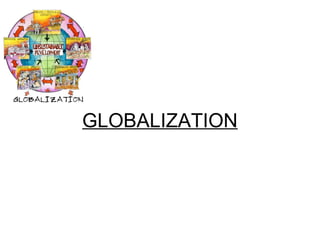
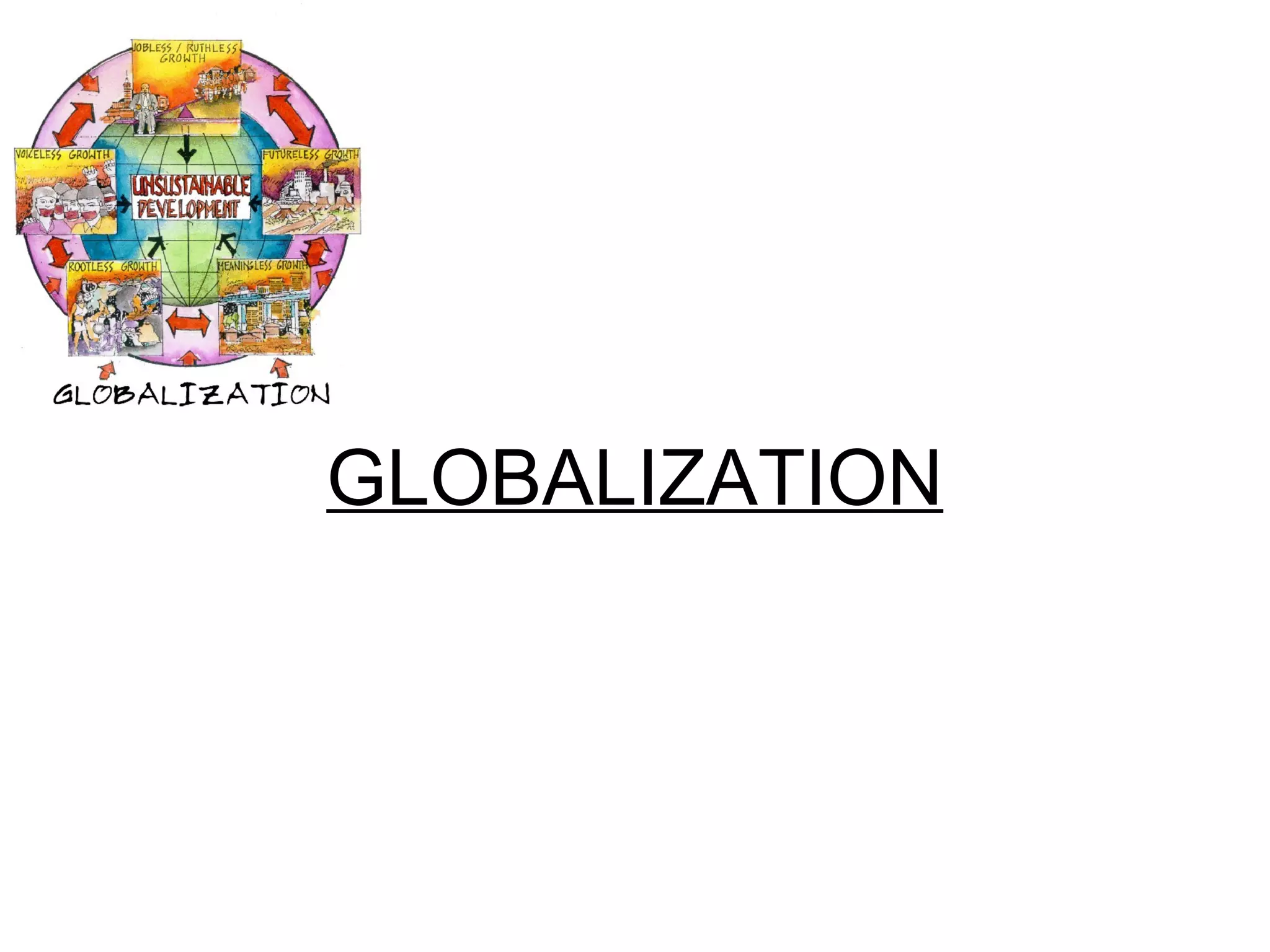
GLOBALIZATION
MEANING   Globalization  (or  globalisation )  describes a process by which regional economies, societies, and cultures have become integrated through a global network of communication, transportation, and trade. The term is sometimes used to refer specifically to economic globalization: the integration of national economies into the international economy through trade, foreign direct investment, capital flows, migration, and the spread of technology. However, globalization is usually recognized as being driven by a combination of economic, technological, sociocultural, political, and biological factors.
HISTORY The historical origins of globalization are the subject of on-going debate. Though some scholars situate the origins of globalization in the modern era, others regard it as a phenomenon with a long history. Perhaps the most extreme proponent of a deep historical origin for globalization was Andre Gunder Frank, an economist associated with dependency theory. Frank argued that a form of globalization has been in existence since the rise of trade links between Sumer and the Indus Valley Civilization in the third millennium B.C The Islamic Golden Age was also an important early stage of globalization, when Jewish and Muslim traders and explorers established a sustained economy across the Old World resulting in a globalization of crops , trade, knowledge and technology. Globally significant crops such as sugar and cotton  became widely cultivated across the Muslim world  in this period, while the necessity of learning Arabic  and completing the Hajj created a cosmopolitan culture.  In late 2000s, much of the industrialized world entered into a deep recession. Some analysts say the world is going through a period of deglobalization after  years of increasing economic integration. Up to 45% of global wealth had been destroyed by the global financial crisis in little less than a year and a half. China has recently become the world's largest exporter surpassing Germany
MODERN GLOBALIZATION Globalization, since World War II, is largely the result of planning by politicians to break down borders hampering trade to increase prosperity and interdependence thereby decreasing the chance of future war. Their work led to the Bretton Woods conference, an agreement by the world's leading politicians to lay down the framework for international commerce and finance, and the founding of several international institutions intended to oversee the processes of globalization. The Uruguay Round (1986 to 1994) led to a treaty to create the WTO to mediate trade disputes and set up a uniform platform of trading. Other bilateral and multilateral trade agreements, including sections of Europe's Maastricht Treaty and the North American Free Trade Agreement (NAFTA) have also been signed in pursuit of the goal of reducing tariffs and barriers to trade. World exports rose from 8.5% in 1970, to 16.2% of total gross world product in 2001.
Measuring Globalization Economic Globalization demonstrates that it can be measured in different ways. It concentrates on four main economic flows that characterize globalization: Goods and services Labor/people Capital Technology Recent Index calculated by the Swiss  think tank  KOF  World's most globalized country - Belgium, followed by Austria, Sweden, the United Kingdom and the Netherlands. Least globalized countries- Haiti, Myanmar, Central African Republic and Burundi.
Effects of Globalization Industrial  - emergence of worldwide production markets and broader access to a range of foreign products for consumers and companies Financial  -  emergence of worldwide financial markets and better access to external financing for borrowers. Economic  - realization of a global common market, based on the freedom of exchange of goods and capital.  Health Policy  - On the global scale, health becomes a commodity. In developing nations, health systems are fragmented and privatized.  Political   - some use "globalization" to mean the creation of a world government which regulates the relationships among governments and guarantees the rights arising from social and economic globalization.  Informational   - increase in information flows between geographically remote locations. Language - Mandarin,Spanish,English   
Competition   Ecological    Cultural - Spreading of multiculturalism - Greater international travel and tourism.  - Greater immigration, including illegal immigration - Spread of local consumer products (e.g., food) to other countries   - Worldwide fads and pop culture such as YouTube, Orkut, Facebook, and MySpace.  - Worldwide sporting events such as FIFA World Cup and the Olympic Games.  Religious   Cultural Effect Culture is what people eat, how they dress, beliefs they hold, and activities they practice. E.g., food, Chinese characters in tattoos.
Negative Effect Increased inequality and environmental degradation Americanization or McDonaldization.  Sweatshops  Factories set up in the poor countries where employees agree to work for low wages. Negative effects of economic liberalization Global financial crisis and Recession Brain drain Opportunities in richer countries drives talent away from poorer countries, leading to brain drains.  Effect on environmental degradation Deforestation  Food security Gradual change in diet among newly prosperous populations is the most important factor underpinning the rise in global food prices.
Effect on disease Flow of information, goods, capital and people across political and geographic boundaries, has also helped to spread some of the deadliest infectious diseases known to humans.  AIDS/HIV Drug and illicit goods trade Global drug trade generates more than $320 billion a year in revenues. Worldwide, the UN estimates there are more than 50 million regular users of heroin, cocaine and synthetic drugs. The international trade of endangered species is second only to drug trafficking.
PRO & ANTI GLOBALIZATION GLOBALIZATION
GLOBALIZATION  Globalization is defined as a process of economic integration of the entire world through the removal of barriers to free trade and capital mobility as well as through the diffusion of knowledge and information  .
'Pro' and 'anti' are really only extremes in a complex issue where most of us fall into the broad middle   Many so-called "pro-globalization" people are well aware of - and concerned about - the dangers of globalization. And many "anti-globalization" activists love the global village aspects of globalization but rail against corporate globalization.
The anti-globalization movement developed in opposition to the perceived negative aspects of globalization. The term 'anti-globalization' is in many ways a misnomer, since the group represents a wide range of interests and issues and many of the people involved in the anti-globalization movement do support closer ties between the various peoples and cultures of the world through, for example, aid, assistance for refugees, and global environmental issues.
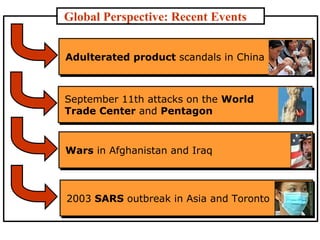
Global Perspective: Recent Events 2003  SARS  outbreak in Asia and Toronto  Wars  in Afghanistan and Iraq Adulterated product  scandals in China  September 11th attacks on the  World  Trade Center  and  Pentagon
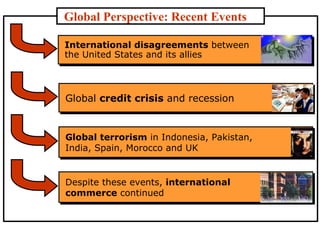
Global Perspective: Recent Events International disagreements  between  the United States and its allies Global  credit crisis  and recession  Global terrorism  in Indonesia, Pakistan, India, Spain, Morocco and UK Despite these events,  international  commerce  continued
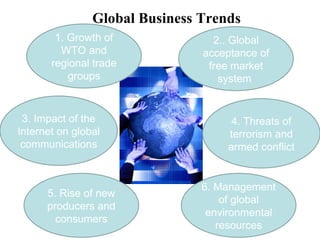
Global Business Trends 1. Growth of WTO and regional trade groups 2.. Global acceptance of free market system  3. Impact of the Internet on global communications 4. Threats of terrorism and armed conflict 5. Rise of new producers and consumers 6. Management of global environmental resources
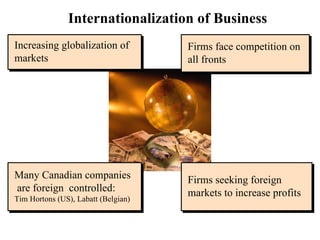
Internationalization of Business Increasing globalization of markets Firms face competition on all fronts Many Canadian companies are foreign  controlled: Tim Hortons (US), Labatt (Belgian) Firms seeking foreign markets to increase profits
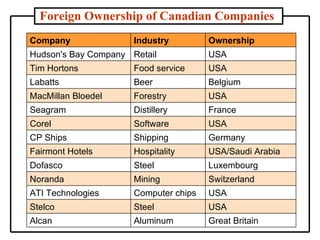
Foreign Ownership of Canadian Companies Company Industry Ownership Hudson's Bay Company Retail USA Tim Hortons Food service USA Labatts Beer Belgium MacMillan Bloedel Forestry USA Seagram Distillery France Corel Software USA CP Ships Shipping Germany Fairmont Hotels Hospitality USA/Saudi Arabia Dofasco Steel Luxembourg Noranda  Mining Switzerland ATI Technologies Computer chips USA Stelco Steel USA Alcan Aluminum Great Britain
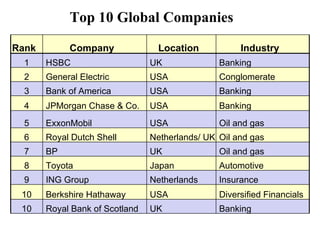
Top 10 Global Companies  Rank   Company   Location   Industry   1 HSBC UK Banking 2 General Electric USA Conglomerate 3 Bank of America USA Banking 4 JPMorgan Chase & Co. USA Banking 5 ExxonMobil USA Oil and gas 6 Royal Dutch Shell Netherlands/ UK Oil and gas 7 BP UK Oil and gas 8 Toyota Japan Automotive 9 ING Group Netherlands Insurance 10 Berkshire Hathaway USA Diversified Financials 10 Royal Bank of Scotland UK Banking
The Globalization Debate Pro-Globalizes Anti-Globalizes Skeptics Transformation lists
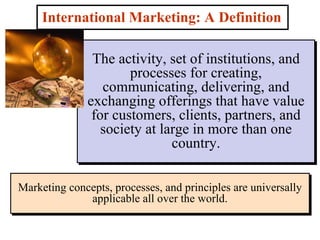
International Marketing: A Definition Marketing concepts, processes, and principles are universally applicable all over the world. The activity, set of institutions, and processes for creating, communicating, delivering, and exchanging offerings that have value for customers, clients, partners, and society at large in more than one country.
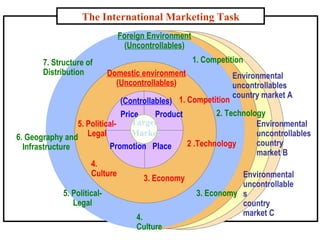
The International Marketing Task 7 3. Economy Environmental uncontrollables country market A Environmental uncontrollables country market B Environmental uncontrollables country market C 1. Competition 1. Competition 2. Technology Price Product Promotion Place  6. Geography and Infrastructure  Foreign Environment ( Uncontrollables ) 7. Structure of Distribution 3. Economy 5. Political- Legal Domestic environment ( Uncontrollables ) ( Controllables ) 2 .Technology 4. Culture 5. Political- Legal 4. Culture Target  Market
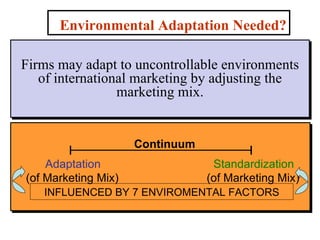
Environmental Adaptation Needed? Firms may adapt to uncontrollable environments of international marketing by adjusting the marketing mix. Adaptation (of Marketing Mix) Standardization (of Marketing Mix) Continuum INFLUENCED BY 7 ENVIROMENTAL FACTORS
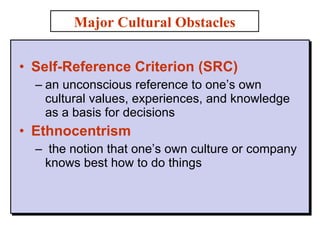
Self-Reference Criterion (SRC) an unconscious reference to one’s own cultural values, experiences, and knowledge as a basis for decisions Ethnocentrism the notion that one’s own culture or company knows best how to do things  Major Cultural Obstacles
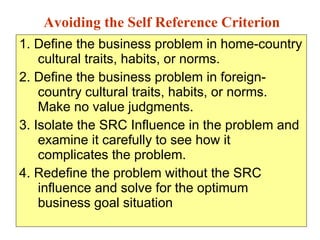
1. Define the business problem in home-country cultural traits, habits, or norms. 2. Define the business problem in foreign-country cultural traits, habits, or norms. Make no value judgments. 3. Isolate the SRC Influence in the problem and examine it carefully to see how it complicates the problem. 4. Redefine the problem without the SRC influence and solve for the optimum business goal situation Avoiding the Self Reference Criterion
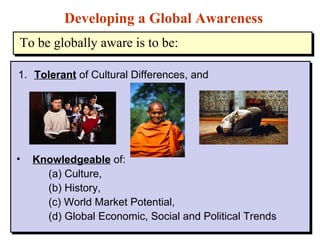
1. Tolerant  of Cultural Differences, and Developing a Global Awareness Knowledgeable  of:  (a) Culture,  (b) History,  (c) World Market Potential, (d) Global Economic, Social and Political Trends To be globally aware is to be:
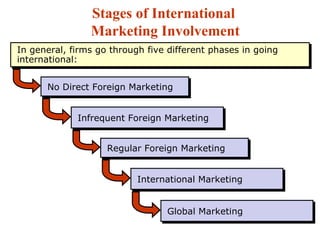
Stages of International  Marketing Involvement In general, firms go through five different phases in going international: Infrequent Foreign Marketing No Direct Foreign Marketing International Marketing Regular Foreign Marketing Global Marketing
Thank You

Global

  • 1.
  • 2.
    MEANING Globalization (or globalisation ) describes a process by which regional economies, societies, and cultures have become integrated through a global network of communication, transportation, and trade. The term is sometimes used to refer specifically to economic globalization: the integration of national economies into the international economy through trade, foreign direct investment, capital flows, migration, and the spread of technology. However, globalization is usually recognized as being driven by a combination of economic, technological, sociocultural, political, and biological factors.
  • 3.
    HISTORY The historicalorigins of globalization are the subject of on-going debate. Though some scholars situate the origins of globalization in the modern era, others regard it as a phenomenon with a long history. Perhaps the most extreme proponent of a deep historical origin for globalization was Andre Gunder Frank, an economist associated with dependency theory. Frank argued that a form of globalization has been in existence since the rise of trade links between Sumer and the Indus Valley Civilization in the third millennium B.C The Islamic Golden Age was also an important early stage of globalization, when Jewish and Muslim traders and explorers established a sustained economy across the Old World resulting in a globalization of crops , trade, knowledge and technology. Globally significant crops such as sugar and cotton became widely cultivated across the Muslim world in this period, while the necessity of learning Arabic and completing the Hajj created a cosmopolitan culture. In late 2000s, much of the industrialized world entered into a deep recession. Some analysts say the world is going through a period of deglobalization after years of increasing economic integration. Up to 45% of global wealth had been destroyed by the global financial crisis in little less than a year and a half. China has recently become the world's largest exporter surpassing Germany
  • 4.
    MODERN GLOBALIZATION Globalization,since World War II, is largely the result of planning by politicians to break down borders hampering trade to increase prosperity and interdependence thereby decreasing the chance of future war. Their work led to the Bretton Woods conference, an agreement by the world's leading politicians to lay down the framework for international commerce and finance, and the founding of several international institutions intended to oversee the processes of globalization. The Uruguay Round (1986 to 1994) led to a treaty to create the WTO to mediate trade disputes and set up a uniform platform of trading. Other bilateral and multilateral trade agreements, including sections of Europe's Maastricht Treaty and the North American Free Trade Agreement (NAFTA) have also been signed in pursuit of the goal of reducing tariffs and barriers to trade. World exports rose from 8.5% in 1970, to 16.2% of total gross world product in 2001.
  • 5.
    Measuring Globalization EconomicGlobalization demonstrates that it can be measured in different ways. It concentrates on four main economic flows that characterize globalization: Goods and services Labor/people Capital Technology Recent Index calculated by the Swiss  think tank  KOF World's most globalized country - Belgium, followed by Austria, Sweden, the United Kingdom and the Netherlands. Least globalized countries- Haiti, Myanmar, Central African Republic and Burundi.
  • 6.
    Effects of GlobalizationIndustrial  - emergence of worldwide production markets and broader access to a range of foreign products for consumers and companies Financial  - emergence of worldwide financial markets and better access to external financing for borrowers. Economic  - realization of a global common market, based on the freedom of exchange of goods and capital. Health Policy  - On the global scale, health becomes a commodity. In developing nations, health systems are fragmented and privatized. Political   - some use "globalization" to mean the creation of a world government which regulates the relationships among governments and guarantees the rights arising from social and economic globalization. Informational   - increase in information flows between geographically remote locations. Language - Mandarin,Spanish,English  
  • 7.
    Competition Ecological   Cultural - Spreading of multiculturalism - Greater international travel and tourism. - Greater immigration, including illegal immigration - Spread of local consumer products (e.g., food) to other countries  - Worldwide fads and pop culture such as YouTube, Orkut, Facebook, and MySpace. - Worldwide sporting events such as FIFA World Cup and the Olympic Games. Religious Cultural Effect Culture is what people eat, how they dress, beliefs they hold, and activities they practice. E.g., food, Chinese characters in tattoos.
  • 8.
    Negative Effect Increasedinequality and environmental degradation Americanization or McDonaldization. Sweatshops Factories set up in the poor countries where employees agree to work for low wages. Negative effects of economic liberalization Global financial crisis and Recession Brain drain Opportunities in richer countries drives talent away from poorer countries, leading to brain drains. Effect on environmental degradation Deforestation Food security Gradual change in diet among newly prosperous populations is the most important factor underpinning the rise in global food prices.
  • 9.
    Effect on diseaseFlow of information, goods, capital and people across political and geographic boundaries, has also helped to spread some of the deadliest infectious diseases known to humans. AIDS/HIV Drug and illicit goods trade Global drug trade generates more than $320 billion a year in revenues. Worldwide, the UN estimates there are more than 50 million regular users of heroin, cocaine and synthetic drugs. The international trade of endangered species is second only to drug trafficking.
  • 10.
    PRO & ANTIGLOBALIZATION GLOBALIZATION
  • 11.
    GLOBALIZATION Globalizationis defined as a process of economic integration of the entire world through the removal of barriers to free trade and capital mobility as well as through the diffusion of knowledge and information .
  • 12.
    'Pro' and 'anti'are really only extremes in a complex issue where most of us fall into the broad middle Many so-called "pro-globalization" people are well aware of - and concerned about - the dangers of globalization. And many "anti-globalization" activists love the global village aspects of globalization but rail against corporate globalization.
  • 13.
    The anti-globalization movementdeveloped in opposition to the perceived negative aspects of globalization. The term 'anti-globalization' is in many ways a misnomer, since the group represents a wide range of interests and issues and many of the people involved in the anti-globalization movement do support closer ties between the various peoples and cultures of the world through, for example, aid, assistance for refugees, and global environmental issues.
  • 14.
    Global Perspective: RecentEvents 2003 SARS outbreak in Asia and Toronto Wars in Afghanistan and Iraq Adulterated product scandals in China September 11th attacks on the World Trade Center and Pentagon
  • 15.
    Global Perspective: RecentEvents International disagreements between the United States and its allies Global credit crisis and recession Global terrorism in Indonesia, Pakistan, India, Spain, Morocco and UK Despite these events, international commerce continued
  • 16.
    Global Business Trends1. Growth of WTO and regional trade groups 2.. Global acceptance of free market system 3. Impact of the Internet on global communications 4. Threats of terrorism and armed conflict 5. Rise of new producers and consumers 6. Management of global environmental resources
  • 17.
    Internationalization of BusinessIncreasing globalization of markets Firms face competition on all fronts Many Canadian companies are foreign controlled: Tim Hortons (US), Labatt (Belgian) Firms seeking foreign markets to increase profits
  • 18.
    Foreign Ownership ofCanadian Companies Company Industry Ownership Hudson's Bay Company Retail USA Tim Hortons Food service USA Labatts Beer Belgium MacMillan Bloedel Forestry USA Seagram Distillery France Corel Software USA CP Ships Shipping Germany Fairmont Hotels Hospitality USA/Saudi Arabia Dofasco Steel Luxembourg Noranda Mining Switzerland ATI Technologies Computer chips USA Stelco Steel USA Alcan Aluminum Great Britain
  • 19.
    Top 10 GlobalCompanies Rank   Company   Location   Industry   1 HSBC UK Banking 2 General Electric USA Conglomerate 3 Bank of America USA Banking 4 JPMorgan Chase & Co. USA Banking 5 ExxonMobil USA Oil and gas 6 Royal Dutch Shell Netherlands/ UK Oil and gas 7 BP UK Oil and gas 8 Toyota Japan Automotive 9 ING Group Netherlands Insurance 10 Berkshire Hathaway USA Diversified Financials 10 Royal Bank of Scotland UK Banking
  • 20.
    The Globalization DebatePro-Globalizes Anti-Globalizes Skeptics Transformation lists
  • 21.
    International Marketing: ADefinition Marketing concepts, processes, and principles are universally applicable all over the world. The activity, set of institutions, and processes for creating, communicating, delivering, and exchanging offerings that have value for customers, clients, partners, and society at large in more than one country.
  • 22.
    The International MarketingTask 7 3. Economy Environmental uncontrollables country market A Environmental uncontrollables country market B Environmental uncontrollables country market C 1. Competition 1. Competition 2. Technology Price Product Promotion Place 6. Geography and Infrastructure Foreign Environment ( Uncontrollables ) 7. Structure of Distribution 3. Economy 5. Political- Legal Domestic environment ( Uncontrollables ) ( Controllables ) 2 .Technology 4. Culture 5. Political- Legal 4. Culture Target Market
  • 23.
    Environmental Adaptation Needed?Firms may adapt to uncontrollable environments of international marketing by adjusting the marketing mix. Adaptation (of Marketing Mix) Standardization (of Marketing Mix) Continuum INFLUENCED BY 7 ENVIROMENTAL FACTORS
  • 24.
    Self-Reference Criterion (SRC)an unconscious reference to one’s own cultural values, experiences, and knowledge as a basis for decisions Ethnocentrism the notion that one’s own culture or company knows best how to do things Major Cultural Obstacles
  • 25.
    1. Define thebusiness problem in home-country cultural traits, habits, or norms. 2. Define the business problem in foreign-country cultural traits, habits, or norms. Make no value judgments. 3. Isolate the SRC Influence in the problem and examine it carefully to see how it complicates the problem. 4. Redefine the problem without the SRC influence and solve for the optimum business goal situation Avoiding the Self Reference Criterion
  • 26.
    1. Tolerant of Cultural Differences, and Developing a Global Awareness Knowledgeable of: (a) Culture, (b) History, (c) World Market Potential, (d) Global Economic, Social and Political Trends To be globally aware is to be:
  • 27.
    Stages of International Marketing Involvement In general, firms go through five different phases in going international: Infrequent Foreign Marketing No Direct Foreign Marketing International Marketing Regular Foreign Marketing Global Marketing
  • 28.