International Business
Globalization & business
Professor: Marc Arza
          marza@rjce.net
1. Globalization and business

Globalization refers to the reduction and removal of
barriers between national borders in order to facilitate
the flow of goods, capital, services and labour...

A fundamental shift is occurring in the world economy.
Moving progressively further away from a world in which
national economies were relatively isolated from each
other by barriers to cross-border trade and investment; by
distance, time zones, and language; and by national
differences in government regulation, culture, and
business systems. Moving toward a world in which national
economies are merging into an interdependent global
economic system. The global context.
1. Globalization and business

The rapidly emerging global economy raises a multitude of issues for businesses
both large and small. It creates opportunities for businesses to expand their
revenues, drive down their costs, and boost their profits.

While the emerging global economy creates opportunities such as this for new
entrepreneurs and established businesses around the world, it also gives rise to
challenges and threats that yesterday's business managers did not have to deal
with in a new and complex context. And managers have to decide how best to
deal with the threat posed by efficient foreign competitors entering their home
marketplace.
2. Drivers of globalization
Different macro factors seem to underlie the trend toward greater globalization.
The first is the decline in barriers to the free flow of goods, services, and capital
that has occurred since the end of World War II. Together with the fall of political
barriers that divided the world and made global business all but impossible until
recently. The second factor is technological change, particularly the dramatic
developments in recent years in communications, information processing, and
transportation technologies.

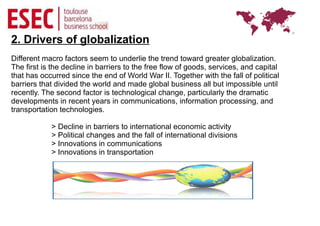
            > Decline in barriers to international economic activity
            > Political changes and the fall of international divisions
            > Innovations in communications
            > Innovations in transportation
2. Drivers of globalization
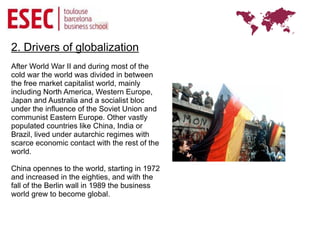
After World War II and during most of the
cold war the world was divided in between
the free market capitalist world, mainly
including North America, Western Europe,
Japan and Australia and a socialist bloc
under the influence of the Soviet Union and
communist Eastern Europe. Other vastly
populated countries like China, India or
Brazil, lived under autarchic regimes with
scarce economic contact with the rest of the
world.

China opennes to the world, starting in 1972
and increased in the eighties, and with the
fall of the Berlin wall in 1989 the business
world grew to become global.
2. Drivers of globalization
After World War II, the advanced industrial nations of the West--under US
leadership--committed themselves to removing barriers to the free flow of goods,
services, and capital between nations. This goal was enshrined in the treaty known
as the General Agreement on Tariffs and Trade (GATT). Under the umbrella of
GATT, there have been eight rounds of negotiations among member states--which
now number over 130--designed to lower barriers to the free flow of goods and
services. The Uruguay Round further reduced trade barriers; extended GATT to
cover services as well as manufactured goods; provided enhanced protection for
patents, trademarks, and copyrights; and established the World Trade
Organization (WTO) to police the international trading system. Average tariff rates
have fallen dramatically since 1950.

In addition to reducing trade barriers, many countries have also been progressively
removing restrictions to foreign direct investment (FDI). The desire to facilitate FDI
has also been reflected in a dramatic increase in the number of bilateral
investment treaties designed to protect and promote investment between two
countries.
2. Drivers of globalization
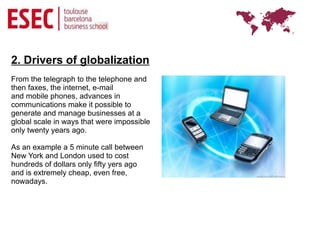
From the telegraph to the telephone and
then faxes, the internet, e-mail
and mobile phones, advances in
communications make it possible to
generate and manage businesses at a
global scale in ways that were impossible
only twenty years ago.

As an example a 5 minute call between
New York and London used to cost
hundreds of dollars only fifty yers ago
and is extremely cheap, even free,
nowadays.
2. Drivers of globalization
In addition to developments in communications technology, several major
innovations in transportation technology have occurred since World War II.
In economic terms, the most important are probably the development of
commercial jet aircraft and superfreighters and the introduction of
containerization, which simplifies transshipment from one mode of
transport to another.

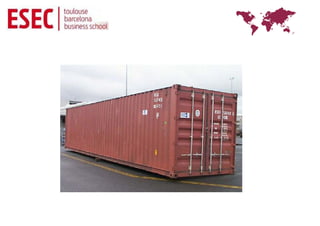
Containerization has revolutionized the transportation business, significantly
lowering the costs of shipping goods over long distances. Before the advent
of containerization, moving goods from one mode of transport to another
was very labor intensive, lengthy, and costly. It could take days and several
hundred longshoremen to unload a ship and reload goods onto trucks and
trains. With the advent of widespread containerization in the 1970s and
1980s, the whole process can be executed by a handful of longshoremen in
a couple of days.
3. Globalization and regionalization
One of the most notable trends in the global economy in recent years has been the
accelerated movement toward regional economic integration. By regional economic
integration, we mean agreements among countries in a geographic region to reduce,
and ultimately remove, tariff and nontariff barriers to the free flow of goods, services, and
factors of production between each other. By entering into regional agreements, groups of
countries aim to reduce trade barriers more rapidly than can be achieved under the
auspices of the World Trade Organization (WTO).

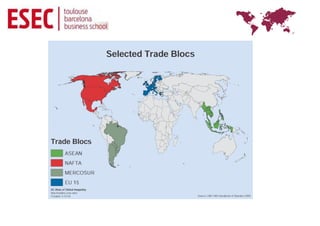
Nowhere has the movement toward regional economic integration been more successful
than in Europe where the European Union has consolidated an integrated market where
most members even share a single currency, the Euro.

Similar moves toward regional integration are being pursued elsewhere in the world.
Canada, Mexico, and the United States have implemented the North American Free
Trade Agreement (NAFTA). Argentina, Brazil, Paraguay, and Uruguay started
MERCOSUR as the first step in a move toward creation of a South American Free Trade
Area (SAFTA). There is also talk of establishing a hemispherewide Free Trade Agreement
of the Americas (FTAA). Along similar lines, ASEAN in South East Asia and the project of
a free trade area in Africa are other examples of this trend.
3. Globalization and regionalization
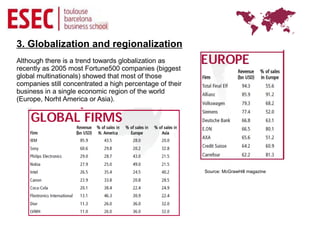
Although there is a trend towards globalization as
recently as 2005 most Fortune500 companies (biggest
global multinationals) showed that most of those
companies still concentrated a high percentage of their
business in a single economic region of the world
(Europe, Norht America or Asia).


                                                          Source: McGrawHill magazine
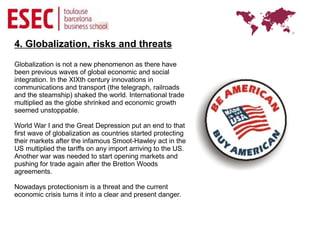
4. Globalization, risks and threats
Globalization is not a new phenomenon as there have
been previous waves of global economic and social
integration. In the XIXth century innovations in
communications and transport (the telegraph, railroads
and the steamship) shaked the world. International trade
multiplied as the globe shrinked and economic growth
seemed unstoppable.

World War I and the Great Depression put an end to that
first wave of globalization as countries started protecting
their markets after the infamous Smoot-Hawley act in the
US multiplied the tariffs on any import arriving to the US.
Another war was needed to start opening markets and
pushing for trade again after the Bretton Woods
agreements.

Nowadays protectionism is a threat and the current
economic crisis turns it into a clear and present danger.
5. Consumers, global or local?

As globalization advances some pretended that global
consumer preferences would start converging. As
differences in between consumers from different regions
would be similar products and services could target similar
consumers all around the globe. Making global operations
easier as great economies of scale would unveil.

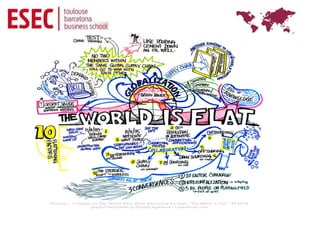
At the same time a flat world would make it possible for any
company around the world to jump into global market
operations. This view was summed up by American
journalist Thomas Friedman in his book “The World is Flat”.
5. Consumers, global or local?

Other, more realistic, views understand
that although globalization softens some
differences and levels the playfield, local
particularities (culture, geography, history,
 economy, ...) still matter a great deal.

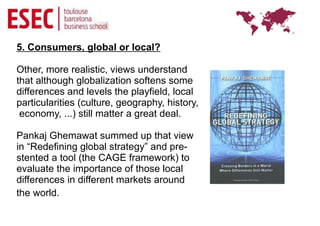
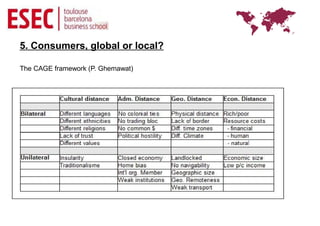
Pankaj Ghemawat summed up that view
in “Redefining global strategy” and pre-
stented a tool (the CAGE framework) to
evaluate the importance of those local
differences in different markets around
the world.
5. Consumers, global or local?

The CAGE framework (P. Ghemawat)
5. Consumers, global or local?

A conclusion could be that different markets
(countries and products) require different
approaches to the global/local mix. Globalization
is a reality by a mixed concept as
GLOCALIZATION helps sum up and understand
the necessary approach when managing
international business.
6. The growing importance of international business
As the world shifts toward a truly integrated global economy, more firms,
both large and small, are becoming international businesses.
Managers need to recognize that the task of managing an international
business differs from that of managing a purely domestic business in many
ways.

This differences and the management tools to face them are going to be
covered during this course.
7. International business (evaluation)


                        C/ Sant Pere Apòstol, 6, 2-2, 43201 REUS
                   www.futura.cat / futura@futura.cat / (+34) 686 475 866

Intl biz lesson1

  • 1.
    International Business Globalization &business Professor: Marc Arza marza@rjce.net
  • 2.
    1. Globalization andbusiness Globalization refers to the reduction and removal of barriers between national borders in order to facilitate the flow of goods, capital, services and labour... A fundamental shift is occurring in the world economy. Moving progressively further away from a world in which national economies were relatively isolated from each other by barriers to cross-border trade and investment; by distance, time zones, and language; and by national differences in government regulation, culture, and business systems. Moving toward a world in which national economies are merging into an interdependent global economic system. The global context.
  • 3.
    1. Globalization andbusiness The rapidly emerging global economy raises a multitude of issues for businesses both large and small. It creates opportunities for businesses to expand their revenues, drive down their costs, and boost their profits. While the emerging global economy creates opportunities such as this for new entrepreneurs and established businesses around the world, it also gives rise to challenges and threats that yesterday's business managers did not have to deal with in a new and complex context. And managers have to decide how best to deal with the threat posed by efficient foreign competitors entering their home marketplace.
  • 4.
    2. Drivers ofglobalization Different macro factors seem to underlie the trend toward greater globalization. The first is the decline in barriers to the free flow of goods, services, and capital that has occurred since the end of World War II. Together with the fall of political barriers that divided the world and made global business all but impossible until recently. The second factor is technological change, particularly the dramatic developments in recent years in communications, information processing, and transportation technologies. > Decline in barriers to international economic activity > Political changes and the fall of international divisions > Innovations in communications > Innovations in transportation
  • 5.
    2. Drivers ofglobalization After World War II and during most of the cold war the world was divided in between the free market capitalist world, mainly including North America, Western Europe, Japan and Australia and a socialist bloc under the influence of the Soviet Union and communist Eastern Europe. Other vastly populated countries like China, India or Brazil, lived under autarchic regimes with scarce economic contact with the rest of the world. China opennes to the world, starting in 1972 and increased in the eighties, and with the fall of the Berlin wall in 1989 the business world grew to become global.
  • 6.
    2. Drivers ofglobalization After World War II, the advanced industrial nations of the West--under US leadership--committed themselves to removing barriers to the free flow of goods, services, and capital between nations. This goal was enshrined in the treaty known as the General Agreement on Tariffs and Trade (GATT). Under the umbrella of GATT, there have been eight rounds of negotiations among member states--which now number over 130--designed to lower barriers to the free flow of goods and services. The Uruguay Round further reduced trade barriers; extended GATT to cover services as well as manufactured goods; provided enhanced protection for patents, trademarks, and copyrights; and established the World Trade Organization (WTO) to police the international trading system. Average tariff rates have fallen dramatically since 1950. In addition to reducing trade barriers, many countries have also been progressively removing restrictions to foreign direct investment (FDI). The desire to facilitate FDI has also been reflected in a dramatic increase in the number of bilateral investment treaties designed to protect and promote investment between two countries.
  • 7.
    2. Drivers ofglobalization From the telegraph to the telephone and then faxes, the internet, e-mail and mobile phones, advances in communications make it possible to generate and manage businesses at a global scale in ways that were impossible only twenty years ago. As an example a 5 minute call between New York and London used to cost hundreds of dollars only fifty yers ago and is extremely cheap, even free, nowadays.
  • 8.
    2. Drivers ofglobalization In addition to developments in communications technology, several major innovations in transportation technology have occurred since World War II. In economic terms, the most important are probably the development of commercial jet aircraft and superfreighters and the introduction of containerization, which simplifies transshipment from one mode of transport to another. Containerization has revolutionized the transportation business, significantly lowering the costs of shipping goods over long distances. Before the advent of containerization, moving goods from one mode of transport to another was very labor intensive, lengthy, and costly. It could take days and several hundred longshoremen to unload a ship and reload goods onto trucks and trains. With the advent of widespread containerization in the 1970s and 1980s, the whole process can be executed by a handful of longshoremen in a couple of days.
  • 10.
    3. Globalization andregionalization One of the most notable trends in the global economy in recent years has been the accelerated movement toward regional economic integration. By regional economic integration, we mean agreements among countries in a geographic region to reduce, and ultimately remove, tariff and nontariff barriers to the free flow of goods, services, and factors of production between each other. By entering into regional agreements, groups of countries aim to reduce trade barriers more rapidly than can be achieved under the auspices of the World Trade Organization (WTO). Nowhere has the movement toward regional economic integration been more successful than in Europe where the European Union has consolidated an integrated market where most members even share a single currency, the Euro. Similar moves toward regional integration are being pursued elsewhere in the world. Canada, Mexico, and the United States have implemented the North American Free Trade Agreement (NAFTA). Argentina, Brazil, Paraguay, and Uruguay started MERCOSUR as the first step in a move toward creation of a South American Free Trade Area (SAFTA). There is also talk of establishing a hemispherewide Free Trade Agreement of the Americas (FTAA). Along similar lines, ASEAN in South East Asia and the project of a free trade area in Africa are other examples of this trend.
  • 12.
    3. Globalization andregionalization Although there is a trend towards globalization as recently as 2005 most Fortune500 companies (biggest global multinationals) showed that most of those companies still concentrated a high percentage of their business in a single economic region of the world (Europe, Norht America or Asia). Source: McGrawHill magazine
  • 13.
    4. Globalization, risksand threats Globalization is not a new phenomenon as there have been previous waves of global economic and social integration. In the XIXth century innovations in communications and transport (the telegraph, railroads and the steamship) shaked the world. International trade multiplied as the globe shrinked and economic growth seemed unstoppable. World War I and the Great Depression put an end to that first wave of globalization as countries started protecting their markets after the infamous Smoot-Hawley act in the US multiplied the tariffs on any import arriving to the US. Another war was needed to start opening markets and pushing for trade again after the Bretton Woods agreements. Nowadays protectionism is a threat and the current economic crisis turns it into a clear and present danger.
  • 14.
    5. Consumers, globalor local? As globalization advances some pretended that global consumer preferences would start converging. As differences in between consumers from different regions would be similar products and services could target similar consumers all around the globe. Making global operations easier as great economies of scale would unveil. At the same time a flat world would make it possible for any company around the world to jump into global market operations. This view was summed up by American journalist Thomas Friedman in his book “The World is Flat”.
  • 16.
    5. Consumers, globalor local? Other, more realistic, views understand that although globalization softens some differences and levels the playfield, local particularities (culture, geography, history, economy, ...) still matter a great deal. Pankaj Ghemawat summed up that view in “Redefining global strategy” and pre- stented a tool (the CAGE framework) to evaluate the importance of those local differences in different markets around the world.
  • 17.
    5. Consumers, globalor local? The CAGE framework (P. Ghemawat)
  • 18.
    5. Consumers, globalor local? A conclusion could be that different markets (countries and products) require different approaches to the global/local mix. Globalization is a reality by a mixed concept as GLOCALIZATION helps sum up and understand the necessary approach when managing international business.
  • 19.
    6. The growingimportance of international business As the world shifts toward a truly integrated global economy, more firms, both large and small, are becoming international businesses. Managers need to recognize that the task of managing an international business differs from that of managing a purely domestic business in many ways. This differences and the management tools to face them are going to be covered during this course.
  • 20.
    7. International business(evaluation) C/ Sant Pere Apòstol, 6, 2-2, 43201 REUS www.futura.cat / futura@futura.cat / (+34) 686 475 866