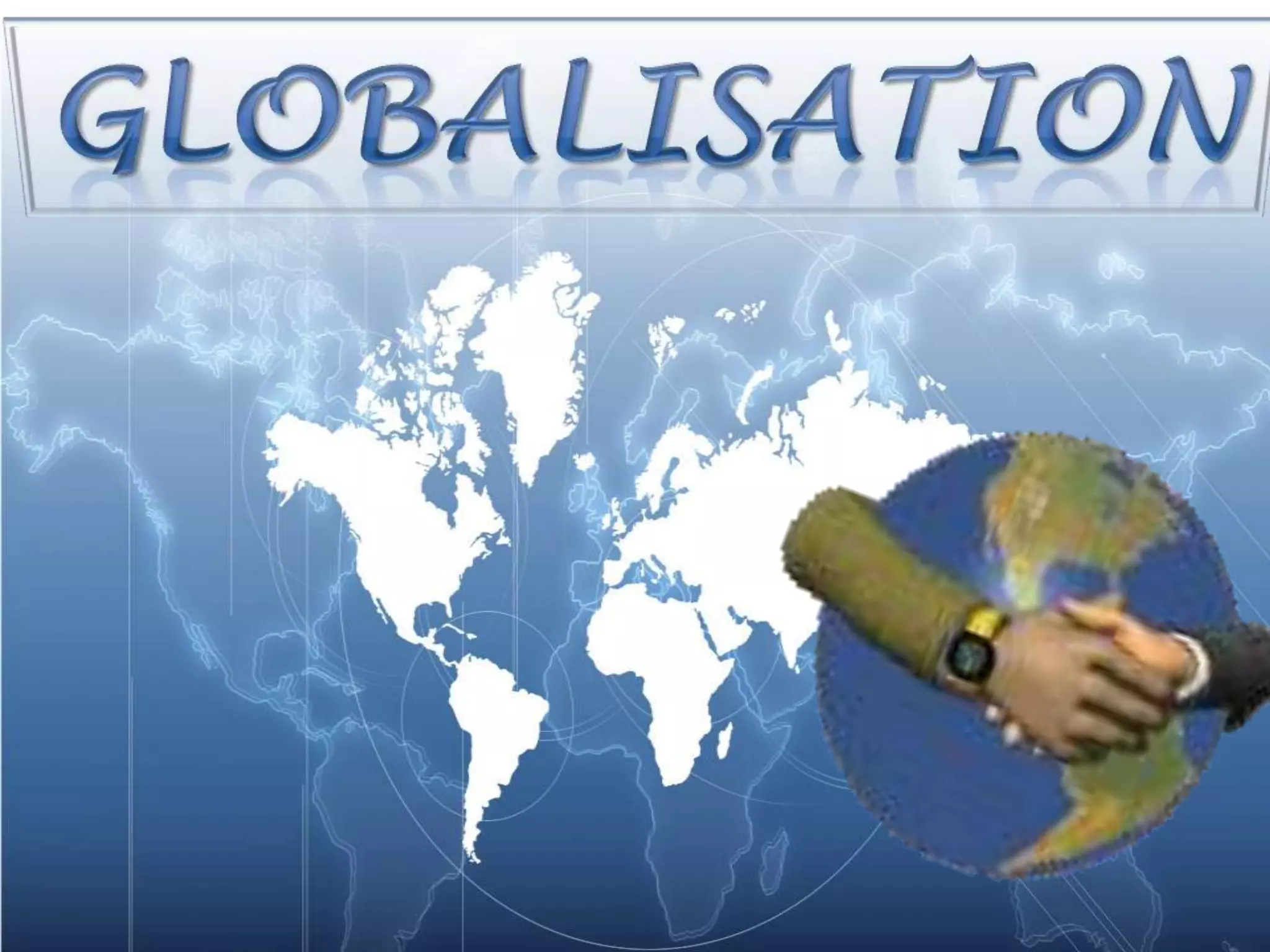
GLOBALISATION
Presented by…M-4104 Abhijit M-4105 ApekshaM-4134 PrabhakarM-4135 PalviM-4136 ArundhatiM-4137 SonaliM-4139 SaniaM-4143 Neha
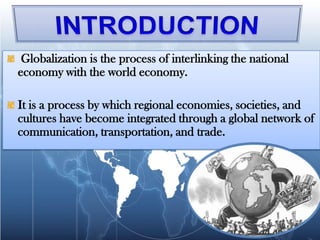
INTRODUCTIONGlobalization is the process of interlinking the national economy with the world economy.It is a process by which regional economies, societies, and cultures have become integrated through a global network of communication, transportation, and trade.
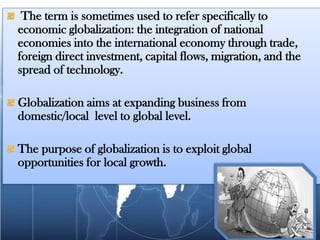
The term is sometimes used to refer specifically to economic globalization: the integration of national economies into the international economy through trade, foreign direct investment, capital flows, migration, and the spread of technology.Globalization aims at expanding business from domestic/local  level to global level.The purpose of globalization is to exploit global opportunities for local growth.

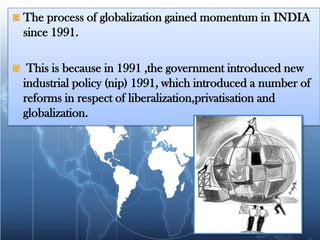
The process of globalization gained momentum in INDIA since 1991. This is because in 1991 ,the government introduced new industrial policy (nip) 1991, which introduced a number of reforms in respect of liberalization,privatisation and globalization.
FEATURES Globalization has closely intertwined economic, political, cultural and institutional dimensions whose social impact is often not easy to disentangle. Some of these processes are driven by the logic of new technologies or market forces which are difficult to control, while others may be more amenable to management.As a result of greater access to markets, new technologies and new ways of doing business, many aspects of globalization have stimulated growth and prosperity and expanded possibilities for millions of people all over the world
The actual experience of globalization has, to a great degree, varied with the level of development at which a country has engaged with it.The degree and nature of participation of different categories of countries in global markets varies substantially.Although globalization raises particular concern for developing countries, apprehensions regarding it abound and have been vocally expressed even in developed countries. The experience of countries with economies in transition has been mixed.
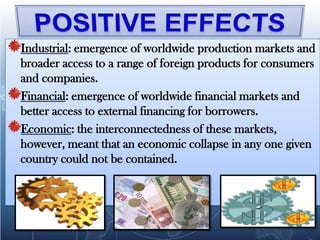
POSITIVE EFFECTSIndustrial: emergence of worldwide production markets and broader access to a range of foreign products for consumers and companies.Financial: emergence of worldwide financial markets and better access to external financing for borrowers. Economic: the interconnectedness of these markets, however, meant that an economic collapse in any one given country could not be contained.
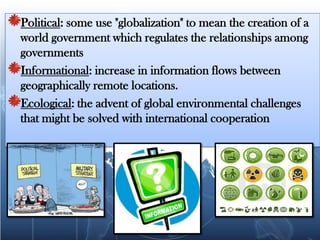
Political: some use "globalization" to mean the creation of a world government which regulates the relationships among governmentsInformational: increase in information flows between geographically remote locations.Ecological: the advent of global environmental challenges that might be solved with international cooperation
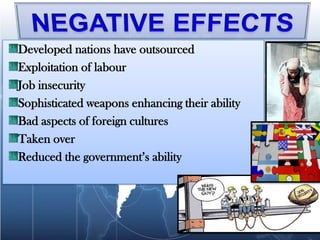
NEGATIVE EFFECTSDeveloped nations have outsourcedExploitation of labourJob insecuritySophisticated weapons enhancing their ability Bad aspects of foreign culturesTaken overReduced the government’s ability
CHALLENGESOne is to ensure that the benefits of globalization extend to all countries. Deal with the fear that globalization leads to instability, which is particularly marked in the developing world.Address the very real fear in the industrial world that increased global competitionGlobalization and all of the complicated problems…..
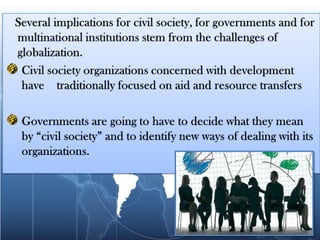
   Several implications for civil society, for governments and for multinational institutions stem from the challenges of globalization.Civil society organizations concerned with development have    traditionally focused on aid and resource transfersGovernments are going to have to decide what they mean by “civil society” and to identify new ways of dealing with its organizations.
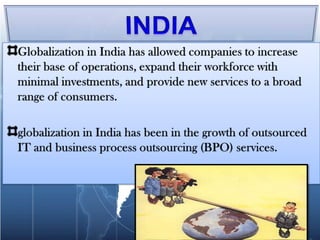
INDIAGlobalization in India has allowed companies to increase their base of operations, expand their workforce with minimal investments, and provide new services to a broad range of consumers. globalization in India has been in the growth of outsourced IT and business process outsourcing (BPO) services.
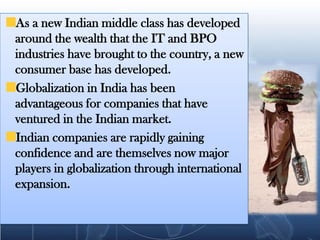
As a new Indian middle class has developed around the wealth that the IT and BPO industries have brought to the country, a new consumer base has developed. Globalization in India has been advantageous for companies that have ventured in the Indian market.Indian companies are rapidly gaining confidence and are themselves now major players in globalization through international expansion.
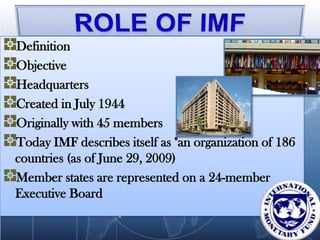
ROLE OF IMFDefinitionObjective Headquarters Created in July 1944 Originally with 45 members Today IMF describes itself as "an organization of 186 countries (as of June 29, 2009) Member states are represented on a 24-member Executive Board
FUNCTIONS AND STRUCTUREThe IMF Charter Originally Established Adjustable Par Values for the Currencies of Member Countries.The IMF charter originally set up a system of fixed exchange rates
All members declared a "par value" in terms of the dollar
The system has been referred to as a gold exchange standard.
The founders believed this system would impose monetary discipline on member countries.
Today the IMF charter implicitly endorses a system of floating exchange rates— rates governed primarily by market forces of supply and demand.The IMF’s "Lending" Facilities Help Member Countries Make Adjustments to Restore Balance of Payments Equilibrium.The founders built flexibility into the system in various ways.
One important aspect of flexibility
The primary method for gaining resources is through the member’s quota subscriptions
Although the IMF’s assistance is usually referred to as "lending" or "loans," a member country actually "purchases" SDRs
Reserve tranche
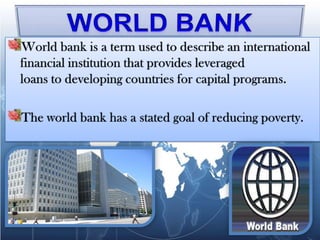
Letter of Intent WORLD BANKWorld bank is a term used to describe an international financial institution that provides leveraged loans to developing countries for capital programs. The world bank has a stated goal of reducing poverty.
ROLE OF WORLD BANKLow-Income Countries Middle-Income Countries
WORLD BANK FOCUSING ONSecure long-term fundingGive advisory servicesCreate the right policy and institutional frameworkAddress weaknesses in the social, structural, and sectoral policies.
FUTURE OF GLOBALIZATION & WORLD BANK'SIn next 25 years, the population of the entire world would go up by 2 billion to a figure of 8 billion people.In 2008, more than 47% of the global population lived in urban areas. By 2020, 4.1 billion, or 55% would be living in urban areas.
The World Bank is now aiming at maintaining parity in education and is also aiming at achieving the gender equality goals.We all must work towards building up a commitment towards global poverty reduction. After all, the benefits of globalization should be harnessed for delivering prosperity to the nations. 
ROLE OF FOREIGN CAPITALForeign capital has not only play key role in the economic development of India but also of Foreign Direct Investment.In economic development not only as an addition to domestic capital but also as an important source of technology and global best practices.FDI has always played a major role in the economic development of developing nations
Global  development finance report net private capital flows to developing countries reaches a record $647 billions in 2006.8% of that capital flowed to poorest 51 countries.government needs to focus on the real barriers to its foreign investment goals. The value of foreign trade has increased substantially with increase in both exports        from and imports into India.
The government had announced, in April 2000-    The establishment of Special Economic    Zones (SEZ) policy
    To boost exports and attract foreign investments.In the financial sector it is required that public policy should be focused on maximizing benefits achieved by the growing involvement of foreign firms by encouraging diversity and competition not only between foreign and domestic banks but also between banks and financial institutions.
INTRODUCTION OF WTOIt is the only international organization dealing with the global rules of trade between nations.It was formed in the year 1995. The main goal of WTO is to help the trading      industry to become smooth, fair, free and predictable. It was organized to become the administrator of multilateral trade and business agreements between its member nations.The scope and future of the WTO are limited by the vision, imagination, courage, and conscience of the trade community.

Globalisation final

  • 1.
  • 2.
    Presented by…M-4104 AbhijitM-4105 ApekshaM-4134 PrabhakarM-4135 PalviM-4136 ArundhatiM-4137 SonaliM-4139 SaniaM-4143 Neha
  • 3.
    INTRODUCTIONGlobalization is theprocess of interlinking the national economy with the world economy.It is a process by which regional economies, societies, and cultures have become integrated through a global network of communication, transportation, and trade.
  • 4.
    The term issometimes used to refer specifically to economic globalization: the integration of national economies into the international economy through trade, foreign direct investment, capital flows, migration, and the spread of technology.Globalization aims at expanding business from domestic/local level to global level.The purpose of globalization is to exploit global opportunities for local growth.

  • 5.
    The process ofglobalization gained momentum in INDIA since 1991. This is because in 1991 ,the government introduced new industrial policy (nip) 1991, which introduced a number of reforms in respect of liberalization,privatisation and globalization.
  • 6.
    FEATURES Globalization hasclosely intertwined economic, political, cultural and institutional dimensions whose social impact is often not easy to disentangle. Some of these processes are driven by the logic of new technologies or market forces which are difficult to control, while others may be more amenable to management.As a result of greater access to markets, new technologies and new ways of doing business, many aspects of globalization have stimulated growth and prosperity and expanded possibilities for millions of people all over the world
  • 7.
    The actual experienceof globalization has, to a great degree, varied with the level of development at which a country has engaged with it.The degree and nature of participation of different categories of countries in global markets varies substantially.Although globalization raises particular concern for developing countries, apprehensions regarding it abound and have been vocally expressed even in developed countries. The experience of countries with economies in transition has been mixed.
  • 8.
    POSITIVE EFFECTSIndustrial: emergenceof worldwide production markets and broader access to a range of foreign products for consumers and companies.Financial: emergence of worldwide financial markets and better access to external financing for borrowers. Economic: the interconnectedness of these markets, however, meant that an economic collapse in any one given country could not be contained.
  • 9.
    Political: some use"globalization" to mean the creation of a world government which regulates the relationships among governmentsInformational: increase in information flows between geographically remote locations.Ecological: the advent of global environmental challenges that might be solved with international cooperation
  • 10.
    NEGATIVE EFFECTSDeveloped nationshave outsourcedExploitation of labourJob insecuritySophisticated weapons enhancing their ability Bad aspects of foreign culturesTaken overReduced the government’s ability
  • 11.
    CHALLENGESOne is toensure that the benefits of globalization extend to all countries. Deal with the fear that globalization leads to instability, which is particularly marked in the developing world.Address the very real fear in the industrial world that increased global competitionGlobalization and all of the complicated problems…..
  • 12.
    Several implications for civil society, for governments and for multinational institutions stem from the challenges of globalization.Civil society organizations concerned with development have traditionally focused on aid and resource transfersGovernments are going to have to decide what they mean by “civil society” and to identify new ways of dealing with its organizations.
  • 13.
    INDIAGlobalization in Indiahas allowed companies to increase their base of operations, expand their workforce with minimal investments, and provide new services to a broad range of consumers. globalization in India has been in the growth of outsourced IT and business process outsourcing (BPO) services.
  • 14.
    As a newIndian middle class has developed around the wealth that the IT and BPO industries have brought to the country, a new consumer base has developed. Globalization in India has been advantageous for companies that have ventured in the Indian market.Indian companies are rapidly gaining confidence and are themselves now major players in globalization through international expansion.
  • 16.
    ROLE OF IMFDefinitionObjectiveHeadquarters Created in July 1944 Originally with 45 members Today IMF describes itself as "an organization of 186 countries (as of June 29, 2009) Member states are represented on a 24-member Executive Board
  • 17.
    FUNCTIONS AND STRUCTURETheIMF Charter Originally Established Adjustable Par Values for the Currencies of Member Countries.The IMF charter originally set up a system of fixed exchange rates
  • 18.
    All members declareda "par value" in terms of the dollar
  • 19.
    The system hasbeen referred to as a gold exchange standard.
  • 20.
    The founders believedthis system would impose monetary discipline on member countries.
  • 21.
    Today the IMFcharter implicitly endorses a system of floating exchange rates— rates governed primarily by market forces of supply and demand.The IMF’s "Lending" Facilities Help Member Countries Make Adjustments to Restore Balance of Payments Equilibrium.The founders built flexibility into the system in various ways.
  • 22.
    One important aspectof flexibility
  • 23.
    The primary methodfor gaining resources is through the member’s quota subscriptions
  • 24.
    Although the IMF’sassistance is usually referred to as "lending" or "loans," a member country actually "purchases" SDRs
  • 25.
  • 26.
    Letter of IntentWORLD BANKWorld bank is a term used to describe an international financial institution that provides leveraged loans to developing countries for capital programs. The world bank has a stated goal of reducing poverty.
  • 27.
    ROLE OF WORLDBANKLow-Income Countries Middle-Income Countries
  • 28.
    WORLD BANK FOCUSINGONSecure long-term fundingGive advisory servicesCreate the right policy and institutional frameworkAddress weaknesses in the social, structural, and sectoral policies.
  • 29.
    FUTURE OF GLOBALIZATION& WORLD BANK'SIn next 25 years, the population of the entire world would go up by 2 billion to a figure of 8 billion people.In 2008, more than 47% of the global population lived in urban areas. By 2020, 4.1 billion, or 55% would be living in urban areas.
  • 30.
    The World Bankis now aiming at maintaining parity in education and is also aiming at achieving the gender equality goals.We all must work towards building up a commitment towards global poverty reduction. After all, the benefits of globalization should be harnessed for delivering prosperity to the nations. 
  • 31.
    ROLE OF FOREIGNCAPITALForeign capital has not only play key role in the economic development of India but also of Foreign Direct Investment.In economic development not only as an addition to domestic capital but also as an important source of technology and global best practices.FDI has always played a major role in the economic development of developing nations
  • 32.
    Global developmentfinance report net private capital flows to developing countries reaches a record $647 billions in 2006.8% of that capital flowed to poorest 51 countries.government needs to focus on the real barriers to its foreign investment goals. The value of foreign trade has increased substantially with increase in both exports from and imports into India.
  • 33.
    The government hadannounced, in April 2000- The establishment of Special Economic Zones (SEZ) policy
  • 34.
    To boost exports and attract foreign investments.In the financial sector it is required that public policy should be focused on maximizing benefits achieved by the growing involvement of foreign firms by encouraging diversity and competition not only between foreign and domestic banks but also between banks and financial institutions.
  • 35.
    INTRODUCTION OF WTOItis the only international organization dealing with the global rules of trade between nations.It was formed in the year 1995. The main goal of WTO is to help the trading industry to become smooth, fair, free and predictable. It was organized to become the administrator of multilateral trade and business agreements between its member nations.The scope and future of the WTO are limited by the vision, imagination, courage, and conscience of the trade community.