UN Millennium DevelopmentGoals:
The United Nations (UN) established
eight Millennuim Development Goals
in the 1990s, with the eradiction of
extreme poverety and hunger being
the primary goal.
Other goals included universal primary
education, gender equality, improved
maternal health, and environmental
sustainability. The UN aimed to achieve
these goals by 2015.
THE GLOBAL ECONOMY
3.
Definition of Poverty:Poverty standards vary
globally. In the Philippines, a person is
considered to be living in poverty if they make
less than 100,534 pesos a year (approximately
275 pesos a day). Extreme poverty is defined
by the UN as severe deprivation of basic human
needs, such as food, water, sanitation, health,
shelter, education, and information, and living
on less than $1.25 a day. The UN aims to
eliminate extreme poverty by 2030.
Progress and Challenges: The UN (2015)
reported that 836 million people still live in
extreme poverty, a decrease from 1.9 billion.
The World Bank predicts this number could
drop below 400 million by 2030, assuming
continued improvements. However, climate
change poses a threat to these improvements.
THE GLOBAL ECONOMY
4.
Remaining Issues: Manypeople lifted out of
extreme poverty still face problems like
disease and lack of water. Income inequality
is prevalent, and one in seven people lack
electricity.
Reasons for Decline in Extreme Poverty: The
reasons for the decline in extreme poverty are
complex, involving factors like better access to
education, humanitarian aid, and international
policies.Economic globalization and free trade
are major drivers in the growth of developing
economies and have significantly contributed to
poverty reduction, even more so than efforts by
organizations like the UN.
THE GLOBAL ECONOMY
5.
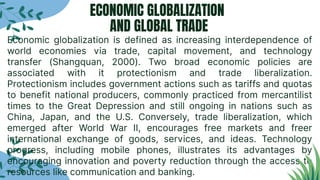
ECONOMIC GLOBALIZATION
AND GLOBALTRADE
Economic globalization is defined as increasing interdependence of
world economies via trade, capital movement, and technology
transfer (Shangquan, 2000). Two broad economic policies are
associated with it protectionism and trade liberalization.
Protectionism includes government actions such as tariffs and quotas
to benefit national producers, commonly practiced from mercantilist
times to the Great Depression and still ongoing in nations such as
China, Japan, and the U.S. Conversely, trade liberalization, which
emerged after World War II, encourages free markets and freer
international exchange of goods, services, and ideas. Technology
progress, including mobile phones, illustrates its advantages by
encouraging innovation and poverty reduction through the access to
resources like communication and banking.
6.
ECONOMIC GLOBALIZATION
AND SUSTAINABLEDEVELOPMENT
A major drawback of economic globalization is its
unsustainability, as it overuses the earth’s resources.
Sustainable development seeks to balance economic
growth with protecting resources for future generations.
While globalization has advanced technology and
communication, it has also worsened climate change and
global inequality, showing that progress comes with
environmental and social costs.
7.
ENVIRONMENTAL DEGRADATION
The IndustrialRevolution accelerated economic development in
terms of mass production but at the cost of immense environmental
degradation, such as pollution, deforestation, and global warming.
Environmentalists sound an alarm for these detriments, whereas
neoliberals consider environmental regulations as barriers to trade.
The collapse of the Kyoto Protocol indicates the difficulty of
international cooperation. Alternatives such as carbon taxation,
green energy, and even geoengineering are in consideration, but
the task of balancing growth and sustainability continues to be
challenging.
8.
FOOD SECURITY
International foodsecurity calls for 60% more food to be
produced by 2050 to sustain 9 billion individuals. The
obstacles include population increase, climate change, water
shortages, deforestation, loss of biodiversity, pollution, and
land degradation, which exacerbate hunger and malnutrition,
as in the case of India. To combat this, projects such as the
UN's SDG 2 and the World Economic Forum's New Vision for
Agriculture encourage sustainable agriculture, partnership, and
assistance for small-scale farmers.
9.
Economic globalization createswinners and
losers—boosting profits and lowering prices
but often harming workers through job loss or
exploitation. Critics see it as economic
colonialism, while supporters argue it drives
growth through investment. One proposed
solution is microcredit, which offers small
loans to the poor, enabling entrepreneurship
and sustainable income.
ECONOMIC GLOBALIZATION, POVERTY
AND INEQUALITY
10.
GLOBAL INCOME INEQUALITY
Globalizationhas increased global wealth and income
inequality, pitting rich and poor countries against each
other. Wealth inequality addresses assets distribution, while
income inequality addresses earnings distribution. Global
wealth is extremely unequal, with the richest 10%
possessing almost 90% of assets and the poorest half
owning less than 1%. Since the Industrial Revolution, affluent
countries have raced ahead, being 100 times richer than
nations such as India and China. Global economic
integration and technological advancements have driven
this divergence by benefiting skilled labor and exporting
low-skill tasks elsewhere.
11.
THE THIRD WORLDGLOBAL
Globalization has increased global wealth and income
inequality, pitting rich and poor countries against each
other. Wealth inequality addresses assets distribution, while
income inequality addresses earnings distribution. Global
wealth is extremely unequal, with the richest 10%
possessing almost 90% of assets and the poorest half
owning less than 1%. Since the Industrial Revolution, affluent
countries have raced ahead, being 100 times richer than
nations such as India and China. Global economic
integration and technological advancements have driven
this divergence by benefiting skilled labor and exporting
low-skill tasks elsewhere.
12.
THE GLOBAL CITY
Globalizationchanged farming in the South, making it
dependent on food from the North and leading to the
loss of local farmers and rural migration. Global cities
like New York, London, and Tokyo became powerful
centers in the world economy and global networks.
However, these cities face inequalities and struggle with
global problems that overwhelm local politics.
13.
THEORIES OF GLOBALSTRATIFICATION
Although most nations were impoverished in the past,
there are now worldwide stratification and disparities
in power and income. In this section, hypotheses that
explain why some regions of the world experienced
faster economic development than others are
examined.
14.
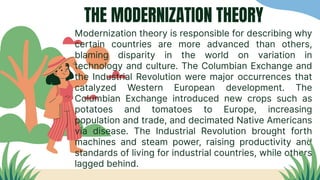
THE MODERNIZATION THEORY
Modernizationtheory is responsible for describing why
certain countries are more advanced than others,
blaming disparity in the world on variation in
technology and culture. The Columbian Exchange and
the Industrial Revolution were major occurrences that
catalyzed Western European development. The
Columbian Exchange introduced new crops such as
potatoes and tomatoes to Europe, increasing
population and trade, and decimated Native Americans
via disease. The Industrial Revolution brought forth
machines and steam power, raising productivity and
standards of living for industrial countries, while others
lagged behind.
15.
WALT ROSTOW’S FOURSTAGES OF MODERNIZATION
Traditional societies, such as feudal Europe and early
Chinese dynasties, have limited resources and
technology, leading to a strict social hierarchy.
The take off stage sees individuals using their talents
to produce beyond necessities, creating new markets
and increasing individualism.
Technological maturity occurs when technological
growth leads to population growth, poverty reduction,
and diverse job opportunities.
High mass consumption occurs when production
becomes more about wants than needs, often
requiring social support systems.
16.
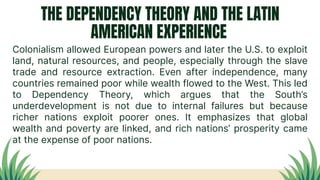
THE DEPENDENCY THEORYAND THE LATIN
AMERICAN EXPERIENCE
Colonialism allowed European powers and later the U.S. to exploit
land, natural resources, and people, especially through the slave
trade and resource extraction. Even after independence, many
countries remained poor while wealth flowed to the West. This led
to Dependency Theory, which argues that the South’s
underdevelopment is not due to internal failures but because
richer nations exploit poorer ones. It emphasizes that global
wealth and poverty are linked, and rich nations’ prosperity came
at the expense of poor nations.
17.
THE MODERN WORLDSYSTEM
This history of colonialism inspired American sociologist Immanuel
Wallerstein model of what he called the capitalist world economy.
Wallerstein described high-income nations as the "core" of the
world economy. This core is the manufacturing base of the
planet where resources funnel in to become the technology
and wealth enjoyed by the Western world today.
Low-income countries, meanwhile, are Wallerstein called the
"periphery," whose natural resources and labor support the
wealthier countries, first as colonies and now by working for
multinational corporations under neocolonialism.
Middle-income countries, such as India or Brazil, are considered the
semi-periphery due to their closer ties to the global economic care.
18.
THE MODERN WORLDSYSTEM
Critics argue that the world economy is not a zero-sum game-one
country getting richer does not mean other countries are getting
poorer.
Innovation and technological growth can spill over to other countries,
improving all nations' well-being and riot just the rich. Also,
colonialism certainly left scars, but it is not enough, on its own, to
explain today's economic disparities.
In direct contrast to what dependency theory predicts, most
evidence suggests that, nowadays, foreign investment by richer
nations helps and do not hurt poorer countries.
19.
THE MODERN WORLDSYSTEM
The growth of the world economy and expansion of world trade have
coincided with rising standards of living worldwide, with even the
poorest nations almost tripling in the last century.
By learning about economic globalization, we are be able to know
about the issues and debates about it. We are also able to think
critically about solutions to the various problems brought by
globalization.