The international conference of 1944 which recommended the
   establishment of IMF(International Monetary Fund) and
   World Bank and also recommended the establishment of
   ITO(International Trade Organisation) but did not
   materialize, but in the year 1948 GATT was established.
International trading system, since 1948 was at least in
   principles, guided by the rules and procedures agreed to the
   signatories to the GATT which was an agreement sign by
   the member nations, which where admitted on the basis of
   there willingness to accept the GATT disciplines.
The primary objectives of GATT was to expand international
trade by liberalizing so as to bring about all round economic
prosperity, the important objective are as follows as:-
1) Raising standards of living.
2) Ensuring full employment and large and steady growing
volume of real income and effective demand.
3) Developing full use of resources of the world.
4) Expansion of production and international trade.
GATT has certain conventions and general principles governing
   international trade among countries that follows the GATT
   agreement:-
1) Any proposed change in the tariff or any type of commercial
   policy of a member country should not be undertaken without
   the consultation with the other parties to the agreement.
2) The countries that adhear to get work towards the reduction of
   tariff and other barriers to the international trade should be
   negotiated within the frame work of GATT.
                                 BARRIERS
            a) TARIFF                                b) NON TARIFF
     (Change in monetary value)                    (Quality &
   Quantity                                                of product
   and                                                     services)
#   For the realisation of the objective GATT adopted the following:-

1) NON DISCRIMINATION- The principle of non-discrimination requires
   that no member country shall discriminate between in the conduct of
   international trade, to ensure non-discrimination the members of GATT to
   apply the principle of MFN(most favoured nation) status to all import and
   export duties. The GATT also permit to member to adopt step to counter
   dumping and export subsidies.

2) PROHIBITION OF QUANTITATIVE RESTRICTIONS- GATT seek
   to prohibit quantitative restrictions as far as possible and limit restrictions
   on trade to the less rigid tariffs, however certain exceptions to this
   prohibition are granted to countries, confronted with balance of payment
   difficulties and to the developing countries.

3) CONSULTATION- By providing a forum for continuing consultation,
   GATT has provided to resolve disagreements through consultation.
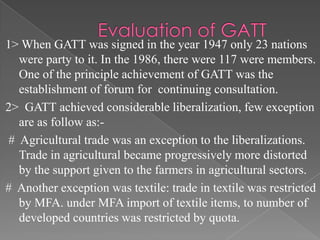
1> When GATT was signed in the year 1947 only 23 nations
  were party to it. In the 1986, there were 117 were members.
  One of the principle achievement of GATT was the
  establishment of forum for continuing consultation.
2> GATT achieved considerable liberalization, few exception
  are as follow as:-
# Agricultural trade was an exception to the liberalizations.
  Trade in agricultural became progressively more distorted
  by the support given to the farmers in agricultural sectors.
# Another exception was textile: trade in textile was restricted
  by MFA. under MFA import of textile items, to number of
  developed countries was restricted by quota.
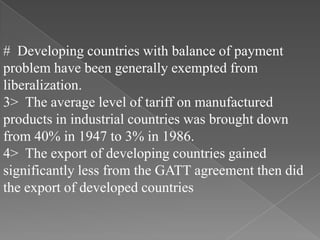
# Developing countries with balance of payment
problem have been generally exempted from
liberalization.
3> The average level of tariff on manufactured
products in industrial countries was brought down
from 40% in 1947 to 3% in 1986.
4> The export of developing countries gained
significantly less from the GATT agreement then did
the export of developed countries
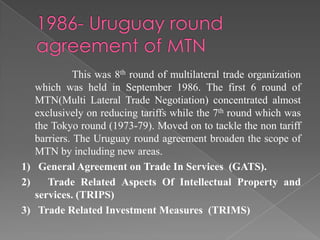
This was 8th round of multilateral trade organization
   which was held in September 1986. The first 6 round of
   MTN(Multi Lateral Trade Negotiation) concentrated almost
   exclusively on reducing tariffs while the 7th round which was
   the Tokyo round (1973-79). Moved on to tackle the non tariff
   barriers. The Uruguay round agreement broaden the scope of
   MTN by including new areas.
1) General Agreement on Trade In Services (GATS).
2)    Trade Related Aspects Of Intellectual Property and
   services. (TRIPS)
3) Trade Related Investment Measures (TRIMS)
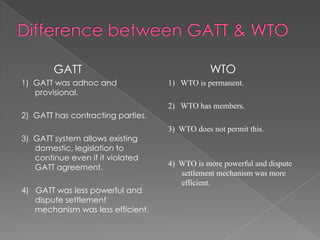
GATT                                   WTO
1) GATT was adhoc and              1) WTO is permanent.
   provisional.
                                   2) WTO has members.
2) GATT has contracting parties.
                                   3) WTO does not permit this.
3) GATT system allows existing
   domestic, legislation to
   continue even if it violated
   GATT agreement.                 4) WTO is more powerful and dispute
                                      settlement mechanism was more
                                      efficient.
4) GATT was less powerful and
   dispute settlement
   mechanism was less efficient.
Following the uruguay round agreement GATT was converted from a provisional
   agreement into a formal international organisation called World Trade Organisation
   with effects from 1st jan 1995, under the old system there were two GATTS:-
1) GATT as an organisation.
2) GATT as an agreement.
                  Under the new system, GATT the organisation seized to exist with the
   establishment WTO where as GATT the agreement continued to exist in amended form.

* FUNCTIONS OF WTO:-

1) WTO shall facilitate the implementation, administration and operation of MTA (Multi-
    lateral trade agreement ).
2) It shall provide the forum for negotiation among its members concerning there multi-
    lateral trade relationship.
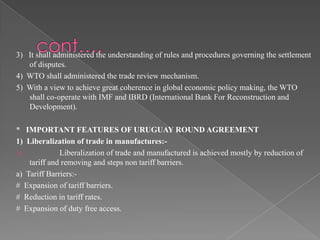
3) It shall administered the understanding of rules and procedures governing the settlement
   of disputes.
4) WTO shall administered the trade review mechanism.
5) With a view to achieve great coherence in global economic policy making, the WTO
   shall co-operate with IMF and IBRD (International Bank For Reconstruction and
   Development).

* IMPORTANT FEATURES OF URUGUAY ROUND AGREEMENT
1) Liberalization of trade in manufactures:-
1)            Liberalization of trade and manufactured is achieved mostly by reduction of
    tariff and removing and steps non tariff barriers.
a) Tariff Barriers:-
# Expansion of tariff barriers.
# Reduction in tariff rates.
# Expansion of duty free access.
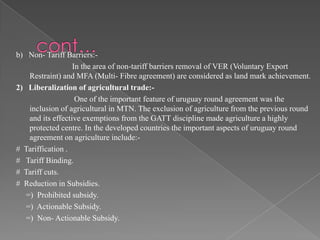
b) Non- Tariff Barriers:-
                   In the area of non-tariff barriers removal of VER (Voluntary Export
    Restraint) and MFA (Multi- Fibre agreement) are considered as land mark achievement.
2) Liberalization of agricultural trade:-
                    One of the important feature of uruguay round agreement was the
    inclusion of agricultural in MTN. The exclusion of agriculture from the previous round
    and its effective exemptions from the GATT discipline made agriculture a highly
    protected centre. In the developed countries the important aspects of uruguay round
    agreement on agriculture include:-
# Tariffication .
# Tariff Binding.
# Tariff cuts.
# Reduction in Subsidies.
   =) Prohibited subsidy.
   =) Actionable Subsidy.
   =) Non- Actionable Subsidy.
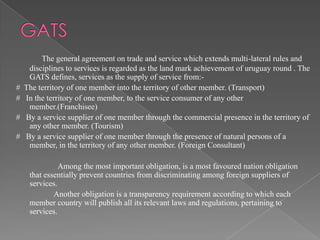
The general agreement on trade and service which extends multi-lateral rules and
     disciplines to services is regarded as the land mark achievement of uruguay round . The
     GATS defines, services as the supply of service from:-
#   The territory of one member into the territory of other member. (Transport)
#   In the territory of one member, to the service consumer of any other
     member.(Franchisee)
#   By a service supplier of one member through the commercial presence in the territory of
     any other member. (Tourism)
#   By a service supplier of one member through the presence of natural persons of a
     member, in the territory of any other member. (Foreign Consultant)

               Among the most important obligation, is a most favoured nation obligation
     that essentially prevent countries from discriminating among foreign suppliers of
     services.
             Another obligation is a transparency requirement according to which each
     member country will publish all its relevant laws and regulations, pertaining to
     services.
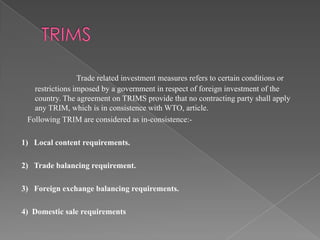
Trade related investment measures refers to certain conditions or
   restrictions imposed by a government in respect of foreign investment of the
   country. The agreement on TRIMS provide that no contracting party shall apply
   any TRIM, which is in consistence with WTO, article.
 Following TRIM are considered as in-consistence:-

1) Local content requirements.

2) Trade balancing requirement.

3) Foreign exchange balancing requirements.

4) Domestic sale requirements
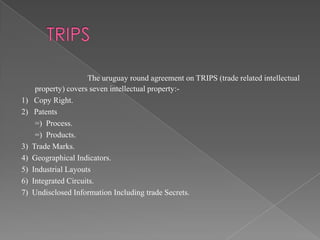
The uruguay round agreement on TRIPS (trade related intellectual
      property) covers seven intellectual property:-
1)    Copy Right.
2)    Patents
      =) Process.
      =) Products.
3)   Trade Marks.
4)   Geographical Indicators.
5)   Industrial Layouts
6)   Integrated Circuits.
7)   Undisclosed Information Including trade Secrets.
Intellectual property rights has been defined as
information with commercial value. They have been
characteristics as the composite of ideas, inventing and
creative expression plus public willingness to bestowe the
status of the property on them and give their owners to
exclude others from the use of protected subject matter.
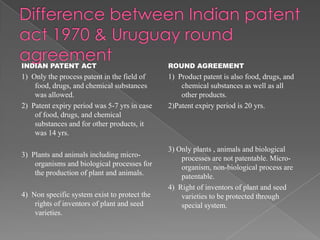
INDIAN PATENT ACT                             ROUND AGREEMENT
1) Only the process patent in the field of    1) Product patent is also food, drugs, and
    food, drugs, and chemical substances          chemical substances as well as all
    was allowed.                                  other products.
2) Patent expiry period was 5-7 yrs in case   2)Patent expiry period is 20 yrs.
    of food, drugs, and chemical
    substances and for other products, it
    was 14 yrs.

                                              3) Only plants , animals and biological
3) Plants and animals including micro-            processes are not patentable. Micro-
    organisms and biological processes for        organism, non-biological process are
    the production of plant and animals.          patentable.
                                              4) Right of inventors of plant and seed
4) Non specific system exist to protect the       varieties to be protected through
    rights of inventors of plant and seed         special system.
    varieties.
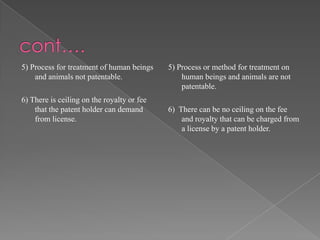
5) Process for treatment of human beings    5) Process or method for treatment on
    and animals not patentable.                 human beings and animals are not
                                                patentable.
6) There is ceiling on the royalty or fee
    that the patent holder can demand       6) There can be no ceiling on the fee
    from license.                               and royalty that can be charged from
                                                a license by a patent holder.

What is gatt

  • 1.
    The international conferenceof 1944 which recommended the establishment of IMF(International Monetary Fund) and World Bank and also recommended the establishment of ITO(International Trade Organisation) but did not materialize, but in the year 1948 GATT was established. International trading system, since 1948 was at least in principles, guided by the rules and procedures agreed to the signatories to the GATT which was an agreement sign by the member nations, which where admitted on the basis of there willingness to accept the GATT disciplines.
  • 2.
    The primary objectivesof GATT was to expand international trade by liberalizing so as to bring about all round economic prosperity, the important objective are as follows as:- 1) Raising standards of living. 2) Ensuring full employment and large and steady growing volume of real income and effective demand. 3) Developing full use of resources of the world. 4) Expansion of production and international trade.
  • 3.
    GATT has certainconventions and general principles governing international trade among countries that follows the GATT agreement:- 1) Any proposed change in the tariff or any type of commercial policy of a member country should not be undertaken without the consultation with the other parties to the agreement. 2) The countries that adhear to get work towards the reduction of tariff and other barriers to the international trade should be negotiated within the frame work of GATT. BARRIERS a) TARIFF b) NON TARIFF (Change in monetary value) (Quality & Quantity of product and services)
  • 4.
    # For the realisation of the objective GATT adopted the following:- 1) NON DISCRIMINATION- The principle of non-discrimination requires that no member country shall discriminate between in the conduct of international trade, to ensure non-discrimination the members of GATT to apply the principle of MFN(most favoured nation) status to all import and export duties. The GATT also permit to member to adopt step to counter dumping and export subsidies. 2) PROHIBITION OF QUANTITATIVE RESTRICTIONS- GATT seek to prohibit quantitative restrictions as far as possible and limit restrictions on trade to the less rigid tariffs, however certain exceptions to this prohibition are granted to countries, confronted with balance of payment difficulties and to the developing countries. 3) CONSULTATION- By providing a forum for continuing consultation, GATT has provided to resolve disagreements through consultation.
  • 5.
    1> When GATTwas signed in the year 1947 only 23 nations were party to it. In the 1986, there were 117 were members. One of the principle achievement of GATT was the establishment of forum for continuing consultation. 2> GATT achieved considerable liberalization, few exception are as follow as:- # Agricultural trade was an exception to the liberalizations. Trade in agricultural became progressively more distorted by the support given to the farmers in agricultural sectors. # Another exception was textile: trade in textile was restricted by MFA. under MFA import of textile items, to number of developed countries was restricted by quota.
  • 6.
    # Developing countrieswith balance of payment problem have been generally exempted from liberalization. 3> The average level of tariff on manufactured products in industrial countries was brought down from 40% in 1947 to 3% in 1986. 4> The export of developing countries gained significantly less from the GATT agreement then did the export of developed countries
  • 7.
    This was 8thround of multilateral trade organization which was held in September 1986. The first 6 round of MTN(Multi Lateral Trade Negotiation) concentrated almost exclusively on reducing tariffs while the 7th round which was the Tokyo round (1973-79). Moved on to tackle the non tariff barriers. The Uruguay round agreement broaden the scope of MTN by including new areas. 1) General Agreement on Trade In Services (GATS). 2) Trade Related Aspects Of Intellectual Property and services. (TRIPS) 3) Trade Related Investment Measures (TRIMS)
  • 8.
    GATT WTO 1) GATT was adhoc and 1) WTO is permanent. provisional. 2) WTO has members. 2) GATT has contracting parties. 3) WTO does not permit this. 3) GATT system allows existing domestic, legislation to continue even if it violated GATT agreement. 4) WTO is more powerful and dispute settlement mechanism was more efficient. 4) GATT was less powerful and dispute settlement mechanism was less efficient.
  • 9.
    Following the uruguayround agreement GATT was converted from a provisional agreement into a formal international organisation called World Trade Organisation with effects from 1st jan 1995, under the old system there were two GATTS:- 1) GATT as an organisation. 2) GATT as an agreement. Under the new system, GATT the organisation seized to exist with the establishment WTO where as GATT the agreement continued to exist in amended form. * FUNCTIONS OF WTO:- 1) WTO shall facilitate the implementation, administration and operation of MTA (Multi- lateral trade agreement ). 2) It shall provide the forum for negotiation among its members concerning there multi- lateral trade relationship.
  • 10.
    3) It shalladministered the understanding of rules and procedures governing the settlement of disputes. 4) WTO shall administered the trade review mechanism. 5) With a view to achieve great coherence in global economic policy making, the WTO shall co-operate with IMF and IBRD (International Bank For Reconstruction and Development). * IMPORTANT FEATURES OF URUGUAY ROUND AGREEMENT 1) Liberalization of trade in manufactures:- 1) Liberalization of trade and manufactured is achieved mostly by reduction of tariff and removing and steps non tariff barriers. a) Tariff Barriers:- # Expansion of tariff barriers. # Reduction in tariff rates. # Expansion of duty free access.
  • 11.
    b) Non- TariffBarriers:- In the area of non-tariff barriers removal of VER (Voluntary Export Restraint) and MFA (Multi- Fibre agreement) are considered as land mark achievement. 2) Liberalization of agricultural trade:- One of the important feature of uruguay round agreement was the inclusion of agricultural in MTN. The exclusion of agriculture from the previous round and its effective exemptions from the GATT discipline made agriculture a highly protected centre. In the developed countries the important aspects of uruguay round agreement on agriculture include:- # Tariffication . # Tariff Binding. # Tariff cuts. # Reduction in Subsidies. =) Prohibited subsidy. =) Actionable Subsidy. =) Non- Actionable Subsidy.
  • 12.
    The general agreementon trade and service which extends multi-lateral rules and disciplines to services is regarded as the land mark achievement of uruguay round . The GATS defines, services as the supply of service from:- # The territory of one member into the territory of other member. (Transport) # In the territory of one member, to the service consumer of any other member.(Franchisee) # By a service supplier of one member through the commercial presence in the territory of any other member. (Tourism) # By a service supplier of one member through the presence of natural persons of a member, in the territory of any other member. (Foreign Consultant) Among the most important obligation, is a most favoured nation obligation that essentially prevent countries from discriminating among foreign suppliers of services. Another obligation is a transparency requirement according to which each member country will publish all its relevant laws and regulations, pertaining to services.
  • 13.
    Trade related investmentmeasures refers to certain conditions or restrictions imposed by a government in respect of foreign investment of the country. The agreement on TRIMS provide that no contracting party shall apply any TRIM, which is in consistence with WTO, article. Following TRIM are considered as in-consistence:- 1) Local content requirements. 2) Trade balancing requirement. 3) Foreign exchange balancing requirements. 4) Domestic sale requirements
  • 14.
    The uruguay roundagreement on TRIPS (trade related intellectual property) covers seven intellectual property:- 1) Copy Right. 2) Patents =) Process. =) Products. 3) Trade Marks. 4) Geographical Indicators. 5) Industrial Layouts 6) Integrated Circuits. 7) Undisclosed Information Including trade Secrets.
  • 15.
    Intellectual property rightshas been defined as information with commercial value. They have been characteristics as the composite of ideas, inventing and creative expression plus public willingness to bestowe the status of the property on them and give their owners to exclude others from the use of protected subject matter.
  • 16.
    INDIAN PATENT ACT ROUND AGREEMENT 1) Only the process patent in the field of 1) Product patent is also food, drugs, and food, drugs, and chemical substances chemical substances as well as all was allowed. other products. 2) Patent expiry period was 5-7 yrs in case 2)Patent expiry period is 20 yrs. of food, drugs, and chemical substances and for other products, it was 14 yrs. 3) Only plants , animals and biological 3) Plants and animals including micro- processes are not patentable. Micro- organisms and biological processes for organism, non-biological process are the production of plant and animals. patentable. 4) Right of inventors of plant and seed 4) Non specific system exist to protect the varieties to be protected through rights of inventors of plant and seed special system. varieties.
  • 17.
    5) Process fortreatment of human beings 5) Process or method for treatment on and animals not patentable. human beings and animals are not patentable. 6) There is ceiling on the royalty or fee that the patent holder can demand 6) There can be no ceiling on the fee from license. and royalty that can be charged from a license by a patent holder.