Intro to American Culture
Culture
American Culture - Stereotypes
Americans...
L
O
U
D
American Culture -
Basics
• Old: The U.S. is a “melting pot”
• Today: The U.S. is a “salad bowl”
• American culture allows individuals to maintain
their own culture.
• This makes the U.S. richer
• and more diverse!
The Role of Geography
Individuality &
Control
• Everyone is encouraged to have their own identity
• Independence is highly valued
• Being strong, self-reliant,
assertive, and independent.
• “Pull yourself up by your own
bootstraps”
• “If I work hard I can achieve anything”
Communication
• Direct - “to the point”
• Looking someone in the eye in a conversation means you
are interested, respectful.
• Personal space
• Informality – “Hey” “What’s up?”
“How are you?”
Time is Important!
• Americans take pride in making the best use of their time.
• Being late = disrespect. It’s better to arrive early!
• Americans apologize if they are late.
• Professors and time.
• In social settings there is more flexibility. It is okay to arrive
“fashionably late” to a party.
Laws / Rules
• Follow all U.S. laws and university rules
• You can’t say “I didn’t know”
• Immigration regulations – student status
• Legal drinking age is 21
• If your car is stopped by police
Repopulating a
Continent
• The Decline of Native Populations
• There were many complex civilizations in
Latin American before Europeans arrived
• 1500: population of 47 million; 1650: 5
million
• Causes:
• disease,
• warfare,
• forced labor,
• collapse of food production system
15
16
INDIAN CULTURE HEARTHS
• SOURCE AREAS from which radiated ideas,
innovations, and ideologies that changed the
world beyond.
MA Hearths
Aztecs
Mayans
Globalization & Diversity: Rowntree, Lewis, Price, Wyckoff 17
Inca Culture
Hearth
Cultural
Patterns
• Patterns of Ethnicity and Culture
• Racial caste system – Spanish legacy: blanco
(European), mestizo (mixed ancestry), indio
(Indian), negro (African)
• Colonial structure – transplanted feudalism
• Peninsulares –
• Creoles –
• Mestizo –
• European/African mix
• Native Americans (Indians) & Africans
• Independence equality of Peninsulares &
Creoles
• Blancos dominated social, political, &
economic systems for more than a century
Catholic
Influence
• Traditionally provided education & health care
• Established many of the social mores
• Higher clergy often came from the aristocracy
and supported the status quo
• Social role of the Church has grown in some
places becoming an advocate for the poor and
disenfranchised
• Bishop Romero in Nicaragua (assassinated)
• Has opposed most birth control methods in
countries with high birth rates and great
poverty
• Many may be Catholic “in name only”
Machismo
• Male oriented society – definitely a double
standard
• Traditionally, marriages were arranged – a greater
disadvantage for women – upper class men were
expected to be unfaithful
• Admiration for the strong, forceful male
• Dictators were often admired as much as they
were feared
• Military often a vehicle for advancement and
control
• Compromise seen as a sign of weakness
• Male resistance to birth control -- # of male
children often considered a measure of one’s
manhood
Globalization & Diversity: Rowntree, Lewis, Price, Wyckoff 21
Language Map of Latin
America
Colombian
Exchange
• Amerindians Contributed:
• Corn (maize), sweet potato, several kinds of
beans, the tomato, several kinds of squash,
cacao, & tobacco (Potato – from Peru)
• Gonorrhea & rheumatoid arthritis
• Europeans Contributed:
• Wheat, oats, rye, & other European crops,
horse, cow, sheep, pigs, chicken
• Syphilis, small pox, chicken pox, measles,
mumps, typhoid fever, influenza, etc. – African
slaves also brought tropical diseases for which
Amerindians had no immunity or resistance
Globalization & Diversity: Rowntree, Lewis, Price, Wyckoff 23
Shifting Political Boundaries
24
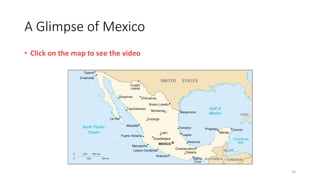
A Glimpse of Mexico
• Click on the map to see the video
25
Dependent
Economic Growth
• Most Latin American countries are “middle income”
• Extreme poverty in the region, however
• Development Strategies
• Import substitution: policies that foster domestic industry by imposing
inflated tariffs on all imported goods
• Industrialization
• Manufacturing emphasized since 1960s
• Growth poles: planned industrial centers
• Maquiladoras and Foreign Investment
• Maquiladoras: Mexican assembly plants lining U.S. border
• Other Latin American countries attracting foreign companies
• The Informal Sector
• Provision of goods & services without government regulation
• Self-employment: construction, manufacturing, vending, etc.
Globalization & Diversity: Rowntree, Lewis, Price, Wyckoff 26
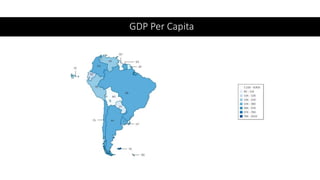
Mapping Poverty and
Prosperity
GDP Per Capita
GDP Per Capita
Birth Rate
Birth Rate
Patterns of
Colonial Rule
PARALLEL RULE VS.
INDIRECT RULE- BRITAIN
ASSIMILATION- FRANCE
PORTUGAL AND FRANCE
VICE ROYALTY-SPAIN SPECIAL ROLE OF
SETTLER COLONIES
Cortez
Status of
Women
33
Lower than rate in U.S. but comparable to many European countries
Many women
work outside
the home
(30%-40%)
Reflective of patriarchal tendencies
Legally,
women can
vote, own
property, and
sign for loans,
but less likely
than men to
do so
Highest rates in Central America
Low illiteracy
rates
Related to education and workforce participation
Trend toward
smaller
families
Colonization and Conflict, 1600-1750
• Spain in North America
• England in the Chesapeake
• Crisis in the Chesapeake
• Changing Chesapeake Society
• The Caribbean to the Carolinas
Spanish Institutions
• Presidios
(Military/State)
• Explore
• Trade
• “Defend”
• Subdue Indians
• -Onate 1590, Acoma
• Missions (Church)
• Franciscans & Jesuits
• Conversion
• Indian Labor
Main Themes of
British Colonization
• Mercantilism
• Late Arrivals
• Violence and Indians
• Social stratification
• Land, colonize, exclude
• Experience with Ireland
British
Colonies on
the Eastern
Coast
The English in the Chesapeake
Joint Stock Company
Investors pooled money and bought “stock” or “part” of a business, received a “share” of profit if successful.
Mercantilism
The state/crown helps improve trade between British
chartered “businesses” and foreign groups
Fueled search for colonies, as “domestic” producers and
suppliers of raw materials. Avoided the need for trade
disputes and importation
Atlantic Slave
Trade and
West Africa
Comparisons Britain
Late arrivals
Smaller colonies
Corporations
Families
“Exclusive”
Proprietary colonies
Land and Property
Spain
Large Institutions
Bureaucracy
Church/state/military
Encomendero
Indian Labor
Mestizo
“Inclusion”
Hudson Bay Company
• Royal Charter
Company
• Oldest Joint Stock
Company in the
English Speaking
World
Trade Network
• Captured Africans became part of network
called the triangular trade
• First leg of triangle: ships carrying European
goods to Africa to be exchanged for slaves
• Second leg: Middle Passage, brought
Africans to Americas to be sold
• Third leg carried American products to
Europe
What is American Studies?
p203

American2019.2.2

  • 1.
  • 2.
  • 5.
    American Culture -Stereotypes
  • 8.
  • 9.
    American Culture - Basics •Old: The U.S. is a “melting pot” • Today: The U.S. is a “salad bowl” • American culture allows individuals to maintain their own culture. • This makes the U.S. richer • and more diverse!
  • 10.
    The Role ofGeography
  • 11.
    Individuality & Control • Everyoneis encouraged to have their own identity • Independence is highly valued • Being strong, self-reliant, assertive, and independent. • “Pull yourself up by your own bootstraps” • “If I work hard I can achieve anything”
  • 12.
    Communication • Direct -“to the point” • Looking someone in the eye in a conversation means you are interested, respectful. • Personal space • Informality – “Hey” “What’s up?” “How are you?”
  • 13.
    Time is Important! •Americans take pride in making the best use of their time. • Being late = disrespect. It’s better to arrive early! • Americans apologize if they are late. • Professors and time. • In social settings there is more flexibility. It is okay to arrive “fashionably late” to a party.
  • 14.
    Laws / Rules •Follow all U.S. laws and university rules • You can’t say “I didn’t know” • Immigration regulations – student status • Legal drinking age is 21 • If your car is stopped by police
  • 15.
    Repopulating a Continent • TheDecline of Native Populations • There were many complex civilizations in Latin American before Europeans arrived • 1500: population of 47 million; 1650: 5 million • Causes: • disease, • warfare, • forced labor, • collapse of food production system 15
  • 16.
    16 INDIAN CULTURE HEARTHS •SOURCE AREAS from which radiated ideas, innovations, and ideologies that changed the world beyond. MA Hearths Aztecs Mayans
  • 17.
    Globalization & Diversity:Rowntree, Lewis, Price, Wyckoff 17 Inca Culture Hearth
  • 18.
    Cultural Patterns • Patterns ofEthnicity and Culture • Racial caste system – Spanish legacy: blanco (European), mestizo (mixed ancestry), indio (Indian), negro (African) • Colonial structure – transplanted feudalism • Peninsulares – • Creoles – • Mestizo – • European/African mix • Native Americans (Indians) & Africans • Independence equality of Peninsulares & Creoles • Blancos dominated social, political, & economic systems for more than a century
  • 19.
    Catholic Influence • Traditionally providededucation & health care • Established many of the social mores • Higher clergy often came from the aristocracy and supported the status quo • Social role of the Church has grown in some places becoming an advocate for the poor and disenfranchised • Bishop Romero in Nicaragua (assassinated) • Has opposed most birth control methods in countries with high birth rates and great poverty • Many may be Catholic “in name only”
  • 20.
    Machismo • Male orientedsociety – definitely a double standard • Traditionally, marriages were arranged – a greater disadvantage for women – upper class men were expected to be unfaithful • Admiration for the strong, forceful male • Dictators were often admired as much as they were feared • Military often a vehicle for advancement and control • Compromise seen as a sign of weakness • Male resistance to birth control -- # of male children often considered a measure of one’s manhood
  • 21.
    Globalization & Diversity:Rowntree, Lewis, Price, Wyckoff 21 Language Map of Latin America
  • 22.
    Colombian Exchange • Amerindians Contributed: •Corn (maize), sweet potato, several kinds of beans, the tomato, several kinds of squash, cacao, & tobacco (Potato – from Peru) • Gonorrhea & rheumatoid arthritis • Europeans Contributed: • Wheat, oats, rye, & other European crops, horse, cow, sheep, pigs, chicken • Syphilis, small pox, chicken pox, measles, mumps, typhoid fever, influenza, etc. – African slaves also brought tropical diseases for which Amerindians had no immunity or resistance
  • 23.
    Globalization & Diversity:Rowntree, Lewis, Price, Wyckoff 23 Shifting Political Boundaries
  • 24.
    24 A Glimpse ofMexico • Click on the map to see the video
  • 25.
    25 Dependent Economic Growth • MostLatin American countries are “middle income” • Extreme poverty in the region, however • Development Strategies • Import substitution: policies that foster domestic industry by imposing inflated tariffs on all imported goods • Industrialization • Manufacturing emphasized since 1960s • Growth poles: planned industrial centers • Maquiladoras and Foreign Investment • Maquiladoras: Mexican assembly plants lining U.S. border • Other Latin American countries attracting foreign companies • The Informal Sector • Provision of goods & services without government regulation • Self-employment: construction, manufacturing, vending, etc.
  • 26.
    Globalization & Diversity:Rowntree, Lewis, Price, Wyckoff 26 Mapping Poverty and Prosperity
  • 27.
  • 28.
  • 29.
  • 30.
  • 31.
    Patterns of Colonial Rule PARALLELRULE VS. INDIRECT RULE- BRITAIN ASSIMILATION- FRANCE PORTUGAL AND FRANCE VICE ROYALTY-SPAIN SPECIAL ROLE OF SETTLER COLONIES
  • 32.
  • 33.
    Status of Women 33 Lower thanrate in U.S. but comparable to many European countries Many women work outside the home (30%-40%) Reflective of patriarchal tendencies Legally, women can vote, own property, and sign for loans, but less likely than men to do so Highest rates in Central America Low illiteracy rates Related to education and workforce participation Trend toward smaller families
  • 34.
    Colonization and Conflict,1600-1750 • Spain in North America • England in the Chesapeake • Crisis in the Chesapeake • Changing Chesapeake Society • The Caribbean to the Carolinas
  • 35.
    Spanish Institutions • Presidios (Military/State) •Explore • Trade • “Defend” • Subdue Indians • -Onate 1590, Acoma • Missions (Church) • Franciscans & Jesuits • Conversion • Indian Labor
  • 36.
    Main Themes of BritishColonization • Mercantilism • Late Arrivals • Violence and Indians • Social stratification • Land, colonize, exclude • Experience with Ireland
  • 37.
  • 38.
    The English inthe Chesapeake Joint Stock Company Investors pooled money and bought “stock” or “part” of a business, received a “share” of profit if successful. Mercantilism The state/crown helps improve trade between British chartered “businesses” and foreign groups Fueled search for colonies, as “domestic” producers and suppliers of raw materials. Avoided the need for trade disputes and importation
  • 39.
  • 40.
    Comparisons Britain Late arrivals Smallercolonies Corporations Families “Exclusive” Proprietary colonies Land and Property Spain Large Institutions Bureaucracy Church/state/military Encomendero Indian Labor Mestizo “Inclusion”
  • 41.
    Hudson Bay Company •Royal Charter Company • Oldest Joint Stock Company in the English Speaking World
  • 43.
    Trade Network • CapturedAfricans became part of network called the triangular trade • First leg of triangle: ships carrying European goods to Africa to be exchanged for slaves • Second leg: Middle Passage, brought Africans to Americas to be sold • Third leg carried American products to Europe
  • 44.
  • 45.
  • 46.
  • 47.
  • 48.