DEFINING
GLOBALIZATION
CONTENTS
• Introduction
• The task of defining Globalization
• Metaphors of Globalization
• Solid and liquid
• Flows
• Globalization theories
• Dynamics of local and global culture
• The Globalization and Religion
• Globalization and Regionalization
• Origins and history of Globalization
• Hardwired
• Cycles
• Epoch
• Events
• Broader, More recent changes
• Global Demography
• Global Migration
What is
Globalization?
Globalization is the interconnectedness
and interdependence of economies,
cultures, and populations worldwide,
driven by increased cross-border flows
of goods, services, capital, people, and
information, leading to a more unified
global society and a single world market.
The task of defining
Globalization
 Since its first appearance in the Webster's
Dictionary in 1961, many opinions about
globalization have flourished. The
literature on the definitions of
globalization revealed that definitions
could be classified as either (1) broad and
inclusive or (2) narrow and exclusive.
Metaphors of Globalization
 Globalization can be understood
through metaphors, specifically
the states of matter: solid and
liquid. These metaphors, along
with related concepts like
structures and flows, help clarify
the definition of globalization.
Solid and liquid
Solid
 refers to barriers that restrict or make
the movement of people, things, and
information difficult. Social
relationships and objects often remain
fixed in the places where they were
created, limiting mobility. Solids can
be natural or man-made.
Examples include:
• Natural solids: landforms and bodies of water
(mountains, rivers, seas), which naturally
limit movement.
• Man-made solids: the Great Wall of China
and the Berlin Wall, built to divide or restrict
mobility.
• Modern man-made solid: intangible
boundaries, such as the nine-dash line
claimed by China in the South China Sea,
which limits Filipino fishers’ access
LIQUID
• refers to the increasing ease of
movement of people, things,
information, and places in the
contemporary world. Unlike solids,
liquids flow and adapt to their
surroundings, making globalization
fast, flexible, and difficult to contain.
Example:
• Videos uploaded on platforms like
YouTube or Facebook can become viral
and are nearly unstoppable once they
spread. These internet sensations gain
fame not only in their home countries
but also around the world,
demonstrating the rapid and borderless
flow of information in a liquid globalized
world.
FLOWS
• The previous section
described the melting process
of solid phenomena followed
by the increase in liquidity. It
is only logical to discuss the
flows of liquid phenomena.
Globalization Theories
•Homogeneity refers to the
increasing sameness in the world as
cultural inputs, economic factors,
and political orientations of
societies expand to create common
practices, same economies, and
similar forms of government.
•Media imperialism is a global phenomenon
where Western media dominates the flow of
media, imposing it on developing countries and
undermining alternative global media. This has
led to the rise of alternative media from
developing countries like Al Jazeera and
Bollywood, and the influence of local and regional
media. The internet serves as an arena for
alternative media, but cultural imperialism denies
viewers' agency. The movement of media is
difficult to stop, and political boundaries become
more permeable to the flow of people and things.
• Global flows of culture tend to move
more easily around the globe than
ever before, especially through non-
material digital forms. There are
three perspectives on global cultural
flows. These are differentialism,
hybridization, and convergence.
Dynamics of local and global
culture
•Cultural differentialism suggests that cultures are
essentially distinct and only superficially affected by global
flows. Samuel Huntington's 1996 theory suggests that
increased interaction among different civilizations, such as
Sinic, Islamic, Orthodox, and Western, could lead to intense
clashes, particularly economic and political conflicts.
However, this theory has been criticized for portraying
Muslims as violent.
•The cultural hybridization approach combines local and
global cultures, resulting in unique outcomes in different
geographic areas. Key concepts include "glocalization" and
Arjun Appadurai's "scapes," which explore global flows
involving people, technology, finance, political images, and
media, leading to cultural hybrids.
•The cultural convergence approach
emphasizes globalization's homogeneity,
while cultural imperialism involves
imposing one culture on another, with
John Tomlinson's "deterritorialization"
critiquing cultural imperialism by making
it harder to link culture to specific origins.
The Globalization and Regionalization
Globalization
• refers to the process by which people,
things, information, and ideas move
more easily across borders, creating a
more connected and interdependent
world. It highlights the integration of
economies, cultures, and societies at a
global scale.
Regionalization
• refers to the process of organizing
countries or areas into smaller, more
closely connected regions for
economic, political, or cultural
cooperation. It focuses on
strengthening ties within a specific
geographic region rather than the
entire world.
Origins and History of
Globalization
• While pinpointing the exact start of
globalization is challenging due to
differing views, this book primarily
focuses on the period after World War
II. However, it also explores five
different perspectives on the origins of
globalization for a comprehensive
understanding.
Cycles
For some, globalization is a long-term cyclical
process and thus, finding its origin will be a
daunting task, What is important is the cycles
that globalization has gone through (Scholte,
2005), Subscribing to this view will suggest
adherence to the idea that other global ages
have appeared. There is also the notion to
suspect that this point of globalization will soon
disappear and reappear.
Epoch
• Ritzer (2015) cited Therbom's (2000)
six great epochs of globalization. These
are also called "waves" and each has
its own origin. Today's globalization is
not unique if this is the case. The
difference of this view from the second
view (cycles) is that it does not treat
epochs as returning.
The following are the sequential
occurrence of the epochs:
• Globalization of religion (fourth to seventh
centuries)
• European colonial conquests (late fifteenth
century)
• Intra-European wars (late eighteenth to
early nineteenth centuries)
• Heyday of European imperialism (mid-
nineteenth century to 1918) 4
• Post-World War II period
• Post-Cold War period
Early Phase of Globalization
• The early phase of globalization includes key events
from the 15th century, such as Columbus's arrival in
the Americas and the discovery of sea routes.
European powers expanded trade and colonization,
establishing international trade networks and global
interactions involving goods, culture, and ideas. This
period saw significant exchanges and laid
groundwork for the modern global economy,
concluding with Magellan's circumnavigation of the
globe in 1522.
Events
Broader More Recent Changes in
Globalization
• Globalization transformed significantly from the late
20th century with the end of the Cold War and Soviet
decline, leading to greater economic integration.
Multinational corporations grew, and countries like
China, Germany, Japan, and the US shaped global
dynamics. Tech advances fueled globalization's
expansion. China emerged as a major player, highlighted
by the 2008 Olympics. Globalization continues impacting
politics, economics, and culture worldwide.
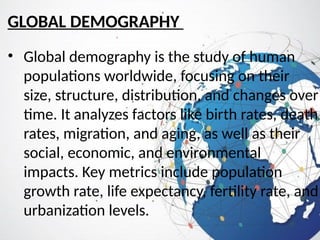
GLOBAL DEMOGRAPHY
• Global demography is the study of human
populations worldwide, focusing on their
size, structure, distribution, and changes over
time. It analyzes factors like birth rates, death
rates, migration, and aging, as well as their
social, economic, and environmental
impacts. Key metrics include population
growth rate, life expectancy, fertility rate, and
urbanization levels.
GLOBAL MIGRATION
• Global migration is when people move from
one country to another to live, work, or
study either for a short time or
permanently.
• Migration changes both the countries
people leave and the ones they move to. It
can help fill job gaps, bring new ideas, and
make cultures more diverse, but it can also
cause challenges like overcrowded cities or
tensions between groups.
Thank you!!

Defining Globalization POWERPOINTPRESENTATION

  • 1.
  • 2.
    CONTENTS • Introduction • Thetask of defining Globalization • Metaphors of Globalization • Solid and liquid • Flows • Globalization theories • Dynamics of local and global culture • The Globalization and Religion • Globalization and Regionalization • Origins and history of Globalization • Hardwired • Cycles • Epoch • Events • Broader, More recent changes • Global Demography • Global Migration
  • 3.
    What is Globalization? Globalization isthe interconnectedness and interdependence of economies, cultures, and populations worldwide, driven by increased cross-border flows of goods, services, capital, people, and information, leading to a more unified global society and a single world market.
  • 4.
    The task ofdefining Globalization  Since its first appearance in the Webster's Dictionary in 1961, many opinions about globalization have flourished. The literature on the definitions of globalization revealed that definitions could be classified as either (1) broad and inclusive or (2) narrow and exclusive.
  • 5.
    Metaphors of Globalization Globalization can be understood through metaphors, specifically the states of matter: solid and liquid. These metaphors, along with related concepts like structures and flows, help clarify the definition of globalization.
  • 6.
    Solid and liquid Solid refers to barriers that restrict or make the movement of people, things, and information difficult. Social relationships and objects often remain fixed in the places where they were created, limiting mobility. Solids can be natural or man-made.
  • 7.
    Examples include: • Naturalsolids: landforms and bodies of water (mountains, rivers, seas), which naturally limit movement. • Man-made solids: the Great Wall of China and the Berlin Wall, built to divide or restrict mobility. • Modern man-made solid: intangible boundaries, such as the nine-dash line claimed by China in the South China Sea, which limits Filipino fishers’ access
  • 8.
    LIQUID • refers tothe increasing ease of movement of people, things, information, and places in the contemporary world. Unlike solids, liquids flow and adapt to their surroundings, making globalization fast, flexible, and difficult to contain.
  • 9.
    Example: • Videos uploadedon platforms like YouTube or Facebook can become viral and are nearly unstoppable once they spread. These internet sensations gain fame not only in their home countries but also around the world, demonstrating the rapid and borderless flow of information in a liquid globalized world.
  • 10.
    FLOWS • The previoussection described the melting process of solid phenomena followed by the increase in liquidity. It is only logical to discuss the flows of liquid phenomena.
  • 11.
    Globalization Theories •Homogeneity refersto the increasing sameness in the world as cultural inputs, economic factors, and political orientations of societies expand to create common practices, same economies, and similar forms of government.
  • 12.
    •Media imperialism isa global phenomenon where Western media dominates the flow of media, imposing it on developing countries and undermining alternative global media. This has led to the rise of alternative media from developing countries like Al Jazeera and Bollywood, and the influence of local and regional media. The internet serves as an arena for alternative media, but cultural imperialism denies viewers' agency. The movement of media is difficult to stop, and political boundaries become more permeable to the flow of people and things.
  • 13.
    • Global flowsof culture tend to move more easily around the globe than ever before, especially through non- material digital forms. There are three perspectives on global cultural flows. These are differentialism, hybridization, and convergence. Dynamics of local and global culture
  • 14.
    •Cultural differentialism suggeststhat cultures are essentially distinct and only superficially affected by global flows. Samuel Huntington's 1996 theory suggests that increased interaction among different civilizations, such as Sinic, Islamic, Orthodox, and Western, could lead to intense clashes, particularly economic and political conflicts. However, this theory has been criticized for portraying Muslims as violent. •The cultural hybridization approach combines local and global cultures, resulting in unique outcomes in different geographic areas. Key concepts include "glocalization" and Arjun Appadurai's "scapes," which explore global flows involving people, technology, finance, political images, and media, leading to cultural hybrids.
  • 15.
    •The cultural convergenceapproach emphasizes globalization's homogeneity, while cultural imperialism involves imposing one culture on another, with John Tomlinson's "deterritorialization" critiquing cultural imperialism by making it harder to link culture to specific origins.
  • 16.
    The Globalization andRegionalization Globalization • refers to the process by which people, things, information, and ideas move more easily across borders, creating a more connected and interdependent world. It highlights the integration of economies, cultures, and societies at a global scale.
  • 17.
    Regionalization • refers tothe process of organizing countries or areas into smaller, more closely connected regions for economic, political, or cultural cooperation. It focuses on strengthening ties within a specific geographic region rather than the entire world.
  • 18.
    Origins and Historyof Globalization • While pinpointing the exact start of globalization is challenging due to differing views, this book primarily focuses on the period after World War II. However, it also explores five different perspectives on the origins of globalization for a comprehensive understanding.
  • 19.
    Cycles For some, globalizationis a long-term cyclical process and thus, finding its origin will be a daunting task, What is important is the cycles that globalization has gone through (Scholte, 2005), Subscribing to this view will suggest adherence to the idea that other global ages have appeared. There is also the notion to suspect that this point of globalization will soon disappear and reappear.
  • 20.
    Epoch • Ritzer (2015)cited Therbom's (2000) six great epochs of globalization. These are also called "waves" and each has its own origin. Today's globalization is not unique if this is the case. The difference of this view from the second view (cycles) is that it does not treat epochs as returning.
  • 21.
    The following arethe sequential occurrence of the epochs: • Globalization of religion (fourth to seventh centuries) • European colonial conquests (late fifteenth century) • Intra-European wars (late eighteenth to early nineteenth centuries) • Heyday of European imperialism (mid- nineteenth century to 1918) 4 • Post-World War II period • Post-Cold War period
  • 22.
    Early Phase ofGlobalization • The early phase of globalization includes key events from the 15th century, such as Columbus's arrival in the Americas and the discovery of sea routes. European powers expanded trade and colonization, establishing international trade networks and global interactions involving goods, culture, and ideas. This period saw significant exchanges and laid groundwork for the modern global economy, concluding with Magellan's circumnavigation of the globe in 1522. Events
  • 23.
    Broader More RecentChanges in Globalization • Globalization transformed significantly from the late 20th century with the end of the Cold War and Soviet decline, leading to greater economic integration. Multinational corporations grew, and countries like China, Germany, Japan, and the US shaped global dynamics. Tech advances fueled globalization's expansion. China emerged as a major player, highlighted by the 2008 Olympics. Globalization continues impacting politics, economics, and culture worldwide.
  • 24.
    GLOBAL DEMOGRAPHY • Globaldemography is the study of human populations worldwide, focusing on their size, structure, distribution, and changes over time. It analyzes factors like birth rates, death rates, migration, and aging, as well as their social, economic, and environmental impacts. Key metrics include population growth rate, life expectancy, fertility rate, and urbanization levels.
  • 25.
    GLOBAL MIGRATION • Globalmigration is when people move from one country to another to live, work, or study either for a short time or permanently. • Migration changes both the countries people leave and the ones they move to. It can help fill job gaps, bring new ideas, and make cultures more diverse, but it can also cause challenges like overcrowded cities or tensions between groups.
  • 26.